Short answer. In the EU, a website needs opt-in consent before it stores or reads any cookie that is not strictly necessary, under Article 5(3) of the ePrivacy Directive. A pre-ticked box is not consent, the banner must explain the purposes, how long cookies last and whether third parties can access them, and refusing must actually stop the cookies. France's regulator fined Shein €150 million on September 1, 2025 for placing cookies before any choice, giving incomplete information and ignoring refusals.
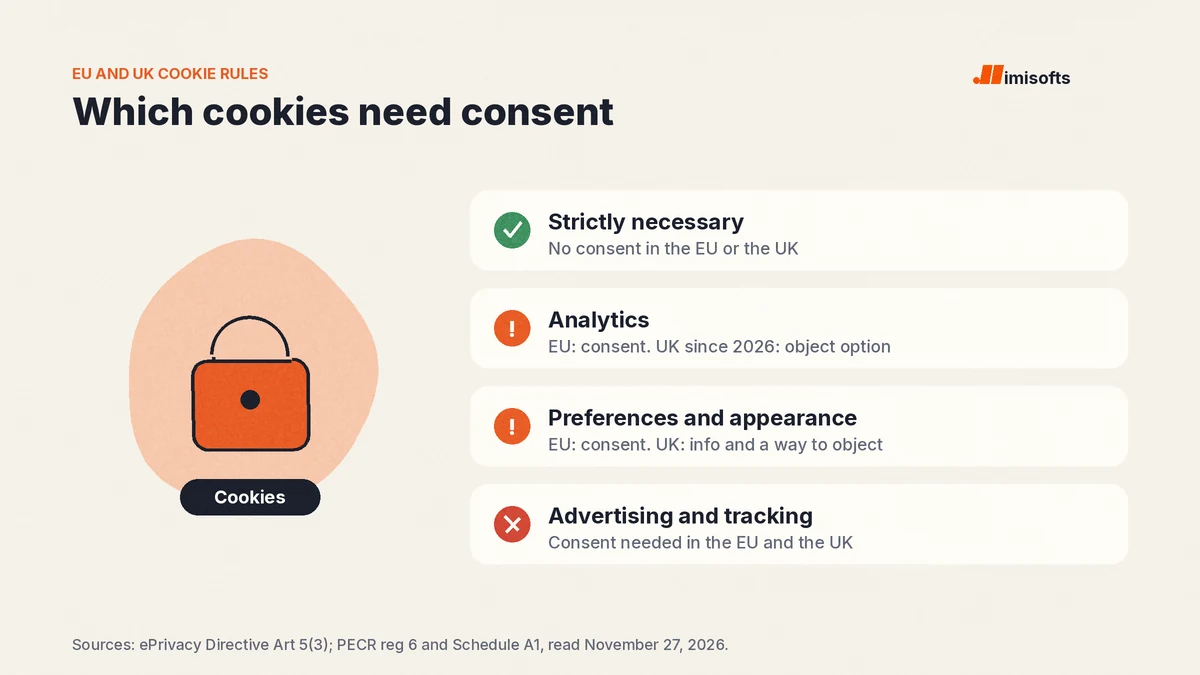
In the UK, a new regulation 6 has applied since February 5, 2026: analytics and website appearance cookies can run without consent if you explain them and offer a simple, free way to object. Advertising and tracking cookies still need consent in both places. In the US, California's rule works the other way round: an opt-out, not an opt-in.
This guide covers the law's wording, which cookies need consent, what a valid banner must do, recent fines, the UK change, the California rule, and a checklist for a B2B site. If your site is also how buyers and AI assistants find you, our AI search optimization page explains how we work on that. Sources were read on November 27, 2026. This is general information, not legal advice.
Key numbers
| Item | Number |
|---|---|
| Shein cookie fine (CNIL, September 1, 2025) | €150M |
| Google fine, two breaches (Gmail ads and account cookies, CNIL, September 1, 2025) | €325M |
| Fnac Darty app tracker fine (CNIL, October 22, 2026) | €7M |
| Daily penalty if Fnac does not comply (Per day of delay after one month) | €10,000 |
| Planet49 judgment (Pre-checked boxes are not consent) | Oct 1, 2019 |
| New UK regulation 6 in force (Data (Use and Access) Act 2025) | Feb 5, 2026 |
| UK exceptions besides consent (Schedule A1, paragraphs 3 to 7) | 5 |
| Monthly French visitors to shein.com (Average cited by the CNIL) | 12 million |
ePrivacy Directive and GDPR (EUR-Lex); CJEU C-673/17; PECR reg 6 and Schedule A1 (legislation.gov.uk); CNIL announcements; California Civil Code 1798.135. Read November 27, 2026.
What the law says about cookie consent
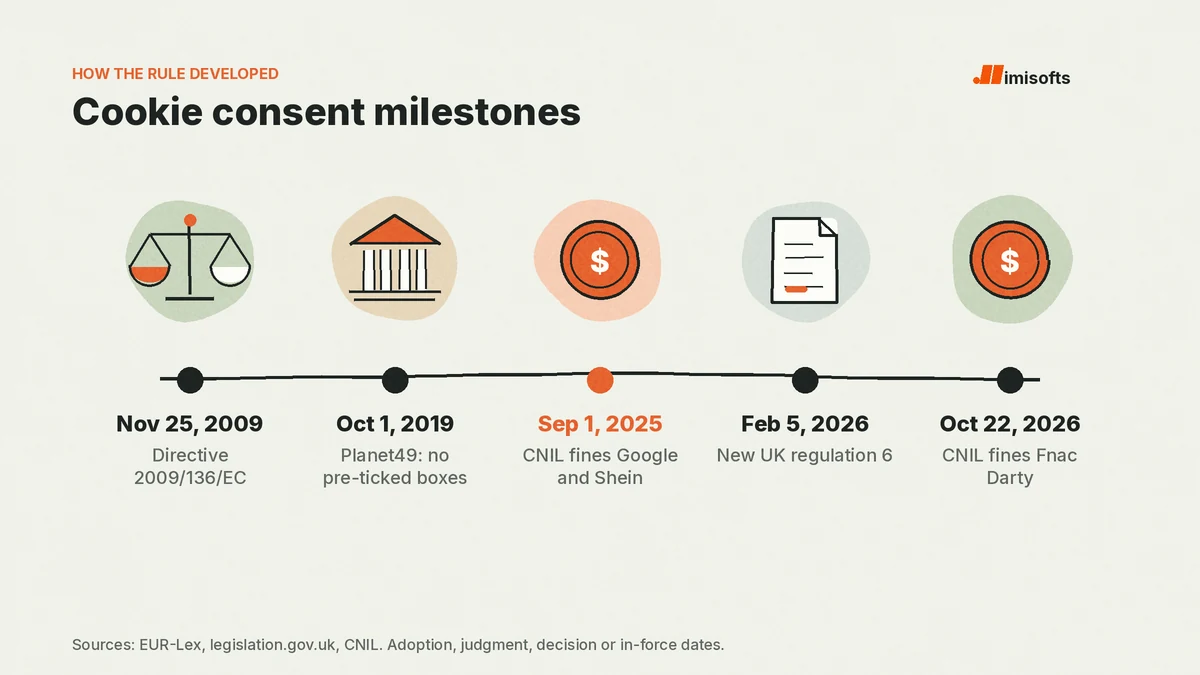
The EU rule is one sentence. Article 5(3) of the ePrivacy Directive, as amended in 2009, says that storing information, or gaining access to information already stored, in a user's device "is only allowed on condition that the subscriber or user concerned has given his or her consent, having been provided with clear and comprehensive information" about the purposes.
It has two exceptions only: storage or access "for the sole purpose of carrying out the transmission of a communication," and storage or access "strictly necessary" for a service "explicitly requested by the subscriber or user." The text has no separate exception for analytics.
The wording is about storing or reading information on a device, not about cookies by name, so ask your adviser about other technologies that do the same. And it applies whether or not the data is personal: in Planet49 (C-673/17), decided on October 1, 2019, the EU Court of Justice ruled that the provisions "are not to be interpreted differently according to whether or not the information stored or accessed" is personal data.
The Planet49 ruling read Article 5(3) together with the consent definition in Article 4(11) of the GDPR. Article 4(11) defines it as a "freely given, specific, informed and unambiguous indication" given "by a statement or by a clear affirmative action." Recital 32 adds: "Silence, pre-ticked boxes or inactivity should not therefore constitute consent."
Which cookies need consent
Sort every cookie and tag on your site by purpose. The table compares the EU text with the UK rules in force since February 5, 2026.
| Purpose | EU (ePrivacy Art 5(3)) | UK (PECR reg 6 and Schedule A1) |
|---|---|---|
| Strictly necessary for a service the user asked for | No consent needed | No consent needed; Schedule A1 lists security, fraud, technical faults, log in and remembering selections as examples |
| Analytics (how the site is used) | Consent needed | No consent if used only for statistics to improve the site or service, not shared except with a helper doing that work, explained clearly, with a simple free way to object |
| Preferences and appearance | Consent needed unless strictly necessary for the requested service | No consent if used only to adapt the site to the user's preferences or improve how it looks or works, explained clearly, with a simple free way to object |
| Advertising, retargeting and cross-site tracking | Consent needed | Consent needed |
Search results show people asking whether Google Analytics can run without a banner. In the EU the Directive's text gives analytics no exemption. In the UK the answer depends on the conditions in paragraph 5 of Schedule A1, including that the data is not shared with anyone else except to help improve the site or service. Whether a given analytics setup meets that test is a question for your adviser, because it turns on how the tool is configured and what the vendor does with the data.
What a valid cookie banner must do
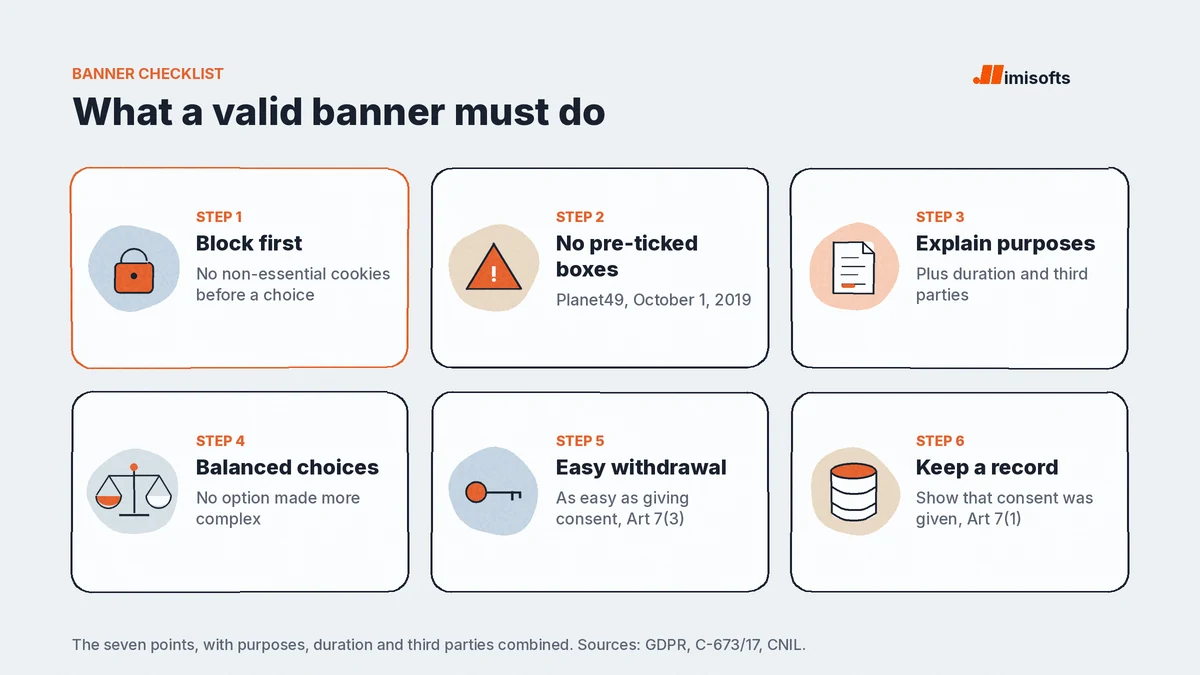
Put together, the texts and the decisions below point to seven requirements for a banner and the code behind it. Items 5 to 7 are our reading of how the GDPR's consent rules and the CNIL's statements apply to a banner.
- Block first, ask second. Non-essential cookies must wait until the user agrees. In the Shein case, the CNIL found advertising cookies were placed "as soon as they arrived on the site, even before they interacted with the information banner."
- No pre-ticked boxes. Planet49 holds that consent "is not validly constituted" when given by "a pre-checked checkbox which the user must deselect to refuse."
- Say what the cookies do. Shein's first banner had "Cookie settings", "Reject all" and "Accept" buttons but no information about the advertising purpose, which the CNIL counted as a breach.
- Give duration and third parties. Planet49 says the information must include "the duration of the operation of cookies and whether or not third parties may have access to those cookies."
- Make the choices balanced. Discussing cookie walls, the CNIL said the alternatives must be presented "in a balanced manner, without encouraging them to choose one option over another (for example, by making one choice more complex than the other)."
- Let people withdraw as easily as they agreed. GDPR Article 7(3): "It shall be as easy to withdraw as to give consent." A footer link that reopens the banner is one way to do this.
- Keep a record. Under GDPR Article 7(1), where processing relies on consent "the controller shall be able to demonstrate" that the person consented. Logging the choice, the time and the banner version is one practical way to do that.
Refusing must also work technically. The CNIL found that after a user clicked "Refuse all" on shein.com, "new cookies were still placed and others, already present, continued to be read." A banner that looks right but does not control the tags fails the same test.
What about cookie walls, where the site refuses entry unless you accept? In its announcement of September 3, 2025, the CNIL said this practice "is not illegal in itself provided the consent is freely given," and the alternatives must be balanced and the user informed. It is a narrow path, and we would not build one without legal advice.
Recent cookie fines in France
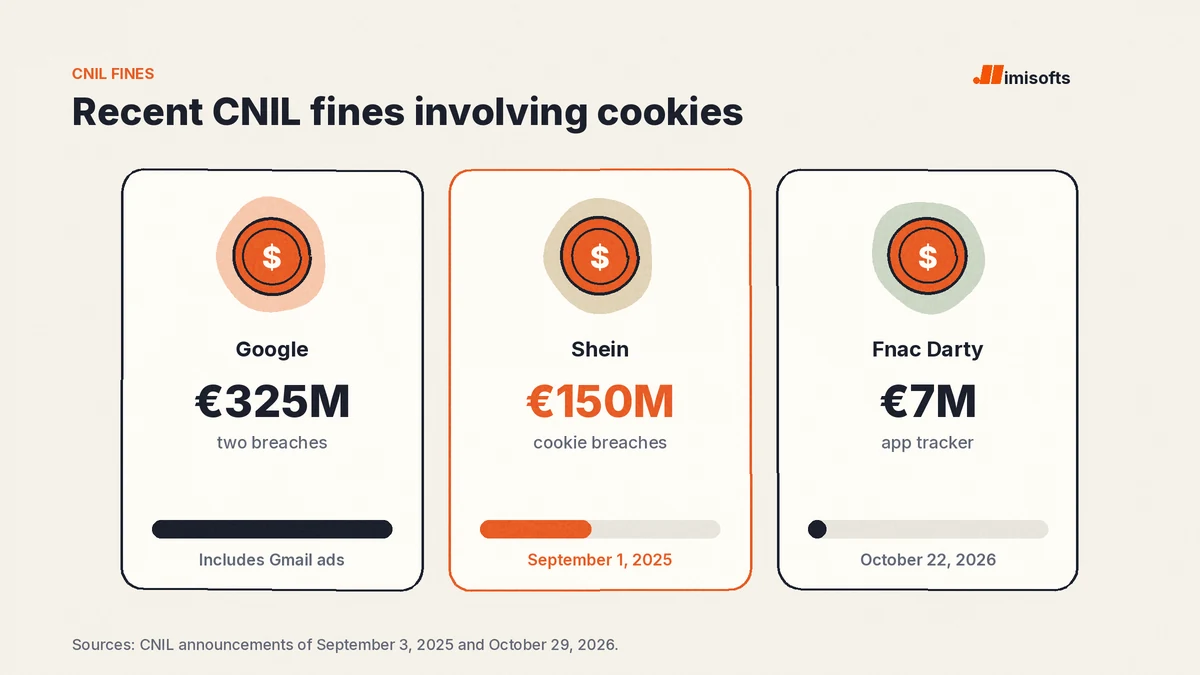
France's CNIL publishes English announcements of its cookie decisions. Cookie cases there fall under Article 82 of the French Data Protection Act, which transposes the ePrivacy Directive, so the GDPR's one-stop shop "does not apply," the CNIL explains in the Shein case. The Shein company fined is an Irish subsidiary, and Google Ireland Limited was fined €125 million.
| Company | Decision date | Fine | What went wrong |
|---|---|---|---|
| Google (Google LLC and Google Ireland) | September 1, 2025 | €325 million (€200M + €125M) | Two breaches: ads shown between Gmail emails without consent, and advertising cookies at account creation without valid consent |
| Shein (Infinite Styles Services Co.) | September 1, 2025 | €150 million | Cookies before any choice, incomplete banners, no list of third parties, refusal and withdrawal not respected |
| Fnac Darty Participations et Services and Fnac Direct | October 22, 2026 | €7 million (€6M + €1M) | A mobile app tracker collected browsing history for recommendations without consent |
Sources: CNIL announcements on Google, Shein and Fnac Darty. The Google amount covers both breaches, not cookies alone.
The Fnac case matters for anyone with an app. The tracker "collected their browsing history in order to display product recommendations to them and to train its recommendation algorithm," and the CNIL said trackers for personalisation and commercial targeting "do not fall within the scope of the exemptions set out in Article 82." The CNIL also ordered the companies to comply within one month, or face a daily penalty of €10,000 for each day of delay. If you are planning an app, our guide to app development cost covers what goes into the build.
The CNIL noted an average of 12 million people in France visited shein.com each month. These fines were imposed under French law (Article 82), not under the GDPR's own fine article; for GDPR fines, which apply to other breaches such as an unlawful basis for processing, see our GDPR fines guide.
The UK rules since February 5, 2026
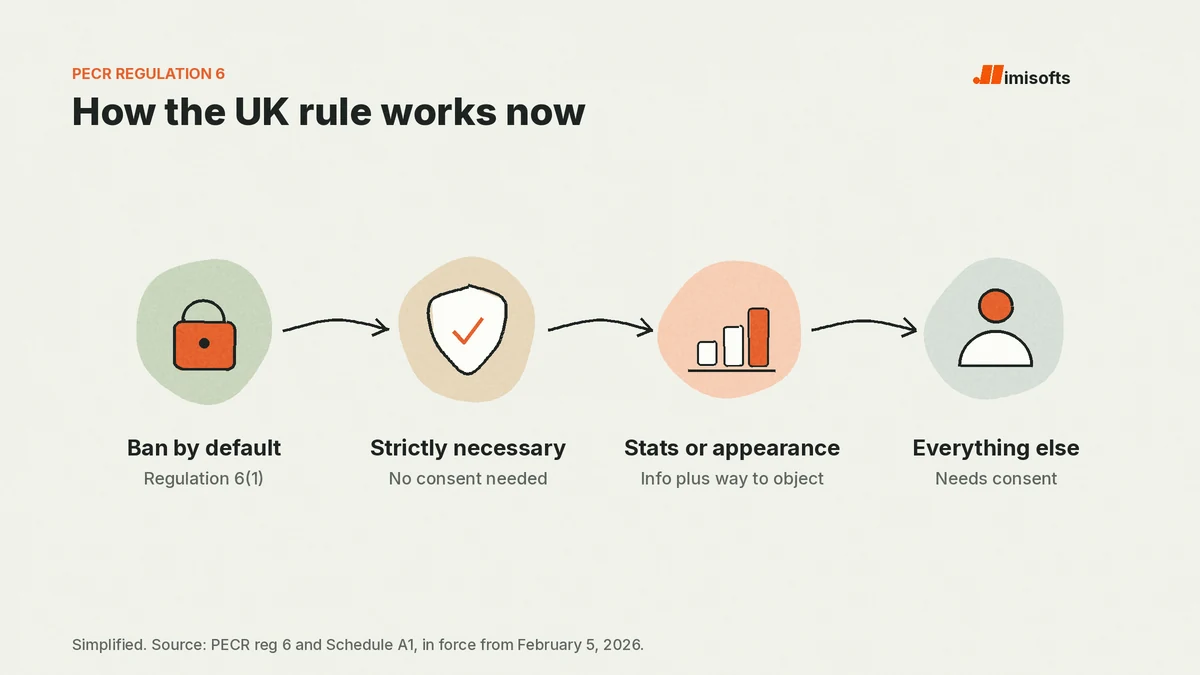
The Data (Use and Access) Act 2025 replaced regulation 6 of PECR on February 5, 2026. The new regulation 6(1) bans storing or reading information on a device "Subject to Schedule A1," and Schedule A1 sets out when that is allowed:
- Consent, after clear and comprehensive information about the purpose. Paragraph 2(3) says consent may be signified by "amending or setting controls on the internet browser" or "using another application or programme."
- Transmission of a communication, where that is the sole purpose.
- Strictly necessary for a service the user requested, with examples: protecting information, device security, fraud, technical faults, authenticating the user and remembering selections or information put into a website.
- Statistics about how the service or website is used, to improve it, under the conditions in the table above.
- Appearance and functionality that adapts to the user's preferences, with clear information and a simple free way to object.
- Emergency assistance, to locate a user who asks for help.
Two details are easy to miss. Schedule A1 says "website" includes a mobile application and any other platform. And regulation 6(2)(b) now says reading a device includes "collecting or monitoring information automatically emitted by the terminal equipment." If your outbound emails carry open tracking pixels, ask your adviser how that wording applies to them. For UK rules on cold email, see our guide to UK cold email laws.
What California requires
California's law, the US rule we read for this guide, uses opt-out, not opt-in. California Civil Code 1798.135 requires a business that sells or shares personal information to provide "a clear and conspicuous link on the business' internet homepages, titled "Do Not Sell or Share My Personal Information."" A business can skip that link if it lets consumers opt out "through an opt-out preference signal sent with the consumer's consent by a platform, technology, or mechanism."
Whether that applies to your site depends on whether the CCPA covers your business and whether your cookies sell or share personal information, which is a question for your adviser. Our CCPA compliance guide covers opt-out preference signals such as the Global Privacy Control and recent penalties. If you also serve EU or UK visitors, ask your adviser how the EU and UK rules above apply to you.
A cookie checklist for a B2B website
A typical B2B site might run analytics, a CRM or chat widget, a scheduling embed and an ad pixel or two. This is how we would approach them.
- Inventory. List every cookie, pixel and script, its purpose, its duration and the third party behind it.
- Classify. Strictly necessary, analytics, preferences or advertising, using the table above for each market you serve.
- Gate the tags. Load anything that needs consent only after the visitor accepts it. Test with a clean browser that rejecting leaves those tags off.
- Write the banner. Accept and reject on the first layer with equal weight, purposes in plain words, and a second layer naming third parties and durations.
- Add the way back. A link in the footer that reopens the choices, so withdrawing is as easy as agreeing.
- Record and review. Log consents, and repeat the inventory when you add a tool. The same habits help with your GDPR privacy notice, which should describe the cookies too.
How imisofts can help
We build websites and run outbound systems for B2B companies. On a site we build or maintain, we can list the tags, set up a consent tool so tags load only after a visitor agrees, and test that "reject" really leaves them off. The legal judgment on your banner stays with you and your adviser. See our web development service, our AI search optimization service for being found by buyers, or talk to us about your site.
Frequently Asked Questions
No. In the EU and the UK, cookies that are strictly necessary for a service the user asked for, such as keeping a user logged in, need no consent. Advertising and tracking cookies do. Since February 5, 2026 the UK also lets analytics and appearance cookies run without consent if you explain them and offer a simple, free way to object.
In the EU, the ePrivacy Directive has no analytics exemption, so analytics cookies need consent. In the UK, statistics cookies can run without consent since February 5, 2026 if the data is used only to improve the site, is not shared except with a helper doing that work, visitors get clear and comprehensive information about the purpose, and they have a simple, free way to object. Whether a setup qualifies depends on its configuration.
No. In Planet49, decided on October 1, 2019, the EU Court of Justice ruled that consent is not valid when given by a pre-checked checkbox the user must untick. GDPR Recital 32 says silence, pre-ticked boxes or inactivity do not count as consent.
The texts we read do not name a button. GDPR Article 7(3) says withdrawing must be as easy as consenting, and, discussing cookie walls, the CNIL said alternatives must be balanced, without making one choice more complex than the other. Shein's banner had a Reject all button and was still fined €150 million; one of the breaches was that refusing did not stop the cookies.
In France, the CNIL fined Shein €150 million and Google €325 million (for two breaches, one about cookies) on September 1, 2025, and Fnac Darty €7 million on October 22, 2026, with a €10,000 daily penalty if it does not comply within one month.
We looked at California's rule, which works on opt-out rather than opt-in. Civil Code 1798.135 requires a Do Not Sell or Share My Personal Information link, or support for opt-out preference signals, from businesses that sell or share personal information and are covered by the CCPA.