Affiliate disclosure: some links in this article are partner links. If you start a paid plan through them, imisofts may earn a commission at no extra cost to you. We only recommend tools we actually use to run client campaigns.
Short answer. Japan's Act on Specified Commercial Transactions regulates cold calling rather than banning it. For the sales calls it covers, it sets three rules: before you pitch, give your company's name, your own name, what you sell and the fact that the call is a sales call (Article 16); do not solicit that contract again from someone who has declined it (Article 17); and avoid conduct its enforcement regulation lists, such as soliciting in a way that annoys or exploits impaired judgment (Article 64). A consumer who buys over the phone can cancel until 8 days after receiving the contract document, and longer if you misstated that right. Contracts a buyer enters into for business purposes are excluded (Article 26), so on our reading many B2B calls fall outside these rules; ask a Japanese lawyer before relying on that. We found no national do not call register in the Act, its Cabinet Order or its regulation.
We earn a commission if you buy Close through our links, and we sell AI calling services that compete with Close's AI agents. On 16 November 2026 we read the Act, its Cabinet Order and its regulation on Japanese Law Translation, the current Japanese text on e-Gov (in force from 12 August 2026), a Consumer Affairs Agency order, Close's help center and Twilio's Japan prices. Only the Japanese text has legal effect; we checked the key articles against it, and e-Gov also lists an amendment not yet in force whose content we did not read. We did not search case law or check how either law applies to sellers based outside Japan. This is general information, not legal advice.
Key numbers
| Item | Number |
|---|---|
| Days a phone buyer has to cancel (from receipt of the Article 18 or 19 document (Article 24)) | 8 |
| Window to cancel excessive-quantity contracts (Article 24-2) | 1 year |
| National do not call register (in the Act, Cabinet Order or regulation; Article 17 works person by person) | None found |
| Fixed calling hours in the Act (Regulation Article 64 lists soliciting in ways that annoy) | None found |
| Longest business suspension order (Article 23) | 2 years |
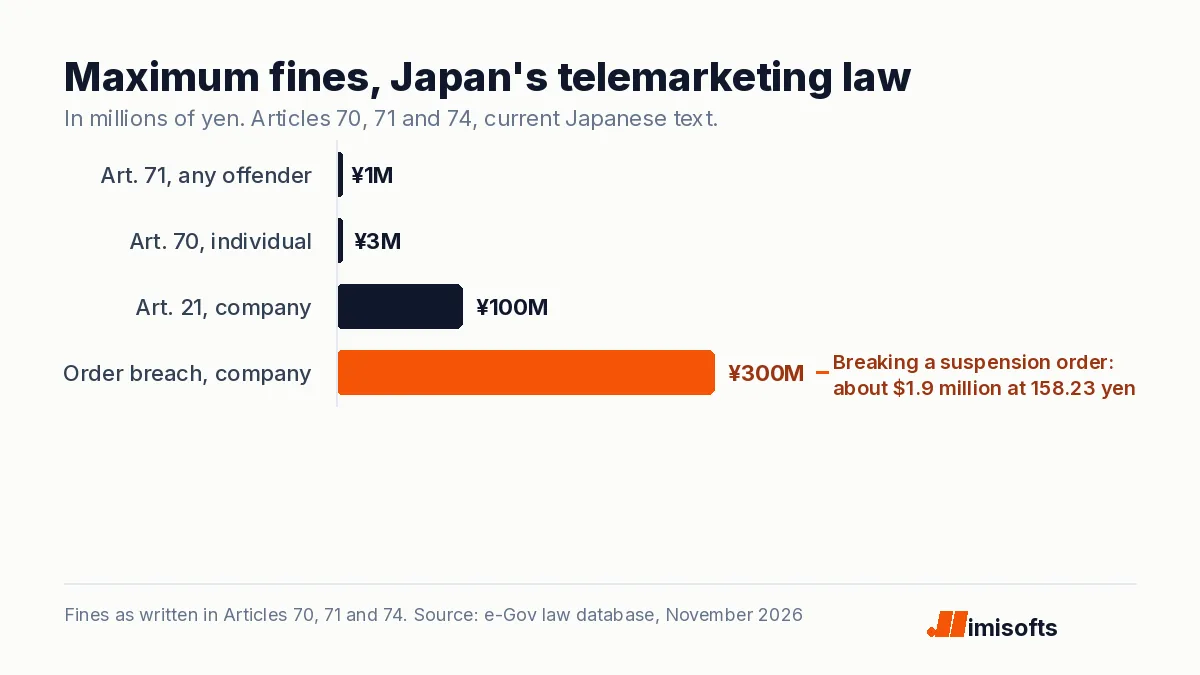
| Article 21 breach, individual (about $18,960; Article 70) | Up to 3 years, ¥3 million or both |
| Article 21 breach, company (about $632,000; Article 74) | Up to ¥100 million |
| Suspension order breach, company (about $1.9 million; Article 74) | Up to ¥300 million |
| Missing, incomplete or false document (about $6,320; Article 71) | Up to 6 months, ¥1 million or both |
| Twilio rate to call a Japanese mobile (Twilio Japan page; Close bills at Twilio rates by caller ID origin) | $0.1850 a minute |
| Twilio rate to call a Japanese landline (priced as of October 2026) | $0.0746 a minute |
| Close Growth (Power Dialer), billed monthly ($99 billed annually; calling usage extra) | $109 per user a month |
Statutes read on 16 November 2026 on Japan's e-Gov and Japanese Law Translation sites; prices read the same day on the Twilio Japan and Close pricing pages; yen converted at the Federal Reserve H.10 rate of 158.23 per dollar (6 November 2026).
What counts as telemarketing sales in Japan
Article 2(3) of the Act (Act No. 57 of 1976) defines a "telemarketing sale" as a sale in which the seller telephones a person, or causes a person to telephone the seller, solicits a contract "during which telephone call", and then receives the offer or concludes the contract by post or a similar means. Japanese texts call it 電話勧誘販売.
The "caused a person to telephone" part catches call-back tactics. Article 2 of the Cabinet Order covers asking someone to phone you by mail, email, flyers, ads or a web page "without informing the person that the purpose of the telephone call is to solicit" a contract, or by promising "extremely favorable terms" (this second route excludes people the seller has done business with before). So an email that says "call us about your account" and leads to a pitch is, on our reading, a telemarketing sale even though the buyer dialed.
The three rules on consumer sales calls
- Say who you are and why you are calling. Article 16: the seller "must tell the other party, prior to solicitation, the name of the seller or the service provider and the name of the solicitor, the type of the goods, rights, or services, and the fact that the purpose of the telephone call is to solicit the person to enter into a sales contract or a service contract." Four items, before the pitch.
- Stop at no. Article 17: "It is prohibited for a seller or service provider to solicit a person to enter into a sales contract or service contract connected with a telemarketing sale if that person has indicated an unwillingness to enter into such a sales contract or service contract." The Japanese text (締結しない旨の意思を表示した者に対し) sets no time limit, so we would treat a refusal as permanent for that offer.
- No pressure. Article 64 of the enforcement regulation lists further conduct that can lead to a ministerial instruction under Article 22(1)(v), starting with soliciting "in ways that makes a person feel annoyed", having "a young person, elderly person or any other person" sign "by taking advantage of the impaired judgment of the person", and soliciting a contract that is inappropriate in light of the person's "knowledge, experience, and asset situation".
Article 21 adds the hard lines: no misrepresenting the product, price, payment, delivery, cancellation rights or other material facts, and no "intimidation to overwhelm a person". We found no fixed calling hours in the Act or Article 64; one test is whether the way you call annoys. We would call in business hours and log the time of every call.
No do not call register in the texts we read
We found no national do not call register in the Act, the Cabinet Order or the regulation, unlike the registry described in our guide to cold calling laws in Mexico. The protection is person by person: Article 17 binds you once that person has said no, so your own suppression list is the control. We suggest logging every refusal against the number and the name and sharing it with every rep, dialer and agency that calls for you.
Contract documents and the 8-day cooling-off
When a call leads to an offer, Article 18(1) requires a document with the product, price, payment and delivery terms, among other items, delivered "without delay"; Article 19 covers the contract document. Under Article 24 the buyer may withdraw or cancel "in writing or using electromagnetic records", and the right ends "once eight days have passed" after the buyer received that document (八日を経過した場合 in the current Japanese text). If a misstatement of the right or intimidation stopped the buyer from cancelling, the 8 days run only from a new document that tells the buyer they can cancel. The seller "may not claim damages nor demand" a penalty for a cancellation. A separate right in Article 24-2 lets the buyer cancel contracts for quantities that "considerably" exceed normal daily needs within one year.
The B2B exemption in Article 26
Article 26(1) switches off "the preceding three Sections" of the Act (door-to-door, mail order and telemarketing sales; on our reading that includes Articles 16 to 24) for several kinds of sale. Item (i) covers a contract that the buyer "enters into for business purposes or as a part of business" (営業のために若しくは営業として締結するもの). Item (ii) covers sales "to a person located outside of Japan".
On our reading, a call that sells software, data or services to a company for use in its business falls under item (i), so the three rules and the cooling-off do not bind it. On our reading of the article text, the test is the purpose of the contract, not whose phone rings, so a sole trader buying for the household would still be a consumer. We have not read the Consumer Affairs Agency's guidance on how it reads item (i), including for sole traders, so ask a Japanese lawyer before you rely on it. We would follow Articles 16 and 17 on B2B calls anyway; they cost nothing.
Penalties: instructions, suspensions and fines
Breaking Article 16 or 17 is not itself one of the offences in Articles 70 to 72 as we read them. It lets the competent minister issue an instruction (Article 22), order the seller to suspend its telemarketing activities "in whole or in part" for up to two years (Article 23) and bar its officers from the same business (Article 23-2). Misrepresentation (Article 21) and missing or false documents (Articles 18 and 19) are crimes in themselves, and so is ignoring an instruction or an order. The amounts match the current Japanese text, which since 1 June 2025 uses one form of imprisonment, 拘禁刑. Dollars use the Federal Reserve H.10 rate of 158.23 yen for 6 November 2026.
| Conduct | Article | Individual | Company (Article 74) |
|---|---|---|---|
| Breaking Article 16, 17 or conduct in Regulation 64 | 22, 23 | Instruction; suspension up to 2 years if the minister finds the harm significant | Same |
| Ignoring an instruction; missing, incomplete or false document | 71 | Up to 6 months, up to ¥1 million (about $6,320), or both | Up to ¥1 million |
| Misrepresentation, hiding facts, intimidation (Article 21) | 70(i) | Up to 3 years, up to ¥3 million (about $18,960), or both | Up to ¥100 million (about $632,000) |
| Breaking a suspension or business ban order | 70(iii) | Up to 3 years, up to ¥3 million, or both | Up to ¥300 million (about $1.9 million) |
A recent case shows the order route. On 27 October 2026 (announced 28 October) the Consumer Affairs Agency ordered Jstyle, a Tokyo seller of study-abroad and English-school services, to stop soliciting, taking applications and signing contracts by door-to-door and telephone sales for three months, to 27 January 2027, and barred its representative director from starting the same business for the same three months. Its telephone findings were under Articles 19 and 21: a contract document not delivered without delay, and telling a customer who asked to cancel that the cooling-off period had passed and a cancellation fee applied.
APPI: the data behind your call list
The Act on the Protection of Personal Information applies, on our reading, whether or not the sales call is B2B, because a contact's name and direct number identify a person. Four articles matter most for a call list:
- Article 20(1): a business "must not acquire personal information by deception or other wrongful means."
- Article 21(1): unless the purpose of use is already public, it must "promptly notify the identifiable person of that purpose of use or disclose this to the public" once it has acquired the data.
- Article 30(1): when you receive personal data from a third party, such as a bought list, you must confirm the provider's name and address, its representative if it is a company, and the "background of the acquisition", then keep a record (30(3) and 30(4)).
- Article 27(2): the opt-out route lets a list seller provide personal data to third parties if it agrees to stop on the person's request, notifies them or makes the details readily accessible in advance, and files a notification with the Personal Information Protection Commission; it is closed for sensitive data and for data acquired in breach of Article 20(1).
Our guide to cold email laws in Japan covers the separate consent rule for sales email.
AI voices and automated calls
The Act, the Cabinet Order and the regulation say nothing specific about AI or prerecorded voices in the texts we searched, so on our reading the same duties apply. Article 16 asks for "the name of the solicitor", so on our reading an AI agent should name the seller, a responsible person and the product, and say it is a sales call, before any pitch. Under Article 17 it should recognise a refusal and write it to your suppression list. We would also have it say that the caller is automated. Our service page on AI calling built around TCPA consent covers US rules; the TCPA is US law, so treat Japan's rules as a separate set.
What calling Japan costs from Close
The Close pages we read list no Japan rates. Its help center says calls are charged per minute and numbers monthly "according to Twilio's Pay-as-you-go Voice pricing", that "all phone calls are rounded up to the nearest minute and cent (a 70-second call is charged as a 2-minute call)", and that the rate depends on the caller ID's origin (with a US caller ID, the US international rate applies). Twilio's Japan page, priced as of October 2026, lists under "To make calls":
- $0.0746 a minute to call a Japanese landline (local or national number);
- $0.1850 a minute to call a Japanese mobile, about 2.5 times the landline rate;
- Japanese numbers from $4.75 a month (national) to $20 a month (local 0ABJ) and $25 (toll-free).
Close's plans, billed monthly, are Solo at $19 (one user), Essentials at $49 per user, Growth at $109 per user (lists the Power Dialer) and Scale at $149 per user (adds the Predictive Dialer); billed annually, $9, $35, $99 and $139. Usage is extra: "Calling and SMS usage fees are not included in plan costs." At the Japan-page rates, a hypothetical rep who makes 400 calls a month to Japanese mobiles, each billed as 2 minutes, pays 400 x 2 x $0.1850 = $148 in usage, or $257 a month with Growth, and $277 with a $20 local Japanese number, before recording ($0.0025 a minute on Twilio's page), transcription or AI credits. The same calls to landlines cost $59.68 in usage. A US caller ID may bill at a different rate, which we did not price.
Two things we could not confirm: Close's help pages we read do not say whether it sells Japanese numbers (they say most countries require registration and that the rules often require identity documents), and its Local Presence feature is described in terms of matching "the prospect's area code", with no mention of Japan. If you need a Japanese caller ID, ask Close before you buy. If US or global calling is the main job and Japan is one market of several, you can try Close free for 14 days (partner link), no card required, and test the dialer on your own list.
A compliance checklist for calls into Japan
- Decide whether each campaign sells to businesses for business use (Article 26(1)(i)) or to consumers, and write the reason down.
- Script the opening: seller name, caller name, product, and "this is a sales call", before the pitch.
- Log every refusal and suppress that person for the offer across all reps, tools and agencies.
- For consumer sales, send the Article 18 or 19 document at once and honor any cancellation made until 8 days after the buyer received it; longer if the document was never delivered or you misstated the right, and up to 1 year for excessive-quantity contracts (Article 24-2).
- For bought lists, record the provider's name, address, representative and how it got the data (APPI Article 30).
- Publish a privacy notice that names sales outreach as a purpose of use (APPI Article 21).
To compare markets, start with cold calling laws by country, South Africa's POPIA rules and whether local presence dialing is legal in the US. For tools, see the best cold calling software, or start a Close trial (partner link) if its dialer fits your team.
Frequently Asked Questions
The Act regulates it rather than banning it. For consumer sales, the Act on Specified Commercial Transactions requires you to give your company name, your own name, the product and the fact that the call is a sales call before you pitch (Article 16), and bars soliciting that contract again from someone who has declined it (Article 17). Contracts made for business purposes are excluded from these rules under Article 26(1)(i).
We found no national do not call register in the Act on Specified Commercial Transactions, its Cabinet Order or its enforcement regulation. Instead, Article 17 bars soliciting anyone who has told you they do not want the contract, so you need your own suppression list.
Article 26(1)(i) excludes sales under contracts the buyer enters into for business purposes or as a part of business, which on our reading covers many B2B software and service calls, while a sole trader buying for personal use would still be a consumer. We have not read the Consumer Affairs Agency's guidance on this, so check with a Japanese lawyer. On our reading, the data protection law (APPI) applies either way.
8 days. Under Article 24 the buyer can withdraw or cancel in writing or electronically until eight days after receiving the contract document, and if a misstatement or intimidation stopped the buyer from cancelling, the 8 days run only from a new written notice of the right. Contracts for quantities far beyond normal needs can be cancelled within one year (Article 24-2).
For breaches of Articles 16 and 17 the competent minister can issue instructions or suspend telemarketing activities in whole or in part for up to two years. Misrepresentation or intimidation carries up to 3 years in prison, a fine of up to 3 million yen (about $18,960), or both; a company can be fined up to 100 million yen, or 300 million yen (about $1.9 million) for breaking a suspension order.
The Act, Cabinet Order and regulation say nothing specific about AI voices in the texts we searched, so on our reading the same duties apply: the call must give the seller's name, the name of the person soliciting, the product and the sales purpose before any pitch, and must stop at a refusal. We would also have the agent name a responsible person and say the call is automated.