Short answer. Nothing in Mexico's consumer law that we read bans cold calling outright, but you may not call a number on PROFECO's do not call registry, the REPEP, or anyone who has told you to stop. Once a number is registered, PROFECO says sellers have 30 days to stop calling it. Breaking those rules (Articles 17 and 18 BIS of the Federal Consumer Protection Law) carries a fine of MXN 760.89 to MXN 2,434,847.42 in 2026, about $41 to $131,000, and up to MXN 6,391,474.56 (about $345,000) in particularly serious cases.
This guide is for teams in the US, the UAE or anywhere else that phone prospects in Mexico. It covers the three articles that govern a sales call, how the REPEP works, which calls it does not cover, the 2026 fines, the 2025 privacy law, and what the law does not say about calling hours or AI voices. Every rule below links to the official text we read on 16 November 2026.
Key numbers
| Item | Number |
|---|---|
| Days to stop calling a newly registered number (PROFECO release, 31 Dec 2024) | 30 |
| Cost to register a number on the REPEP (registration is indefinite) | Free |
| Article 127 fine, 2026 (about $41 to $131,000; covers Arts. 17 and 18 BIS) | MXN 760.89 to MXN 2,434,847.42 |
| Article 128 BIS fine, serious cases (about $345,000, plus closure up to 90 days) | up to MXN 6,391,474.56 |
| Article 133 cap, several infractions from one act (about $689,000) | MXN 12,782,949.06 |
| REPEP in operation since (PROFECO bulletin 069/2017) | November 2007 |
| Numbers registered in its first 10 years (PROFECO, May 2017) | almost 2 million |
| REUS waiting period (financial firms) (CONDUSEF article, Oct 2019) | 45 calendar days |
| B2B exemption found in the LFPC (Art. 2 counts legal persons as consumers) | None |
Sources: LFPC (Orden Jurídico Nacional copy), DOF update of LFPC amounts for 2026, PROFECO releases of 31 Dec 2024 and 31 May 2017, CONDUSEF (2019), Banxico FIX 13 Nov 2026. Read 16 November 2026.
The law that governs a sales call in Mexico
The rules we found sit in the Ley Federal de Protección al Consumidor (LFPC), the Federal Consumer Protection Law, enforced by the Procuraduría Federal del Consumidor, PROFECO. We read the consolidated text published by the Orden Jurídico Nacional. Three articles do the work.
- Article 17, first paragraph: advertising sent to consumers must give the name, address and telephone number (or failing that the email address) of the provider, of any company sending the advertising on the provider's behalf, and of PROFECO itself.
- Article 17, second paragraph: a consumer may demand of specific providers, and of companies that use consumer information for marketing, not to be bothered "at their home, workplace, email address or by any other means" with offers, and that no advertising be sent to them. They may also demand that their information not be passed to third parties, unless a judicial authority orders it.
- Article 18 BIS: providers, marketing companies and their clients may not send advertising to consumers who have expressly said they do not want it, or who are on the registry of Article 18.
Note the two triggers in Article 18 BIS. A number on the REPEP is one. A plain "do not call me again" said to your caller is the other, and it needs no registry at all. Your suppression list has to catch both.
How the REPEP works
Article 18 says PROFECO "may" keep a public registry of consumers who do not want their information used for marketing, and that registration is free. PROFECO runs that registry as the Registro Público para Evitar Publicidad (REPEP). PROFECO's 2017 bulletin says it began operating in November 2007 and covers phone calls and text messages.
From PROFECO's release of 31 December 2024:
- Registration of a landline or mobile number is free and indefinite.
- A consumer registers by dialing 55 9628 0000 (Mexico City, Guadalajara and Monterrey areas) or 800 962 8000 from the number to be listed, online, or through PROFECO's consumer line.
- Once a number is registered, providers have a period of 30 days to stop calling. Calls or advertising texts after that can be reported against the provider.
- The REPEP targets calls from the telecommunications, tourism and commerce sectors.
Treat the 30 days as the outer limit, not a grace period for new campaigns. A number registered on 1 March should be out of your dialer by 31 March at the latest, so scrub against the list on a fixed schedule well inside that window. We could not load the REPEP's own site on 16 November, so this guide makes no claim about how providers obtain or check the list. Ask PROFECO or Mexican counsel before your first campaign.
B2B calls are covered too
The usual exit from a consumer law is to say you only call businesses. In our reading, the definitions close it. Article 2, fraction I of the LFPC defines a consumer as the natural or legal person who acquires, carries out or enjoys goods, products or services as final recipient. In our reading, a company buying software or a service for its own use is a final recipient.
Article 17 also names the "workplace" as a place where a consumer may refuse to be bothered. So a cold call to a purchasing manager at a Mexican company likely sits inside the same rules as a call to a household. We found no B2B exemption in the text. Our cold email laws in Mexico guide reads the same articles for email.
Calls the REPEP does not stop, and the REUS
PROFECO's 2024 release lists four kinds of call the REPEP does not stop, because they fall outside PROFECO's remit: debt collection, political organizations, charities and telephone survey takers.
Banks, insurers, pension fund managers (afores) and investment companies have their own registry. PROFECO sends those consumers to the Registro Público de Usuarios (REUS) run by CONDUSEF, the federal commission that protects financial services users. A 2019 CONDUSEF article says the REUS takes landlines, mobiles and email addresses, and that a user should wait 45 calendar days for the registration to take effect. If you call for a bank, insurer or other financial institution, scrub against the REUS as well.
The 30 days is PROFECO's figure; the 45 days is CONDUSEF's 2019 figure. We could not open CONDUSEF's current REUS page on 16 November, so confirm the REUS period before you rely on it.
Fines in 2026
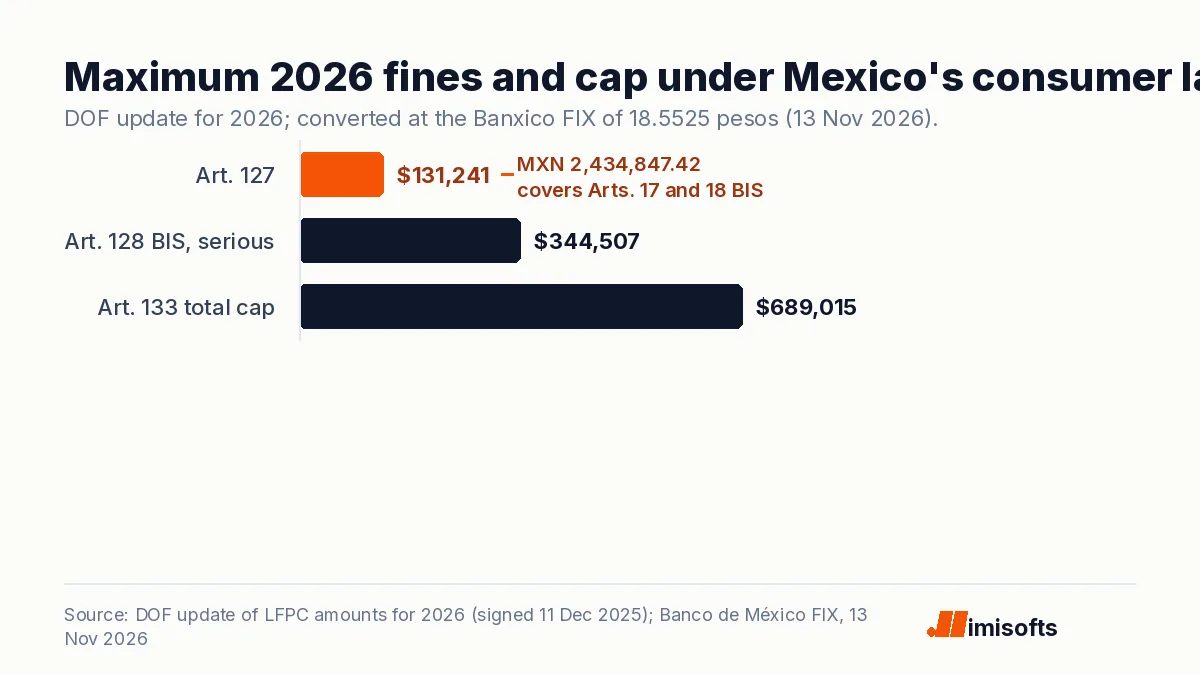
Article 127 of the LFPC lists the infractions punished with its fine band, and Articles 17 and 18 BIS are on that list. Article 129 BIS requires the amounts to be updated for inflation each year and published in the Diario Oficial by 30 December. The 2026 update, signed on 11 December 2025 and in force from 1 January to 31 December 2026, sets these amounts. Dollar figures use the Banco de México FIX rate of 18.5525 pesos per dollar for 13 November 2026.
| Provision | 2026 fine, pesos | About, US dollars |
|---|---|---|
| Art. 127 (covers Arts. 17 and 18 BIS) | MXN 760.89 to MXN 2,434,847.42 | $41 to $131,000 |
| Art. 128 BIS (particularly serious cases, plus closure up to 90 days) | MXN 228,266.96 to MXN 6,391,474.56 | $12,300 to $345,000 |
| Art. 133 cap (total when one act or omission commits several infractions) | up to MXN 12,782,949.06 | about $689,000 |
Article 128 TER says what counts as particularly serious. Its first case is conduct that, if the provider kept operating, could affect the rights and interests of a group of consumers. In our reading, a dialer that keeps calling registered numbers is the kind of conduct a regulator could argue fits that. Article 132 tells PROFECO to set the amount by the harm caused, intent, repeat offending and the offender's economic condition.
The amounts are updated every year. The Article 127 maximum in the copy we read, the amount set by the update published on 21 December 2023, was MXN 2,243,671.49. The 2026 figure is 8.5% higher.
Clients share responsibility when an agency calls
The last sentence of Article 18 BIS makes providers whose products are advertised "co-responsible" for the handling of consumer information when the advertising is sent through third parties. In our reading, hiring a call center or an outsourced SDR team does not remove the client's responsibility for the consumer data; it adds a second responsible party.
Article 17 requires advertising sent to consumers to give the name, address and phone of the provider, of any company sending it on the provider's behalf, and of PROFECO. As a precaution, we suggest also saying on the call whose behalf you are calling on, and keeping the client's suppression list and yours as one list.
The 2025 privacy law and phone data
If your call list ties phone numbers to named people, that data falls, in our reading, under the Federal Law on the Protection of Personal Data Held by Private Parties (LFPDPPP), a new law published in the Diario Oficial on 20 March 2025. Its Article 7 says all processing needs the person's consent, except where the law provides otherwise, and that consent may be express or tacit. Consent is tacit when the privacy notice was made available and the person did not object, and the law says tacit consent is valid as a general rule. Financial or property data need express consent.
Its definitions (Article 2, XV) name the Secretaría Anticorrupción y Buen Gobierno as the ministry the law refers to. In the text we read, the words "publicidad" and "mercadotécnica" appear zero times, while "aviso de privacidad" (privacy notice) appears 22 times. In our reading, the marketing rules for calls stay in the LFPC, and the privacy law adds the need for consent, express or tacit through a privacy notice, for the data on your list.
Calling hours and AI voices: what the consumer law omits
We searched the LFPC text for a calling window and for automated or recorded voices. The word "horario" (hours) appears zero times and the phrase "inteligencia artificial" zero times, against 527 uses of "consumidor". In the text we read there is no calling window and no rule specific to prerecorded or AI voices. We did not check Mexican telecom regulation.
That does not make an AI caller a gap in the law. Article 17 lets a consumer refuse offers "by any other means", and Article 18 BIS bars sending advertising to registered or refusing consumers without naming a channel. In our reading, an AI voice agent placing sales calls to Mexico has to honor the REPEP, the 30 days and every direct refusal, like a human caller. If you are choosing a platform, see our list of AI voice agents. For US campaigns, our page on AI calling built around consent records explains how we set up suppression and consent logging.
A checklist for teams calling Mexico
- Scrub every list against the REPEP before dialing, and again on a schedule well inside 30 days.
- For financial products, scrub against the REUS too.
- Log every verbal "do not call" and suppress the number at once. Article 18 BIS needs no registry entry.
- Treat company numbers and workplace lines as covered.
- Name the provider, any agency sending for it, and PROFECO in written follow ups, as Article 17 requires of advertising sent to consumers.
- Make a privacy notice available to the people on your list; LFPDPPP Article 7 ties tacit consent to it.
- Put the client's co-responsibility under Article 18 BIS into your agency contract.
Comparing markets? See the cold calling laws by country table, the Spain and South Africa guides, and what B2B telemarketing services cost.
How imisofts can help
imisofts is a Dubai-based agency that builds outbound systems: AI voice agents, dialer workflows, cold email infrastructure and the CRM logic behind them. For a team calling Mexico we can build suppression handling that applies registry scrubs and recorded refusals across callers and AI agents, and keeps consent and privacy notice records. Whether those records are enough is a question for your counsel; we do not give legal advice.
What we could not verify
- The REPEP's own website did not load on 16 November 2026, so we make no claim about how providers access or pay for the list.
- The Chamber of Deputies copy of the LFPC (last reformed 12 December 2025) timed out. Article texts here come from the Orden Jurídico Nacional copy, last reformed 12 April 2019; the 2026 amounts come from the official update.
- The current REUS waiting period beyond CONDUSEF's 2019 article.
- Mexican telecom regulation, for any calling hours or automated call rules outside the consumer law.
This is general information, not legal advice.
Frequently Asked Questions
In our reading, yes, with limits. Under Articles 17 and 18 BIS of the Federal Consumer Protection Law you may not call people who told you to stop or whose number is on PROFECO's REPEP registry. PROFECO says sellers have 30 days to stop calling a newly registered number.
The REPEP (Registro Público para Evitar Publicidad) is PROFECO's free do not call registry for landlines and mobiles. It began in November 2007, covers sales calls and texts, and registration is indefinite. PROFECO said in 2017 that almost 2 million numbers had been registered in its first 10 years.
The law has no B2B exemption we could find. Article 2 of the LFPC defines a consumer as a natural or legal person acting as final recipient, and Article 17 lets a consumer refuse calls at the workplace. We treat business numbers as covered.
Breaches of Articles 17 and 18 BIS are fined under Article 127: MXN 760.89 to MXN 2,434,847.42 in 2026, about $41 to $131,000. Particularly serious cases can reach MXN 6,391,474.56 under Article 128 BIS, plus closure for up to 90 days.
PROFECO says debt collection, political, charity and telephone survey calls fall outside the REPEP. Calls from banks, insurers and other financial firms are handled by CONDUSEF's separate REUS registry, which CONDUSEF said in 2019 takes 45 calendar days to apply.
We found no Mexican rule specific to AI or prerecorded voices, and no statutory calling window, in the consumer law text we read. Article 17 lets consumers refuse offers by any other means and Article 18 BIS names no channel, so in our reading an AI caller must honor the REPEP and every direct refusal.