September 29, 2026. Cold calling is legal in Australia. Two instruments decide who you may call and how: the Do Not Call Register Act 2006, which bars telemarketing calls to registered numbers unless the account-holder consented, and the Telecommunications (Telemarketing and Research Calls) Industry Standard 2017, which sets calling hours, identification, caller ID and hang-up rules for every telemarketing call, calls to businesses included. An AI voice agent is caught by both, because the Act defines a voice call to include "a call that involves a recorded or synthetic voice". Since July 1, 2026 a Commonwealth penalty unit is worth A$364, so the court maximum for a first-time company is A$36,400 per call to a registered number and A$728,000 for all such calls on one day. The Standard itself is due to sunset on April 1, 2027.
Key numbers
| Item | Number |
|---|---|
| Weekday telemarketing hours (at the account-holder's residential address) | 9 am to 8 pm |
| Saturday telemarketing hours (no calls on Sundays or 7 national public holidays) | 9 am to 5 pm |
| Numbers on the Do Not Call Register | about 12.2 million |
| How long a register wash protects you (Do Not Call Register Act s11(3)) | 30 days |
| Express consent with no stated period lapses after (Schedule 2, clause 3) | 3 months |
| Commonwealth penalty unit from July 1, 2026 | A$364 |
| Court maximum per call, first-time company (100 penalty units) | A$36,400 |
| Court maximum per day, first-time company (2,000 penalty units) | A$728,000 |
| Infringement notice per call, company (20 penalty units, capped at 1,000 units for 50 or more calls) | A$7,280 |
| Industry Standard breach, company maximum (per contravention, Telecommunications Act s570) | A$250,000 |
| TAB penalties announced July 22, 2026 (telemarketing and spam breaches together) | more than A$2.7 million |
| Industry Standard 2017 sunset date | April 1, 2027 |
Statute, Industry Standard, ACMA, ASIC and NSW Government pages read on 29 September 2026.
The Do Not Call Register and who it protects
Section 11 prohibits making, or causing to be made, a telemarketing call to a registered number unless the account-holder or their nominee consented or the call is exempt. Section 5 defines a telemarketing call by purpose: a voice call that offers, advertises or promotes goods, services, land or a supplier. The register holds about 12.2 million numbers, according to its own site.
- Only private numbers can be registered. Section 14 admits numbers used primarily for private or domestic purposes, plus fax, government and emergency numbers, and section 17 keeps them there indefinitely. The ACMA says a business number cannot be added, but a phone used for both is eligible when personal use exceeds 50 percent, which is why a B2B list full of mobiles still has to be washed.
- A published number is not consent. Schedule 2 accepts express consent or consent reasonably inferred from conduct and business relationships, but not from the mere fact a number was published. Express consent that names no period, fixed or indefinite, is taken to be withdrawn after three months.
- A wash protects you for 30 days. Section 11(3) excuses a call to a number the register did not report as registered, in answer to a list you submitted, within the 30 days ending on the day of the call. The subscription table prices washing at nothing for 500 numbers, A$126 for 20,000 and A$585 for 100,000, each valid for 12 months.
- Exemptions are narrow. Schedule 1 designates calls by government bodies, registered charities, political parties and candidates raising funds, and educational institutions calling the households of current or former students.
The Industry Standard covers every call, B2B included
The Standard borrows the Act's definition of a telemarketing call, which has no consumer-only limit, and the register's industry guidance says it applies to anyone who makes or arranges calls to Australian numbers, "even those not on the register". A call to a company's main line is covered although that line can never be registered.
- Calling hours. Section 8 bars calls on weekdays before 9 am or after 8 pm, on Saturdays before 9 am or after 5 pm, all day Sunday, and on seven national public holidays: New Year's Day, Australia Day, Good Friday, Easter Monday, Anzac Day, Christmas Day and Boxing Day. Times run at the account-holder's usual residential address, not where you dial from, and section 15 keeps any stricter state or territory rule alive.
- Identify yourself as the call starts. Section 9 requires the caller's given name, the business name, who caused the call and its purpose, unless the recipient hangs up first or the caller drops within 5 seconds without speaking.
- Details on request, and hang up when asked. The caller must supply contact details, including an Australian number, and a complaints contact, and section 13 ends the call the moment the recipient asks.
- A caller ID people can ring back. Section 14 requires calling line identification, and the number shown must lead to the caller's details and accept return calls for at least 30 days.
What changes when the caller is an AI voice agent
Australia has no separate robocall regime. Section 4 counts a call involving a synthetic voice as a voice call, so an AI agent's outbound call is a telemarketing call on the same terms as a human's, and the Spam Act adds no consent layer to an ordinary phone call because its section 5(5) takes a message sent by voice call over a standard telephone service outside the definition of an electronic message. The UK, by contrast, fines pre-recorded speech in live calls as automated calls needing consent (our UK cold calling guide; for the US, is AI cold calling legal). The Standard's duties land differently on an agent:
- No personal name, everything else. Section 9 excuses the given name when a call is made solely with a recorded or synthetic voice; the business, the client and the purpose are still required.
- A route to the details. Section 12 requires a synthetic-voice call to offer, during the call, a way to request the contact and complaints details, and the Standard's own example is pressing a button to talk to an operator. An agent that can neither transfer nor read out those details fails it.
- Stop means stop. "Not interested" triggers section 13. An agent tuned for objection handling needs that intent routed to hang-up, not to a rebuttal.
- Time zones are the agent's job. Section 13 also requires a hang-up if the caller learns the person is somewhere it is a prohibited time. Daylight saving starts on Sunday, October 4, 2026 in New South Wales, Victoria, South Australia, Tasmania and the ACT but not in Queensland, Western Australia or the Northern Territory, per the NSW Government, so from that day 8 pm in Sydney is 7 pm in Brisbane. Schedule by the recipient's state.
- Caller ID that answers. Diallers that rotate numbers nobody can ring back fail section 14.
- No AI disclosure rule, but no pretending. Neither instrument requires the agent to say it is an AI, but the ban on misleading or deceptive conduct in trade or commerce in section 18 of the Australian Consumer Law still governs what it says when asked.
Offshore diallers and the businesses that hire them
Section 9 extends the Act to acts outside Australia, so an agent hosted abroad or an offshore call centre is covered. Under section 11(9) a business that contracts someone to make its calls is taken to have caused them, and section 11(7) reaches anyone knowingly concerned in a breach. Section 12 adds a contract rule, itself a civil penalty provision: an agreement for telemarketing calls likely to reach register-eligible numbers must expressly require the caller to comply with the Act. The Australian brand answers for its vendor's calls, human or AI.
Penalties and the enforcement record
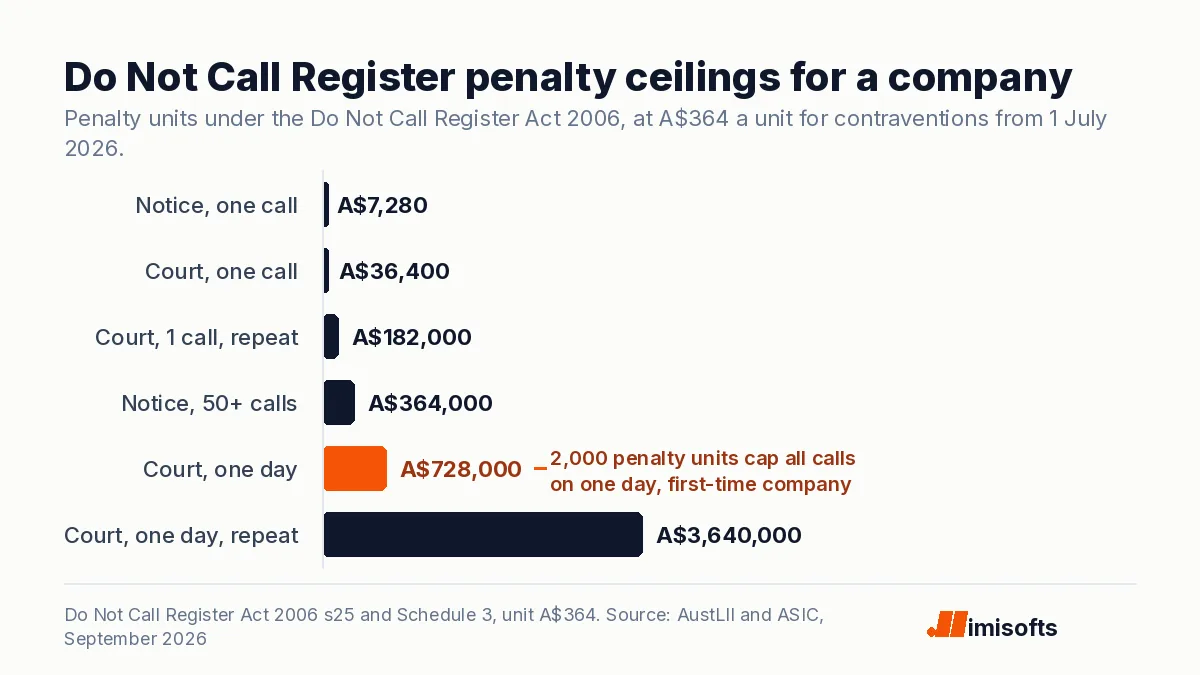
Section 11 is a civil penalty provision enforced in the federal courts on the ACMA's application. Section 25 caps a first-time company at 100 penalty units per call and 2,000 for all calls on one day, and a repeat offender at 500 and 10,000; individuals face a fifth of that. The ACMA can instead issue an infringement notice under Schedule 3 at 20 units per call for a company, capped at 1,000 units for 50 or more calls. At the A$364 unit in ASIC's table for contraventions from July 1, 2026, that is A$7,280 per call on a notice, A$364,000 for 50 calls or more, A$36,400 per call in court and A$728,000 a day, or A$182,000 and A$3.64 million for a repeat offender. Breaching the Standard is separate: section 128 of the Telecommunications Act 1997 makes compliance a civil penalty provision, and section 570 caps it at A$250,000 per contravention for a company.
The latest large case is Tabcorp. On July 22, 2026 the ACMA announced that TAB had paid more than A$2.7 million after its calls to VIP customers between February 2024 and June 2025 included 351 calls to registered numbers without consent, 82 outside permitted hours and nearly 4,000 without properly identifying the caller or the purpose, alongside a separate spam breach. TAB also gave a court-enforceable undertaking to have its telemarketing systems independently reviewed. Businesses have paid more than A$12 million in spam and telemarketing penalties in the past 18 months, the ACMA says, and its January to March 2026 report counts 16,537 telemarketing complaints in 2024-25 and 10,174 in the first three quarters of 2025-26, with solar, insurance and electricity the most complained-about industries in that quarter.
What it means for operators
Australia regulates the call, not the technology that places it, which makes it kinder to AI voice than the UK and simpler than the US. Calls to business lines are the least restricted lane, but the Standard travels with every dial, and the register bites on mobiles, where most B2B lists now live. Inbound is different again: a customer calling you is not a telemarketing call, which is why many service firms start AI voice with after-hours call answering before pointing it at a list. If you want consent, washing and the Standard's duties built into the system rather than a policy document, that is how we scope compliant AI calling for Australian, UK and US clients.
Checklist for calling Australian numbers
- Wash every list with private or mixed-use numbers, and never dial on a wash older than 30 days.
- Record consent with its source and a stated duration.
- Schedule by the account-holder's state: weekdays 9 am to 8 pm, Saturdays 9 am to 5 pm, no Sundays or national public holidays.
- Open with the business, the client and the purpose.
- Give an AI agent a transfer or keypress route to contact and complaints details, and end the call when asked.
- Present a caller ID that takes return calls for 30 days, and put the Act's compliance clause in every calling contract.
The email and SMS side is in our guide to Australian cold email laws, the US state rules in AI caller disclosure laws by state, and the email rules across markets in the cold email laws by country table.
Frequently Asked Questions
No. Cold calling is legal in Australia. Telemarketing calls must not go to numbers on the Do Not Call Register without the account-holder's consent, and every telemarketing call must follow the Telecommunications (Telemarketing and Research Calls) Industry Standard 2017: calling hours, identification at the start of the call, caller ID and hanging up when asked.
Business numbers cannot be registered, so calls to a company's business lines are not restricted by the register. A phone used more than half for personal purposes can be registered, so B2B lists that contain mobile numbers must be washed. The Industry Standard's hours, identification, caller ID and hang-up rules apply to B2B calls as well.
Yes, on the same terms as a human caller. The Do Not Call Register Act counts a call involving a synthetic voice as a voice call, so the register, the calling hours and the identification rules all apply. The Standard adds a duty to give the recipient a way, such as a keypress or a transfer to an operator, to request contact and complaints details during the call.
Weekdays 9 am to 8 pm and Saturdays 9 am to 5 pm, measured at the account-holder's usual residential address. No telemarketing calls on Sundays, on New Year's Day, Australia Day, Good Friday, Easter Monday, Anzac Day, Christmas Day or Boxing Day, or on a weekday holiday given in lieu. Express consent in advance to a particular call can lift the restriction for that call.
For a company without a prior record a court can impose up to 100 penalty units per call and 2,000 for all calls on one day, which is A$36,400 and A$728,000 at the A$364 unit for contraventions from July 1, 2026. The ACMA can instead issue an infringement notice of 20 penalty units, A$7,280, per call, capped at 1,000 units for 50 or more calls. A repeat offender faces five times the court caps.
Yes. Section 9 of the Do Not Call Register Act extends it to acts outside Australia, and under section 11(9) a business that contracts someone else to make its calls is taken to have caused them, so an Australian brand is liable for its offshore call centre or AI calling vendor.