Yes. Cabinet Resolution No. 56 of 2024, the UAE’s telemarketing rules in force since 27 August 2024, says automated communication systems may be used for marketing. The agent then carries every duty a human caller has: a licensed UAE company with prior approval, numbers registered to its own trade licence, calls only from 9:00 am to 6:00 pm, nobody on the Do Not Call Registry, and an opening that names the company, the purpose and the recording, then asks to continue. Resolution No. 57 fines a company AED 10,000 to AED 150,000 per breach.
I run imisofts from Dubai, and I read both resolutions on the UAE legislation portal on 30 September 2026. The robot is the settled part. The fines sit in everything attached to it, starting with the number your agent dials from.
The UAE never banned the robot caller. It gave the mistakes a robot caller makes their own lines in a fine table.
Key numbers
| Item | Number |
|---|---|
| Telemarketing rules in force since (Cabinet Resolutions 56 and 57 of 2024) | 27 August 2024 |
| Permitted calling window (Resolution 56, Article 5 clause 3) | 9:00 am to 6:00 pm |
| Call backs after no answer, maximum (Article 5 clause 5) | 1 a day, 2 a week |
| Call backs after a refusal on the first call (Article 5 clause 4) | 0 |
| Fine, marketing calls without prior approval (first to third offence) | AED 75,000 to 150,000 |
| Fine, calling a number on the DNCR (first to third offence) | AED 50,000 to 150,000 |
| Fine, number not on the company’s trade licence | AED 25,000 to 75,000 |
| Fine, automated calling in breach (row 16) | AED 10,000 to 50,000 |
| Fine, missing ID, recording notice or continue question (each) | AED 10,000 to 30,000 |
| Individual on a personal number, first offence (plus every number in their name cut until paid) | AED 5,000 |
| e& black points before a line is barred (AED 5,000 per number to lift, from 1 September 2026) | 5 |
| e& black points before trade licence restrictions | 25 |
Read on 30 September 2026 from Cabinet Resolutions No. 56 and No. 57 of 2024 on uaelegislation.gov.ae (official English translation; the Arabic text prevails) and the DNCR page of e& Business.
The yes is one sentence long
Clause 6 of Article 5 reads: “Automated communication systems may be used for marketing, advertising and promoting the products or services provided by the Company in accordance with the provisions of this resolution.” An AI voice agent is an automated communication system, and the last eight words mean every other clause applies to it as it applies to a person.
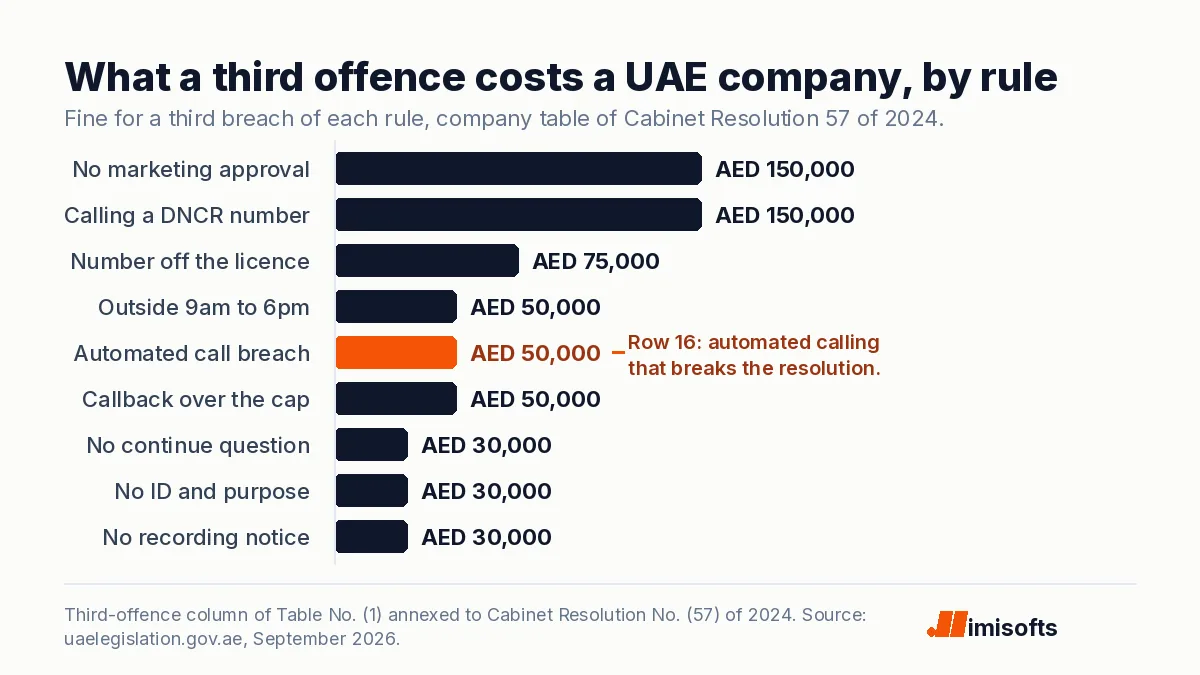
Resolution 57 prices those clauses in two fine tables, companies and individuals, by first, second and third offence. The company table has eighteen rows, and row 16 is written for you: automatic calling that breaks the resolution, AED 10,000 the first time, 25,000 the second and 50,000 the third. Calling without the prior approval Article 4 requires is row 1, AED 75,000 rising to 150,000. Repeat the same violation within six months of a penalty and the authority may skip to its most severe option, up to cancelling the licence.
The mistake: running the UAE like a US dialer
Picture a dialer built on virtual numbers, a founder’s mobile for warm leads and a bought list with consent assumed. In the UAE, each piece breaks a different clause.
Article 4 requires “local Phone numbers issued by telecommunications companies licensed in the State”, registered under the company’s commercial licence, and clause 13 bans any number “not registered or owned by the Company”. A number off your licence is row 3: AED 25,000, then 50,000, then 75,000. A personal mobile puts every line in your name at risk. Article 3 bars individuals from marketing calls on numbers in their own name, and the fine is AED 5,000 plus every fixed and mobile number in that person’s name cut until paid. Repeat within 30 days: AED 20,000 and three months without them, then AED 50,000 and a twelve-month ban from every licensed operator.
Then the list. Consent does not rescue a number on the Do Not Call Registry: e& tells businesses they must not make promotional calls to registered customers “regardless of prior consent”, and du says the check is required “even if they have prior consent”. Calling a registered number is row 4, AED 50,000 for a first offence and 150,000 for a third.
What the agent must say before it sells
Three duties sit in the opening seconds. Article 4 clause 11: “Identify the Company and the purpose of the call at the beginning”. Clause 7: inform the consumer “of this recording when the call begins”. Article 5 clause 7: “Ask the Consumer whether he wants to continue the Phone Call or not before starting to market”. Miss any one and the fine is AED 10,000 the first time and 30,000 the third. Not recording at all is its own row, AED 10,000 to 50,000.
For an AI agent that is a scripting job: permission comes before the pitch. The timing rules belong in the dialer, not the prompt: calls only from 9:00 am to 6:00 pm, no call back after a refusal, and after no answer or a hang up, one call back a day and two a week at most (Article 5, clauses 3 to 5). Each is AED 10,000 the first time and 50,000 the third.
Any number, any hour, open with the offer, and redial until someone picks up.
Four rows of the company fine table: a number off the licence, outside 9:00 am to 6:00 pm, no question before the pitch, call backs over the cap.
Company, purpose, “this call is recorded”, then: would you like to continue?
Resolution 56, Article 4 clauses 7 and 11 and Article 5 clause 7, read 30 September 2026.
The clause that decides who you may call
Clause 4 of Article 4 decides who is on your list. It tells the company to “Create a communication channel for Consumers interested in obtaining marketing information”, then says “marketing communication is only made with these Consumers”. Read plainly, that is an opt-in list: you may market by phone to the people who came through your channel.
The resolution defines a Consumer as a “Natural Person” and exempts no business-to-business calls; a decision maker on their own mobile is a natural person. Telemarketing also covers “marketing text messages and marketing messages through social media applications”, so moving the pitch to WhatsApp does not leave the rules. I would build UAE numbers inbound first: the agent calls back people who asked, and cold outreach moves to email, covered in our UAE cold email guide.
The operator keeps score too
e&’s business page, updated in August 2026, lists extra enforcement from 1 September 2026 under the Voice Spam Policy for the registry: black points against the offending number, a Do Not Originate Register at 5 points that bars outgoing calls, AED 5,000 per number to get off it, and at 25 points on a trade licence, a block on buying telecom services for its active numbers or new UAE numbers. An agent dialing from twenty lines can collect points on all twenty for one licence.
The enforcement is real: The National reported in August 2026 that the TDRA had issued more than AED 19 million in fines and cut 9,433 numbers since August 2024, and in February 2025 Dubai’s consumer protection agency said it had fined 159 companies AED 50,000 each.
Four settings before the first dial
Put every outbound number on your own trade licence
UAE numbers from a licensed operator, registered under the company’s commercial licence, and the phone marketing approval from your competent authority in hand. Retire personal mobiles and offshore numbers from the dialer.
Check the registry before every campaign
Run each list through the DNCR check in your operator’s business portal, which costs nothing. Consent does not clear a registered number, so warm lists get checked too.
Hard-code the window and the caps
Calls between 9:00 am and 6:00 pm UAE time, one call back a day and two a week after no answer, and a permanent stop after a refusal. Put them in the scheduler, where a caller cannot talk the agent out of them.
Script the opening, then record everything
Company name, purpose and the recording notice, then ask whether the person wants to continue, before any offer. Keep the call register and the recordings in the form your competent authority sets.
The bottom line
The UAE has answered in writing: an AI agent may make the call. It did not lower the bar for the call. The agent must be the best-behaved caller on your team, on your own numbers, inside nine to six, asking permission before it pitches.
I have built inbound and outbound calling for more than 200 businesses, and on UAE numbers the prompt is the last thing I would write: numbers, approval, the registry check and the opening come first. That is how we scope compliant AI calling. For other markets, see our Australian cold calling guide and the cold email laws by country table. I am not a lawyer and this is not legal advice; I read the official English translation, and the Arabic text prevails.