October 11, 2026. Israel is one of the strictest countries in the world for cold email. Section 30A of the Communications Law, Israel's anti-spam law, bans advertising by email without the recipient's prior, explicit consent in writing, allows a single message to a business asking for that consent, and lets a court award up to ILS 1,000 for every advertising email received in breach, without the recipient having to prove any harm. A sender is presumed to have acted knowingly unless it proves otherwise, and every advertising email must carry the Hebrew word for advertisement in its subject line.
This guide reads section 30A in the Hebrew text of the Communications Law (Telecommunications and Broadcasting), 5742-1982, as published on Wikisource, read 11 October 2026; the translations are ours. Clean, authenticated sending is necessary but not sufficient in Israel, and our email infrastructure work assumes the consent question has been answered first. This is a map of the rules, not legal advice.
Key numbers
| Item | Number |
|---|---|
| Consent required for advertising email (including by email or recorded call; s.30A(b)) | Prior, explicit, in writing |
| Consent requests allowed to a business (a one-time offer to agree to receive advertising) | 1 |
| Existing customer exception conditions (s.30A(c)) | 3, all required |
| Label required in an email subject line (s.30A(e)) | פרסומת (advertisement) |
| Exemplary damages per advertisement (no proof of harm; s.30A(j)) | up to ILS 1,000 |
| Presumption that the sender acted knowingly | Yes, unless disproved |
| Cost to the recipient of refusing (s.30A(d)) | Free, apart from sending cost |
| Managers' duty to supervise (s.30A(h)) | Yes, with a presumption of breach |
Communications Law (Telecommunications and Broadcasting), 5742-1982, section 30A, Hebrew text, and DLA Piper Data Protection Laws of the World, both read 11 October 2026.
What counts as an advertisement and an electronic message
The law defines an advertisement broadly: a message distributed commercially whose purpose is to encourage the purchase of a product or service or otherwise to encourage spending money, plus requests for donations and propaganda sent to the public. An "electronic message" is an encoded message sent over the internet to one or more recipients that can be stored and retrieved by computer, which is email. The "advertiser" is anyone whose name or contact details appear as the place to buy, whose business the message promotes, or who markets the product for someone else. A licensed provider that only transmitted the message is not the advertiser, so outsourcing the sending does not move the liability.
The consent rule
Section 30A(b) says an advertiser shall not send an advertisement by fax, automatic dialing system, electronic message or text message "without obtaining the explicit prior consent of the recipient, in writing, including in an electronic message or a recorded conversation." There is no general business-to-business exemption and no legitimate interest test. A typical B2B cold email that pitches a product to someone who never agreed to receive it is an advertisement sent without consent.
The one message you may send to a business
The same subsection carves out one exception that matters for outbound teams: "a one-time approach by an advertiser to a recipient that is a business", by one of those channels, "which constitutes an offer to agree to receive advertisements from it", is not a breach. In practice that means a single email to a business whose purpose is to ask whether it wants to hear from you. Write it as an invitation rather than a pitch: who you are, what kind of information you would send, and a clear way to say yes or no. Send it once; a follow-up sequence is no longer a one-time approach, and a pitch dressed as a consent request is still a pitch.
The existing customer exception
Section 30A(c) lets you advertise without fresh consent only if all three conditions hold:
- The recipient gave you their details while buying a product or service from you, or while negotiating to buy one, and you told them at the time that the details would be used to send them advertising.
- You gave them the opportunity to refuse such advertising, and they did not.
- The advertisement is for products or services of a similar type.
Leads from a trade show, a webinar or a scraped list do not meet these conditions on their own.
What every advertising email must show
Under section 30A(e), any advertising email you are allowed to send must state, prominently and clearly and without misleading:
- That it is an advertisement. The word "פרסומת" (pirsomet, advertisement) must appear at the beginning of the message, and for an email, in the subject line.
- Who is sending it. The advertiser's name, address and contact details.
- How to refuse. The recipient's right to send a refusal notice at any time, a simple and reasonable way to do it, and, for email, a valid internet address of the advertiser for refusals.
Under section 30A(d), refusal must be free apart from the cost of sending it, and the recipient chooses whether to refuse in writing or through the same channel the advertisement arrived on. Once a refusal arrives, every further message is a fresh breach.
Damages, fines and personal liability
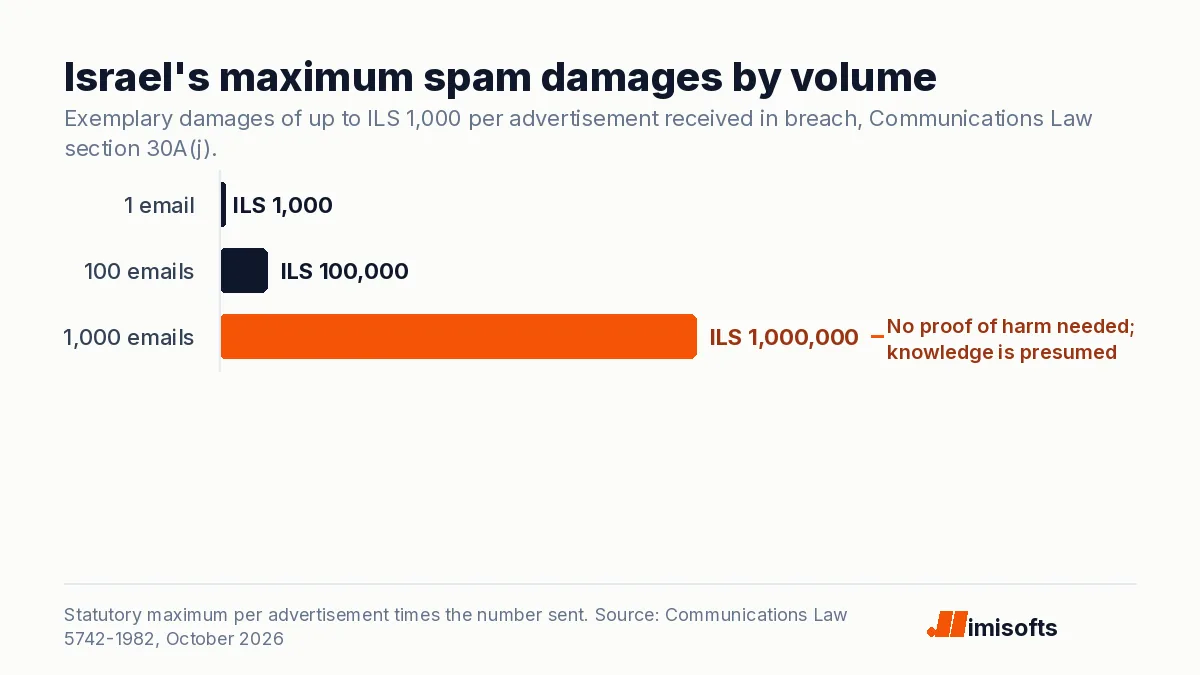
Section 30A(j) is what makes Israel expensive. If an advertisement was sent knowingly in breach, a court may award "exemplary damages" that do not depend on harm, of up to ILS 1,000 for each advertisement the recipient received. The court weighs enforcement and deterrence, encouraging recipients to claim their rights and the scale of the breach, not the damage caused. An advertiser is presumed to have acted knowingly unless it proves otherwise, and that defence is unavailable when it kept sending after a refusal. At the maximum, 100 non-compliant emails to Israeli recipients could cost ILS 100,000, and 1,000 could cost ILS 1 million.
The section also makes a breach a civil wrong under the Torts Ordinance, sets criminal fines by reference to section 61 of the Penal Law for sending without consent and for leaving out the required details, and puts a duty on a company's managers and on whoever is responsible for marketing to supervise and do everything possible to prevent offences, with a presumption that they failed unless they show otherwise.
Data protection on top of the spam law
Section 30A is about the message. The Privacy Protection Law governs the lists behind it: according to DLA Piper's summary, it regulates databases used for direct mailing, including registration and record keeping, and the Privacy Protection Authority's guidelines for direct mailing add notice duties about the database and its sources and an initial opt-in. If you build or buy a database of Israeli contacts for marketing, check both regimes; our guide to buying email lists explains why bought data rarely carries usable consent.
A workable approach for B2B senders
- Split Israeli contacts into existing customers who meet the three conditions, people who have opted in, and businesses you have never contacted.
- For the third group, send one consent request per business, written as an invitation, with your identity and a simple way to answer.
- Only those who say yes enter a sequence. Store the consent with its date, the wording you used and the address it covers.
- Put "פרסומת" in every advertising subject line, include your name, address and contact details, and give a working refusal address.
- Process refusals immediately across every tool, because each later email is a new breach.
If that sounds closer to Canada's CASL than to the US CAN-SPAM Act, it is: compare our guides to Canada and GDPR, and the cold email laws by country table. Colombia and Malaysia, covered this week in our guides to Colombia and Malaysia, are strict in different ways.
Checklist for emailing Israel
- No advertising email without prior, explicit, written consent, unless the existing customer conditions are all met.
- One consent request per business, never a sequence.
- The Hebrew word for advertisement in the subject line of every advertising email.
- Name, address, contact details and a valid refusal address in every message.
- Refusals honoured at once, free of charge, whether they arrive in writing or through the channel the advertisement came by, as the recipient chooses.
- A named person in the company responsible for supervising compliance.
- Authenticated sending through dedicated infrastructure, so a complaint does not damage your main domain.
Frequently Asked Questions
Only with consent. Section 30A of the Communications Law bans advertising emails without the recipient's prior, explicit consent in writing, including by email or a recorded call. The exceptions are a single email to a business asking for consent, and advertising to existing customers who meet three conditions.
You may send one email to a business that offers it the chance to agree to receive your advertising. Any pitch beyond that, and any follow-up sequence, needs the recipient's prior written consent.
An advertising email must say it is an advertisement, with the word פרסומת (pirsomet) at the start of the message and, for email, in the subject line, together with the sender's name, address, contact details and a way to refuse.
A court may award exemplary damages of up to ILS 1,000 for each advertisement received in breach, without proof of harm. The sender is presumed to have acted knowingly unless it proves otherwise, and there is no defence for messages sent after a refusal.
You may advertise without fresh consent if the recipient gave you their details while buying or negotiating to buy from you and was told they would be used for advertising, was given a chance to refuse and did not, and the advertising is for similar products or services.
Section 30A requires a company's managers and whoever is responsible for marketing to supervise and do everything possible to prevent offences, and presumes they failed unless they show they did everything possible.