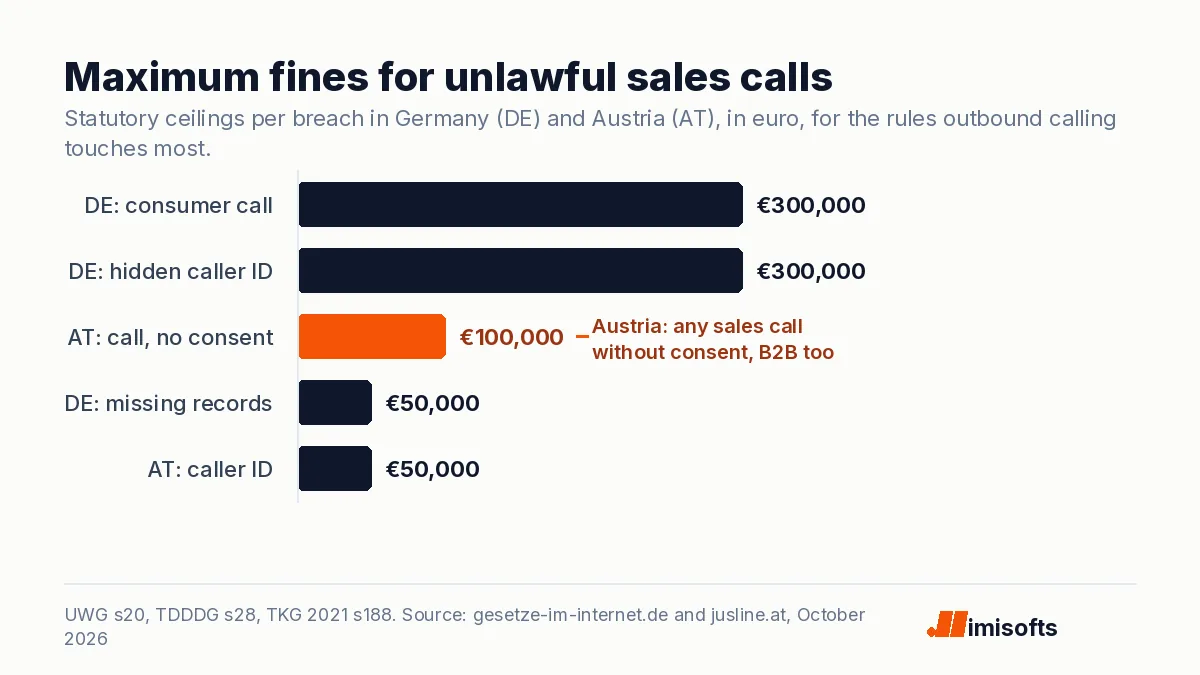
October 6, 2026. Germany and Austria split on the question every outbound team asks first: may we call a business that has never heard of us? In Germany a human caller may, on the business's presumed consent, but advertising with an automatic calling machine needs the addressee's prior express consent whoever the addressee is, and an AI voice agent that dials and talks with no person on the line fits that description on a plain reading. Austria needs prior consent for every advertising call, businesses included. The fines are real: the Bundesnetzagentur can fine an advertising call to a consumer without consent up to €300,000 under section 20 of the German Unfair Competition Act (UWG), and Austria's Telecommunications Act 2021 allows up to €100,000 for an advertising call made without consent.
Key numbers
| Item | Number |
|---|---|
| Germany, fine for a sales call to a consumer without consent (UWG s20, human caller or automatic calling machine) | up to €300,000 |
| Germany, fine for missing phone consent records (UWG s20 with s7a) | up to €50,000 |
| Germany, how long consumer consent records are kept (from consent and after each use) | 5 years |
| Germany, fine for hiding caller ID on a sales call (TDDDG s15(2) and s28, businesses included) | up to €300,000 |
| Germany, written complaints about sales calls in 2025 (up 6 percent on 37,561 in 2024) | 39,842 |
| Germany, fines imposed by the Bundesnetzagentur in 2025 (13 large proceedings) | over €1.099 million |
| Germany, largest published fine so far in 2026 (March 9, 2026, not final) | €50,000 |
| Austria, fine for a sales call without consent (TKG 2021 s188(6), businesses included) | up to €100,000 |
| Austria, fine for suppressed or falsified caller ID (TKG 2021 s188(4)) | up to €50,000 |
| EU AI Act disclosure duty applies from (Article 50(1) and (5)) | August 2, 2026 |
| EU AI Act fine for a disclosure breach (of worldwide turnover, whichever is higher) | up to €15 million or 3 percent |
| Bundesnetzagentur AI Act complaints office since (KI-MIG in force) | July 29, 2026 |
Statute text, regulator decisions and EU law read on 6 October 2026 at gesetze-im-internet.de, bundesnetzagentur.de, jusline.at and eur-lex.europa.eu.
Germany: what a human caller may do
Section 7 of the UWG sorts advertising calls by who receives them and how they are placed. Four rules decide it:
- Consumers need prior express consent. Section 7(2) No. 1 treats an advertising call to a consumer without prior express consent as an unacceptable nuisance in every case.
- Businesses need at least presumed consent. A call to any other market participant may rest on "at least presumed" consent, which the Federal Court of Justice reads narrowly: concrete facts must let the caller assume the business expects such a call or would at least welcome it, judged on the circumstances before the call and the kind of offer (I ZR 27/08, March 11, 2010, collected in the omsels.info UWG commentary).
- Consumer consent must be on file. Section 7a requires a business that advertises by phone to consumers to document the consent when it is given, keep the record for five years from consent and after each use, and produce it to the authority on request.
- Breaches toward consumers are fined; breaches toward businesses are sued. Section 20 lets the Bundesnetzagentur fine an advertising call, or the use of an automatic calling machine, aimed at a consumer without prior express consent up to €300,000, and a missing or incomplete consent record up to €50,000. Calls to businesses, by a person or a machine, are not on that list; a breach there is enforced by injunction under section 8, which competitors and qualified trade associations among others can seek, against the business owner too when an employee or contractor made the call.
Why an AI voice agent loses the B2B route in Germany
Section 7(2) No. 2 is the clause that matters for AI. It treats advertising using an automatic calling machine as an unacceptable nuisance unless the addressee gave prior express consent, and unlike No. 1 it does not stop at consumers. The UWG does not define the term. It comes from Article 13(1) of the ePrivacy Directive, which speaks of "automated calling and communication systems without human intervention (automatic calling machines)". An agent that places the call and holds the conversation with no person on the line is, on a plain reading, a calling system without human intervention. The Bundesnetzagentur's own FAQ says an unlawful advertising call can be made by a person or by an automatic calling machine, and that machine calls have carried fines since October 9, 2013.
We found no German court decision on conversational AI agents as of October 6, 2026; this is a reading of the statute, but it decides the design. If the agent dials a German business cold, the presumed-consent route that covers a human sales rep is probably not available, and the call needs express consent first. If a person places the call and the AI only researches, prepares and logs, you are back under the presumed-consent test.
Caller ID, consent records and the 2026 fines
One more German rule applies to every advertising call, business or consumer. Section 15(2) of the TDDDG, the telecoms data protection act, bars a caller from suppressing caller ID on an advertising call and requires the number assigned to the caller to be shown. Suppression can cost up to €300,000 under section 28, and the regulator's FAQ says it can fine the display of a number not assigned to the company as well, so check which number your dialer shows before the first German call. The records duty is now enforced too: in its January 2026 report the Bundesnetzagentur counted 39,842 written complaints about unlawful phone advertising in 2025, six percent more than the 37,561 of 2024, imposed more than €1.099 million in fines across 13 large proceedings, and sanctioned failures to document consent for the first time.
The 2026 decisions on the regulator's published fines list show what it pursues:
- March 9, 2026: €50,000 on a seller of finance and insurance products whose callers posed as an independent advice service and disguised the sales purpose (not final).
- March 9, 2026: €14,868 on a former managing director personally, €177 for each of 84 failures to document consent (not final).
- April 28, 2026: €6,000 on a call centre for calls to consumers without consent (final).
- July 24, 2026: €34,327 on a call centre: €32,000 for calls to consumers without consent and €2,327 for incomplete consent records, after a campaign kept running without knowing who had allowed calls (not final).
Austria: consent before every sales call
Section 174(1) of the Telecommunications Act 2021 (TKG 2021) makes advertising calls without the user's prior consent inadmissible, and consent can be withdrawn at any time. The text draws no line between consumers and businesses. The Administrative Court held in 2013, on the same rule in the previous act, that the ban protects every subscriber, obviously commercial ones included, and that pitching a contract with the caller's company is advertising (VwGH 2013/03/0048). The Austrian Economic Chamber's guidance adds that the ban covers a first-contact call to a potential customer.
- Human or AI makes no difference. Consent is required for any advertising call, so an AI agent needs what a person needs.
- Caller ID. Section 174(2) forbids suppressing or falsifying caller ID on an advertising call.
- Calls from abroad. Section 174(6) treats an offence committed outside Austria as committed where the call reaches the user's line, so a dialer in Dubai or Manila is inside the rule.
- Fines. Under section 188, an advertising call without consent costs up to €100,000 and suppressed or falsified caller ID up to €50,000, and the authority must weigh commercial or repeated conduct and the unlawful gain. The regional telecom offices (Fernmeldebüros) enforce it.
The EU layer: AI disclosure and the right to object
Two EU rules apply on top. Article 50(1) of the AI Act requires providers to design AI systems that interact directly with people so those people are told they are dealing with an AI, unless that is obvious, and Article 50(5) says the information must come at the latest at the first interaction. The duty has applied since August 2, 2026; the amending Regulation (EU) 2026/1744 of July 8, 2026 pushed back the high-risk rules and left that start date in place. A breach can cost up to €15 million or 3 percent of worldwide annual turnover, whichever is higher (Article 99(4)). In Germany the same Bundesnetzagentur that fines unlawful sales calls became the AI Act's market surveillance authority and central complaints office on July 29, 2026, when the KI-MIG act took effect (press release).
Where the person you call is identifiable, Article 21 of the GDPR also gives them a right to object to direct marketing at any time, which must be flagged clearly at the latest in the first communication; an objection ends marketing use of their data.
What it means for operators
A workable design for AI calling into the DACH region:
- Use the AI where consent already exists. Inbound calls, requested callbacks and follow-ups to a documented opt-in for calls are safe ground in both countries; that is where an after-hours call answering agent earns its keep.
- In Germany, keep a person on cold B2B dials. Let the agent research, prepare and log, and let a human place the first call to a business, only where the presumed-consent test is met.
- In Austria, get consent before any sales call. A form, an inbound enquiry or an event opt-in, logged per person. There is no B2B route.
- Log consent the way a regulator will ask for it. Who agreed, when, how, to calls from which company; keep it five years for German consumers.
- Show your own number. No suppressed or borrowed caller ID in either country.
- Open every AI call with the disclosure and the exit. Say it is an AI calling for a named company and offer the objection before the pitch.
That is the consent-first design we build into a compliant AI calling setup, adapted to stricter rules. For email in the same markets, read our Austrian cold email guide; for other countries, compare the UK calling rules, South Africa and our note on scripting the AI disclosure.
Frequently Asked Questions
For a human caller, yes, if there is at least presumed consent. Section 7(2) No. 1 of the UWG requires prior express consent for advertising calls to consumers but accepts presumed consent for calls to businesses, which the Federal Court of Justice reads as concrete facts suggesting the business has a genuine interest in the call. A call to a business without it can be stopped by injunction from competitors or trade associations; calls to consumers without consent can be fined up to €300,000.
Probably not without prior express consent. Section 7(2) No. 2 of the UWG requires prior express consent from any addressee for advertising using an automatic calling machine, and the term comes from Article 13(1) of the ePrivacy Directive, which describes automated calling systems without human intervention. An agent that dials and holds the conversation alone fits that on a plain reading. We found no court ruling on conversational AI agents as of October 6, 2026.
Not without prior consent. Section 174(1) of the Telecommunications Act 2021 bans advertising calls without the user's prior consent and draws no line between consumers and businesses; the Administrative Court applied the same rule to a business in 2013 (VwGH 2013/03/0048). A breach costs up to €100,000 under section 188, and calls placed from abroad count as made where they reach the Austrian line.
Germany: up to €300,000 for an advertising call or automatic calling machine aimed at a consumer without prior express consent, up to €50,000 for missing consent records, and up to €300,000 for suppressing caller ID. The Bundesnetzagentur imposed more than €1.099 million across 13 large proceedings in 2025. Austria: up to €100,000 for an advertising call without consent and up to €50,000 for suppressed or falsified caller ID.
Yes, unless it is obvious. Article 50(1) of the AI Act requires AI systems that interact directly with people to be designed so they are told they are dealing with an AI, and Article 50(5) requires that at the latest at the first interaction. The duty has applied since August 2, 2026, and a breach can cost up to €15 million or 3 percent of worldwide turnover. In Germany the Bundesnetzagentur has taken AI Act complaints since July 29, 2026.
Five years. Section 7a of the UWG requires a business that advertises by phone to consumers to document prior express consent when it is given and keep the proof for five years from the consent and after each use, and to produce it to the Bundesnetzagentur on request. Missing records can be fined up to €50,000; in March 2026 the regulator fined a former managing director €177 for each of 84 documentation failures.