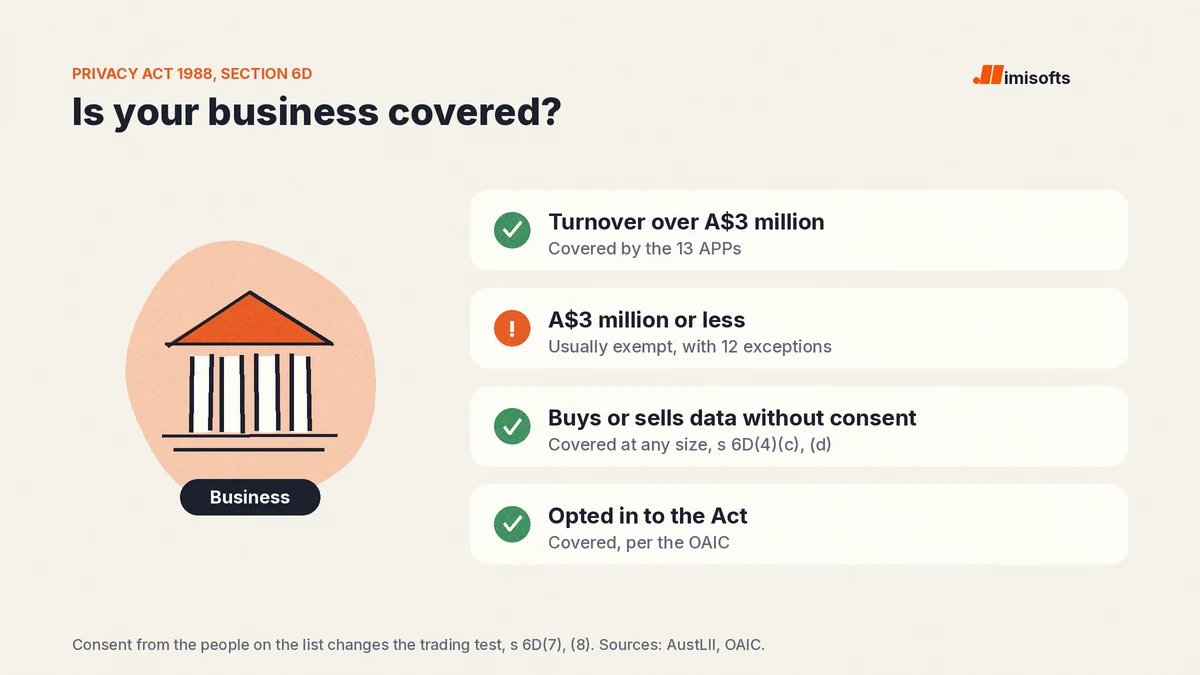
Short answer. Australia's Privacy Act 1988 applies to businesses with an annual turnover of more than A$3 million, and to smaller ones in listed groups, including a business that buys or sells personal information without the consent of the people concerned. Covered businesses must follow the 13 Australian Privacy Principles. For a serious interference with privacy, a company faces up to the greatest of A$50 million, three times the benefit, or, if the benefit cannot be valued, 30% of adjusted turnover, under section 13G.
One change lands soon. From 10 December 2026, the privacy regulator, the OAIC, says covered businesses must explain in their privacy policy where a computer program makes or informs decisions that significantly affect people. If you sell into Australia, see our lead generation service for Australia, and our email infrastructure service for the sending layer, including unsubscribe and suppression handling.
This guide covers who the Act covers, why trading in lists removes the small business exemption, the 13 principles, the direct marketing rule in APP 7, access requests, penalties, and what is changing. The statute was read on AustLII on November 27, 2026. Amounts are in Australian dollars. This is general information, not legal advice.
Key numbers
| Item | Number |
|---|---|
| Small business turnover test (Previous financial year, s 6D(1)) | A$3 million |
| Australian Privacy Principles (Schedule 1 of the Act) | 13 |
| Kinds of business covered at any size (OAIC list, including trading in personal information) | 12 |
| Serious interference, company (Or 3x the benefit, or 30% of turnover if it cannot be valued) | A$50 million |
| Serious interference, individual (s 13G(2)) | A$2.5 million |
| Interference penalty cap (Payable by a person; A$728,000 at A$364, s 13H) | 2,000 penalty units |
| Civil penalty, s 13K breaches (A$72,800 at A$364) | 200 penalty units |
| Commonwealth penalty unit (Conduct on or after 1 July 2026, per ASIC) | A$364 |
| Automated decision disclosure (APP 1.7 and 1.8) | 10 December 2026 |
| Agency deadline for access (Organisations: a reasonable period, APP 12.4) | 30 days |
Privacy Act 1988 on AustLII, OAIC small business page and OAIC release of September 30, 2026, ASIC penalty unit table, read November 27, 2026.
Who the Privacy Act covers
Small business operators are left out of the Act's private sector rules. Section 6D(3) describes one as an individual, body corporate, partnership, unincorporated association or trust that carries on only small businesses, and section 6D defines a small business by turnover: "A business is a small business at a time ... in a financial year ... if its annual turnover for the previous financial year is $3,000,000 or less." A new business uses its current year's turnover instead.
The OAIC's small business page puts it plainly: "Most small businesses are not covered by the Privacy Act 1988 ... but some are." It adds that turnover "includes all income from all sources." Regardless of turnover, the OAIC lists twelve kinds of business that are covered.
| Covered regardless of turnover (OAIC list) | Why it matters for outbound |
|---|---|
| Trading in personal information | Buying or selling contact lists |
| Related to a business the Act covers | A small subsidiary of a larger group |
| Has opted in to the Act | A choice the business makes |
| Health service provider | Clinics holding health information |
| Contractor under a Commonwealth contract | Government suppliers |
| Credit reporting body, AML/CTF reporting entity, CDR accredited | Finance and data businesses |
| Residential tenancy database, employee associations, protection action ballots, prescribed by regulation | Specialist cases |
Done for you by imisofts
Selling to Australian businesses?
imisofts runs Spam Act compliant cold email and appointment setting for Australian companies and books qualified meetings for you.
Why buying or selling lists removes the exemption
This is the clause outbound teams miss. Section 6D(4) says a business is not a small business operator if it "(c) discloses personal information about another individual to anyone else for a benefit, service or advantage; or (d) provides a benefit, service or advantage to collect personal information about another individual from anyone else." Selling a list falls under (c); paying for one falls under (d).
There is a carve-out. Sections 6D(7) and 6D(8) say those two limbs do not apply where the disclosure or collection is "with the consent of the other individual" or "as required or authorised by or under legislation." In our reading, a small agency that buys contact data without the consent of the people on the list should assume the Act applies to it, even with turnover under A$3 million. Check your own position with the OAIC's checklist or a lawyer.
The 13 Australian Privacy Principles
The principles are in Schedule 1 of the Act.
| APP | Subject |
|---|---|
| 1 | Open and transparent management, including an up-to-date privacy policy |
| 2 | Anonymity and pseudonymity |
| 3 | Collection of solicited personal information |
| 4 | Dealing with unsolicited personal information |
| 5 | Notification of the collection |
| 6 | Use or disclosure |
| 7 | Direct marketing |
| 8 | Cross-border disclosure |
| 9 | Government related identifiers |
| 10 | Quality of personal information |
| 11 | Security of personal information |
| 12 | Access to personal information |
| 13 | Correction of personal information |
APP 1.3 requires "a clearly expressed and up-to-date policy (the APP privacy policy)." For a sales team, APPs 1, 5, 7, 11 and 12 do most of the work: the policy, telling people you hold their data, marketing rules, security, and answering access requests.
APP 7: the direct marketing rule
APP 7.1 starts with a ban: an organisation "must not use or disclose the information for the purpose of direct marketing." The exceptions carry the conditions.
- Data you collected from the person (APP 7.2): allowed if "the individual would reasonably expect the organisation to use or disclose the information for that purpose," you provide "a simple means by which the individual may easily request not to receive direct marketing communications," and they have not asked you to stop.
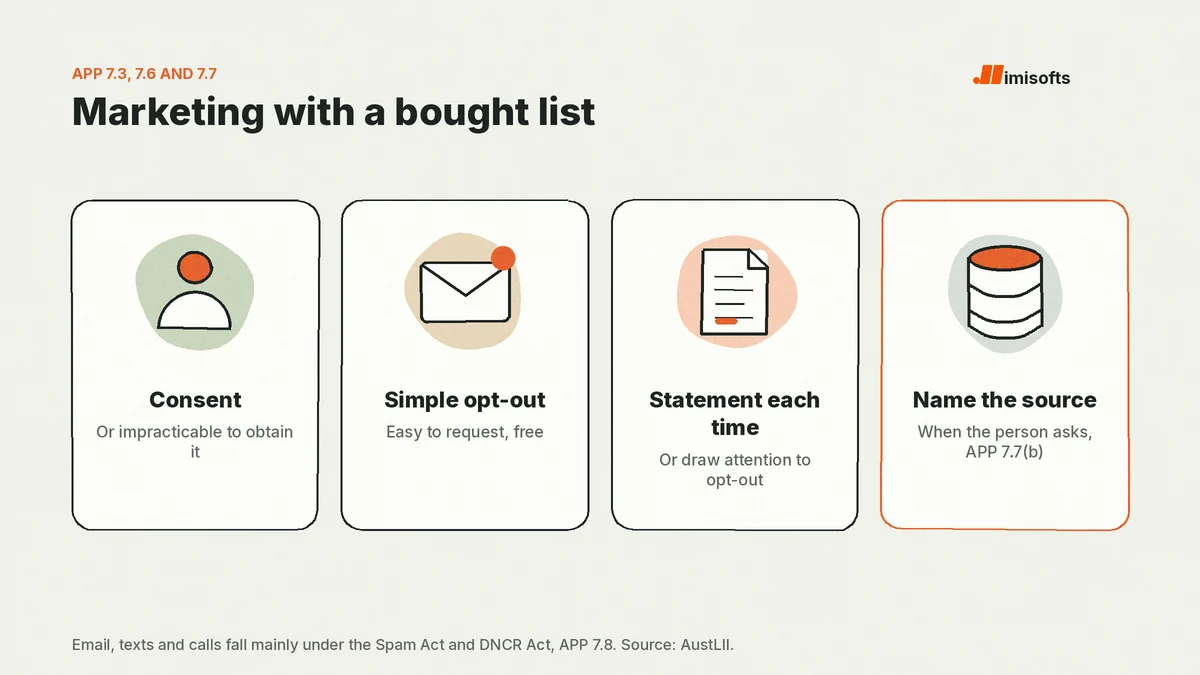
- Data from someone else (APP 7.3): allowed only if the person consented "or it is impracticable to obtain that consent," you provide the simple opt-out, "in each direct marketing communication" you include "a prominent statement that the individual may make such a request" or otherwise draw their attention to it, and they have not asked you to stop.
- Sensitive information (APP 7.4): consent only.
- The source (APP 7.6 and 7.7): a person can ask you "to provide its source of the information," and you must, "within a reasonable period after the request is made, notify the individual of its source unless it is impracticable or unreasonable to do so." You cannot charge for an opt-out or a source request.
APP 7.8 says the principle "does not apply to the extent that" the Spam Act 2003 or the Do Not Call Register Act 2006 apply. In our reading, that means commercial emails and texts are governed mainly by the Spam Act, covered in our guide to cold email laws in Australia, and telemarketing calls by the Do Not Call Register rules, covered in cold calling laws in Australia, to the extent those Acts apply. The rest of the APPs still apply to how you collect, hold and secure the list.
Access requests and correction
Under APP 12.4, an organisation must respond to a request for access "within a reasonable period after the request is made," while an agency has 30 days. It must give access "in the manner requested by the individual, if it is reasonable and practicable to do so." APP 13 covers correction. Compare the GDPR, which sets one month with a possible extension; our guide to answering a subject access request covers that version.
Penalties
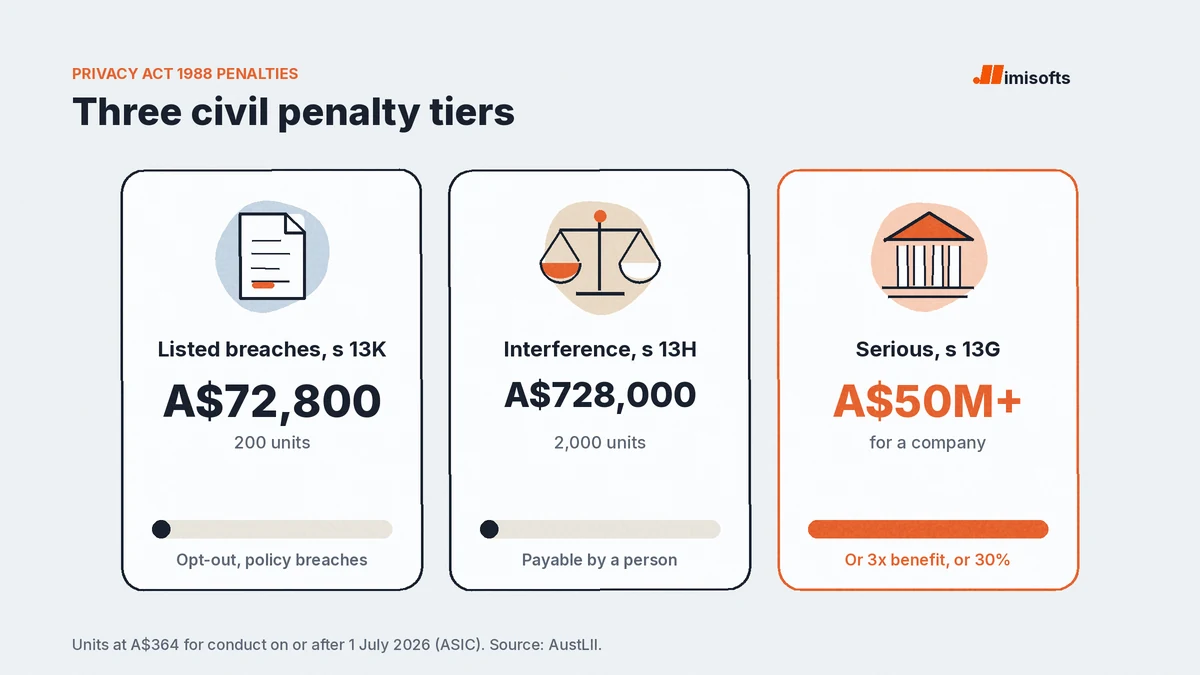
The Act has three civil penalty tiers. Penalty units are converted at the Commonwealth value, which ASIC lists as A$364 for contraventions on or after 1 July 2026 (A$330 before that, from 7 November 2024).
- Serious interference (s 13G): up to A$2.5 million for an individual. For a company, the greatest of A$50 million, three times the benefit obtained, or, if the benefit cannot be valued, "30% of the adjusted turnover" during the breach period. In deciding whether an interference is serious, a court may consider, among other things, the number of people affected and whether the conduct was repeated.
- Interference that is not serious (s 13H): the penalty "payable by a person" must not exceed 2,000 penalty units, which is A$728,000 at A$364. We did not check whether other laws change this figure for companies.
- Breaches that can draw infringement or compliance notices (s 13K): specific breaches, including no APP privacy policy (APP 1.3), missing policy content (APP 1.4), no simple opt-out from direct marketing (APP 7.2(c) or 7.3(c)), no opt-out statement (APP 7.3(d)), not acting on an opt-out in a reasonable period (APP 7.7(a)) and not naming the source (APP 7.7(b)). The civil penalty for these is capped at 200 penalty units, which is A$72,800 at A$364. We did not read the separate infringement notice amounts.
The s 13K list matters for outbound: four of its nine items are APP 7 duties (an opt-out, a statement in each message, acting on an opt-out and naming the source), and two more are about the privacy policy.
What changed in 2026, and what comes next
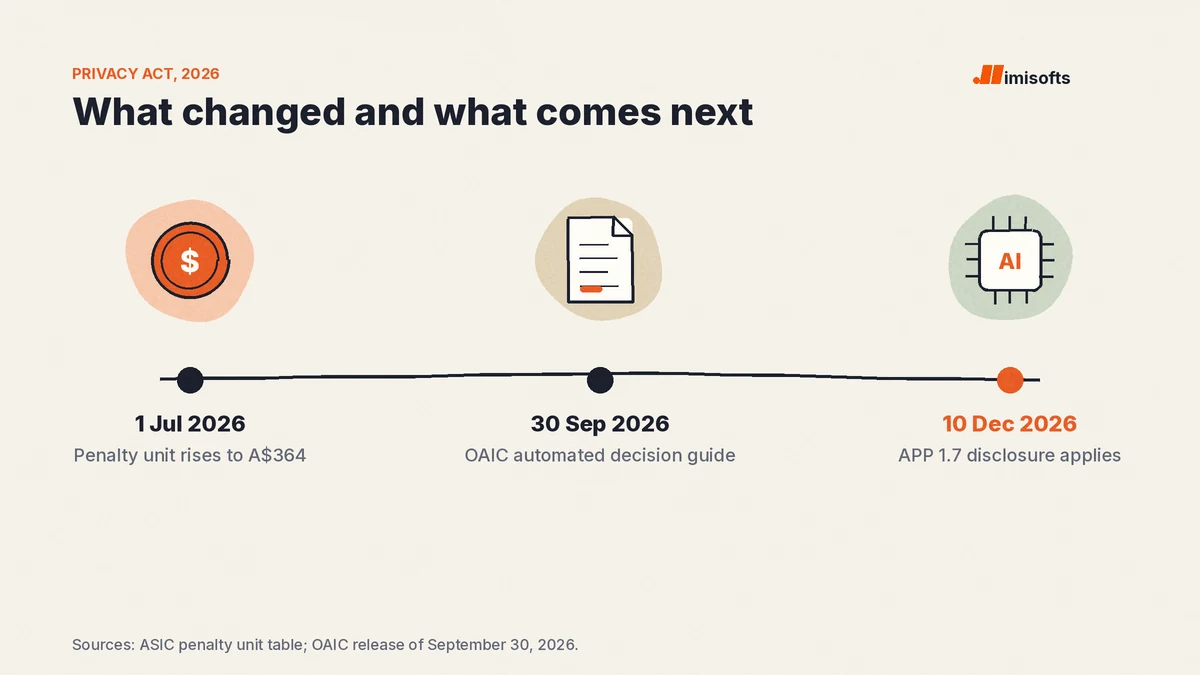
- 1 July 2026: the Commonwealth penalty unit rose to A$364, per ASIC's table.
- 30 September 2026: the OAIC published resources on transparency for automated decisions.
- 10 December 2026: APP 1.7 and 1.8, added by the Privacy and Other Legislation Amendment Act 2024, apply. Where a computer program makes a decision, or does "a thing that is substantially and directly related to making a decision," and the decision "could reasonably be expected to significantly affect the rights or interests of an individual," the privacy policy must list the kinds of personal information used and the kinds of decisions involved.
The small business exemption itself has been under review. In September 2023, Capital Brief reported that proposed laws following the government's review would end the exemption for businesses under A$3 million. As read on November 27, 2026, section 6D still sets the A$3,000,000 test.
A checklist for an outbound team selling into Australia
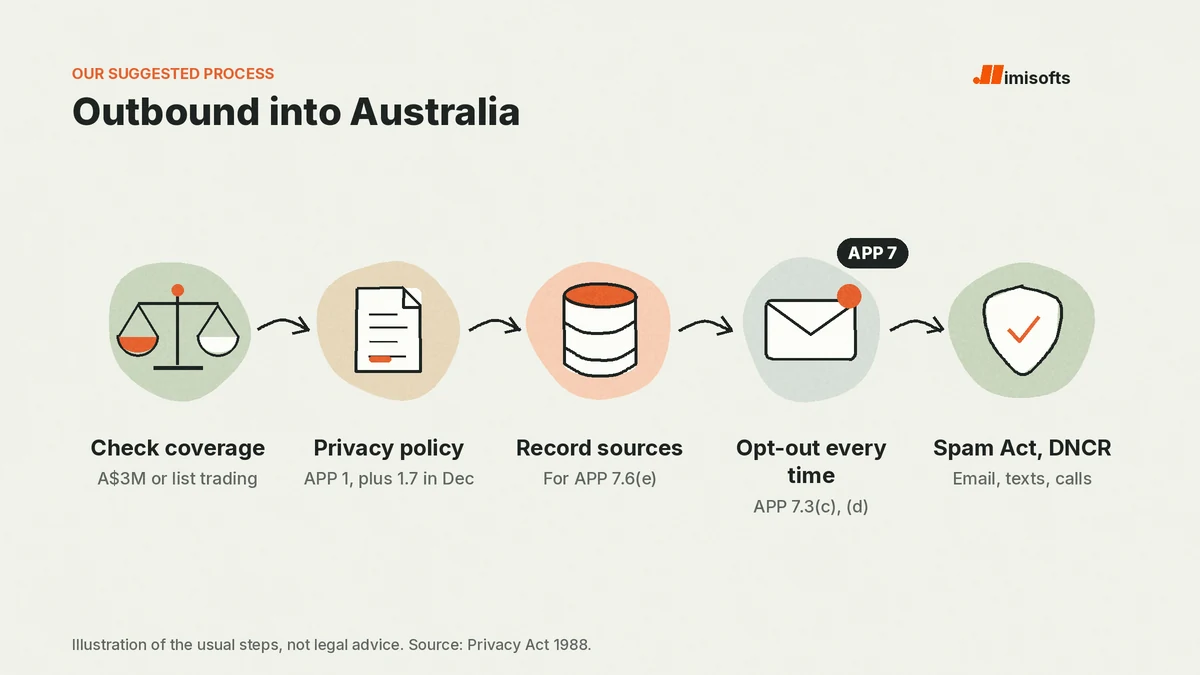
This is the process we suggest from the sections above. It is not legal advice.
- Check coverage. Turnover over A$3 million, or buying or selling lists without consent, means the Act likely applies.
- Publish an APP privacy policy that covers APP 1.4, and from 10 December 2026, any automated decisions under APP 1.7.
- Record the source of every contact when it enters your CRM, so you can answer an APP 7.6(e) request.
- Put an opt-out and a statement in every message and act on opt-outs within a reasonable period.
- Follow the Spam Act and Do Not Call Register rules for email, texts and calls.
If you buy help with sending, our page on email deliverability consultant cost shows what that work usually includes.
The bottom line
The Privacy Act covers businesses over A$3 million and, whatever its size, a business that trades in personal information without consent. For outbound, the most practical rules are APP 7's opt-out and source duties, which also appear on the list of breaches that can draw an infringement notice. Add the automated decision disclosure to your privacy policy before 10 December 2026. To run Australian outreach on a stack that records sources and honours opt-outs, see our Australian lead generation service.
Frequently Asked Questions
Usually not, if annual turnover for the previous financial year is A$3 million or less. But a small business is covered if it trades in personal information, provides a health service, is related to a covered business, has opted in, or falls in another OAIC-listed group, twelve kinds in all.
Open and transparent management (APP 1), anonymity and pseudonymity (2), collection of solicited information (3), unsolicited information (4), notification of collection (5), use or disclosure (6), direct marketing (7), cross-border disclosure (8), government identifiers (9), quality (10), security (11), access (12) and correction (13).
Paying to collect personal information about others can take a business out of the small business exemption under section 6D(4)(d), unless the people consented. If you then market with the data, APP 7.3 requires consent or that consent was impracticable, a simple opt-out and an opt-out statement in each message. Commercial emails also fall under the Spam Act.
For a serious interference with privacy, a company faces up to the greatest of A$50 million, three times the benefit, or, if the benefit cannot be valued, 30% of adjusted turnover. A non-serious interference carries a penalty payable by a person of up to 2,000 penalty units, and listed breaches such as a missing opt-out up to 200 penalty units: A$728,000 and A$72,800 at the A$364 unit.
Yes, if they ask and you used their data for direct marketing. APP 7.6(e) lets them request the source, and APP 7.7(b) says you must notify them of it within a reasonable period after the request unless it is impracticable or unreasonable, and you cannot charge for it.
APP 1.7 and 1.8 start to apply. If a computer program makes, or does something substantially and directly related to making, decisions that could significantly affect people, your APP privacy policy must describe the kinds of personal information used and the kinds of decisions.