October 3, 2026. On September 29, standing outside the West Wing after the White House lunch on super intelligence, Elon Musk said the likeliest outcome of AI and robotics is an "age of abundance" in which people receive a universal high income rather than a universal basic one. He has been saying it for three years. He first put it to Rishi Sunak, then Britain's prime minister, on November 2, 2023: "We won't have universal basic income, we'll have universal high income." What he has never said, in either room, is where the money comes from. This article explains what universal high income means, how it differs from the basic income that has actually been tested, what the funding proposals on the table look like, and what the evidence from real cash programmes says about work. It ends with the part of the abundance thesis that already applies to a small business.
Key numbers
| Item | Number |
|---|---|
| Musk first says universal high income (conversation with Rishi Sunak, London) | November 2, 2023 |
| Musk repeats it at the White House (did not say how it would be funded) | September 29, 2026 |
| Global employment exposed to AI, IMF estimate (about 60 percent in advanced economies) | Almost 40 percent |
| Altman's proposed equity fund tax (of market value yearly, in shares, plus 2.5 percent of private land value) | 2.5 percent |
| Altman's estimated payout per US adult (a decade after the fund starts, his 2021 arithmetic) | About $13,500 a year |
| Alaska Permanent Fund Dividend, 2026 (includes a $200 energy relief payment; paid yearly since 1982) | $1,200 |
| OpenResearch trial payment (1,000 recipients; control group of 2,000 got $50 a month) | $1,000 a month for 3 years |
| Effect of the trial on work hours (employment 2.0 points lower than control; both groups rose overall) | 1.3 to 1.4 fewer hours a week |
| US searches for universal high income (Google Keyword Planner, before the September 29 remarks) | 1,000 to 10,000 a month |
Fortune (3 November 2023), The Next Web and Gulf News (29 to 30 September 2026), the IMF blog (14 January 2024), Moore's Law for Everything (16 March 2021), pfd.alaska.gov, OpenResearch and NBER (July 2024), read 1 to 3 October 2026; Google Keyword Planner read 2 October 2026.
What universal high income means
Universal basic income (UBI) is a regular, unconditional cash payment to every member of a population, set high enough to cover basic needs. Universal high income (UHI) is Musk's name for a version set far above that floor, on the theory that if AI and robots produce most goods and services, output becomes so cheap and plentiful that everyone can be paid well without working. "There will come a point where no job is needed," he told Sunak, as Fortune reported. "You could have a job if you wanted to have a job, for personal satisfaction, but the AI will be able to do everything." UHI is not a policy. No government has proposed one, no bill defines one, and Musk has not attached a number, a funding source or a timeline to it.
What Musk actually said, 2023 and 2026
- November 2, 2023, London. In a conversation with Sunak after the Bletchley Park AI Safety Summit, Musk predicted AI "that far exceeds human intelligence", said no job would be needed, and framed UHI as "some sort of level up, or an equalizer, because everyone will have access to this". He added the caveat himself: "it is the magic genie problem: if you have a genie that can grant wishes, usually those stories don't end well."
- September 29, 2026, Washington. After signing the White House accord alongside Sam Altman, Dario Amodei, Mark Zuckerberg, Sundar Pichai and Jensen Huang, Musk told reporters that robots and superintelligence mean "everyone in the world can have better medical care than anyone here, including me", Gulf News reported. Asked about people without jobs, he answered: "Jobs are going to change. Jobs have always changed." The Next Web has the full exchange. Our report on the super intelligence executive order covers the rest of the day.
UHI versus UBI
The two ideas share the word universal and little else. UBI has decades of pilots and one permanent programme behind it; it is costed, taxed and argued over in legislatures. UHI is a prediction about what abundance would make affordable. The honest way to read it is as a claim about prices, not payments: if an AI system can do a $60,000 job for $600 of compute, the goods that job produced get cheaper, and a modest cash payment buys more. Whether the payment itself is "high" depends entirely on who owns the AI and the robots, and on whether governments can tax them. That is the question Musk has not answered, and it is the one that decides whether UHI is an equalizer or a dividend to shareholders.
Who would pay for it
Three mechanisms exist in the real world or in detailed proposals. None comes from Musk.
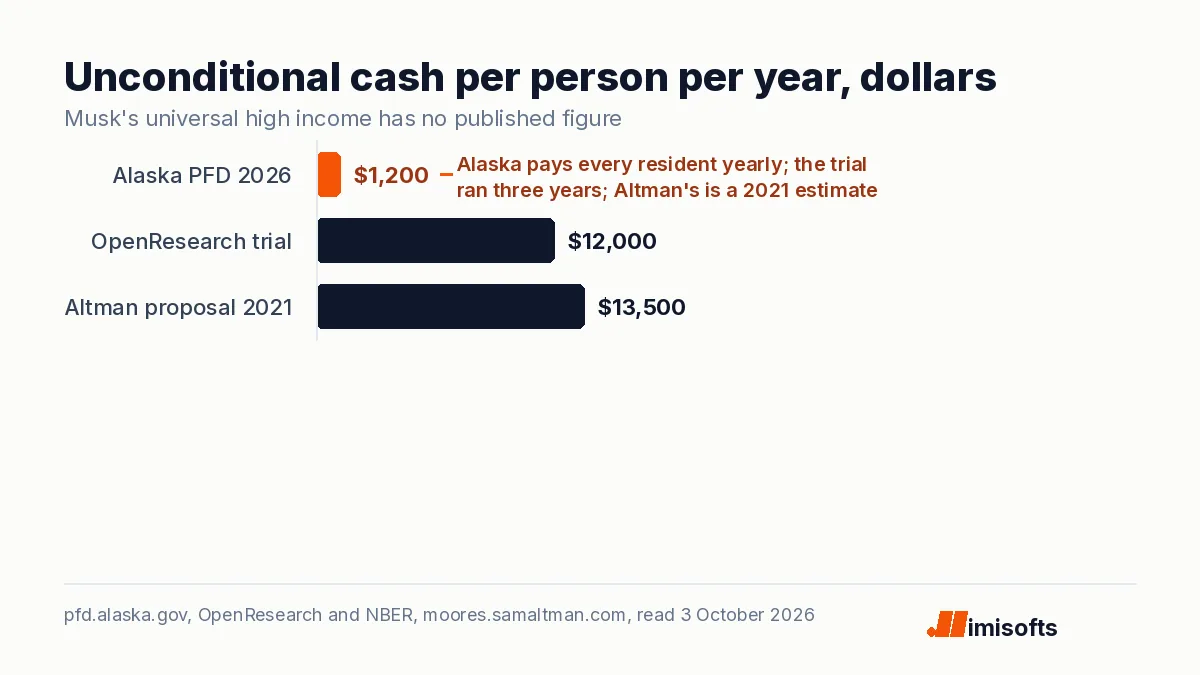
- Tax the capital that replaces the labour. Sam Altman's 2021 essay Moore's Law for Everything proposed an American Equity Fund capitalised by taxing companies above a certain valuation 2.5 percent of their market value each year, payable in shares, plus 2.5 percent of the value of all privately held land. By his own arithmetic, each of 250 million American adults would receive about $13,500 a year a decade on, "much higher if AI accelerates growth". Nothing resembling it has been introduced in Congress.
- Own the asset and pay a dividend. Alaska has done this since 1982. The Permanent Fund, built on oil revenue, pays every eligible resident a yearly dividend; the 2026 amount is $1,200, including a $200 energy relief payment, announced on September 21. It is the only permanent, universal, unconditional cash payment in the United States, and it is a floor, not a high income.
- Let prices fall. This is Musk's implicit answer: abundance makes income less necessary. It is also the IMF's warning. In January 2024 the Fund's managing director, Kristalina Georgieva, wrote that almost 40 percent of global employment is exposed to AI, about 60 percent in advanced economies, and that for roughly half of exposed jobs AI "may execute key tasks currently performed by humans, which could lower labor demand, leading to lower wages and reduced hiring" (IMF blog). Falling prices help only people who still have an income to spend.
What happens when people are actually paid
The largest controlled test of unconditional cash in the United States was funded by Altman's OpenResearch and reported in July 2024. One thousand low-income adults received $1,000 a month for three years; a control group of 2,000 received $50 a month. Recipients were 2.0 percentage points less likely to be employed and worked 1.3 to 1.4 fewer hours a week, their partners cut hours by a similar amount, and their non-transfer income fell by about $1,500 a year, with the largest gain in time going to leisure (NBER working paper). Employment still rose for both groups over the period, from 58 to 72 percent for recipients and 59 to 74 percent for controls, because the study began during the pandemic (key findings). Twelve thousand dollars a year, in other words, changed work habits at the margin and did not end work. Nobody has tested what a genuinely high income does, because nobody has paid one.
Why the search interest spiked
Google's Keyword Planner puts US searches for "universal high income" at 1,000 to 10,000 a month, and that figure predates the White House remarks. The interest is real and the supply of plain answers is thin, which is why this page exists. For the wider picture of what the labour data actually show, see our analysis of whether AI will take your job; for the technology Musk is betting on, start with what super intelligence is.
The part that already applies to your business
Strip the futurism away and the abundance thesis is a cost thesis: the price of a unit of routine cognitive work is collapsing now, years before any income policy. A home services company that once paid a receptionist to answer, qualify and book calls can run an AI calling agent for home services that does the same job around the clock for a fraction of a salary. A sales team that spent its mornings on data entry can hand the entry to an agent built by an AI automation agency and spend the mornings selling. None of that requires a universal anything. It requires choosing the three tasks in your business that are repetitive, measurable and already written down, and automating those first. The owners who do that in 2026 are the ones for whom the age of abundance arrives early, whatever Washington decides about the income.
Frequently Asked Questions
Universal high income is Elon Musk's term for a regular, unconditional payment to everyone that is set far above a basic income, on the theory that AI and robots will make goods and services so cheap and plentiful that nobody needs a job to live well. It is a prediction, not a policy; no government has proposed one.
On November 2, 2023, in a conversation with Rishi Sunak in London after the Bletchley Park AI Safety Summit. He said there would come a point where no job is needed and that we would have universal high income rather than universal basic income. He repeated the idea at the White House on September 29, 2026.
Universal basic income is a costed, tested idea: a payment that covers basic needs, piloted in several countries and paid permanently in Alaska. Universal high income is an uncosted forecast that AI-driven abundance will allow a much larger payment. Musk has not attached a figure, a funding source or a timeline to it.
Musk has not said. The detailed proposals come from elsewhere: Sam Altman's 2021 plan to tax large companies 2.5 percent of market value in shares plus 2.5 percent of private land value, paying about $13,500 per adult a year; Alaska's model of a publicly owned fund paying a dividend, $1,200 in 2026; or simply letting prices fall, which the IMF warns helps only people who still have an income.
Not at a high level. The largest US trial, funded by OpenResearch, paid 1,000 low-income adults $1,000 a month for three years. Recipients were 2 percentage points less likely to be employed and worked about 1.3 fewer hours a week than a control group; employment still rose for both groups. Nobody has paid a genuinely high income to test it.
Musk's claim is that AI will be able to do everything and that jobs will change as they always have. The measured data are narrower: the IMF estimates about 40 percent of jobs worldwide are exposed to AI, and US payroll research finds no economy-wide displacement so far, with the effect concentrated in reduced hiring of workers aged 22 to 25 in exposed occupations.