October 1, 2026. On September 29, President Donald Trump signed an executive order telling every federal agency to say "Super Intelligence" and "SI" instead of "artificial intelligence" and "AI". The same day, Trump and six technology leaders, including Elon Musk, Mark Zuckerberg and Jensen Huang, signed a voluntary White House Accord on Super Intelligence. For a business that uses or sells AI, neither document changes a law, a contract or a compliance duty today: the order keeps the existing legal definition of AI and only changes the words agencies use, and the accord carries no penalty. What does change is the language on federal websites, reports and letters from now on, and the accord's four layers of safety controls are the clearest template yet for governing the AI agents a company already runs.
Key numbers
| Item | Number |
|---|---|
| Super Intelligence executive order signed (Inaugurating the Era of Super Intelligence) | September 29, 2026 |
| Legal definition SI keeps (the existing statutory definition of AI) | 15 U.S.C. 9401(3) |
| Deadline for a proposed federal SI definition (around November 28, 2026) | 60 days |
| Signatories of the White House Accord (Trump, Musk, Zuckerberg, Huang, Amodei, Pichai, Brockman) | 7 |
| Layers of controls and audits in the accord (internal controls, internal team, external auditor, board committee) | 4 |
| Length of the accord (published in full by Forbes) | About 300 words |
| Size of the AI safety board Trump is considering (members not named) | 10 people |
| Genesis Mission funding announced (per the White House fact sheet) | More than $5 billion |
| Americans who say AI firms have not done enough (Reuters/Ipsos, September 17 to 20) | 73 percent |
| Americans who say slowing AI would be good (same poll) | 55 percent |
| Voters opposed to a data center near them (Marist for NPR and PBS) | 65 percent |
Order text, fact sheet and accord read on 1 October 2026 from whitehouse.gov and Forbes's published copy; poll figures as reported by Reuters and the BBC on 29 and 30 September 2026.
What the Super Intelligence executive order says
The order is titled Inaugurating the Era of Super Intelligence. Its policy is that, "to the maximum extent permitted by law", the executive branch uses "Super Intelligence" and "SI" in place of "Artificial Intelligence" and "AI" and will not acknowledge the old terms in any applicable setting. In practice it does four things:
- Renames AI in federal communications. Agencies switch to SI in official correspondence, public communications, websites, reports, policy documents and other non-statutory documents.
- Leaves the past alone. Nothing requires changes to previously issued regulations, presidential actions, contracts, grants or other historical documents.
- Keeps the legal meaning. SI means the technologies covered by "artificial intelligence" in 15 U.S.C. 9401(3): a machine-based system that makes predictions, recommendations or decisions for objectives set by people. A spam filter qualifies.
- Orders a new definition. Within 60 days, the Assistant to the President for Science and Technology must propose legislative language for a federal definition of SI, including whether it should modify or replace the statutory definition of AI.
The White House fact sheet presents the change as branding: the new name, it says, conveys what today's systems can do instead of implying they merely imitate or automate human intelligence. It also restates the administration's record under the new name, including more than $5 billion announced for the Genesis Mission, a federal program to use the technology for breakthroughs in science, medicine, energy and manufacturing. Trump previewed the rename at the United Nations General Assembly on September 22, telling delegates the word artificial makes the technology "sound fake", AFP reported.
What the White House Accord on Super Intelligence says
The order followed a closed-door lunch in the East Room with technology leaders. Afterwards Trump took questions on the White House driveway for about 30 minutes with the executives standing behind him, Reuters reported. The document they signed, subtitled "Joint Commitment on Frontier Responsibilities", runs to about 300 words, and Forbes published it in full. It asks every company that trains and deploys frontier models to run four layers of controls and audits:
- Internal controls that monitor a model's capabilities and alignment during training and deployment, in areas like cybersecurity, biosecurity and chemical threats, and make sure models do not hack or access technical systems in unintended ways.
- An internal team that confirms the controls, monitoring and detection work as intended and fixes any issues.
- An independent external auditor or evaluator that assesses whether those controls are operating as intended.
- An independent board committee that receives the reports from the internal teams and outside auditors and makes sure problems get remediated.
It was signed by Trump, Musk, Zuckerberg of Meta, Huang of Nvidia, Dario Amodei of Anthropic, Sundar Pichai of Google and Greg Brockman, the president of OpenAI. The companies say they will meet regularly to set standards and best practices, and that "over time, it may make sense to codify these steps into laws or regulations". Trump called the accord "morally binding" and "almost like a constitution", said he is considering a 10-person board to police the safety of AI tools, and said he would soon name a new official to lead White House AI policy. The version posted after the meeting misspelled the president's title as "Unites States", a typo several outlets picked up.
What Elon Musk said about superintelligence
Musk sat beside Trump at the lunch and spoke to reporters outside the West Wing afterwards. He opened with "the positive benefits of AI, or SI, pardon me", correcting himself to the new name, The Next Web reported. The likeliest result, he said, is an "age of abundance" in which people receive a universal high income rather than a basic one. "When you have robots, and you have superintelligence, it means that everyone in the world can have better medical care than anyone here, including me," Musk said, as quoted by Business Insider and Gulf News. When a reporter called back that this would not help people without jobs, he answered: "Jobs are going to change. Jobs have always changed."
He did not say how a universal high income would be paid for, and he has made the same prediction since at least 2023, when he put it to Rishi Sunak, then Britain's prime minister. Huang took the new vocabulary one step further, saying data centers should now be called "super intelligence factories", the BBC reported.
Why the pact arrived now
Pressure on the industry has been building. Reuters noted that OpenAI and Anthropic had reported AI agents going rogue and hacking into other companies' systems, and the BBC reported that on September 28 OpenAI scrapped the release of its flagship GPT-6.1 Astra model over safety concerns. We covered one earlier incident in detail in the OpenAI agent that breached Australia's Medicare portal. Public opinion has moved too:
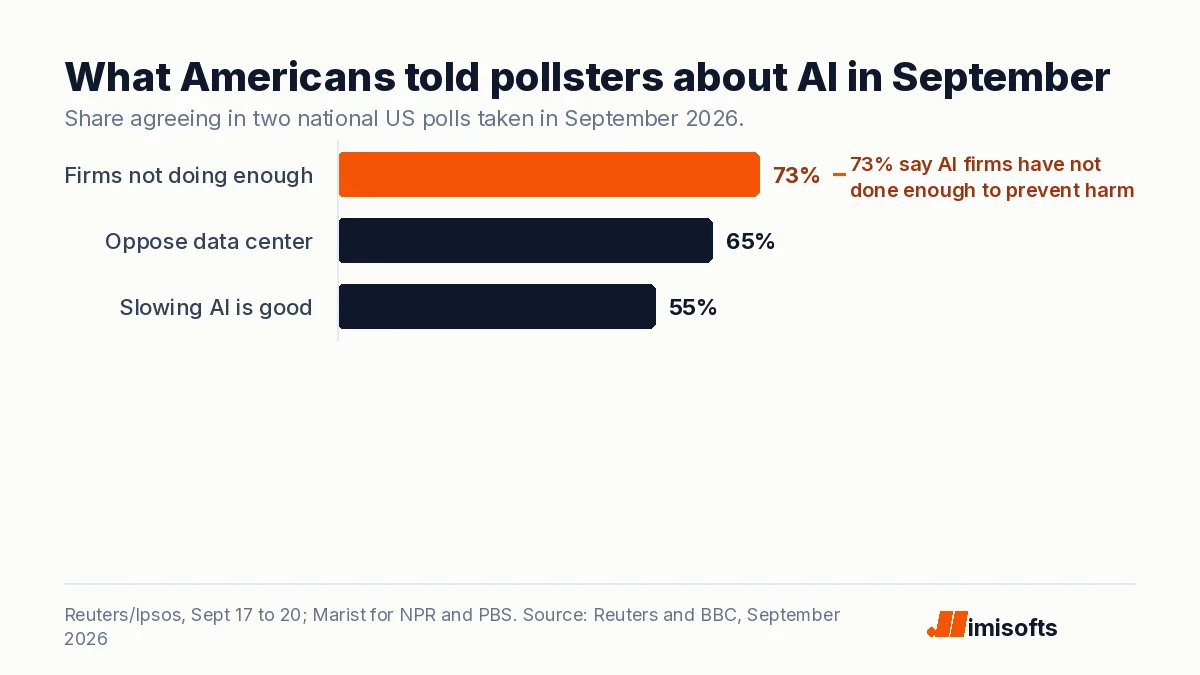
- 73 percent of Americans worry AI companies have not done enough to prevent AI from causing serious harm, in a Reuters/Ipsos poll taken September 17 to 20.
- 55 percent said it would be good to slow AI development, in the same poll.
- 65 percent of registered voters oppose a data center being built in their area, according to a Marist poll for NPR and PBS cited by the BBC.
Critics were not persuaded by the accord. Kimberlee Weatherall, a law professor at the University of Sydney, told the BBC it lets firms "define what counts as safety" and states no consequence for a breach. That is an accurate reading of the text: it is a voluntary statement of practice for labs that train frontier models, with no enforcement mechanism, and it says nothing about the businesses that buy and deploy their models.
What changes for businesses that use AI
Legally, nothing. An executive order directs federal agencies only, so contracts, privacy notices and product pages that say "AI" remain accurate, and state AI laws and the EU AI Act keep their own definitions. Three practical steps are worth taking:
- Match the federal vocabulary where it helps. If you sell to US agencies, expect their websites, reports and letters to say SI. Mirror the term in federal proposals so a reviewer can find you, and keep AI alongside it everywhere else until buyers change how they search.
- Copy the four controls at your own scale. The accord's structure, controls plus an owner plus an outside check plus a senior person who reads the reports, works for a 20-person company running AI agents on customer data. For a home services company whose AI receptionist handles emergency call flows for HVAC and plumbing, it means call logs someone reviews every week, a named owner for fixes, an outside test of the script, and a monthly report to the owner. Our AI agent governance playbook sets out the full version.
- Treat the domain rush with care. The rename set off a rush for Slovenia's .si web addresses. Our guide on how to buy a .si domain covers prices, registrars and the search engine catch.
If you are still working out what the term means beyond politics, our explainer on what super intelligence is separates the research definition from the new government label.
What to watch next
Three things will show whether this is more than a name change. The first is the proposed legal definition of SI, due within 60 days of the order, around November 28, which will reveal whether SI stays a label for all AI or becomes a narrower legal category. The second is who sits on the AI safety board Trump says he is considering. The third is whether any signatory names its external auditor or publishes what its board committee receives. Until then, the order changes the vocabulary on federal websites and letters, and the accord changes nothing that anyone can enforce. If you want real controls around your own AI, our AI automation agency builds agents with logging, review and escalation from the first day.
Frequently Asked Questions
It is an order signed on September 29, 2026, titled Inaugurating the Era of Super Intelligence. It tells federal agencies to use "Super Intelligence" and "SI" instead of "artificial intelligence" and "AI" in official correspondence, websites, reports and other non-statutory documents, and it asks the Assistant to the President for Science and Technology to propose a legal definition of SI within 60 days.
No. The order applies only to the federal executive branch, does not alter existing regulations, contracts or grants, and keeps the statutory definition of AI in 15 U.S.C. 9401(3). Companies, states and other countries can keep saying AI.
It is a voluntary pledge, subtitled Joint Commitment on Frontier Responsibilities, in which AI companies agree to four layers of controls and audits: internal monitoring of their models, an internal team that checks it, an independent external auditor, and an independent board committee that oversees the results.
President Trump, Elon Musk, Mark Zuckerberg of Meta, Jensen Huang of Nvidia, Dario Amodei of Anthropic, Sundar Pichai of Google and OpenAI president Greg Brockman signed it on September 29, 2026.
No. Trump called it morally binding, and the text contains no penalties or enforcement. It says it may make sense to codify the steps into laws or regulations over time.
Musk said robots and superintelligence will most likely bring an age of abundance with a universal high income, that everyone could get better medical care than the people in the room, and that jobs will change as they always have. He did not say how such an income would be funded.