October 3, 2026. There are two standard ways to sort artificial intelligence into types, and almost every "types of AI" explainer mixes them up. The first sorts by capability: narrow AI, general AI and superintelligence. The second sorts by how the system works: reactive machines, limited memory, theory of mind and self-aware AI. Put the two together and you get the honest map of 2026. Everything running in your business, from the spam filter to the phone agent to the model that writes your proposals, is type one on the first scale and type two on the second. The other categories are either research goals, legal definitions written in the last month, or science fiction. This guide defines each type, says which ones exist, gives the test scores that show where the frontier sits today, and ends with what the classification means when you are deciding what to automate.
Key numbers
| Item | Number |
|---|---|
| Capability types of AI (narrow (exists), general (goal), super (hypothetical)) | 3 |
| Functionality types of AI, Hintze 2016 (reactive, limited memory, theory of mind, self-aware) | 4 |
| Type of every production AI system in 2026 (including language models and agents) | Narrow, limited memory |
| Best model score on ARC-AGI-2 (human panel 100) (GPT-6 Astra, read 3 October 2026) | 95.0 percent |
| Best standard-harness score on ARC-AGI-3 (interactive test released in 2026) | 62.7 percent |
| Best model score on ARC-AGI-1 (human panel 98.0) (test published in 2019) | 98.5 percent |
| Bostrom's Superintelligence published (Oxford University Press, 352 pages) | July 3, 2014 |
| Ban Artificial Superintelligence Act introduced (first US bill to define ASI in statute) | September 23, 2026 |
| Executive order renaming AI as Super Intelligence (legal definition of AI unchanged) | September 29, 2026 |
ARC Prize leaderboard, OpenAI charter, Oxford University Press, sanders.senate.gov, whitehouse.gov and The Conversation (Hintze, 2016), all read 3 October 2026.
Two scales, not one list
The capability scale asks how much of human intellectual work a system can do. The functionality scale, proposed in 2016 by the computer scientist Arend Hintze, asks what kind of internal machinery the system has (The Conversation). They are independent. A system can be narrow and reactive, like a chess engine, or narrow with memory, like a language model that remembers your conversation. Listing seven types in a row, as many articles do, hides the fact that four of the seven describe mechanisms and three describe reach. We will take the capability scale first, because it is the one in the news.
Type 1: artificial narrow intelligence
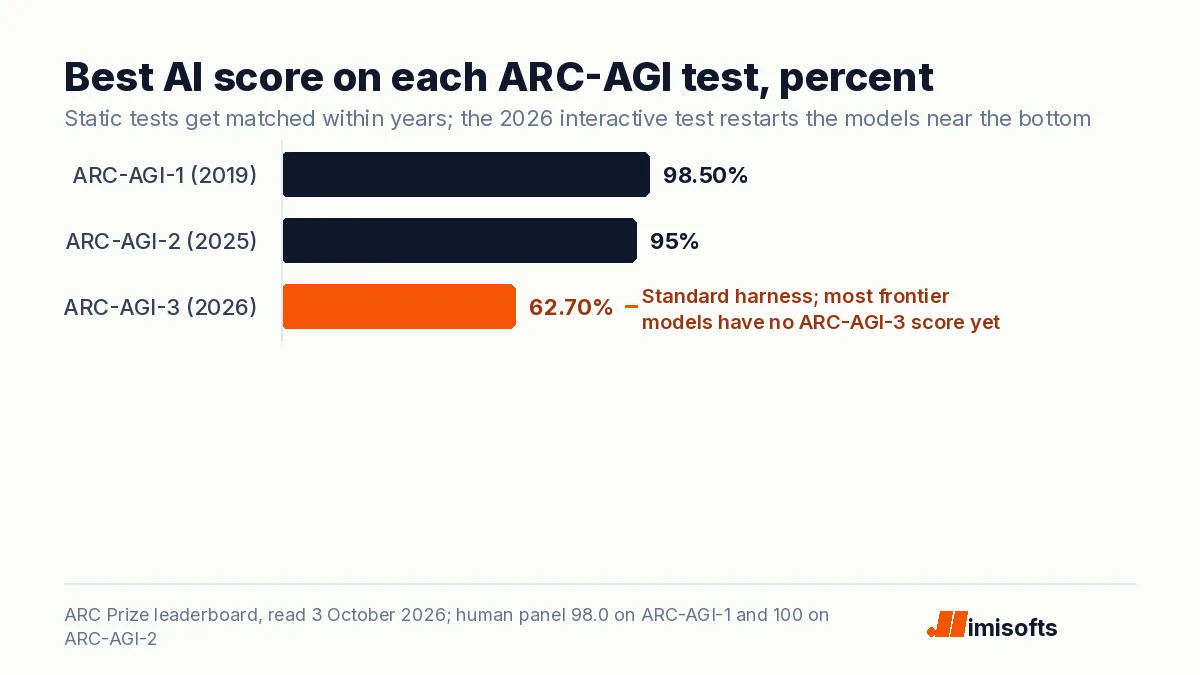
Artificial narrow intelligence (ANI), also called weak AI, is a system that performs a specific task or a bounded set of tasks, with no ability to transfer that skill to an unrelated problem on its own. Spam filters, recommendation engines, fraud detection, speech recognition, image classifiers and route planning are all narrow AI, and so, by the strict definition, are today's large language models. That last claim surprises people, because a model that can draft a contract, debug a program and translate Urdu feels general. It is broad, but it is still narrow in the sense that matters: it does not form its own goals, it does not learn from one task to the next without being retrained, and when it is given an open-ended job in an unfamiliar environment it still fails at rates no competent employee would. On the ARC Prize leaderboard, the best model scores 95.0 percent on ARC-AGI-2, a test of fluid reasoning on which a human panel scores 100, but the best score under the standard setup on ARC-AGI-3, the interactive version released in 2026, is 62.7 percent (ARC Prize leaderboard, read 3 October 2026). Narrow AI with a very wide aperture is the accurate description, and it is also the best news for a business: narrow is what you can scope, test and trust.
Type 2: artificial general intelligence
Artificial general intelligence (AGI) is AI that can do most intellectual work as well as a capable person, across fields, rather than excelling at one. The companies building it do not agree on the line. OpenAI's charter defines AGI as "highly autonomous systems that outperform humans at most economically valuable work" (OpenAI charter). Google DeepMind prefers a grid of levels by performance and generality. Independent benchmarks such as ARC-AGI exist precisely because self-declared definitions are unfalsifiable. No lab claims to have reached AGI by its own definition as of this writing, although OpenAI describes its GPT-6 Astra as having "saturated" ARC-AGI-3 under a setup that preserves the model's reasoning between steps. Our explainer on what AGI is walks through the three competing definitions and why the date keeps moving.
Type 3: artificial superintelligence
Artificial superintelligence (ASI) is intelligence that greatly exceeds the best human minds in virtually every domain. The definition most people use comes from Nick Bostrom's 2014 book, published by Oxford University Press on July 3 of that year: "any intellect that greatly exceeds the cognitive performance of humans in virtually all domains of interest" (OUP). No such system exists. What changed in 2026 is that the term left philosophy and entered law. On September 29, President Trump signed an executive order directing federal agencies to use "Super Intelligence" as the name for all AI, which does not change the legal definition of AI but does change the vocabulary; our report on the Super Intelligence executive order has the text. Six days earlier, on September 23, Senator Bernie Sanders and Representative Greg Casar introduced the Ban Artificial Superintelligence Act, which would define ASI in statute as "an AI that exceeds human cognitive performance and capabilities across most domains, or has sufficient capabilities to destroy or disempower humanity, including by overthrowing the federal government" (Sanders press release). The research meaning is in what super intelligence is.
The functionality scale: four types by mechanism
- Reactive machines. They respond to the present input with no memory of the past. IBM's Deep Blue, which beat Garry Kasparov in 1997, evaluated the board in front of it and nothing else. Most rule-based automation is reactive.
- Limited memory. They use recent history to inform the next decision: a self-driving system tracking the cars around it over the last few seconds, or a language model carrying your conversation and the documents you gave it. Every production AI system in 2026 is in this class, including agents, whose "memory" is a store of past steps they can read back.
- Theory of mind. Systems that model what other agents believe, want and intend, and adjust to it. This is an active research area, and language models imitate it convincingly in text, but no system has it as a reliable working capability. A phone agent that infers a caller is frustrated from word choice is pattern matching on training data, not modelling a mind.
- Self-aware AI. Systems with a model of themselves and, in the strong version, experiences. Nothing of the kind is established. The most careful public position is Anthropic's, which calls the moral status of its own models "deeply uncertain" and runs a research programme on the question; we cover it in is AI conscious.
Where the frontier actually sits
The useful way to place today's systems is on both scales at once. By capability they are narrow with wide coverage. By mechanism they are limited memory with tools attached. The benchmark numbers show both halves. On ARC-AGI-1, the 2019 test, the best models now score 98.5 percent against a human panel's 98.0. On ARC-AGI-2 they score 95.0 against 100. On ARC-AGI-3, where the system has to learn the rules of an unfamiliar interactive environment as it goes, the best standard-harness score is 62.7 percent and most frontier models have no published score at all. The pattern is consistent across three generations of the test: each static benchmark is matched within two to three years of publication, and the next one, built to need something closer to general intelligence, starts the models near the bottom again. That is what narrow intelligence getting broader looks like from the outside.
Which type is actually in your business
All of it is type one, limited memory. That is not a put-down; it is the specification you should buy against. A narrow, limited-memory system does the task it was scoped for, uses the context it was given, and does not notice what it was not told. Three consequences follow for anyone deploying AI in a company of 10 to 200 people.
- Scope is the product. An AI calling agent for home services that answers, qualifies, quotes from a price list and books into a live calendar works because every one of those steps is narrow and checkable. Ask the same system to negotiate a commercial contract and you have left its type.
- Context is the memory. The system knows what is in its context window and its connected tools, nothing more. If your pricing lives in a spreadsheet the agent cannot read, the agent will invent a price. Most "the AI got it wrong" stories in small businesses are context failures, not intelligence failures.
- Judgement is yours. Because there is no theory of mind and no general reasoning you can rely on, the places where a decision affects money or a relationship need a human checkpoint. An AI automation agency earns its fee by placing those checkpoints correctly, not by promising a system that does not need them.
Gartner's finding that many use cases "positioned as agentic today don't require agentic implementations" is the same point from the vendor side (Gartner, June 2025): the more a product is sold as a higher type than it is, the more of the real work falls back on you.
A one-minute type check before you buy
- What exact task does it do, and what happens when the input is outside that task?
- What does it remember between steps, and between sessions, and where is that stored?
- What can it read and what can it change? The second list is the risk list.
- Where does a person review before money moves or a customer is told something binding?
- How is success measured, per task, in a number I can see monthly?
Any vendor whose answers imply a theory-of-mind or general system is describing a type that has not shipped. For what the terms will mean next, see what agentic AI is, which covers the systems that sit at the top of type one today, and the technological singularity, which covers what people expect after type three.
Frequently Asked Questions
Artificial narrow intelligence, which performs a specific task or bounded set of tasks; artificial general intelligence, which can do most intellectual work as well as a capable person across fields; and artificial superintelligence, which greatly exceeds the best humans in virtually every domain. Only the first exists.
Reactive machines, which respond to the current input with no memory; limited memory systems, which use recent history to decide; theory of mind systems, which would model what others believe and want; and self-aware AI. Every production system in 2026, including language models and agents, is limited memory.
By the standard definitions it is narrow AI with very broad coverage. It performs many tasks but does not set its own goals, does not learn from one task to the next without retraining, and still fails at open-ended tasks in unfamiliar environments; the best model scores 62.7 percent under the standard setup on the interactive ARC-AGI-3 test, against 95 percent on the static ARC-AGI-2.
No lab claims to have reached AGI by its own definition. OpenAI's charter defines it as highly autonomous systems that outperform humans at most economically valuable work. Independent tests show frontier models matching humans on static reasoning benchmarks and trailing badly on interactive ones.
Nick Bostrom defined it in his 2014 book as any intellect that greatly exceeds the cognitive performance of humans in virtually all domains of interest. No such system exists. In September 2026 a US bill proposed a legal definition, and an executive order directed federal agencies to call all AI Super Intelligence, without changing the legal definition of AI.
Narrow, limited-memory AI, in every case: phone agents, lead scoring, document extraction, drafting and forecasting tools. The practical rule is that such systems do the task they were scoped for using the context they were given, so scope, connected data and human checkpoints decide whether a deployment works.