October 3, 2026. AGI, artificial general intelligence, means an AI that can do most intellectual work as well as a capable person, across fields, instead of being good at one thing. That is the short answer. The long answer is that the companies building it do not agree on the line. OpenAI's charter defines AGI as "highly autonomous systems that outperform humans at most economically valuable work". Google DeepMind rejects a single line altogether and grades systems on five levels. And on the reasoning tests built to settle the question, the best models now match a human panel on one test and trail it badly on the newest one. For a business, the practical point is that AGI is a destination the labs disagree about, while the AI you can buy today is measured one task at a time.
Key numbers
| Item | Number |
|---|---|
| OpenAI charter definition of AGI (2018 charter) | Outperforms humans at most economically valuable work |
| DeepMind Levels of AGI framework published (performance and generality grades) | November 2023 |
| Best model on ARC-AGI-1 (human panel 98.0 percent) | 98.5 percent |
| Best model on ARC-AGI-2 (human panel 100 percent) | 94.2 percent |
| Best model on ARC-AGI-3 (GPT-6.1 Sol, standard setup) | 52.7 percent |
| Kurzweil's date for human-level AI (first made in 2005, reaffirmed 2024) | Around 2029 |
| Researcher poll median for human-level AI (Bostrom and Muller, 2012 to 2013) | 2040 to 2050 |
| US monthly searches for artificial general intelligence (Google Keyword Planner, read 3 October 2026) | 1M to 10M |
| US monthly searches for super intelligence (same source) | 1K to 10K |
Definitions read on 3 October 2026 from OpenAI's charter and the DeepMind papers; scores from the ARC Prize leaderboard on 1 October 2026; search ranges from Google Keyword Planner on 3 October 2026.
AGI, defined three ways
- OpenAI (2018 charter): highly autonomous systems that outperform humans at most economically valuable work. Note the word "most": by this test, an AI that writes code better than people but cannot run a clinic is not AGI.
- Google DeepMind (2023): its Levels of AGI paper argues that AGI is a spectrum, not a switch. It grades systems on performance (from emerging to superhuman) and generality (narrow or general), and says the useful question is which level a system has reached, not whether it "is" AGI.
- Everyday usage: an AI as capable as a smart, educated adult at any thinking task you hand it, learning new ones as fast as a person would.
Two neighbouring terms cause most of the confusion. Narrow AI, also called ANI, is today's normal AI, built for one job. Superintelligence, or ASI, is the step beyond AGI: an AI that greatly exceeds the best humans in virtually every field. Our explainer on what super intelligence means covers that term and the US government's new habit of calling all AI "SI".
Has AGI been achieved?
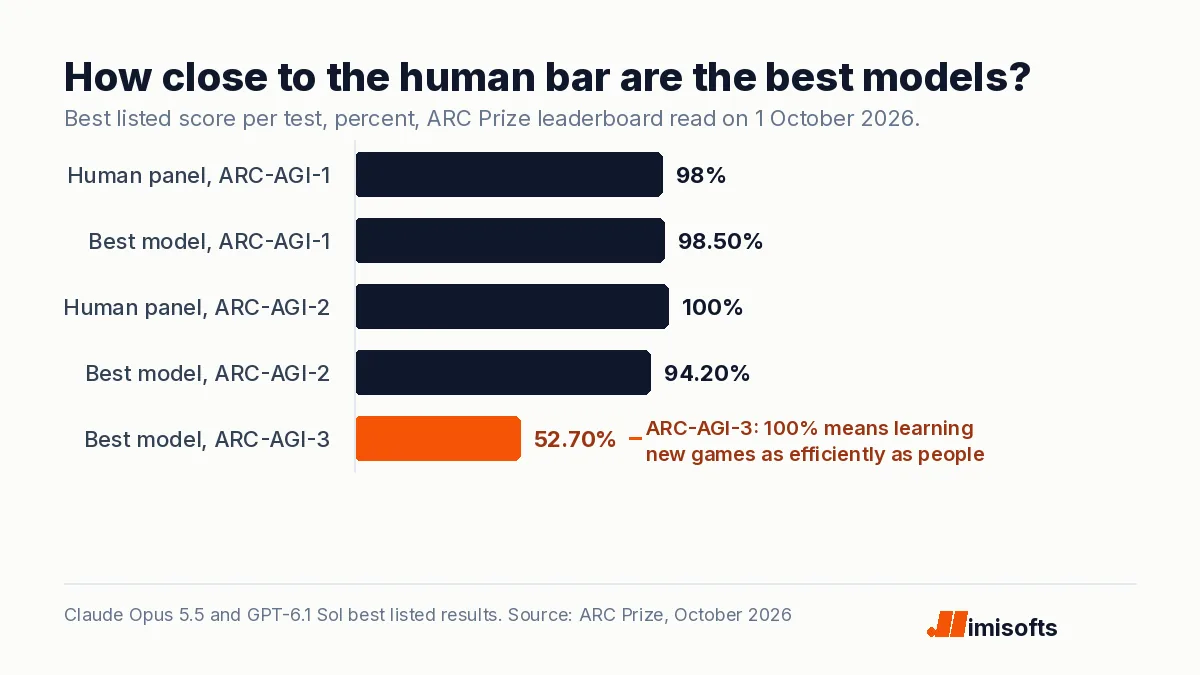
No, by the common definitions, and the evidence sits on the ARC Prize leaderboard, a set of puzzles designed to be easy for people and hard for machines. Read on October 1, 2026:
- ARC-AGI-1: solved. Claude Opus 5.5 scores 98.5 percent against 98.0 percent for ARC Prize's human panel.
- ARC-AGI-2: nearly solved. GPT-6.1 Sol scores 94.2 percent and Claude Opus 5.5 93.3 percent, against 100 percent for the human panel.
- ARC-AGI-3: not close. The newest test uses interactive games where 100 percent means learning each game as efficiently as a human. GPT-6.1 Sol scores 52.7 percent in the standard setup and the best Claude result listed is 30.2 percent.
That pattern is the whole AGI debate in three numbers. Models now beat people on puzzle formats they have seen many of, and still learn genuinely new tasks far less efficiently than a person does. When a benchmark falls, the field builds a harder one, which is why "has AGI been achieved" keeps getting asked and keeps getting answered differently.
When will AGI happen?
Forecasts have compressed sharply, and almost all of the short ones come from people building the technology. The authors of AI 2027 note that the chief executives of OpenAI, Google DeepMind and Anthropic have all predicted AGI within five years. Ray Kurzweil has said human-level AI around 2029 since 2005 and reaffirmed it in 2024, per Wikipedia's summary. Polls of AI researchers run by Nick Bostrom and Vincent Müller in 2012 and 2013 put the median at 2040 to 2050. Anthropic's Dario Amodei wrote in his September 2026 essay We Must Pace the Frontier that AI has been "advancing drastically faster" since the summer, driven by AI's growing ability to help build the next generation of AI, and that he wants to slow down before models reach "critical levels of capability". None of these is a measurement. Treat every date as a forecast by an interested party.
Why the definition matters more than it looks
The word carries money and law. OpenAI's charter commits the company to specific conduct once AGI is reached, so where the line sits changes obligations. DeepMind's June 2026 report From AGI to ASI treats AGI as the starting point and maps four routes to superintelligence: scaling AGI, new AI paradigms, recursive self-improvement and multi-agent collectives. And since September 29, 2026, the US government has its own vocabulary: an executive order tells federal agencies to call all AI "Super Intelligence", a label that skips AGI entirely. Our report on the order and the White House accord explains why the legal definition of AI did not change.
Public interest is far larger for AGI than for the newer term. Google's Keyword Planner, read on October 3, 2026, puts US searches for "artificial general intelligence" at 1 million to 10 million a month, against 1,000 to 10,000 for "super intelligence". Searches for "has AGI been achieved" are up about 900 percent year on year.
What AGI talk means for your business right now
Nothing you can buy today is AGI, and nothing you deploy should depend on it arriving. Three rules hold whatever the timeline:
- Buy tasks, not intelligence. Price an AI system by what it finishes per dollar. Our guide to what an AI agent costs to run shows how.
- Keep the narrow jobs narrow. An AI receptionist that answers emergency calls for a plumbing firm is narrow AI doing one job well, and it works because the job is bounded.
- Design for model swaps. The leaderboard leader changed twice in September. Systems built with logging, review steps and a replaceable model survive that; ones built around a single vendor do not. That is how our AI automation agency builds them.
If a vendor tells you its product "is AGI", ask which definition, and ask for the ARC-AGI-3 score.
Frequently Asked Questions
AGI, or artificial general intelligence, is an AI that can do most intellectual work as well as a capable person across many fields, rather than being good at one task. OpenAI's charter defines it as highly autonomous systems that outperform humans at most economically valuable work.
Not by the common definitions. On the ARC Prize tests read on October 1, 2026, the best models match a human panel on ARC-AGI-1 and nearly match it on ARC-AGI-2, but the best scores on ARC-AGI-3, which measures how efficiently an AI learns new games, are 52.7 percent for GPT-6.1 Sol and 30.2 percent for Claude.
AGI matches a capable human across most tasks. ASI, artificial superintelligence, greatly exceeds the best humans in virtually all fields. DeepMind's June 2026 report From AGI to ASI describes four routes from one to the other.
Nobody knows. The chief executives of OpenAI, Google DeepMind and Anthropic have all predicted AGI within five years, Ray Kurzweil says around 2029, and 2012 to 2013 polls of researchers put the median at 2040 to 2050. All are forecasts, not measurements.
No. Since September 29, 2026, the US federal government uses Super Intelligence, or SI, as its name for all AI, with the same legal definition AI had before. AGI is a specific capability level that no current system has reached.