What did the TRACED Act change for a business that makes calls? Public Law 116-105, signed on 30 December 2019, lets the FCC propose a robocall fine without a warning first, adds up to $10,000 when the FCC finds a robocall violation was intentional, and gives the FCC 4 years to act on those, against 1 year for other robocall violations. It also brought STIR/SHAKEN, blocking rules with redress for callers, and limits on exempt prerecorded calls (texts read on 19 November 2026).
My view: FCC fines are the smaller part. The FCC’s own report says neither it nor the Attorney General collected any section 227 forfeiture or criminal fine in 2024. Much of the rest reaches a sales team through its carriers; the private $500 claim in section 227(b)(3) is a separate risk.
In my view, the TRACED Act moved robocall policing into the phone network: carriers authenticate your calls, may block them and, under an FCC rule, must fully respond to a traceback request within 24 hours of receipt.
Key numbers
| Item | Number |
|---|---|
| TRACED Act signed (Public Law 116-105) | 30 December 2019 |
| FCC add-on for an intentional robocall violation ($12,266 after the 2025 inflation adjustment, 47 CFR 1.80(b)(5); section 227(b)) | Up to $10,000 |
| FCC window, intentional robocall violation (1 year for other section 227(b) forfeitures) | 4 years |
| FCC window, caller ID forfeiture under section 227(e) (2 years before the Act) | 4 years |
| STIR/SHAKEN deadline in IP networks, set by the FCC (extensions for some providers) | 30 June 2021 |
| Exempt prerecorded calls to a residential line (non-commercial; commercial with no advertisement or telemarketing; tax-exempt nonprofit; opt-outs honored) | 3 in any 30 days |
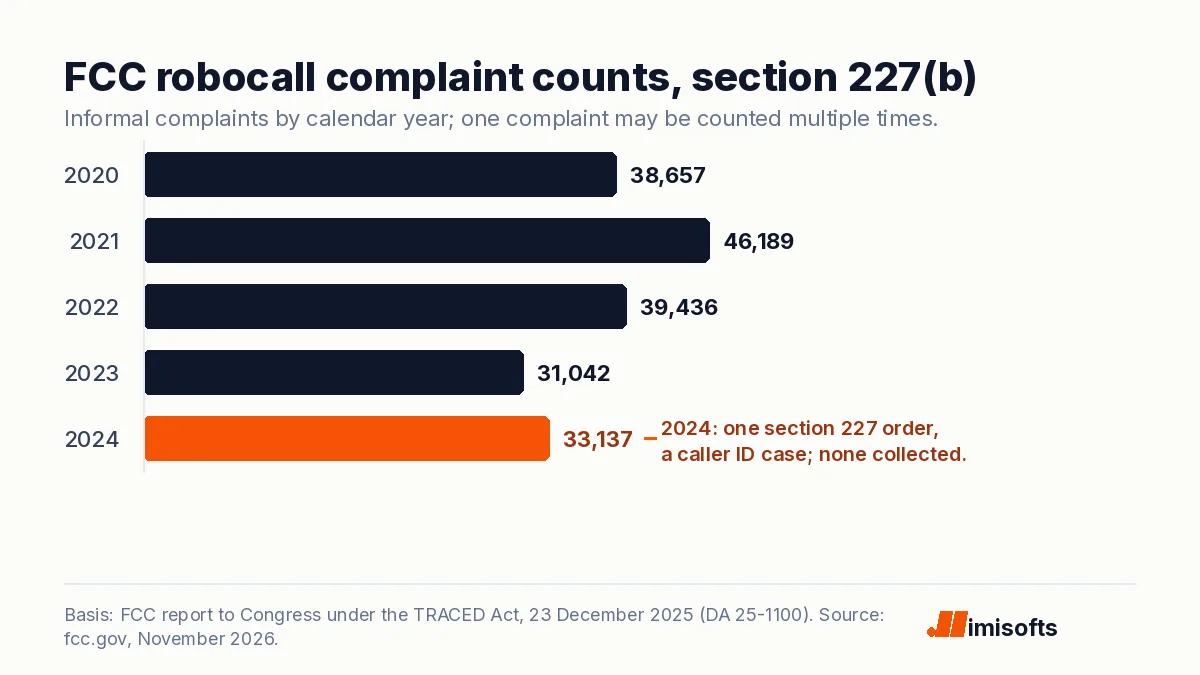
| Section 227(b) complaint counts to the FCC, 2024 (one complaint may be counted multiple times) | 33,137 |
| FCC forfeiture orders under section 227, 2024 (Steve Kramer, $6,000,000, a caller ID case under section 227(e)) | 1 |
| Section 227 forfeitures or criminal fines collected, 2024 (by the FCC or the Attorney General) | $0 |
| Referrals to DOJ for failure to pay, listed in the report (some name several parties; 10 August 2018 to 3 December 2024) | 10 |
| Voice provider traceback response, from receipt (47 CFR 64.1200(n)(1); the clock does not start outside business hours) | 24 hours |
| Completed ITG tracebacks ending in a warning or termination (2024: an originating provider warned or terminated the caller; 84% in 2023) | 69% |
Read on 19 November 2026 from Public Law 116-105 on govinfo.gov, 47 U.S.C. 227 on Cornell LII, 47 CFR 1.80 and 64.1200 on eCFR (up to date as of 17 November 2026), the FCC’s TRACED Act report to Congress of 23 December 2025 (DA 25-1100), FCC public notice DA 26-257 and the FCC’s TRACED Act Implementation page. Traceback figures are the Industry Traceback Group’s, as reported by the FCC.
The five sections, and who they reach first
On my reading, five of the Act’s 15 sections matter most to a business that places calls. I do not cover the other ten, which include a report on the Reassigned Numbers Database.
| Section | What changed | Who it reaches first (my reading) |
|---|---|---|
| 3, forfeiture | No prior citation; up to $10,000 more for intentional robocall violations; 4-year windows; a yearly report | Callers |
| 4, call authentication | STIR/SHAKEN in IP networks; the FCC set 30 June 2021 | Voice providers |
| 8, exemptions | Limits on exempt calls, including how many | Callers |
| 10, stop robocalls | Blocking with “transparency and effective redress options” for consumers and callers | Blocking services and voice providers |
| 13, annual robocall report | One registered traceback consortium, reported on yearly | The FCC and voice providers |
“The TRACED Act is about fines, so our risk is an FCC fine.” (illustrative)
The FCC reported one forfeiture order under section 227 for 2024.
My suggestion: read most of it as rules for the companies that carry your calls, then ask what they do with them.
Authentication, blocking and traceback run through voice providers and blocking services.
No-warning FCC fines, and what was collected in 2024
Section 3, in the FCC’s words, “removed the requirement that the Commission issue a citation, or warning” before proposing a fine under section 227(b); for section 227(e), the caller ID provision, the FCC says the Act codified that no citation is required. A person who commits a robocall violation “with the intent to cause such violation” can be held liable for “an additional penalty not to exceed $10,000”, now $12,266 after the 2025 inflation adjustment in 47 CFR 1.80(b)(5), and the FCC has 4 years to issue its notice, against 1 year for other section 227(b) forfeitures. The FCC’s window for caller ID forfeitures went from 2 years to 4. Our TCPA fines guide has the rest.
The FCC’s report to Congress of 23 December 2025 covers 2024. To enforce sections 227(b) through (e), the FCC issued one Notice of Apparent Liability, proposing $6,000,000 against Steve Kramer under the caller ID law, and one forfeiture order imposing it. Then: “In 2024, neither the Commission nor the Attorney General collected forfeiture penalties or criminal fines for violations of section 227.” The report lists 10 referrals to the Department of Justice for failure to pay, some naming several parties, from 10 August 2018 to Kramer’s on 3 December 2024.
Section 227(b) complaint counts by year; the report warns that one complaint “may be counted multiple times” across sections:
| Year | 227(b) robocall complaint counts |
|---|---|
| 2020 | 38,657 |
| 2021 | 46,189 |
| 2022 | 39,436 |
| 2023 | 31,042 |
| 2024 | 33,137 |
The changes that run through your carrier
Section 4 told the FCC to require STIR/SHAKEN in IP networks within 18 months; the FCC set 30 June 2021, with extensions for some, including small phone companies with 100,000 or fewer customers. Our STIR/SHAKEN attestation guide covers how calls are graded. Providers face enforcement too: in 2024 the FCC proposed $2,000,000 against Lingo Telecom under its caller ID authentication rules over Kramer’s spoofed calls, a case outside the report’s section 227 counts; the Enforcement Bureau later entered into a consent decree with Lingo.
Section 10 had the FCC ensure blocking comes with “no additional charge to callers” for resolving erroneous-block complaints. Under 47 CFR 64.1200(k)(8), a terminating provider that blocks must offer a single point of contact for blocking error complaints, promptly stop the call treatment once it finds the calls should not have been blocked, and charge nothing for good-faith complaints. Under (k)(9), one that blocks based on analytics must immediately return a code to the origination point: SIP code 603+ on IP networks, ISUP code 21 otherwise. Spam labels are another matter: why a business number shows as spam.
Traceback: a 24-hour clock on your provider
Section 13 had the FCC register a single traceback consortium: the Industry Traceback Group, an industry group of providers. Under 47 CFR 64.1200(n)(1), a voice provider must “fully respond to the traceback request within 24 hours of receipt”, on a clock that does not start outside business hours. In 2024 the Industry Traceback Group initiated 3,606 tracebacks of suspected unlawful robocalls, the FCC reports from the group’s own status letter, and 69% of completed tracebacks “resulted in an originating provider warning or terminating the caller”, down from 84% in 2023.
My view: plan for a warning from your own carrier before you plan for an FCC fine.
Exempt prerecorded calls now have a counter
Section 8 had the FCC put limits, including “the number of such calls”, on exemptions under section 227(b)(2)(B) and (C). Under 47 CFR 64.1200(a)(3), an artificial or prerecorded voice call to a residential line needs no consent if it is non-commercial, commercial with no advertisement or telemarketing, or from a tax-exempt nonprofit, but only if the caller “makes no more than three calls within any consecutive 30-day period” and honors opt-outs. Health care messages under HIPAA: one call a day and three a week, combined, per patient’s residential line. A call that includes or introduces an advertisement or constitutes telemarketing needs prior express written consent.
The report says a February 2024 ruling confirmed that “artificial or prerecorded voice” covers “current AI technologies that generate human voices”. On my reading, an AI voice agent calling home lines without consent must be making an emergency call, or fit one of these exemptions and stay within its limit.
What I would do this week
Ask your carrier two questions
My suggestion: what attestation your calls receive, and who handles traceback requests about your traffic.
Log SIP response codes
My suggestion: ask your provider to pass response codes through, then store the code for every failed call; 603+ is the code the FCC’s blocking rule names.
Count exempt calls per line
If you rely on an exemption for prerecorded or AI voice calls to home lines, my suggestion: track every number against its limit (three in any 30 days, or the HIPAA limit).
Keep proof of consent
On my reading, the Act did not amend the text of section 227(b)(3), the $500 private claim. My suggestion: store consent per number.
My team’s record: 500+ projects delivered across 30 countries. Our pages on AI calling built around TCPA consent and AI calling for home services describe what we build; whether a call is lawful is for you and your lawyer. Comparing tools? See our AI voice agent comparison and our guide to AI answering services for HVAC.
The bottom line
In 2024 neither the FCC nor the Attorney General collected a section 227 forfeiture or criminal fine. In my view, a sales team feels the Act through carriers (attestation, blocking codes, traceback) and directly through the three-call cap on exempt prerecorded calls. This is general information, not legal advice.