Short answer. A TPS check means screening every number on a UK marketing call list against the Telephone Preference Service (and, for companies, the Corporate TPS) at least once every 28 days, then dropping the registered numbers unless that person told you they do not object to your calls. The official TPS licence price list (read November 25, 2026) charges £300 plus VAT for one full ad-hoc download, valid for 28 days, or £2,200 plus VAT for a full annual licence. Registering your own number is free.
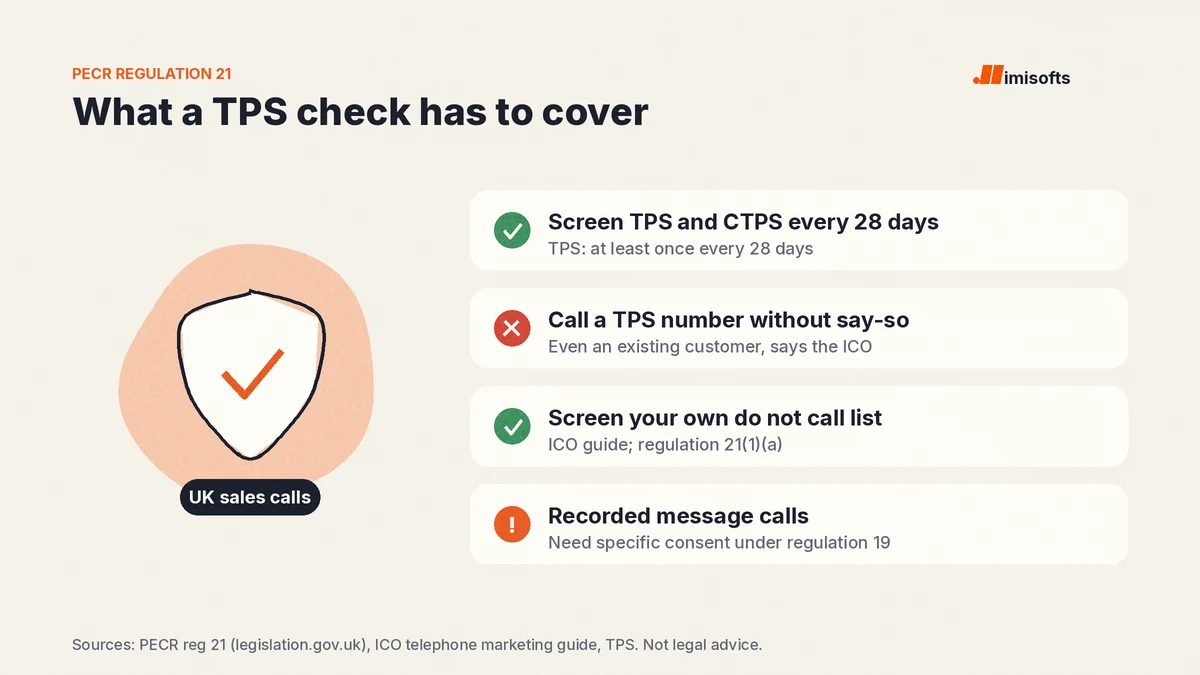
The rule sits in regulation 21 of the Privacy and Electronic Communications Regulations (PECR), and the Information Commissioner's Office (ICO) enforces it. Under the Data (Use and Access) Act, the ICO said on February 5, 2026 that it can fine up to £17.5 million or 4% of global turnover under PECR. If you run outbound calls from the US into the UK, or with an AI caller, see how we build compliance-first AI calling before the first dial.
Key numbers
| Item | Number |
|---|---|
| Screening frequency (TPS) | at least every 28 days |
| Full ad-hoc TPS licence (one download, valid 28 days) | £300 + VAT (£360) |
| Full annual TPS licence (daily-updated file) | £2,200 + VAT (£2,640) |
| Partial ad-hoc licence, 1% of file (by area code) | £30 + VAT (£36) |
| Ad-hoc downloads to cover a year (our arithmetic) | 14 (£4,200 + VAT) |
| Annual licence cheaper from (our arithmetic) | 8 downloads a year |
| Maximum PECR fine (ICO statement, Feb 5, 2026) | £17.5m or 4% of turnover |
| Bluon Energy fine (194,379 TPS calls, ICO Nov 4, 2026) | £105,000 |
| Elderly Aids fine (758,053 TPS calls, ICO Aug 27, 2026) | £190,000 |
TPS price list and TPS public site; PECR regulation 21 (legislation.gov.uk); ICO telephone marketing guide; ICO releases of Feb 5, Aug 27 and Nov 4, 2026. Read November 25, 2026.
What a TPS check is and who needs one
The TPS describes itself as "the UK's only official 'Do Not Call' register" for landlines and mobiles. People and businesses add their numbers to opt out of unsolicited live sales and marketing calls. The TPS site states that "Organisations are required to screen against TPS/CTPS at least once every 28 days".
Two registers matter:
- TPS holds consumers, plus sole traders and partnerships, except partnerships in Scotland, as the TPS corporate site puts it.
- CTPS (Corporate TPS) holds limited companies, PLCs and LLPs, any partnership in Scotland, schools, hospitals, government departments and other public bodies, per the CTPS registration page.
The ICO says you "will need to screen most call lists" for live marketing calls to UK numbers, whether the calls come from an in-house team, an agency or a dialler. The ICO's telephone marketing guide says the ban on calling a registered number applies "even if they are an existing customer", unless that person has specifically consented to your calls. The ICO notes that guide is under review after the Data (Use and Access) Act.
How to check or register your own number
If you want to stop sales calls to your own phone, registration is free. On the TPS home page you can register online, or text "TPS" and your email address to 85095 from a mobile at no charge. The TPS register page says it is "a legal requirement for organisations not to call a TPS registered number after 28 days", so allow four weeks before you judge whether it worked.
- A TPS registration does not need renewing.
- A CTPS registration is renewed every year, after an email reminder that asks you to confirm the numbers.
- For a bulk CTPS registration, email [email protected] using the TPS template.
We found no single-number lookup tool among the pages linked from the TPS public site when we checked on November 25, 2026. For a business, a TPS check is done through a TPS licence or through a third-party screening service.
TPS licence cost: the official price list
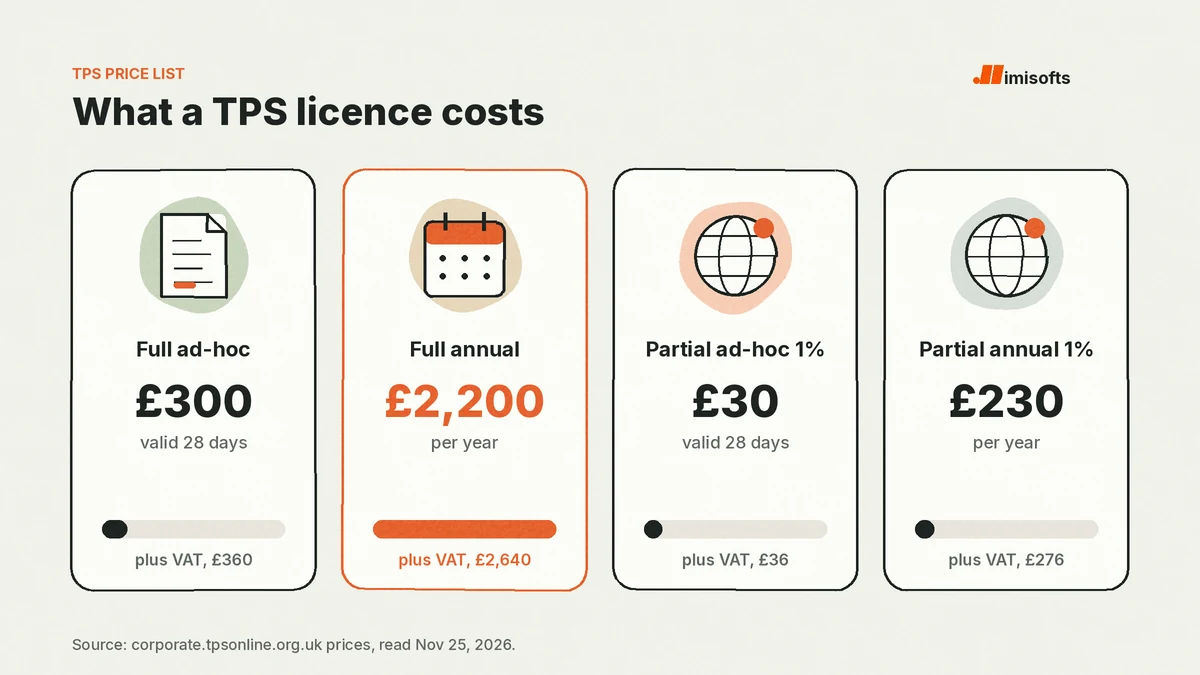
The TPS sells its data file directly. An annual licence gives "unlimited access to the full TPS data file", updated daily, by website download. An ad-hoc licence is "a single website download" that is valid for 28 days. Partial licences cover only the area codes you name: the TPS works out your share of all registrations from your list of STD codes (for example 020 for London) and prices it as a percentage.
| Licence | Price | VAT | Total |
|---|---|---|---|
| Full annual | £2,200 | £440 | £2,640 |
| Partial annual 50% | £1,920 | £384 | £2,304 |
| Partial annual 25% | £880 | £176 | £1,056 |
| Partial annual 5% | £340 | £68 | £408 |
| Partial annual 1% | £230 | £46 | £276 |
| Full ad-hoc (28 days) | £300 | £60 | £360 |
| Partial ad-hoc 50% | £230 | £46 | £276 |
| Partial ad-hoc 25% | £220 | £44 | £264 |
| Partial ad-hoc 5% | £50 | £10 | £60 |
| Partial ad-hoc 1% | £30 | £6 | £36 |
Source: TPS price list, read November 25, 2026. Prices are in pounds because the register is UK only. The price list we read covers the TPS file; it does not show a separate CTPS price, so ask the TPS what a CTPS licence costs before you budget a B2B campaign.
Third-party screening services also sell TPS and CTPS screening, by file upload or API. We did not verify their terms or prices, so they are not in the table.
Annual or ad-hoc: which licence is cheaper
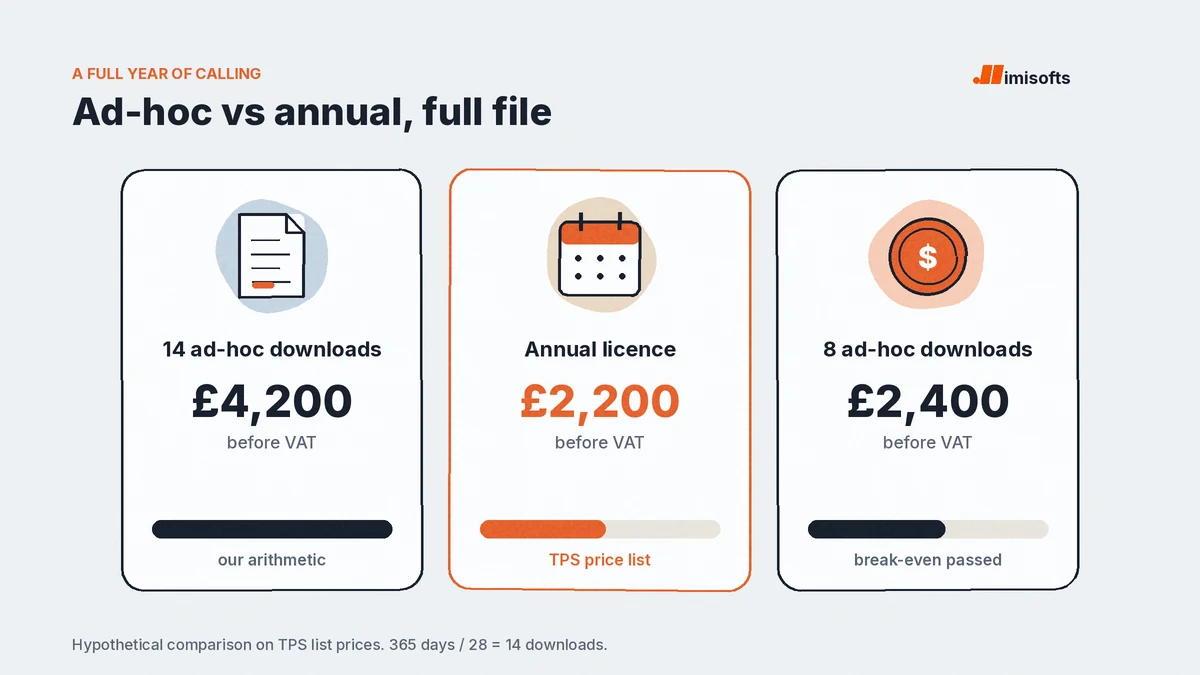
Because an ad-hoc download is valid for 28 days, the choice depends on how many months you call. Our arithmetic on the official prices:
- Calling all year. 365 days need 14 ad-hoc downloads to keep a list no older than 28 days. That is 14 x £300 = £4,200 plus VAT, against £2,200 plus VAT for the annual licence.
- Break-even. £2,200 / £300 = 7.33, so from 8 downloads a year the annual licence is cheaper (8 x £300 = £2,400).
- A one-region campaign. At 1% of the file, the ad-hoc download is £30 and the annual licence £230. The break-even is again 8 downloads a year (8 x £30 = £240).
We would pick ad-hoc for a single campaign of up to about six months, and the annual licence for a team that calls every month. This is a hypothetical comparison on list prices; the TPS corporate site adds that if a campaign is short or targets specific parts of the country, "prices may be reduced".
B2B calls: screen against both registers
Calling businesses does not remove the check. The ICO says: "For business-to-business (B2B) calls, you will therefore need to screen against both the TPS and the CTPS registers, as well as your own 'do not call' list." The reason is that sole traders and some partnerships sit on the TPS, while companies sit on the CTPS.
The same law has three more parts that screening does not cover:
- Your own do not call list. Regulation 21(1)(a) bars calls to a line whose subscriber has told you not to call, registered or not, and the ICO says to keep and screen your own list.
- Consent wins over the register. Under regulation 21(4), a registered person who has told you they do not object to your calls can be called by you, until they withdraw it (21(5)).
- Automated calls are stricter. The ICO says recorded message calls under regulation 19 need specific consent, so a clean TPS check does not make them lawful.
Every call must also not hide your number, or must show a number you can be reached on (regulation 21(A1)), and the caller must say who is calling. If you use a dialler, read our guide to predictive dialler rules in the UK, and for the wider picture see cold calling laws in the UK.
How to run a TPS check, step by step
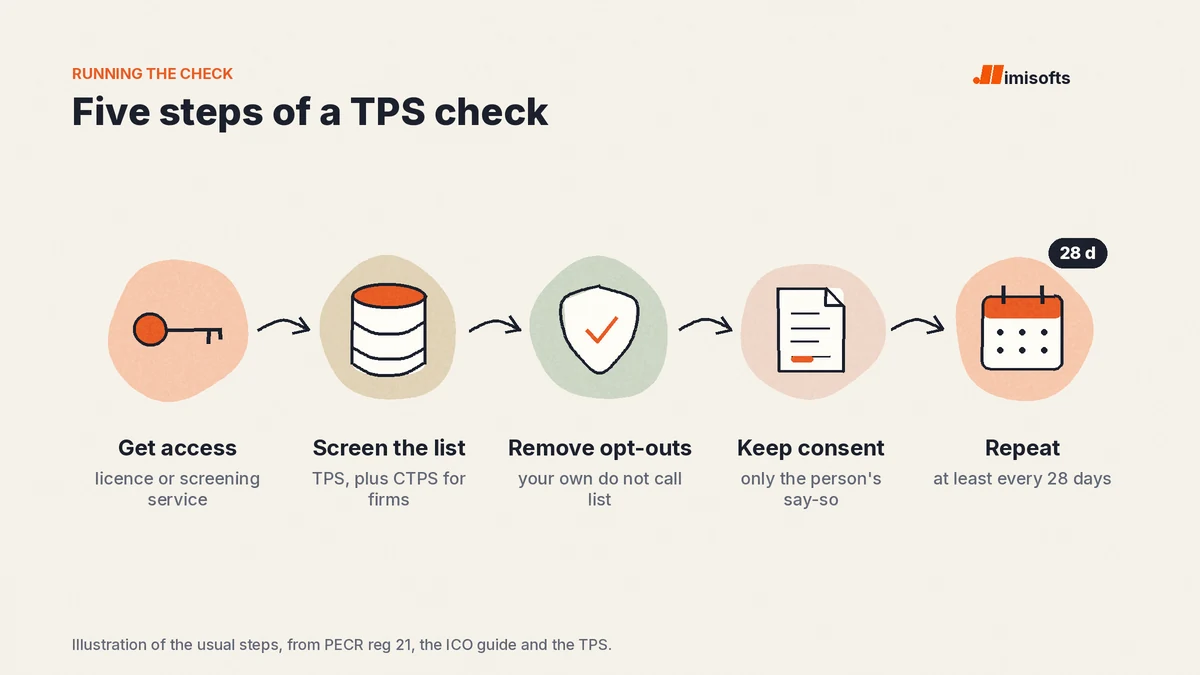
- Get access. Buy a TPS licence (and ask about CTPS for B2B), or use a third-party screening service.
- Screen the list. Remove every number on the TPS, plus the CTPS for company numbers.
- Remove your own opt-outs. Screen against your internal do not call list too.
- Keep consent records. Only call a registered number back in if you hold that person's own statement that they do not object to your calls.
- Repeat within 28 days. Rescreen at least every 28 days while the campaign runs, and keep a dated record of each screen.
The 28-day window mirrors regulation 21(3), which says a caller has not broken the rule where the number has been on the register "for less than 28 days" before the call. For the US version of the same job, see our guide to DNC scrubbing. Bought data does not change the duty: in the Bluon Energy case below, the ICO found the company "bought leads from third-party data suppliers without checking that people had consented to being called".
What happens if you skip it: recent ICO fines
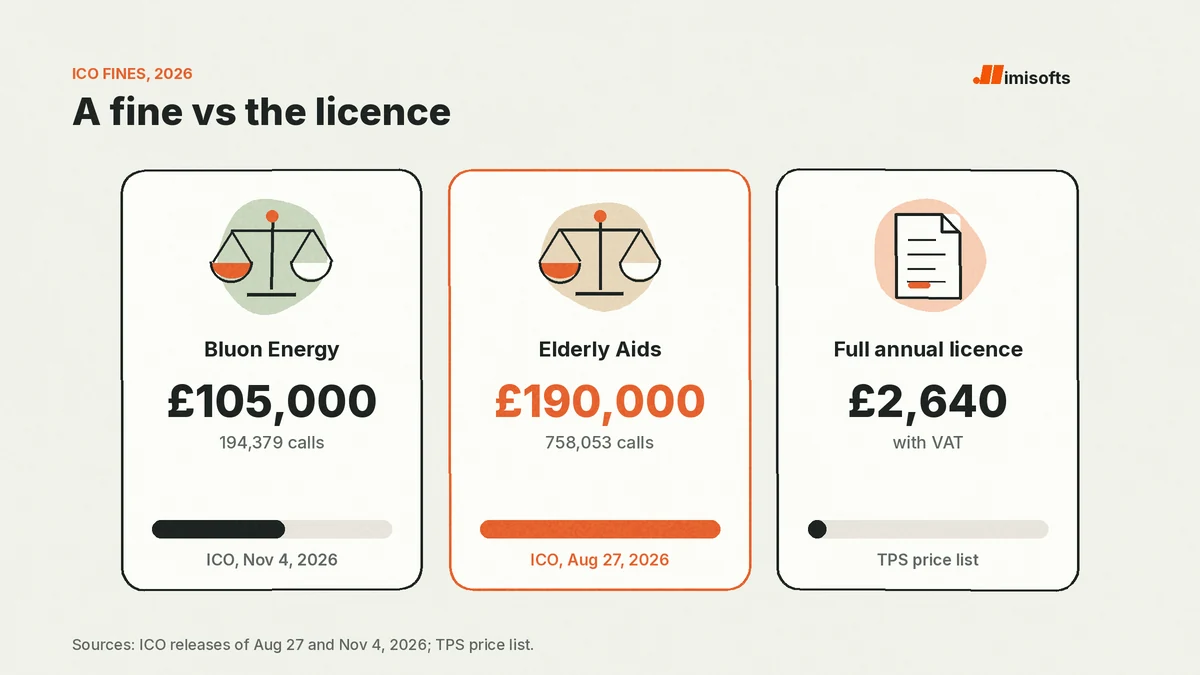
The TPS does not enforce; it passes complaints to the ICO, which has overseen the TPS since December 2016. Two 2026 cases show the scale:
| Case (ICO release) | Calls to TPS numbers | Fine | Fine per call (our arithmetic) |
|---|---|---|---|
| Bluon Energy Ltd, November 4, 2026 | 194,379 (April 2024 to April 2025) | £105,000 | about £0.54 |
| Elderly Aids Ltd, August 27, 2026 | 758,053 (May 2024 to February 2025) | £190,000 | about £0.25 |
Either fine is many times the £2,640 a full annual licence costs with VAT. The ICO also issued an enforcement notice in the Elderly Aids case. The ceiling is high: the ICO's statement of February 5, 2026 confirms fines "of up to £17.5 million or 4% of global turnover" under PECR. This is general information, not legal advice.
Other countries run their own registers and rules; for one example, see our page on cold calling laws in South Africa
How imisofts can help
imisofts sets up outbound calling, including AI voice agents, for sales teams. If you plan a UK campaign, we can scope list screening, opt-out capture and caller ID into the setup with you. If you are weighing an outside team instead, our guide to B2B telemarketing services cost shows what agencies charge. To plan a UK campaign with the TPS check built in, talk to us about AI calling set up for consent and screening.
Frequently Asked Questions
Screen your call list against the TPS (and the CTPS for company numbers) with a TPS licence or a third-party screening service, drop registered numbers unless the person told you they do not object to your calls, and repeat at least every 28 days.
On the official price list read November 25, 2026: £300 plus VAT (£360) for a full ad-hoc download valid 28 days, or £2,200 plus VAT (£2,640) for a full annual licence. Partial licences by area code start at £30 plus VAT ad-hoc and £230 plus VAT a year.
At least once every 28 days, as the TPS states. Regulation 21(3) of PECR gives callers 28 days from the date a number is registered before a call to it breaks the rule.
Yes. The ICO says B2B callers must screen against both the TPS and the CTPS, because sole traders and some partnerships sit on the TPS and companies sit on the CTPS, plus your own do not call list.
Only if that customer has told you they do not object to your calls. The ICO says the ban applies even if they are an existing customer, and regulation 21(4) allows the call once they have told you so.
The ICO said on February 5, 2026 that under the Data (Use and Access) Act it can fine up to £17.5 million or 4% of global turnover under PECR. In 2026 it fined Bluon Energy £105,000 for 194,379 calls and Elderly Aids £190,000 for 758,053 calls to TPS numbers.