Is there a 3% abandoned call rule for predictive diallers in the UK? Not in Ofcom’s current policy. Its persistent misuse statement, in force since 1 March 2017, deliberately names no specific abandoned call rate, says the old 3% figure was never a safe harbour, and says silent calls are likely to be its highest priority. The maximum penalty for persistent misuse is £2 million (sources read on 25 November 2026).
My view: the common mistake is tuning a dialler to a number Ofcom took out of its policy in 2016, and treating 2.9% as safe. Ofcom says a rate under 3% is not a safe harbour.
In my view, the UK has no safe abandoned call rate to aim for. Aim for no silent calls, and keep records that prove it.
Key numbers
| Item | Number |
|---|---|
| Safe abandoned call rate in Ofcom’s current policy (no specific rate, whether three per cent or a different rate) | None |
| Ofcom persistent misuse statement in force from | 1 March 2017 |
| Maximum penalty for persistent misuse (Communications Act 2003 s.130(4)) | £2,000,000 |
| Repeat-call window Ofcom is likely to treat as aggravating (unless a live agent is guaranteed) | 72 hours |
| Ofcom expects the information message within (of pick-up, or of the person speaking where voice recognition is used) | 2 seconds |
| Ring time likely to face enforcement (ended by the caller unless answered; or ringing for extended periods) | Under 15 seconds |
| Call records Ofcom expects you to keep (at least) | 6 months |
| Ofcom worked example: abandoned call rate (3.96 abandoned to people, 392 live calls) | 1.00% |
| Ofcom enforcement programme on these calls (closed; action still possible) | 2006 to 2023 |
| Ofcom refresher on silent and abandoned calls | 22 January 2026 |
| TalkTalk penalty for persistent misuse (calls between 1 February and 21 March 2011) | £750,000 |
Read on 25 November 2026 from Ofcom’s persistent misuse statement (2016), Ofcom’s refresher of 22 January 2026, sections 128 and 130 of the Communications Act 2003 on legislation.gov.uk and Ofcom’s TalkTalk penalty notification.
Where the 3% figure came from
The figure was set out in Ofcom’s 2010 policy. When Ofcom reviewed it, the statement it published explains what went wrong: the 3% rate “was intended to be a criterion for prioritising cases for enforcement action”, but “It appeared to have created a view that abandoned calls below that level were lawful or acceptable and would not face action.” Its answer: “We cannot create safe harbours allowing a certain amount of that conduct”, and the view that 3% created one “is incorrect.”
Ofcom had consulted on treating a rate of 3% or more as a higher priority, and on treating misuse as persistent once it happened three times. Respondents warned that the three-times rule “would effectively ban the use of predictive dialling technology”, and Ofcom dropped it. On the rate, the final statement went the other way too: “We have not included as a prioritisation criterion in the revised policy a reference to a specific abandoned call rate”, with a footnote that reads “Whether three per cent or a different rate.” For the US rules, see our page on the TCPA abandonment rate.
Silent calls and abandoned calls
The law behind all of this is section 128 of the Communications Act 2003: misuse is use whose effect or likely effect is to cause another person “unnecessarily to suffer annoyance, inconvenience or anxiety”, and it is persistent when repeated enough to show “a pattern of behaviour or practice” or recklessness. Ofcom then separates two kinds of call.
A silent call is one where the person answers and hears nothing, is cut off “as soon as or shortly after they pick up”, or hears only background noise, with no information message. Ofcom says these usually result from automated calling systems, and may occur when the system has “over-dialled”; it adds that answer machine detection (AMD) “may generate silent calls by mistaking a call recipient for an answer machine and disconnecting the call.” An abandoned call is one where the person was meant to reach a live agent but got a recorded message instead. Ofcom calls silent calls misuse “wherever they are caused by something within the calling party’s responsibility or control.”
“We are under 3% per campaign, so we are compliant.” (illustrative)
Ofcom’s 2016 statement says the 3% rate was a prioritisation criterion, never a safe harbour, and the current policy names no rate.
My suggestion: zero silent calls, a fast information message, and the call records to show both.
Ofcom says action on silent calls is likely to be its highest priority; persistent abandoned calls are “also likely generally to be a priority”.
What Ofcom weighs when it picks a case
These are the case-selection factors in the statement that a dialler team controls:
| Factor | What the 2016 statement says | Paragraph |
|---|---|---|
| Silent calls | Likely to be Ofcom’s highest priority | A2.3 |
| Repeat calls | Repeats within 72 hours of a first misused call, without a guaranteed live agent, likely aggravating | A2.9 |
| Ring time | Ended by the caller in under 15 seconds (unless answered), or left ringing for extended periods, likely to face enforcement | A2.15 |
| Information message | Within two seconds; identifies the party on whose behalf the call was made, gives a basic rate number to opt out, no marketing | A2.17, A2.19 |
| Caller ID (CLI) | Withholding it usually aggravates the harm | A2.13 |
| Outsourced call centres | Reasonable steps to monitor them, beyond assurances or contract terms | A2.22 |
| Records | Kept for at least six months; where ACS or AMD is used, Ofcom is likely to require detailed call records and evidence of AMD accuracy | A2.23, A2.24 |
On the message, the two-second clock starts when the phone is picked up, or, where the message depends on voice recognition, when the person called begins to speak. Ofcom also warns that playing a message “does not prevent persistent misuse occurring.” And the records point has teeth: where records are missing but there are reasonable grounds to suspect misuse, Ofcom says it “is highly likely to take action” and may weigh the gap when it sets the penalty. Our page on UK cold calling laws covers the separate TPS and CTPS screening rules.
Under section 130, penalties go up to £2,000,000, at an amount Ofcom finds “appropriate” and “proportionate to the misuse”, after a section 128 notification and a chance to respond. The TalkTalk notification shows the shape of a case: a £750,000 penalty for persistent misuse between 1 February and 21 March 2011, with two third parties, Teleperformance Limited and McAlpine Marketing Limited, also making representations. Ofcom’s refresher of 22 January 2026 says its enforcement programme on these calls ran from 2006 to 2023 and that closing it “does not preclude it from taking enforcement action”.
How Ofcom counts the abandoned call rate
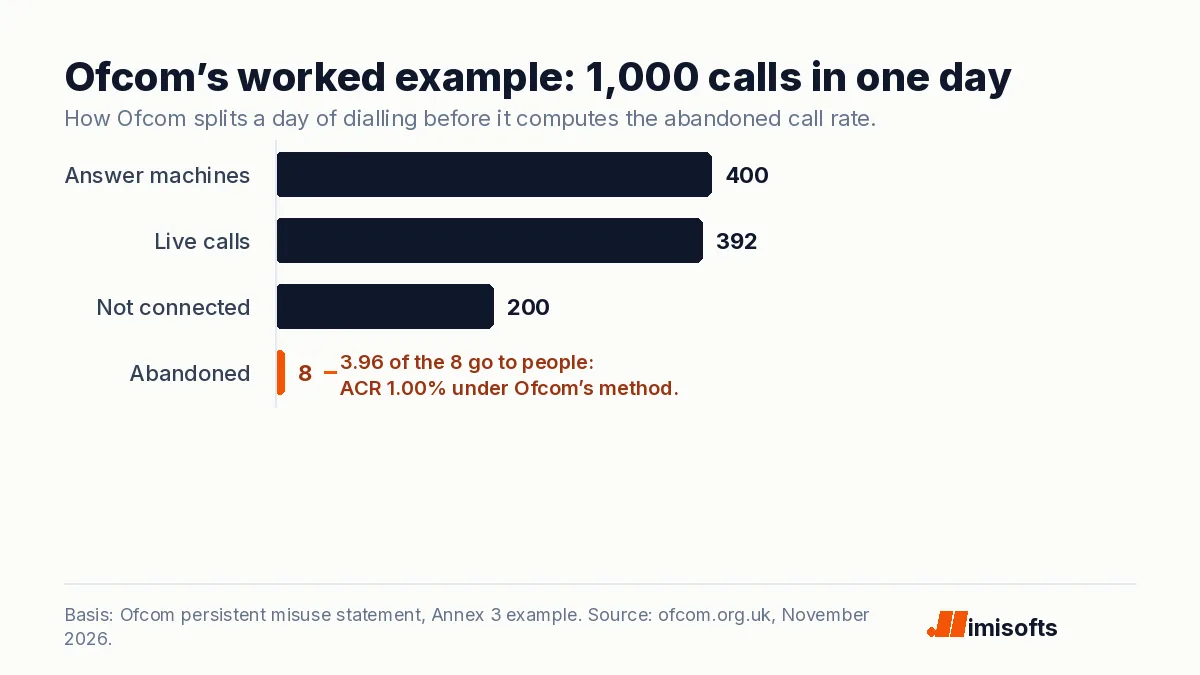
Ofcom still uses the abandoned call rate (ACR) as one factor. Per calendar day, it is abandoned calls divided by abandoned plus live calls, assessed per campaign or per call centre. Silent calls, unconnected calls and calls to answer machines are left out. Its own worked example: 1,000 calls in a day, of which 392 reach a live person and an agent, 400 are passed to agents but turn out to be answer machines, 200 never connect and 8 are abandoned. Because 400 of the 792 calls passed to agents were machines (50.5%), Ofcom assumes the same share of the 8 abandoned calls went to machines, which leaves 3.96 abandoned to people. The ACR is 3.96 divided by 395.96, or 1.00%.
What I would do this week
Pull 30 days of dialler data
My suggestion: count silent calls, abandoned calls and live calls per day and per campaign, and compute the ACR the way Ofcom does.
Check the two-second message
Test that an abandoned call plays a message within two seconds that names you, gives a basic rate number to opt out and sells nothing.
Lock the 72-hour rule
Set the dialler so a number that got a silent or abandoned call is not redialled inside 72 hours unless a live agent is guaranteed.
Ask your call centre for the records
If an outsourced team dials for you, ask for six months of call records and AMD accuracy evidence now, not after a complaint. See B2B telemarketing services cost for what outsourced teams charge.
My team’s record: 500+ projects delivered across 30 countries. Ofcom’s statement does not say whether an AI voice agent counts as a live agent, so in my view test it against every item above before you rely on it; our page on compliant AI calling covers our approach, and our AI voice agents compared page covers the platforms. For other markets, see cold calling laws by country, and for the US dialer question, parallel dialing.
The bottom line
In the UK, 3% is not a compliance target. Ofcom’s current policy names no safe abandoned call rate, says silent calls are likely to be its highest priority, and looks at the message, the 72-hour window, the ring time, the caller ID and your records. This is general information, not legal advice.