November 10, 2026. A LaSalle County, Illinois court has given final approval to a TCPA class settlement of up to $1.1 million, all costs included, for a class defined as the 853 people to whom Crown Administrators, on behalf of Altrua HealthShare, placed calls "through the use of AIRudder" between December 2 and December 11, 2024, calls during which "a pre-recorded voice message was played." The defendants deny wrongdoing, and AI Rudder, the calling platform named in the class definition, was not a defendant. The final approval order in Finley v. Altrua Ministries was e-filed on October 23, 2026, and TCPAWorld, a blog run by the TCPA defense firm Troutman Amin, flagged it on November 9 as a warning about outbound AI voice. For a business testing AI calling, the useful part is the class definition: it is limited to cell numbers not assigned to Altrua account holders, inside a ten-day window.
Key numbers
| Item | Number |
|---|---|
| Settlement cap, everything included (claims, notice, fees, service award) | $1,100,000 |
| Class members (853 phone numbers after Kroll removed 6 duplicates from 859 records) | 853 people |
| Class call window (10 calendar days) | December 2 to 11, 2024 |
| Payment per approved claim | Up to $700 |
| Attorney fees and costs, agreed ceiling (one third of the cap; award not stated in the order) | $366,666.67 |
| Notice and administration, Kroll estimate (as of September 17, 2026) | $44,773 |
| Service award to the plaintiff, agreed | $5,000 |
| Claims received by September 17, 2026 (1.5% claims rate) | 13 |
| Statutory damages per violation, 227(b)(3) (or actual loss if greater; up to 3 times if willful or knowing) | $500 |
| Final approval order e-filed (LaSalle County, Illinois) | October 23, 2026 |
| FCC ruling on AI voices (FCC 24-17) released | February 8, 2024 |
Figures read on 10 November 2026 from the court-authorized settlement website and its filings (final approval order, motion, class counsel and Kroll declarations), 47 U.S.C. 227 and the FCC.
What the filings show
- The class. The plaintiff's motion for final approval quotes the class as "All persons in the United States to whom Crown Administrators d/b/a HealthAdmins on behalf of Altrua Ministries d/b/a Altrua HealthShare placed a phone call (1) through the use of AIRudder, (2) to a phone number assigned to a cellular telephone service, but not assigned to a person with an account with Altrua Ministries dba Altrua HealthShare, (3) during which a pre-recorded voice message was played, (4) from December 2, 2024 through December 11, 2024," and counts 853 people. AI Rudder describes itself as conversational AI for contact center automation.
- The claim. The plaintiff "brought a single claim under the TCPA for violations of 47 U.S.C. § 227(b)(1)(A)(iii)," the provision on calls to cell phones made with an autodialer or "an artificial or prerecorded voice" without prior express consent. The final approval order says the court "expressly does not make any finding of liability or wrongdoing by Defendants."
- The money. The defendants agreed to provide "up to $1,100,000.00 (the 'Aggregate Cap')" to pay claims, notice and administration, attorney fees and costs, and a service award, with "Settlement Payments of $700.00 per person" that can be reduced pro rata if the total would exceed the cap.
- The courts and dates. The plaintiff first sued Altrua in the US District Court for the Northern District of Illinois on April 4, 2025 (No. 1:25-cv-03653). The parties mediated on February 4, 2026, signed the settlement on June 18, 2026, and won preliminary approval on July 22, 2026 in the Circuit Court of LaSalle County, Illinois (No. 2026CH000018). The final approval hearing was set for October 22, 2026; there were zero objections and zero valid opt-out requests, and the case was dismissed with prejudice.
- The dispute between defendants. Altrua filed a third-party complaint against Crown on June 12, 2025, then voluntarily dismissed it on November 7, 2025 after it "reached a resolution of its third-party claims against Crown Administrators, Inc." The release covers vendors and "service providers retained to make calls," limited to actions taken on behalf of Crown and Altrua.
Where up to $1.1 million goes
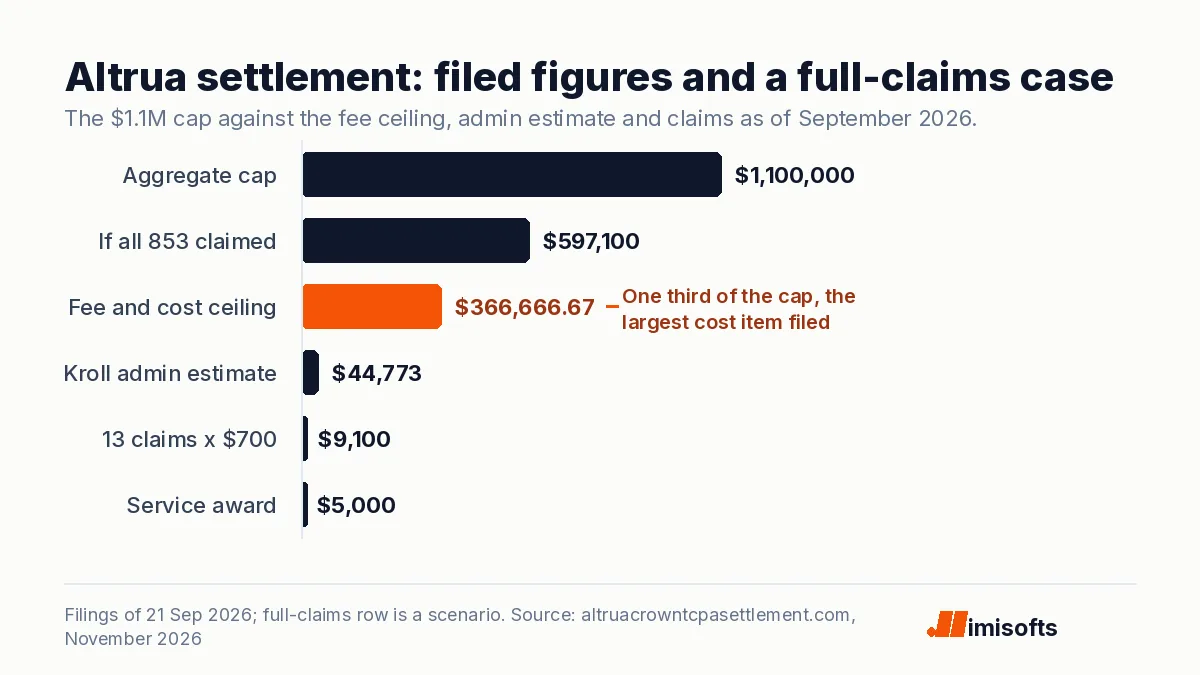
TCPAWorld's headline says $1.1MM for "Just 900 People," and its post says the company used AiRudder for "NINE DAYS" and ended up "spending 7 figures." The filings count 853 people in a class window of ten calendar days, and $1.1 million is the cap on everything, not a sum shown as paid. The post ends by offering a paid compliance review from the firm. Here are the figures in the court filings and on the settlement website, as of September 2026:
| Item | Amount | Source |
|---|---|---|
| Aggregate cap on everything | $1,100,000 | Motion for final approval |
| Attorney fees and costs, agreed ceiling | $366,666.67 (one third); amount awarded not stated in the order | Class counsel declaration, Sep 2026 |
| Notice and administration, estimate | $44,773 | Kroll declaration, 17 Sep 2026 |
| Service award to the plaintiff, agreed | $5,000 | Motion for final approval |
| Payment per approved claim | Up to $700 | Settlement website |
| Claims received by 17 Sep 2026 | 13 (1.5% of 853) | Kroll and class counsel |
On those numbers, 13 claims at $700 come to $9,100, and claims plus the fee ceiling, the administration estimate and the service award add up to $425,539.67, about 39% of the cap. That is not the final bill: claims stayed open until October 20, 2026, and the final approval order we read does not state the fee amount awarded. As a scenario, if all 853 people had claimed, payments would total $597,100 and the filed items $1,013,539.67, still under the cap.
Why an AI voice counts as an artificial voice
The statute, 47 U.S.C. 227(b)(1)(A), bars any call "using any automatic telephone dialing system or an artificial or prerecorded voice" to numbers that include cell phone numbers, unless it is an emergency call or "made with the prior express consent of the called party." In February 2024 the FCC's Declaratory Ruling FCC 24-17 (adopted February 2, released February 8) confirmed that this restriction covers "current AI technologies that generate human voices," so those calls "require the prior express consent of the called party."
For calls that include an advertisement or constitute telemarketing, made with an autodialer or an artificial or prerecorded voice, the FCC's rule at 47 CFR 64.1200(a)(2) requires "the prior express written consent of the called party," but "the prior express consent" is enough when the call is made "by or on behalf of a tax-exempt nonprofit organization," and the rule separately addresses calls that deliver a "health care" message. The filings we read do not say which standard applied to Altrua. Under 227(b)(3), a person can recover actual monetary loss or "$500 in damages for each such violation," whichever is greater, and a court may raise that to "not more than 3 times" the amount for a willful or knowing violation. One call to each of 853 numbers would be $426,500 at $500 and $1,279,500 trebled; the filings do not say how many calls each person received.
One caution on the label: the motion and declarations we read describe "pre-recorded" voice messages and do not use the words "artificial intelligence," so they do not say whether an AI-generated voice was used. TCPAWorld calls it AI voice outreach. Under FCC 24-17 the consent rule is the same either way. This is general information, not legal advice.
What the class definition tells outbound teams
- The class sat outside the customer file. It was limited to cell numbers "not assigned to a person with an account" with Altrua. A reassigned numbers database check and a Do Not Call list policy are two ways to catch numbers outside your customer records before dialing.
- A short window still built a class. TCPAWorld calls this "essentially a test run by a vendor." A ten-day class window produced 853 class members.
- The defendants' records became the class list. Kroll received "one (1) data file from the Defendants" with 859 records "consisting of an impacted phone number, name, and email address," cut to 853 impacted phone numbers after removing six duplicates, and sent notice from that list.
- The brand and the company that placed the calls were both defendants. The class covers calls Crown placed "on behalf of Altrua." Our TCPA vicarious liability guide covers when calls placed for you become your problem.
What it means for operators
We suggest five checks before any AI voice agent dials a cell phone:
- Consent per number, stored. Keep the form, timestamp and wording for each number the agent may call. Our TCPA compliance checklist lists 12 checks.
- Scrub numbers that are not your customers. Run reassigned and Do Not Call checks before a campaign, not after a complaint.
- Treat pilots as production. Ask any AI calling vendor what it logs, who places the calls and who holds the consent records.
- Build the opt-out in. See our guide to AI voice agent opt-out rules and our GPT-Live outbound calling walkthrough.
- Know the clock. Here the federal complaint came 114 days after the class window closed, and final approval about 22 months after it. Our TCPA statute of limitations page explains the time limit.
This is general information, not legal advice. We build AI calling systems that log recordings, transcripts, consent records and opt-outs in one place; getting valid consent stays with the business that places the calls. We also offer AI call answering and lead callbacks for home services. Comparing tools first? See our AI voice agents comparison, AI answering services for HVAC and, for calls outside the US, cold calling laws in South Africa.
Frequently Asked Questions
It is the class settlement in Finley v. Altrua Ministries, Case No. 2026CH000018 in the Circuit Court of LaSalle County, Illinois. The class is defined as the 853 people in the United States to whom Crown Administrators, on behalf of Altrua HealthShare, placed a call through the use of AIRudder to a cell number not assigned to an Altrua account holder, during which a pre-recorded voice message was played, from December 2 to December 11, 2024. The defendants agreed to pay up to $1,100,000 in total, deny wrongdoing, and the court made no finding of liability. The final approval order was e-filed on October 23, 2026.
Up to $700 per approved claim, which class members could take electronically or by mailed check. Payments can be reduced pro rata if claims, notice and administration, attorney fees and the $5,000 service award together would exceed the $1,100,000 cap. The claim deadline was October 20, 2026. By September 17, 2026, Kroll had received 13 claims, a 1.5% claims rate.
The motion and declarations we read say the calls were placed through the use of AIRudder and that a pre-recorded voice message was played; they do not use the words artificial intelligence, so they do not say whether the voice was AI-generated. AI Rudder describes itself as conversational AI for contact centers, and TCPAWorld calls the case AI voice outreach. Under the FCC's February 2024 ruling FCC 24-17, AI-generated voices count as artificial voices under the TCPA, so the consent rule is the same either way. This is general information, not legal advice.
For violations of the TCPA's robocall rules, 47 U.S.C. 227(b)(3) lets a person recover actual monetary loss or $500 for each violation, whichever is greater, and a court may raise that to up to three times the amount, $1,500, if the violation was willful or knowing. In the Altrua case, one call to each of 853 numbers would come to $426,500 at $500, or $1,279,500 trebled; the filings do not say how many calls each person received. This is general information, not legal advice.
In the US, generally yes, unless the call is made for emergency purposes. The TCPA bars calls to cell phones using an artificial or prerecorded voice without the called party's prior express consent, and the FCC confirmed in February 2024 that AI-generated voices are covered. For telemarketing calls, 47 CFR 64.1200(a)(2) requires prior express written consent, while prior express consent is enough for calls made by or on behalf of a tax-exempt nonprofit organization. This is general information, not legal advice.
In this case both the brand and the company that placed the calls were defendants: the class covers calls Crown Administrators placed on behalf of Altrua. Altrua filed a third-party complaint against Crown, then voluntarily dismissed it on November 7, 2025 after reaching a resolution. The settlement release covers vendors and service providers retained to make the calls, limited to actions taken on behalf of Crown and Altrua. Check who places the calls and who keeps the consent records before any campaign. This is general information, not legal advice.