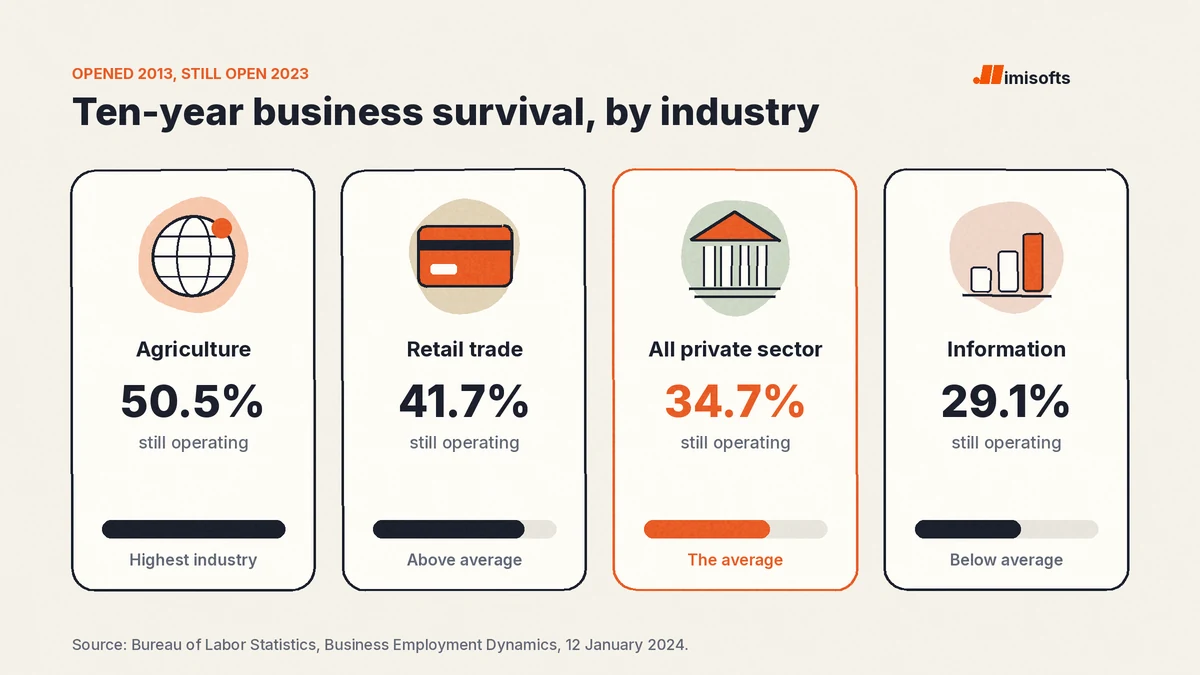
Short answer. No business is recession-proof. Of the US private-sector businesses that opened in March 2013, the survival rate fell by 20.4 percentage points in the first year, and only 34.7% were still operating in March 2023, according to the Bureau of Labor Statistics. Ten-year survival ran from 50.5% in agriculture to 24.5% in mining, oil and gas, so no industry is safe. The safest business is one that puts little of your money at risk, sells something customers buy again, has no customer it cannot afford to lose, and can live for three months on its own cash. The seven tests below check for exactly that.
This guide uses the risks The Economist's editors list for 2027 as the stress test, then covers the survival data, the seven tests, which kinds of business pass them, how to make your own household safe first, and a 90-day plan. It is general information, not financial advice.
Key numbers
| Item | Number |
|---|---|
| Businesses opened March 2013 still operating March 2023 (all US private sector, Bureau of Labor Statistics) | 34.7% |
| Survival lost in the first year (2013 to 2014; construction 24.0 points) | 20.4 points |
| Highest ten-year survival by industry (agriculture, forestry, fishing and hunting) | 50.5% |
| Lowest ten-year survival by industry (mining, quarrying, and oil and gas extraction) | 24.5% |
| Median small business cash buffer (JPMorgan Chase Institute, 597,000 firms, 2015 data) | 27 days |
| Small firms reporting rising or tariff costs (Federal Reserve Banks survey, September to November 2025) | 77% |
| Online-lender borrowers surprised by a higher cost (37% at small banks, 32% at large banks) | 60% |
| US adults with three months of expenses saved (Federal Reserve survey, October 2025) | 55% |
Bureau of Labor Statistics (12 January 2024); Federal Reserve Banks, 2026 Report on Employer Firms (3 March 2026); JPMorgan Chase Institute, Cash is King (September 2016); Federal Reserve, Economic Well-Being of U.S. Households in 2025 (May 2026); The Economist press release of 17 November 2026. Read 29 November 2026.
What the survival data says
The Bureau of Labor Statistics tracks every group of new business establishments from the year it opens. For the group born in March 2013, these shares were still operating ten years later.
| Industry | Still operating after 10 years |
|---|---|
| Agriculture, forestry, fishing and hunting | 50.5% |
| Utilities | 45.7% |
| Manufacturing | 43.6% |
| Retail trade | 41.7% |
| Construction | 40.1% |
| Accommodation and food services | 38.2% |
| Health care and social assistance | 35.7% |
| All private sector | 34.7% |
| Professional, scientific and technical services | 30.9% |
| Information | 29.1% |
| Mining, quarrying, and oil and gas extraction | 24.5% |
Three things to take from it:
- The first year is the dangerous one. The overall survival rate dropped 20.4 points between 2013 and 2014, and construction had the sharpest first-year fall at 24.0 points.
- No category is safe. Even in the best industry, about half were gone in ten years.
- A closure is not always a loss. The figures count establishments that stopped operating, not owners who lost money. Businesses that cost little to open, such as consulting, also cost little to close, which is part of why professional services sit below the average. What you have at stake matters more than the label on the door.
Done for you by imisofts
Want qualified B2B meetings without building an SDR team?
imisofts builds verified prospect lists, runs the outreach and books qualified meetings into your calendar.
The 2027 risk list a business has to survive
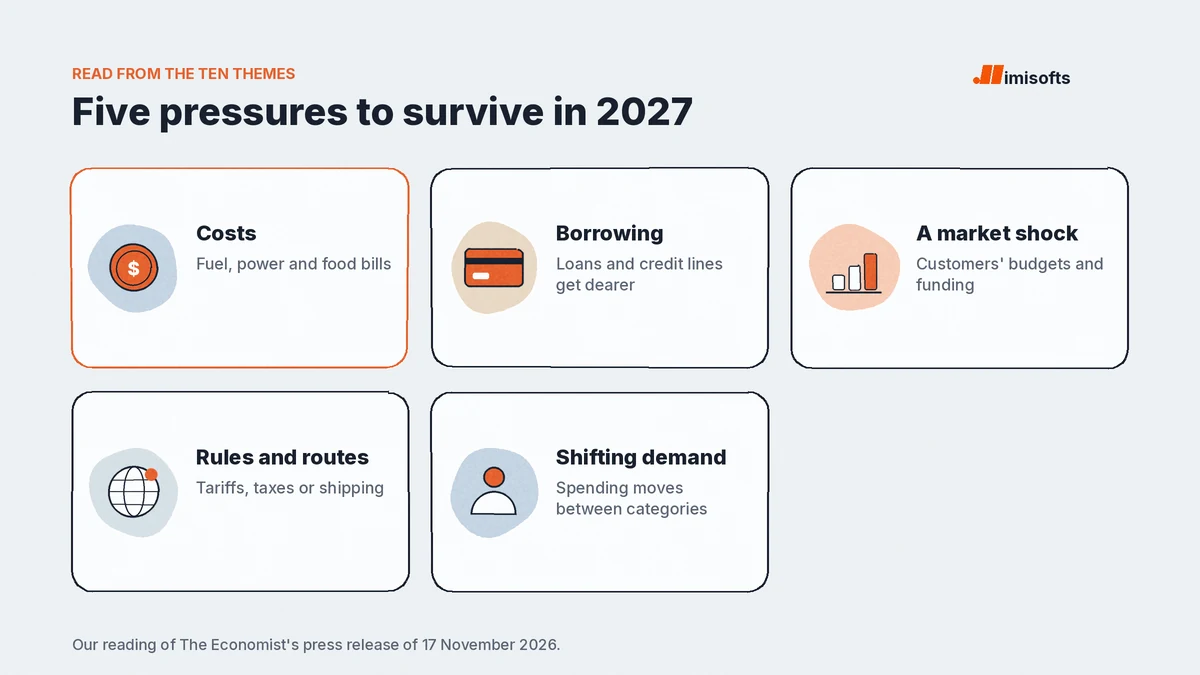
The Economist's annual issue, The World Ahead 2027, names ten themes for the year in its press release of 17 November 2026. Read as a risk list for a small business, they come down to five pressures. The reading is ours; our guide to The Economist cover for 2027 explains the themes and the drawing.
- Costs. The editors expect the Iran war to keep reshaping energy flows and leave fertiliser short, and they expect another year of droughts, wildfires and heat waves. That means fuel, power and food bills.
- Borrowing. Their bond-market theme is that many rich countries are overspending and yields are rising. Loans and credit lines follow.
- A market shock. They see a growing risk of a crash as AI firms take on debt through complex deals. A fall in markets hits customers' budgets and funding.
- Rules and routes. US politics, the French election and Taiwan are all places where tariffs, taxes or shipping could change fast.
- Shifting demand. Weight-loss drugs are moving spending toward clothes, cosmetics and fitness, by the editors' account, and they ask whether film audiences want something new.
These pressures are already visible. In the Federal Reserve Banks' small business survey of 6,525 firms, taken from September to November 2025, 77% reported rising costs, tariff costs or both, and tariff cost challenges were most common in retail (69%) and manufacturing (62%).
The seven tests of a safe business
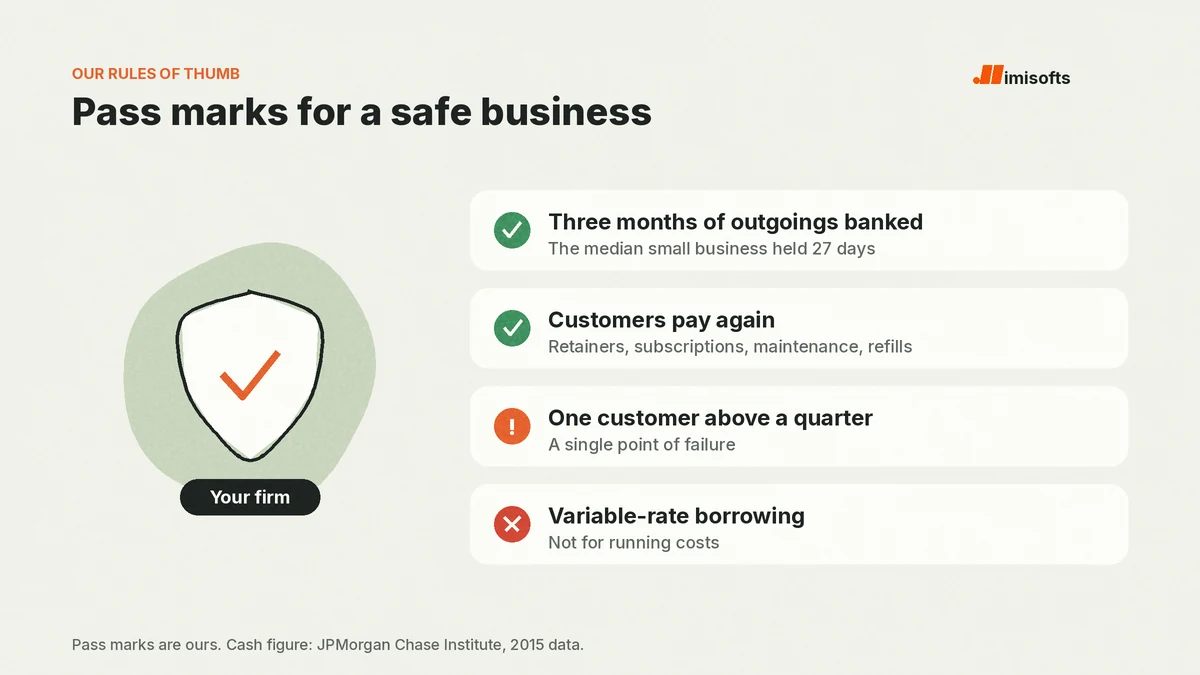
The evidence column is from the sources linked. The pass marks are our own rules of thumb, not official standards.
| # | Test | Evidence | Our pass mark |
|---|---|---|---|
| 1 | Small money at risk | 20.4 points of survival lost in year one (BLS) | You could lose every dollar you put in and still pay your household bills |
| 2 | Low fixed costs | 77% of small firms report rising or tariff costs (Fed Banks) | Your slowest month still covers rent, software and wages |
| 3 | Repeat demand | Our reasoning: repeat income keeps a cost rise from becoming a crisis | Customers pay again without being sold to again: retainers, subscriptions, maintenance, refills |
| 4 | No single point of failure | Tariff cost challenges reported by 69% of retail firms (Fed Banks) | No customer above about a quarter of revenue, and more than one supplier |
| 5 | A cash buffer | The median small business held 27 days of cash (JPMorgan Chase Institute) | Three months of outgoings in the bank |
| 6 | Little debt, at a fixed rate | 60% of online-lender borrowers found the cost higher than expected (Fed Banks) | No variable-rate borrowing for running costs |
| 7 | A repeatable way to find customers | Reaching customers is the top operational challenge (Fed Banks) | You can name the channel that produced your last five customers |
On test 5. The JPMorgan Chase Institute measured cash buffer days, the number of days a firm could keep paying its bills with no money coming in, across 597,000 small businesses in 2015. The median was 27 days. A quarter held fewer than 13 days and a quarter held more than 62. Restaurants held 16 days, repair and maintenance firms 18, retailers 19 and real estate firms 47. In a later report the typical small business with employees held only 18. The data is from 2015, so treat it as a rough guide.
On test 6. In the Fed Banks' survey, 42% of applicants received all the financing they sought, 36% received some or most and 22% received none. Borrowers were also surprised by the price: 60% of those who used online lenders said the cost was higher than expected, against 37% at small banks and 32% at large banks. A business that needs a loan to get through a slow quarter is relying on something it does not control.
On test 7. This is the one owners skip. A business that depends on referrals arriving by luck has no control over next quarter's revenue. One with a measured channel, whether search, outbound email, partnerships or a storefront on a busy street, can turn effort into customers when it needs to.
Which kinds of business pass the tests
This is our assessment against the seven tests, not a ranking from any data set. Use it to question your own idea.
- Recurring business services such as bookkeeping, IT support, compliance work and managed marketing. They pass tests 1, 2 and 3 easily: little money at risk, few fixed costs, monthly retainers. In our experience they tend to fail test 4 (one big client) and test 7 (no pipeline). Professional services as a whole sit below average, at 30.9% ten-year survival.
- Repair and maintenance trades. Things break in every economy, so demand repeats. Stock and premises are small. The weak point is cash: 18 buffer days in the JPMorgan Chase Institute data.
- Essential local services in health, care and education. Demand is steady, but licences, staff and premises raise the money at risk and the fixed costs.
- Small subscription products, including niche software. Strong on repeat demand and customer spread. The risk is depending on one platform or one supplier of technology.
- Harder by default: restaurants (16 cash buffer days), shops that import their stock (tariff cost challenges at 69% of retail firms) and any business that needs outside funding to reach break-even. They can work, and retail's ten-year survival is above average at 41.7%, but they start with more tests to pass.
The pattern is simple. The safest shape is a service or product that customers pay for every month, sold to many customers, run with few fixed costs and funded from its own sales.
Make your own life safe first
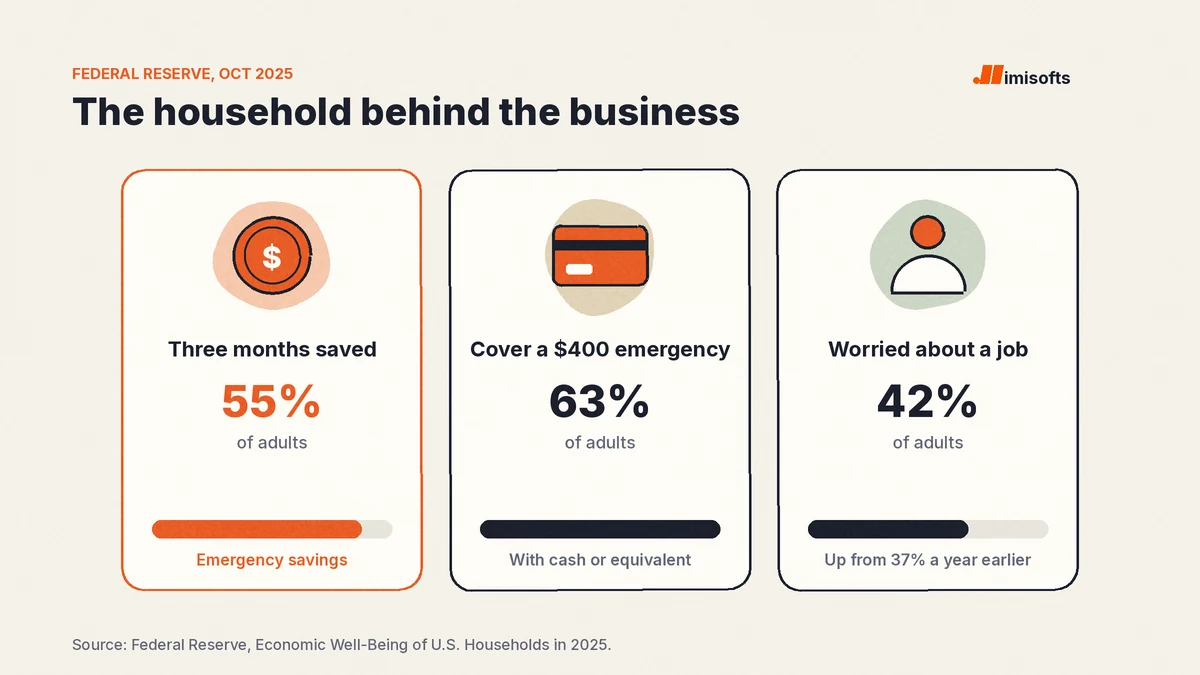
A business is only as safe as the household behind it. If you need the business to pay your rent in month two, every decision will be made under pressure.
- Three months of expenses before you depend on it. In the Federal Reserve's household survey, taken in October 2025, 55% of adults had that set aside and 63% would cover a $400 emergency with cash or its equivalent.
- Keep an income while you test. The same survey found 42% of adults worried about finding or keeping a job, up from 37% a year earlier. A paying job is an asset. Start on evenings and weekends, and move across when the business covers your basics for three months in a row.
- Fix the big bills. Housing and debt at fixed rates, and a lifestyle you could run on less for a year, protect you from the cost and borrowing pressures above.
- Separate the money. A business account and a salary you pay yourself make it obvious when the business is not really working.
- Protect your health and your time. Both are the stock a small business runs on, and neither shows up on a balance sheet.
A 90-day plan
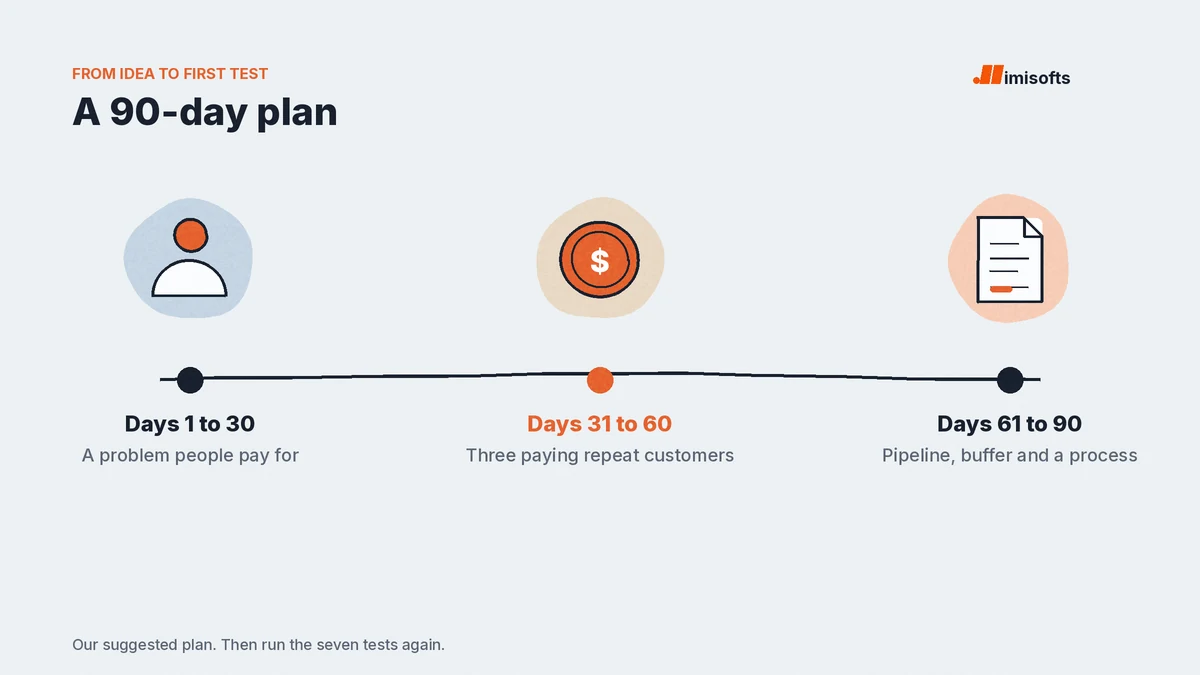
- Days 1 to 30: find a problem people already pay for. Talk to at least ten possible customers. Ask what they pay today and what annoys them. Do not build anything yet.
- Days 31 to 60: win three paying repeat customers. Sell a monthly service or a subscription, even a small one. Three customers paying every month teach you more than three hundred people saying it sounds interesting.
- Days 61 to 90: pipeline, buffer and a process. Pick one channel and measure it. Put a fixed share of every payment into the cash buffer. Write down how the work is delivered so someone else could do it.
Then run the seven tests again. If the business fails three or more, change the offer before you add costs.
Where imisofts fits
Test 7 is the work we do. imisofts runs outbound lead generation for B2B companies, with plans from $2,997 a month, and builds the cold email infrastructure behind it from $2,497 one time. For firms that want to be found instead, we do AI search optimization. And for test 2, our AI automation builds, from $2,497, take repetitive work off a small team so fixed costs stay low. If you are unsure which channel fits, our guide to demand generation vs lead generation is a good place to start.
Frequently Asked Questions
No. Of US private-sector businesses opened in March 2013, only 34.7% were still operating in March 2023, and even the best industry, agriculture, kept only 50.5%. What you can do is lower the risk: little money at stake, low fixed costs, repeat customers, a cash buffer and a dependable way to find customers.
By our seven tests, a service or product that customers pay for every month, sold to many customers, run with few fixed costs and funded from its own sales. Examples are bookkeeping, IT support, maintenance trades and small subscription products. This is general information, not financial advice.
For the group that opened in March 2013, the Bureau of Labor Statistics reports that the survival rate fell by 20.4 percentage points in the first year. Construction had the sharpest first-year fall, 24.0 points.
The JPMorgan Chase Institute found the median small business held 27 days of cash, and the typical one with employees 18 days. Our rule of thumb is three months of outgoings, because that is long enough to replace a lost customer.
For businesses opened in 2013, ten-year survival was highest in agriculture, forestry, fishing and hunting (50.5%), utilities (45.7%) and manufacturing (43.6%). It was lowest in mining, quarrying, and oil and gas extraction (24.5%) and information (29.1%).
Not at first, in our view. Build three months of household expenses, test the idea while you still have an income, and move across when the business has covered your basic costs for three months in a row. This is general information, not financial advice.