Short answer. The Economist's cover for The World Ahead 2027, shown on 16 November 2026, is one red, black and white circle crowded with small scenes: suited leaders along the top, a brain made of circuits, a falling red arrow over banknotes, an oil tanker in chains, a burning forest, a ballot box and a crystal ball. It illustrates the 10 themes the magazine's editors expect to matter in 2027. It is not a coded forecast. Six short lines on the cover name the main subjects: Donald Trump's final chapter, artificial intelligence, the aftermath of the Iran war, climate change, rising populism and Hollywood reboots.
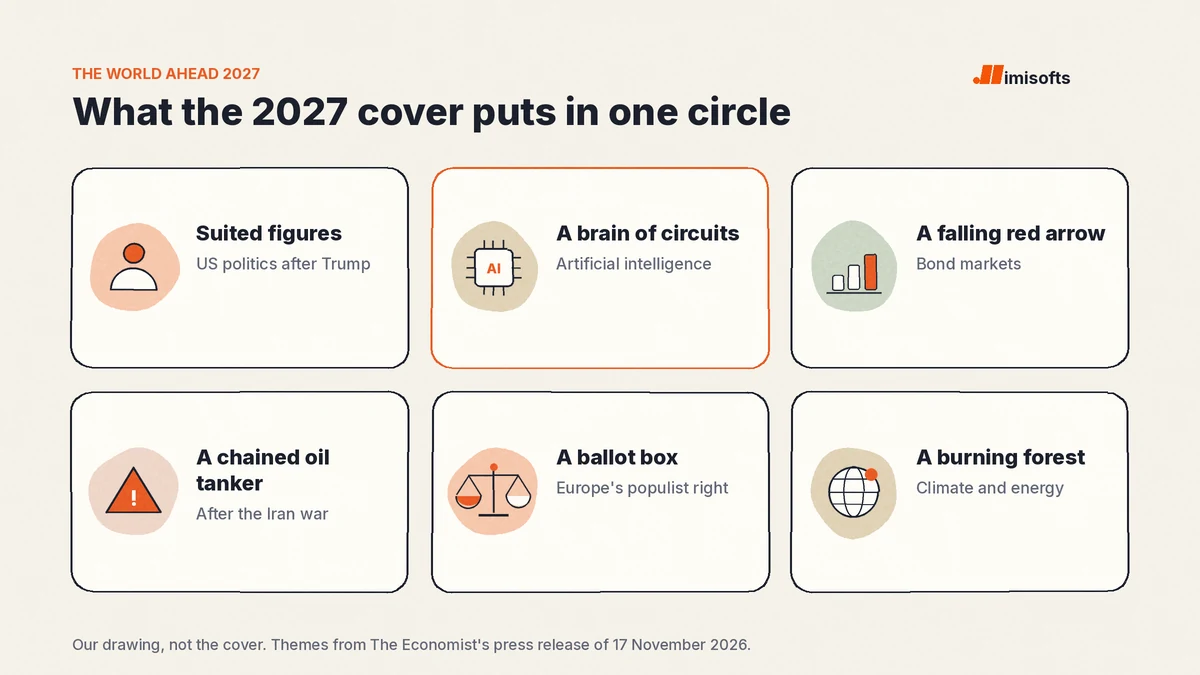
Below: what is drawn, which theme each picture matches, how to read a cover like this without fooling yourself, and what the same themes mean for your household, your work and a small business. The practical sections are our own reading and are general information, not financial advice.
Key numbers
| Item | Number |
|---|---|
| Themes The Economist names for 2027 (press release of 17 November 2026) | 10 |
| Lines printed on the cover (Trump, AI, Iran, climate, populism, Hollywood) | 6 |
| Cover shown (print edition dated 21 November; newsstand from 26 November) | 16 November 2026 |
| Colours in the drawing (red, black and white; credited to Cleon Peterson) | 3 |
| US adults with three months of expenses saved (Federal Reserve survey, October 2025) | 55% |
| US adults who would cover $400 with cash (cash or its equivalent; same survey) | 63% |
| Small firms reporting rising or tariff costs (Federal Reserve Banks survey, September to November 2025) | 77% |
| Businesses opened in 2013 still operating in 2023 (Bureau of Labor Statistics) | 34.7% |
The Economist press release of 17 November 2026 (as published by Editor and Publisher); Federal Reserve, Economic Well-Being of U.S. Households in 2025 (May 2026); Federal Reserve Banks, 2026 Report on Employer Firms (3 March 2026); Bureau of Labor Statistics (12 January 2024). Read 29 November 2026.
What is on the cover
The drawing is credited to the American artist Cleon Peterson and uses three colours: red, black and the white of the page. Everything sits inside one circle. A row of suited figures stands along the top beside a tower labelled TRUMP. The middle is packed with machines, weapons, money and crowds. At the bottom are red tents, seated figures and a crowd gathered around a crystal ball.
The Economist announced the issue in a press release on 17 November 2026. The World Ahead 2027 is part of the weekly print edition dated 21 November and is sold on its own from 26 November. It is edited by Tom Standage, and its guest writers include Japan's prime minister, Takaichi Sanae, Finland's president, Alexander Stubb, and Fatih Birol, who heads the International Energy Agency. The articles themselves are on economist.com.
The six cover lines are short labels, not predictions. The one about the climate reads "Hottest year ever, again"; the others name Trump's last years in office, the speed and risks of AI, the knock-on effects of the Iran war, populism (with a pun on Marine Le Pen's name) and tired film franchises.
One thing to know before reading any explanation, including this one: the press release lists the themes but does not explain the drawing, and we found no official key. To describe the picture we compared four independent write-ups, such as this symbol-by-symbol account, and kept only the elements that at least two of them describe.
Done for you by imisofts
Want more leads from Google search?
imisofts runs technical SEO, content and link building for B2B, SaaS and service businesses.
Each picture and the theme it matches
The right-hand column is our short paraphrase of what The Economist's editors say in the press release. The matching of pictures to themes is the reading shared by the write-ups we compared, not something the magazine has confirmed.
| What is drawn | Theme | What the editors say about 2027 |
|---|---|---|
| A row of suited figures and a tower labelled TRUMP | US politics after Trump | The race to succeed him begins. With Democrats holding both chambers of Congress, they expect a more combative president |
| Tanks, missiles, jets, a chained oil tanker, a broken pipeline, camels | After the Iran war | Changed regional politics and energy flows, and a fertiliser shortage that threatens food supplies |
| A burning forest, a deer and a thermometer; wind turbines and a vehicle at a charger | Climate and energy | More droughts, wildfires and heat waves, with renewables as a way out of unstable oil and gas markets |
| A brain made of circuits, a robot, falling ones and zeros | Artificial intelligence | A growing backlash, and a higher risk of a crash as AI firms borrow through complex deals |
| A draped statue, a crowd and a ballot box | Europe's populist right | A win for Marine Le Pen in France would strain the European Union's Franco-German core and French public finances |
| A falling red arrow, banknotes and casino chips | Bond markets | Many rich countries are overspending and their borrowing costs are rising |
| A Chinese flag over a crowd watched by a camera | Taiwan | 2027 is the year by which China's forces were reportedly told to be ready; cheap technology helps smaller powers resist |
| A syringe, capsules, a lab worker and cosmetics | Weight-loss drugs | Slimmer consumers spend more on clothes, cosmetics and fitness, and drug makers look again at longevity |
| A rocket, a satellite and an astronaut | Space | Regular Starship satellite launches and the first private space station |
| A film projector | Hollywood | Old franchises chase new audiences while low-budget films by YouTubers succeed |
| A Kremlin-style tower and an hourglass | Not one of the ten themes | Writers link it to Russia, which is not one of the ten themes |
| Red tents and seated figures | Food and displacement | Writers tie it to the fertiliser and food warning |
| A crystal ball with a crowd around it | The forecast itself | Read by writers as the editors poking fun at prediction |
So the ten themes, in our words, are: America after Trump, the fallout from Iran, another record-hot year, a backlash against AI, Europe's populist right, pressure in bond markets, Taiwan, weight-loss drugs, cheaper space launches and Hollywood's reboots. If the AI part is what brought you here, our explainer of the AI 2027 scenario covers a different forecast with a similar name.
How to read it without fooling yourself
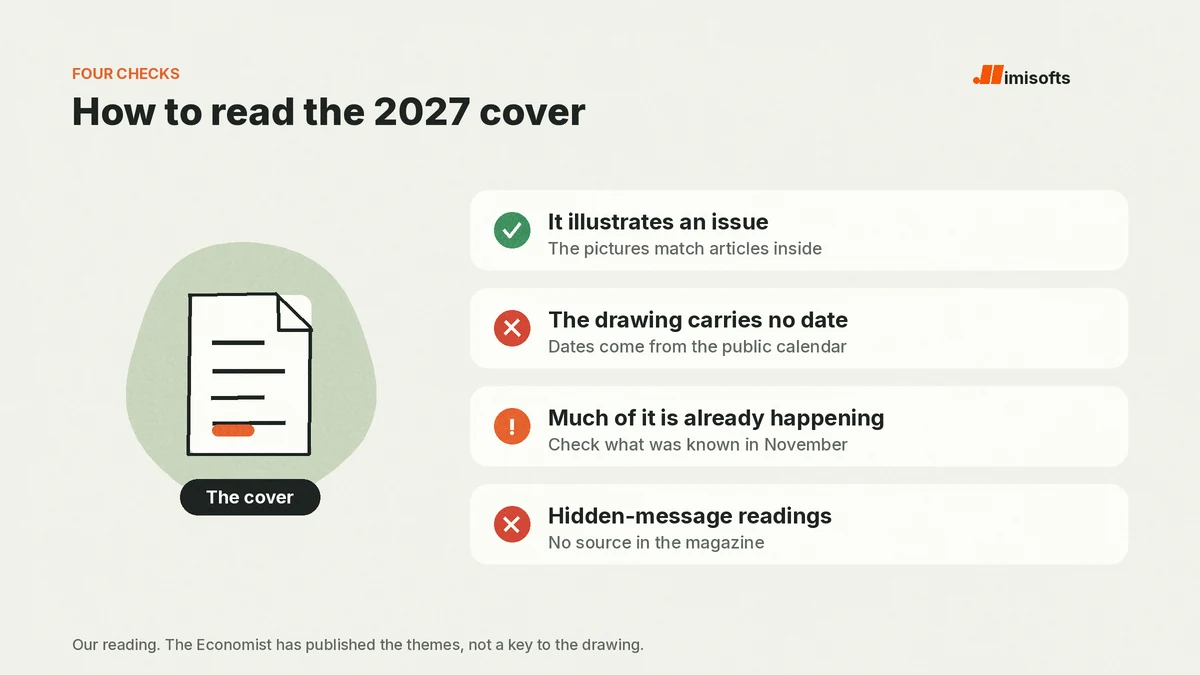
Each year the cover attracts readings that claim it hides the future. Four checks keep you on the safe side of that.
- It illustrates an issue of a magazine. The pictures match articles inside, and the editors write about risks rising and about what a result would mean, not about dated events.
- The drawing carries no date. Dates people attach to it come from the public calendar, such as France's presidential election in spring 2027, not from the art.
- Much of it is already happening. The Iran war, extreme heat and heavy AI borrowing were already in the news in 2026. When someone says next year that the cover predicted them, check what was already known in November.
- Hidden-message readings have no source. Mirror images and letter shapes are not explained anywhere by the magazine. Treat them as entertainment.
A simpler test is to ask whether a reading changes a decision you control. If it does not, drop it. The useful part of the cover is the list of pressures behind it: prices, borrowing costs, jobs, supply and trust.
Where households and small firms stand going into 2027
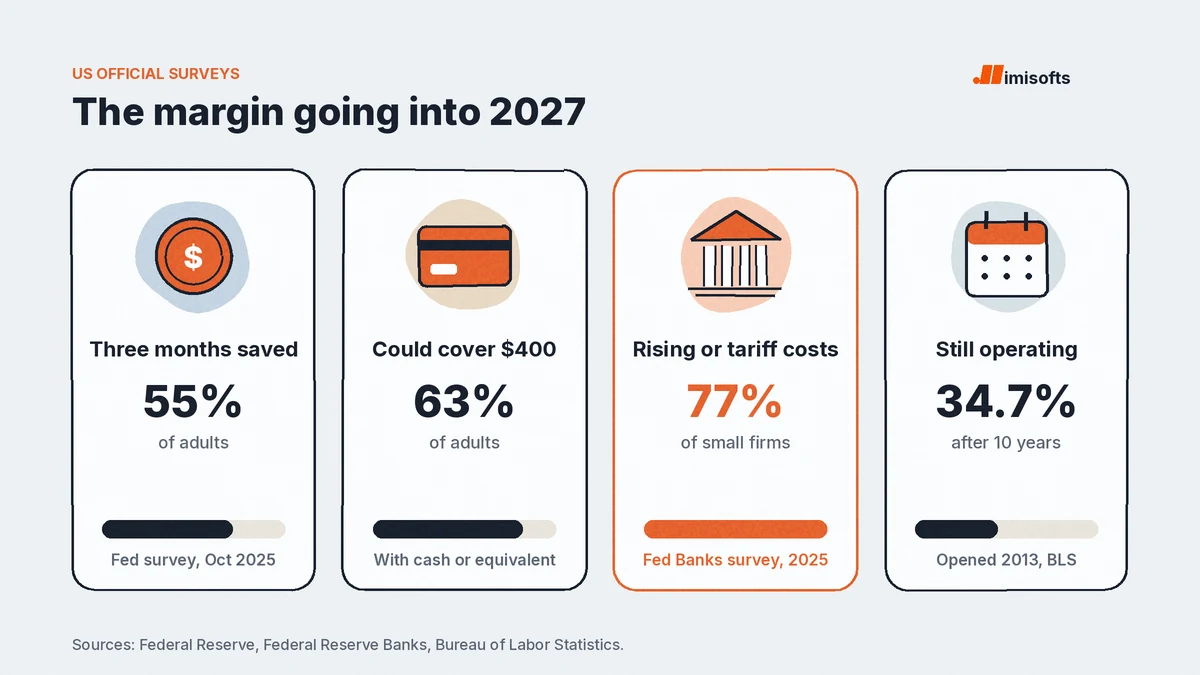
These are US figures from official surveys, and they show how thin the margin is for many people before any of the ten themes plays out.
- 55% of adults had set aside three months of expenses, and 63% would cover a $400 emergency with cash or its equivalent, according to the Federal Reserve's household survey taken in October 2025 (savings chapter, summary).
- 42% of adults said finding or keeping a job was a concern, up from 37% a year earlier, in the same survey. One in four workers had used generative AI at work in the prior month.
- 77% of small employer firms reported rising costs, tariff costs or both, and reaching customers was their most common operational challenge, in the Federal Reserve Banks' small business survey of 6,525 firms taken from September to November 2025.
- 34.7% of businesses opened in March 2013 were still operating in March 2023, according to the Bureau of Labor Statistics.
Six safe-side moves for living, work and business
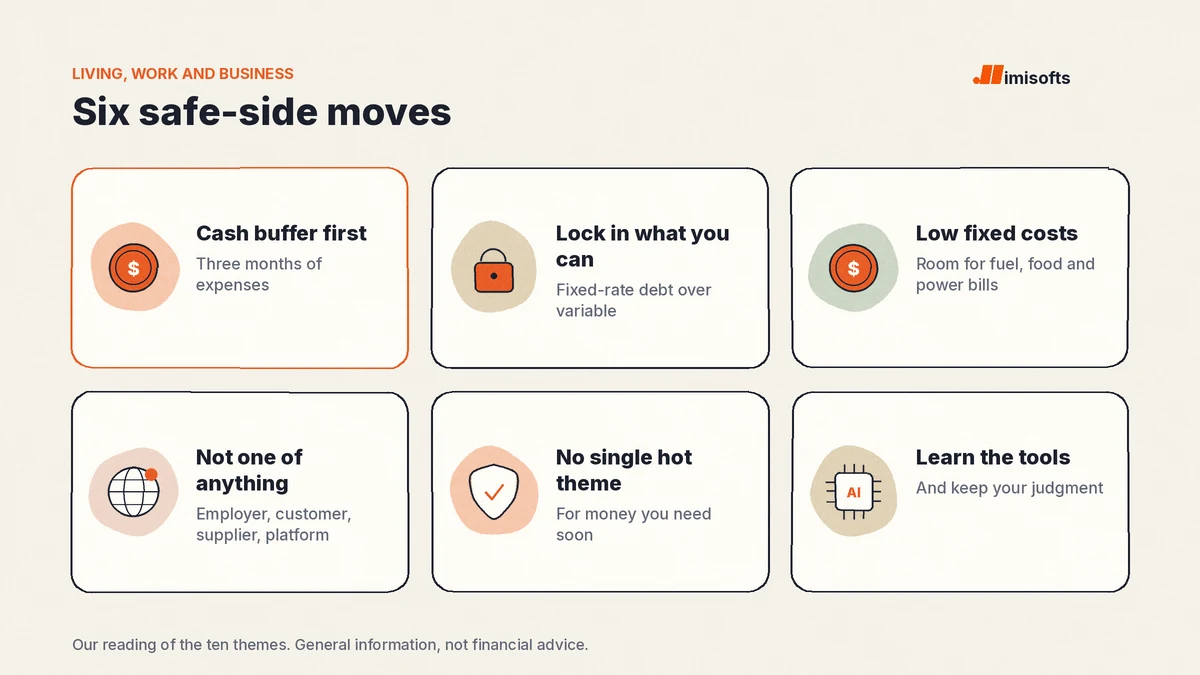
None of these depends on the cover being right. They are the moves that help if prices, borrowing costs or markets move against you, and cost little if they do not.
- Build the cash buffer first. Three months of expenses is the measure the Federal Reserve's survey uses. 55% of adults have it, which leaves 45% without. It is the difference between a bad month and a forced decision.
- Lock in what you can. The bond-market theme is about borrowing getting dearer. Fixed-rate debt and paying down variable-rate balances remove that risk from your life. In the Fed's small business survey, 60% of firms that borrowed from online lenders said the cost was higher than they expected, against 37% at small banks.
- Keep fixed costs low and flexible. The Iran and climate themes both point to fuel, food and power prices. A home, a commute and a business that still work when those bills jump are safer than ones stretched to the limit.
- Do not depend on one of anything. One employer, one customer, one supplier, one country or one platform. The US politics, France and Taiwan themes are all reminders that rules and routes can change quickly.
- Keep money you need soon out of a single hot theme. The editors' crash warning is about AI firms' borrowing. Nobody knows the timing. Spreading risk is a general principle, not investment advice.
- Learn the tools and keep your judgment. The editors consider fears about AI and jobs overstated, but a quarter of workers already use these tools. Skills you can sell to more than one employer are the safest asset you own.
For daily life the same idea applies in small ways: spend on things that lower future bills or protect your health and your ability to earn, and be slow to add fixed monthly commitments. This is general information, not financial advice.
If you run or plan a business
For an owner, the ten themes come down to three questions: can the business absorb higher costs, can it survive a slow quarter on its own cash, and does it have a dependable way to find customers. Our companion guide, Recession-Proof Business: 7 Tests and the 10-Year Survival Data, turns those into a checklist with the survival numbers by industry.
The third question is the work imisofts does. We run outbound lead generation for B2B companies, make firms easier to find through AI search optimization, and build AI automations that cut repetitive work, with scoped builds from $2,497. If your plan for 2027 is to make revenue less fragile, that is where to start the conversation.
Frequently Asked Questions
It illustrates the 10 themes the magazine's editors expect to matter in 2027: America after Trump, the fallout from the Iran war, another record-hot year, a backlash against AI, Europe's populist right, bond-market pressure, Taiwan, weight-loss drugs, cheaper space launches and Hollywood reboots. The Economist has not published a key to the individual pictures.
The cover is credited to the American artist Cleon Peterson. It uses three colours, red, black and white, and places every scene inside one circle.
The cover was shown on 16 November 2026 and The Economist issued its press release on 17 November. The issue is part of the print edition dated 21 November and has been sold as a stand-alone edition from 26 November 2026.
No. It is an editorial illustration of themes covered inside the issue. The drawing carries no date, the editors write about risks and possibilities, and several themes, such as the Iran war and record heat, were already under way in 2026.
They name Trump's final chapter, artificial intelligence, the aftermath of the Iran war, climate change, populism on the rise and Hollywood reboots. The climate line reads "Hottest year ever, again".
Use it as a list of pressures, not a prophecy. Build three months of expenses in cash, prefer fixed-rate debt, keep fixed costs low, avoid depending on one employer, customer or supplier, and keep your skills current. This is general information, not financial advice.