Short answer. Yes, email can be HIPAA compliant. HHS says covered health care providers may email patients "provided they apply reasonable safeguards", and the Security Rule "does not expressly prohibit the use of email" for electronic protected health information (ePHI). Encryption is an addressable safeguard under 45 CFR 164.312(e), not an automatic requirement, and any email provider that stores PHI for you needs a business associate agreement (BAA).
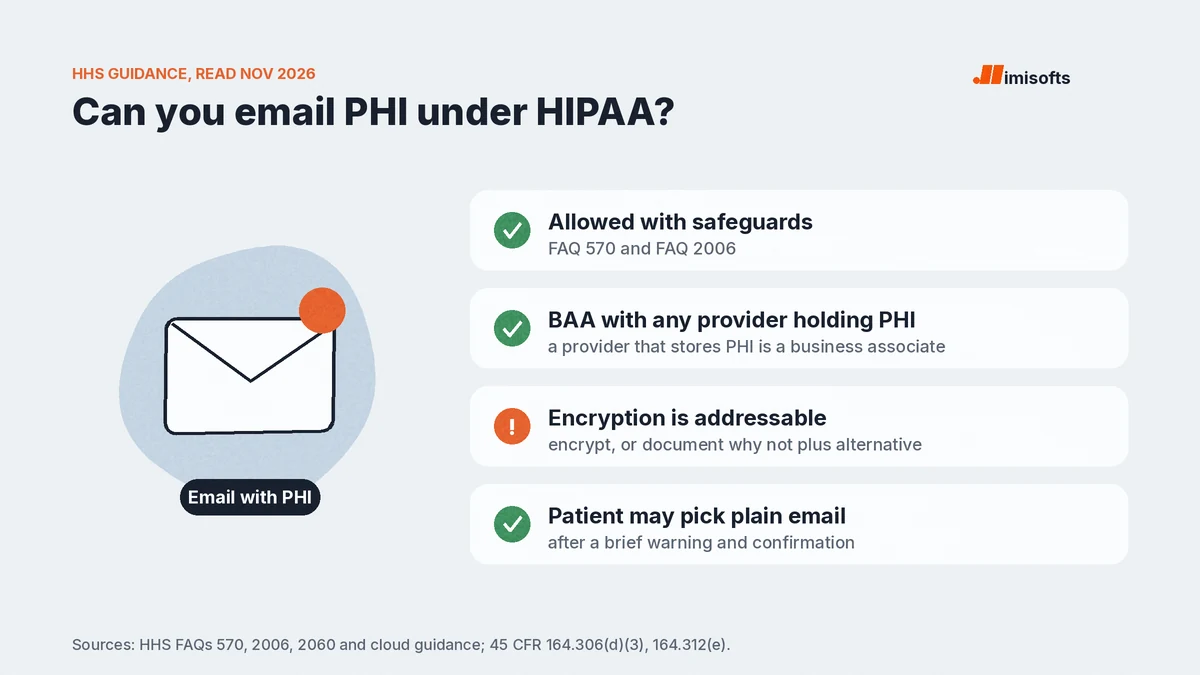
So "HIPAA compliant email" is not a product you buy. It is a set of choices you make and write down: a provider that signs a BAA, a decision on encryption, checks before you hit send, and a plan for the patient who asks for plain email. This guide walks through each one from the HHS guidance and the regulation text, all read on November 23, 2026. If you also need the sending side set up properly (domains, authentication, inboxes), see our email infrastructure service.
Key numbers
| Item | Number |
|---|---|
| Encryption under 164.312(e) (assess, implement or document) | Addressable |
| Breach notice to patients (after discovery, 164.404(b)) | 60 days max |
| HHS notice, 500+ people (as patient notice, 164.408(b)) | Same time |
| HHS report, under 500 (after year end (Mar 1, 2027 for 2026)) | 60 days |
| Access request deadline, new rule (was 30; one 30-day extension) | 15 days |
| New Privacy Rule effective (91 FR 74848) | Jan 19, 2027 |
| Compliance date (2026 Privacy Final Rule) | Jul 19, 2027 |
| Security Rule encryption proposal (not final as of Nov 23, 2026) | Jan 6, 2025 |
HHS FAQs 570, 2006 and 2060; HHS breach and cloud guidance; 45 CFR 164.306, 164.312 (eCFR as of Nov 19, 2026), 164.404, 164.408; Federal Register 2026-23429 and 2024-30983; Google Workspace Help; Microsoft Learn. Read November 23, 2026.
What HHS says about email and PHI
Two HHS answers cover most of the question. The first, FAQ 570, is about the Privacy Rule. It says providers may communicate with patients by email if they apply reasonable safeguards (45 CFR 164.530(c)), and gives examples: "checking the e-mail address for accuracy before sending, or sending an e-mail alert to the patient for address confirmation prior to sending the message."
The same answer says the Privacy Rule "does not prohibit the use of unencrypted e-mail for treatment-related communications between health care providers and patients", but that other safeguards should then apply, "such as limiting the amount or type of information disclosed through the unencrypted e-mail."
The second, FAQ 2006, is about the Security Rule. It points to three standards in 45 CFR 164.312: access control, integrity and transmission security. Its conclusion: "The Security Rule allows for e-PHI to be sent over an electronic open network as long as it is adequately protected."
Both FAQs were last reviewed by HHS on July 26, 2013. They are still the agency's published answers, and the rule sections they cite are in the current eCFR (up to date as of November 19, 2026).
Is encryption required for HIPAA email?
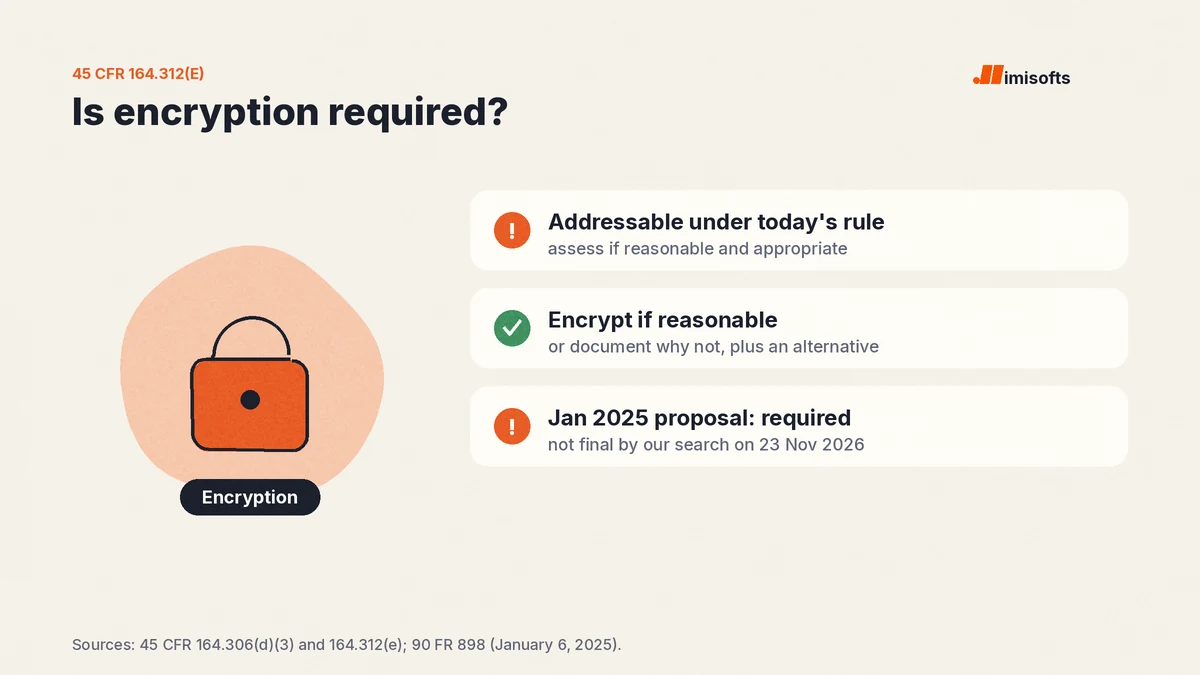
Not automatically, under the rule in force today. The transmission security standard says to "guard against unauthorized access to electronic protected health information that is being transmitted over an electronic communications network." Under it, encryption is listed as "(Addressable). Implement a mechanism to encrypt electronic protected health information whenever deemed appropriate."
In our reading, addressable does not mean optional. Under 45 CFR 164.306(d)(3), you must assess whether encryption is reasonable and appropriate for you. If it is, you implement it. If it is not, you must "Document why it would not be reasonable and appropriate" and implement an equivalent alternative measure if reasonable and appropriate. FAQ 2006 puts it as: assess your use of open networks, select a solution, and document the decision.
Encryption also matters after a mistake. HHS's breach guidance treats ePHI as secured when it is encrypted to the Security Rule's definition and the key was not breached. For data in motion, it names processes that comply with NIST Special Publications 800-52 (TLS), 800-77 (IPsec VPNs) or 800-113 (SSL VPNs), or others that are FIPS 140-2 validated.
A proposal would change this. In its Security Rule proposal of January 6, 2025, HHS proposed to "make all implementation specifications required, with specific, limited exceptions", and a new 164.312(b)(2) "would require regulated entities to encrypt all ePHI at rest and in transit, with limited exceptions." By our search of the Federal Register on November 23, 2026, that proposal had not been finalized. In our view it is sensible to encrypt PHI email now rather than plan around the old wording.
This is general information, not legal advice.
The BAA: Gmail, Microsoft 365 and other providers
An email provider that stores your PHI is a business associate. HHS's cloud computing guidance says you may use a cloud service for ePHI "provided the covered entity or business associate enters into a HIPAA-compliant business associate contract or agreement (BAA)". It adds that a provider holding encrypted ePHI is still a business associate "even if it does not hold a decryption key."
The "conduit" exception does not help a mailbox provider much. HHS says it is "limited to transmission-only services for PHI", with only temporary storage incident to that transmission. A service that keeps your mail is not a conduit in that sense.
What Google and Microsoft publish:
| Provider | BAA offered | How you get it | What their page warns |
|---|---|---|---|
| Google Workspace (Gmail) | Yes, for Workspace and Cloud Identity customers | An administrator reviews and accepts it in the Admin console | "Customers who have not signed a BAA with Google must not use PHI"; third-party add-ons are not covered |
| Microsoft (enterprise online services, Exchange Online listed in scope) | Yes, for covered entities and business associates | Available by default through the Microsoft Online Services Data Protection Addendum | "Your organization is wholly responsible for ensuring compliance" |
Sources: Google Workspace Help, HIPAA Compliance with Google Workspace and Cloud Identity; Microsoft Learn, HIPAA and HITECH Act (last updated July 29, 2025). Both read November 23, 2026.
Google's page describes the BAA only for Workspace and Cloud Identity customers, accepted by an administrator. We found nothing on it about personal Gmail accounts, so we would not put PHI in one. A signed BAA covers the provider's side only. How you configure sharing, add-ons and access is still your job. Mailbox costs per user are covered in our email hosting cost guide.
When a patient asks for plain, unencrypted email
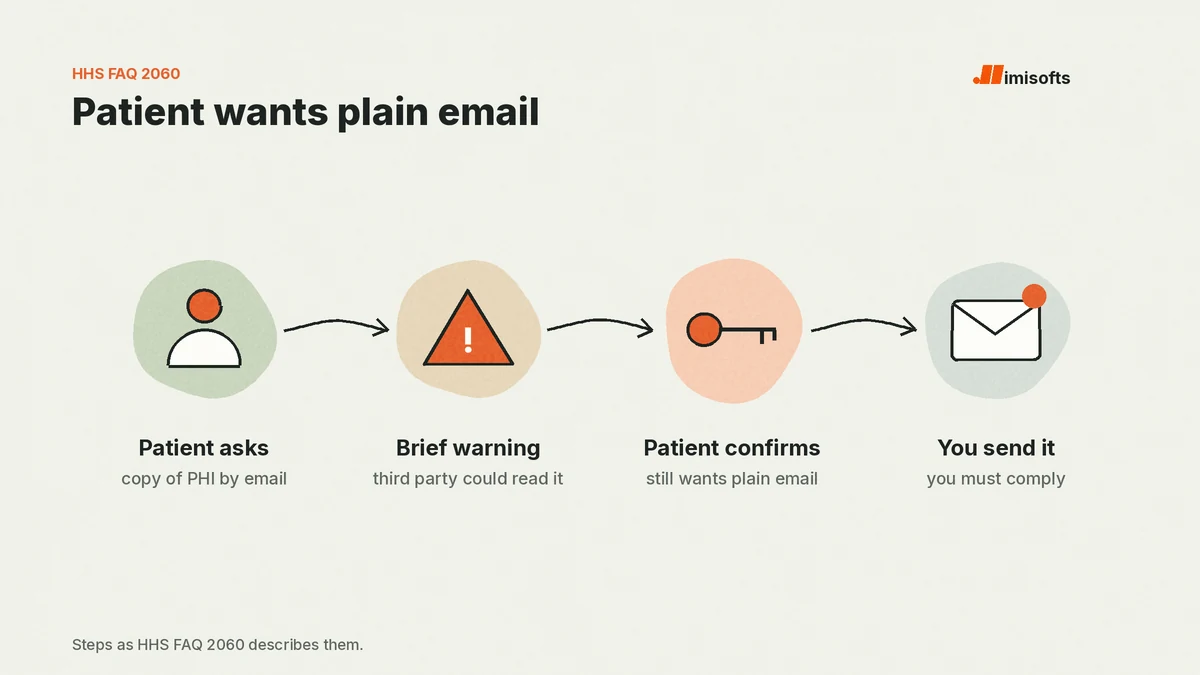
Patients can choose email, even unencrypted. HHS FAQ 2060 says "individuals have a right to receive a copy of their PHI by unencrypted e-mail if the individual requests access in this manner." Before sending, the covered entity "must provide a brief warning" that a third party could read the PHI in transit, and confirm the patient still wants it that way. "If the individual says yes, the covered entity must comply with the request."
The same FAQ says a covered entity "may not require that an individual travel to the covered entity's physical location" to collect a copy when the patient asked for it by mail or email.
FAQ 570 adds two points for everyday messages. If a patient emails you first, you "can assume (unless the patient has explicitly stated otherwise) that e-mail communications are acceptable." And if a patient finds unencrypted email unacceptable, you should offer another way, such as a more secure electronic method, mail or the phone. A short note in the patient's record of what was warned and agreed is our suggestion, not a rule text.
This is general information, not legal advice.
Sent to the wrong address: the breach clock
A misdirected email with unsecured PHI can be a breach. If it is, the notice rules in the regulation apply:
- Patients: notice "without unreasonable delay and in no case later than 60 calendar days after discovery" (45 CFR 164.404(b)).
- HHS, 500 or more people: notify the Secretary at the same time as the patients (45 CFR 164.408(b)).
- HHS, fewer than 500: keep a log and report within 60 days after the end of the calendar year (164.408(c)). For breaches found in 2026, by our date arithmetic that is March 1, 2027.
HHS's breach guidance treats PHI encrypted to its standard, with the key not breached, as unusable to unauthorized people. Encryption in transit does not stop the wrong person reading an email that was delivered to them, though. For a misaddressed message, the safeguard is the first one in FAQ 570: check the address before you send. For how notice works under the EU's rules, see our GDPR breach notification guide.
What changes in 2027 under the new Privacy Rule
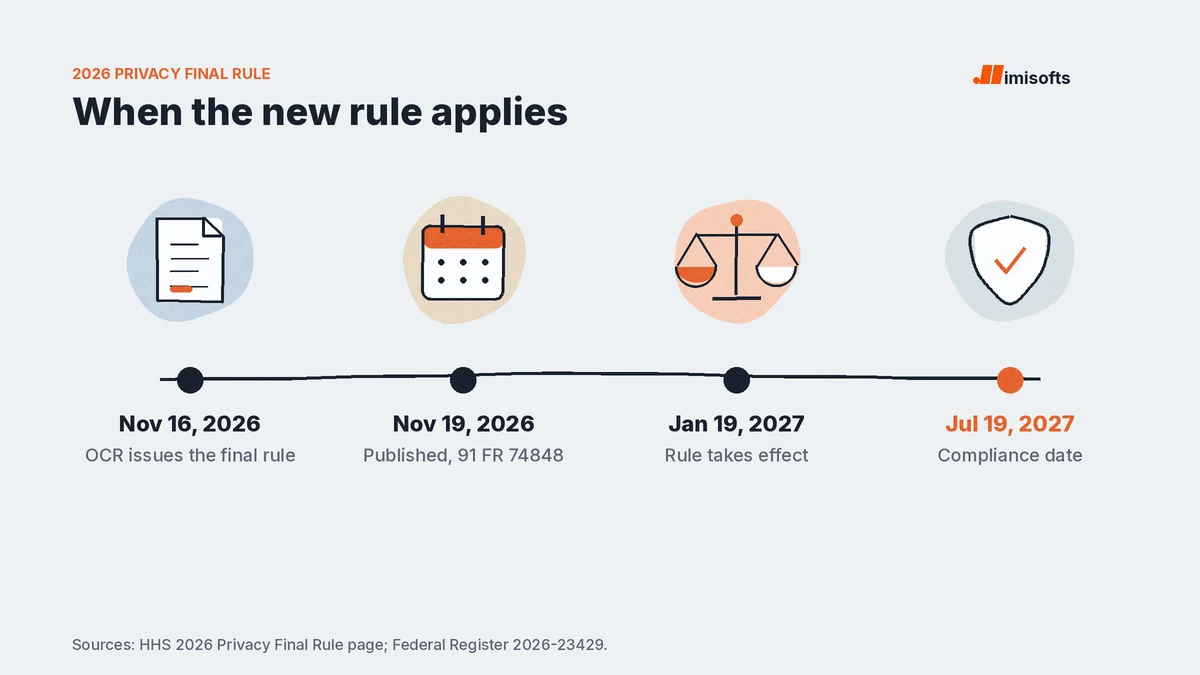
On November 16, 2026, the HHS Office for Civil Rights issued a final rule, "HIPAA Privacy Rule: Changes to Support Coordinated Care and Individual Engagement and Reduce Regulatory Burdens". The Federal Register published it on November 19, 2026 (91 FR 74848). It is effective January 19, 2027, and covered entities must comply by July 19, 2027.
According to the HHS fact sheet, the changes that touch requests for records are:
- Access requests must be answered "as soon as practicable, but no more than 15 calendar days after receipt" (down from 30), with one extension of no more than 30 calendar days. By our arithmetic the longest wait falls from 60 days to 45.
- Covered entities must post estimated fee schedules for copies of PHI on their websites.
We found no change to the email guidance above in the rule's text. It mentions unencrypted email only where a patient "has requested to receive their PHI by, and accepted the risks associated with, unencrypted email." We expect the shorter deadline to put more records into email, which is one more reason to have the safeguards below in place.
This is general information, not legal advice.
5 safeguards to have in place before you send
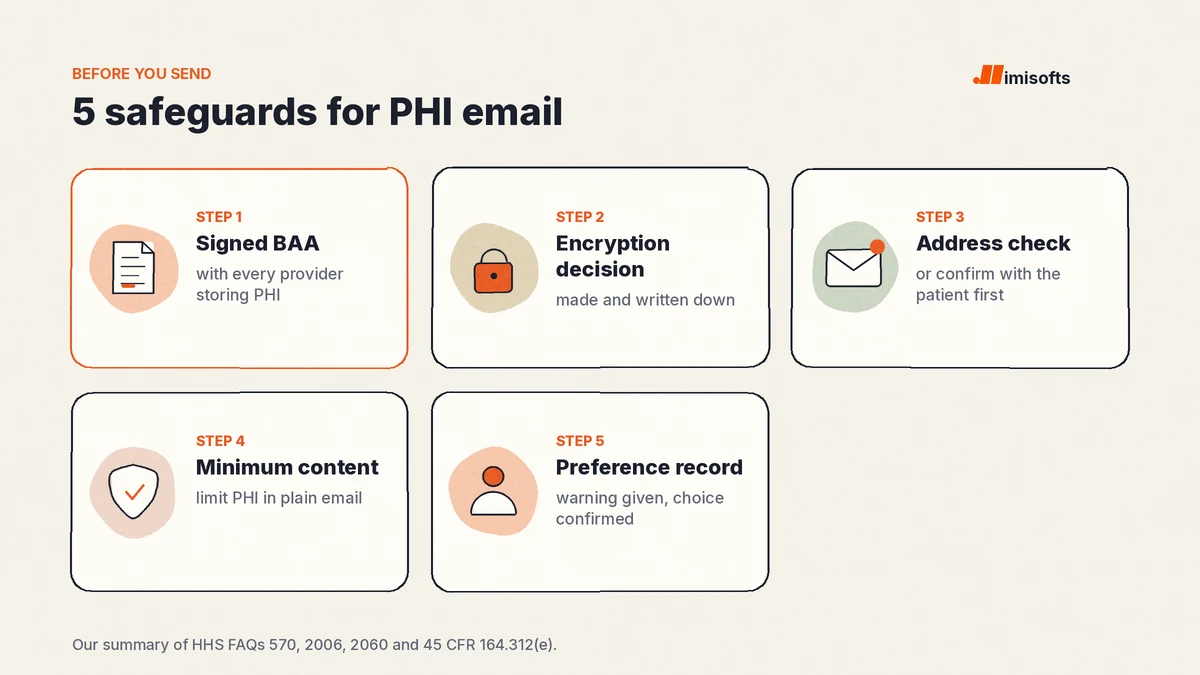
This is our own summary of the HHS answers and rule text above, not a list HHS publishes. Here is what we would put in writing:
- A signed BAA with every email provider that creates, receives, maintains or transmits your PHI, and no PHI in accounts without one.
- A documented encryption decision under 164.312(e). Encrypt, or write down why not and use an equivalent alternative if reasonable and appropriate.
- Address checks before sending, or a confirmation email to the patient first, as FAQ 570 suggests.
- Minimum content in any unencrypted message: limit the amount and type of PHI, as FAQ 570 says.
- A patient preference record: the warning given, the confirmation received, and an alternative offered when a patient declines plain email.
If your team also uses AI tools on patient messages, the same BAA question applies to them. Our guide on whether the OpenAI API is HIPAA compliant covers one example, and AI dental receptionists covers another.
How imisofts can help
imisofts is a Dubai-based agency whose email infrastructure service covers domains, SPF, DKIM and DMARC records, and mailboxes. We do not provide legal advice or HIPAA certification, and the BAA is signed between you and your email provider. If your setup needs work, see our email setup service. If deliverability is the problem, our guide to what an email deliverability consultant costs sets out the options.
Frequently Asked Questions
Not by itself. HHS says covered health care providers may email patients if they apply reasonable safeguards (45 CFR 164.530(c)), and the Security Rule does not expressly prohibit email for ePHI. The risk comes from missing safeguards, such as no business associate agreement with a provider that holds the PHI. A misaddressed email may also be a reportable breach.
Not automatically under the current rule. Encryption is an addressable specification in 45 CFR 164.312(e): you must encrypt if reasonable and appropriate, or document why not and use an equivalent alternative if reasonable and appropriate. A January 6, 2025 HHS proposal would require encryption of all ePHI in transit; by our Federal Register search on November 23, 2026, it was not final.
Gmail in Google Workspace can be used for PHI, for services on Google's HIPAA Included Functionality list, after an administrator accepts Google's Business Associate Amendment in the Admin console. Google's help page says customers who have not signed a BAA must not use PHI, and that third-party add-ons are not covered. Its page describes the BAA only for Workspace and Cloud Identity customers.
Microsoft says its HIPAA Business Associate Agreement is available by default to covered entities and business associates through the Microsoft Online Services Data Protection Addendum, and its HIPAA page lists Exchange Online in scope. Microsoft also says your organization is wholly responsible for compliance, so configuration is still yours. We did not check consumer Outlook.com accounts.
Yes. HHS FAQ 2060 says individuals have a right to receive a copy of their PHI by unencrypted email if they ask. You must give a brief warning about the risk in transit and confirm they still want it; if they say yes, you must send it.
If it was unsecured PHI and it is a breach, you must notify the patient without unreasonable delay and within 60 calendar days of discovery. Breaches of 500 or more people go to HHS at the same time; smaller ones are logged and reported within 60 days after the year ends. PHI encrypted to HHS guidance, with the key not breached, is not unsecured.