Short answer. Under the GDPR you must report a personal data breach to the supervisory authority without undue delay and, where feasible, within 72 hours of becoming aware of it, unless the breach is unlikely to result in a risk to people's rights and freedoms. That is Article 33(1) of the regulation. If you file after 72 hours, the notice must give reasons for the delay.
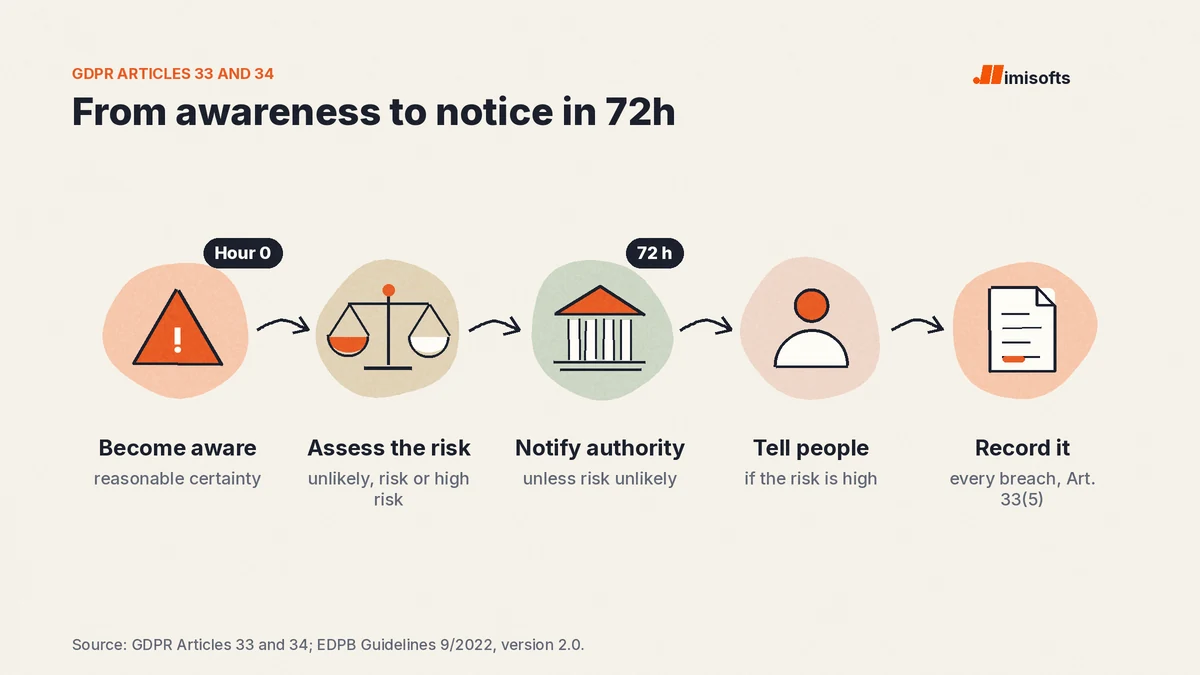
If the breach is likely to result in a high risk, you must also tell the people affected without undue delay (Article 34). Every breach, reported or not, goes into your own breach record. Missing these duties can cost up to €10 million or 2% of worldwide annual turnover, whichever is higher.
One thing may change: the EU's Digital Omnibus proposal would move the deadline to 96 hours and limit notice to high-risk breaches, and the Council backed a longer deadline on October 21, 2026. It is not law yet. If your team holds lead lists or runs cold email, this sits next to the email infrastructure you send from. This is general information, not legal advice.
Key numbers
| Item | Number |
|---|---|
| Deadline to the authority (from awareness, where feasible; reasons needed if later (Art. 33(1))) | 72 hours |
| Deadline to people (only when the risk is likely to be high (Art. 34(1))) | Without undue delay |
| Minimum notice items (nature, contact point, consequences, measures (Art. 33(3))) | 4 |
| Breach types (confidentiality, integrity, availability (EDPB)) | 3 |
| Fine ceiling (of worldwide annual turnover, whichever is higher (Art. 83(4))) | €10 million or 2% |
| UK fine ceiling (of global turnover (ICO)) | £8.7 million or 2% |
| Twitter fine (late notice and poor documentation, DPC, December 15, 2020) | €450,000 |
| Proposed deadline (high-risk breaches only; Digital Omnibus, not law yet) | 96 hours |
Regulation (EU) 2016/679 Articles 3, 4, 33, 34 and 83; EDPB Guidelines 9/2022 version 2.0 (March 28, 2023); ICO guide; DPC press release of December 15, 2020; COM(2025) 837; Council press release of October 21, 2026. Read November 22, 2026.
What counts as a personal data breach
Article 4(12) defines a personal data breach as "a breach of security leading to the accidental or unlawful destruction, loss, alteration, unauthorised disclosure of, or access to, personal data transmitted, stored or otherwise processed".
The European Data Protection Board (EDPB), in its Guidelines 9/2022 (version 2.0, adopted March 28, 2023), sorts breaches into three types:
- Confidentiality breach: unauthorised or accidental disclosure of, or access to, personal data. For example, a lead list emailed to the wrong person.
- Integrity breach: unauthorised or accidental alteration of personal data.
- Availability breach: accidental or unauthorised loss of access to, or destruction of, personal data. The EDPB's examples include a lost or stolen device holding a copy of a customer database and the only copy of a data set encrypted by ransomware.
One breach can be all three at once. The EDPB also draws a line worth keeping in mind: every personal data breach is a security incident, but not every security incident is a personal data breach. For example, an outage that touches no personal data would not be a personal data breach.
When the 72-hour clock starts
The 72 hours run from the moment you become "aware" of the breach, not from the moment it happened. The EDPB says a controller is aware "when that controller has a reasonable degree of certainty that a security incident has occurred that has led to personal data being compromised."
You may take a short period to investigate whether a breach has in fact happened, but the EDPB puts the emphasis on prompt action. Its own examples of when awareness starts:
- You lose a USB key with unencrypted personal data: you are aware when you realise it is lost.
- A third party tells you it received a customer's data by mistake and shows you evidence: you are aware.
- You detect a possible intrusion and your checks confirm personal data was compromised: you are aware.
- An attacker contacts you for a ransom and your checks confirm the attack: you are aware.
In practice, a breach confirmed at 09:00 on a Monday has a deadline of 09:00 on Thursday. If you do not have every detail yet, Article 33(4) lets you send the information "in phases without undue further delay." The EDPB adds that late notices should not become routine, and that several similar breaches reported within 72 hours can go in one bundled notice.
Processors have their own duty. Article 33(2) says a processor must notify the controller "without undue delay" after becoming aware of a breach. If your email platform, CRM or data vendor processes data for you, ask how it will meet that duty.
When you do not have to report it
The test in Article 33(1) is risk. A breach that is "unlikely to result in a risk to the rights and freedoms of natural persons" does not have to go to the authority. The EDPB gives the example of personal data that is already publicly available.
Encryption changes the second notice too. The EDPB says data encrypted with a state of the art algorithm, where the key was not compromised, is in principle unintelligible, so the breach is unlikely to adversely affect individuals and telling them may not be needed. It treats securely hashed and salted passwords the same way. The catch: if the data is lost or altered and you have no backup, notice to individuals can still be required.
Whatever you decide, write it down. Article 33(5) requires you to document "any personal data breaches", including the facts, the effects and the remedial action, so the authority can check your decision later.
What the notice to the authority must contain
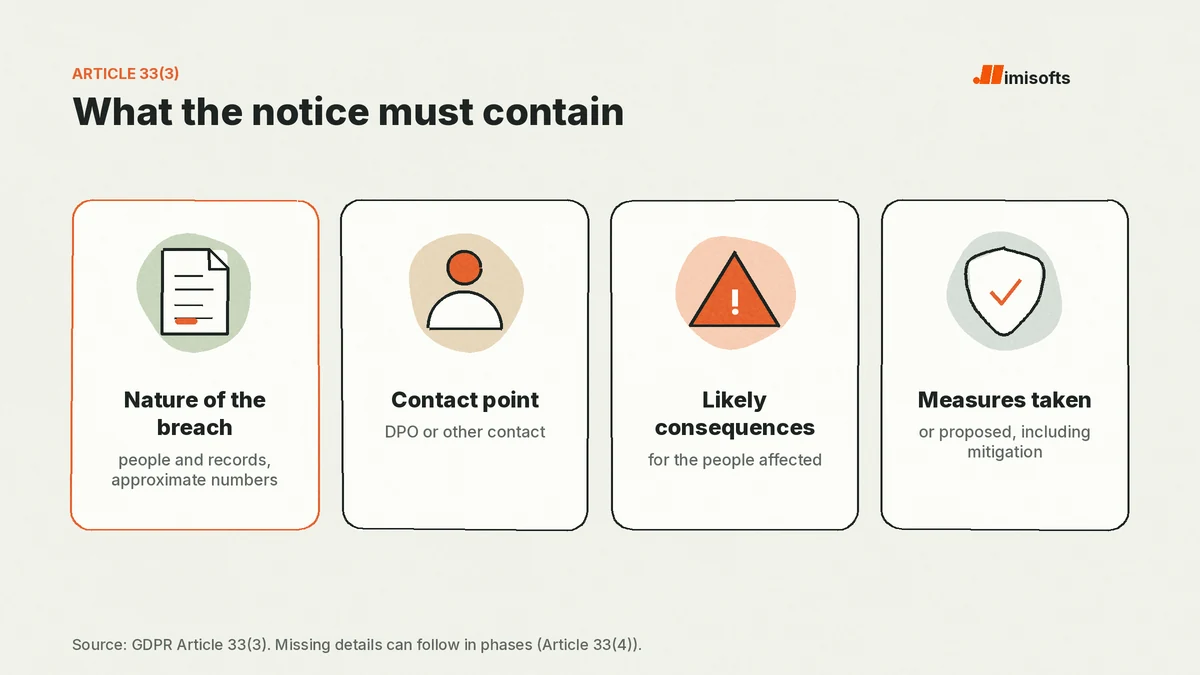
Article 33(3) sets the minimum content. The table puts the two notices side by side.
| Item | To the authority (Art. 33) | To the people affected (Art. 34) |
|---|---|---|
| When required | Unless unlikely to result in a risk | Only when likely to result in a high risk |
| Deadline | Without undue delay, where feasible within 72 hours | Without undue delay |
| Nature of the breach | Yes, with categories and approximate numbers of people and records where possible | Yes, in clear and plain language |
| Contact point (DPO or other) | Yes | Yes |
| Likely consequences | Yes | Yes |
| Measures taken or proposed | Yes, including mitigation | Yes |
| Late filing | Must give reasons for the delay | No 72-hour limit; without undue delay |
| Authority powers | Checks your breach record (Art. 33(5)) | May require you to tell people, or decide an exception applies (Art. 34(4)) |
Some businesses have a second duty. In the UK, the ICO says a communications service provider must notify it of any personal data breach within 72 hours under the Privacy and Electronic Communications Regulations (PECR), using its PECR breach form rather than the GDPR process.
When you must tell the people affected
Article 34(1) adds a second notice when a breach "is likely to result in a high risk to the rights and freedoms of natural persons." The message must describe the nature of the breach in clear and plain language and carry the contact point, the likely consequences and the measures taken or proposed.
Article 34(3) lists three cases where you can skip it:
- the data was protected by measures that make it unintelligible to anyone not authorised to see it, "such as encryption";
- you have since taken measures that make the high risk no longer likely to materialise;
- it would take disproportionate effort, in which case you must use a public communication or a similar measure that informs people equally well.
Under Article 34(4), if you have not told people, the authority may require you to, or decide that one of these exceptions applies.
If your business is outside the EU
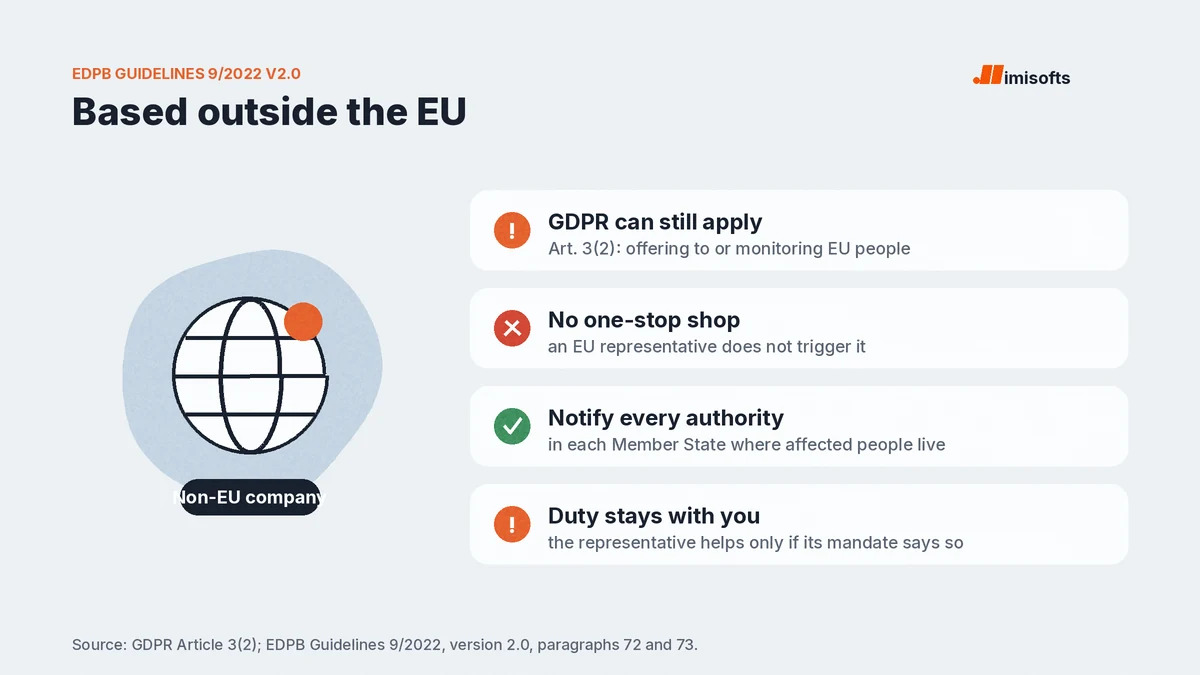
The GDPR reaches companies with no EU office. Article 3(2) applies it to processing of personal data of people in the EU when you offer them goods or services, paid or free, or monitor their behaviour in the EU. An agency outside the EU that offers services to people in the EU can fall inside that.
Version 2.0 of the EDPB guidelines was adopted after a consultation on exactly this case, controllers not established in the EEA. A company inside the EU with cross-border processing reports to one lead supervisory authority. A company outside the EU does not get that one-stop shop just by appointing an EU representative. In the EDPB's words, "the breach will need to be notified to every supervisory authority for which affected data subjects reside in their Member State." The duty stays with the company; the representative can help only if its written mandate says so. Our guide to the GDPR representative for cold email covers when you need one.
The UK has its own 72-hour duty under the UK GDPR. The ICO's guide says you must report a notifiable breach "without undue delay, but not later than 72 hours after becoming aware of it", and that a breach affecting people in EEA countries also engages the EU GDPR.
Fines for a late or missing notice
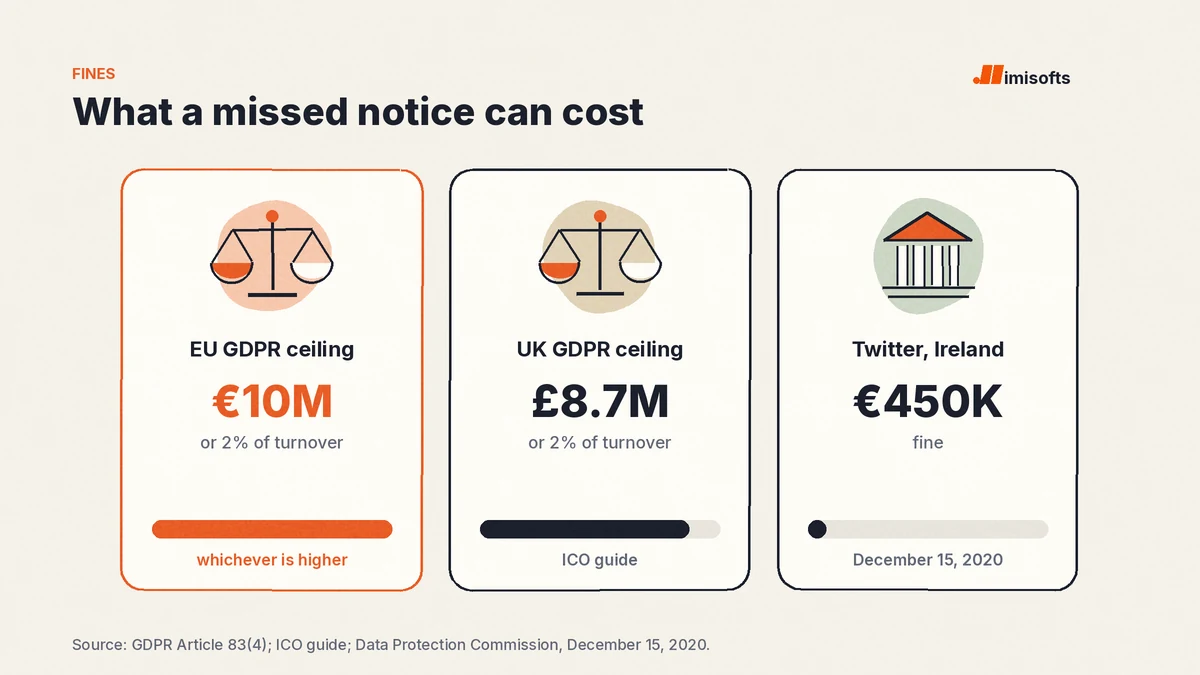
Breach notification sits in Articles 33 and 34, which fall under Article 83(4)(a). The ceiling is €10 million or 2% of total worldwide annual turnover of the preceding financial year, whichever is higher. For a company with €1 billion in turnover, 2% is €20 million, so the higher figure applies. The EDPB notes that a failure to notify and a lack of adequate security under Article 32 are two separate infringements. Other GDPR infringements are covered in our GDPR fines guide.
A real case: on December 15, 2020, Ireland's Data Protection Commission fined Twitter International Company €450,000 for infringing Article 33(1) and 33(5), a failure to notify a breach on time and a failure to document it adequately.
In the UK, the ICO says failing to notify when required "can result in a heavy fine of up to £8.7 million or 2 per cent of your global turnover."
The proposed 96-hour deadline
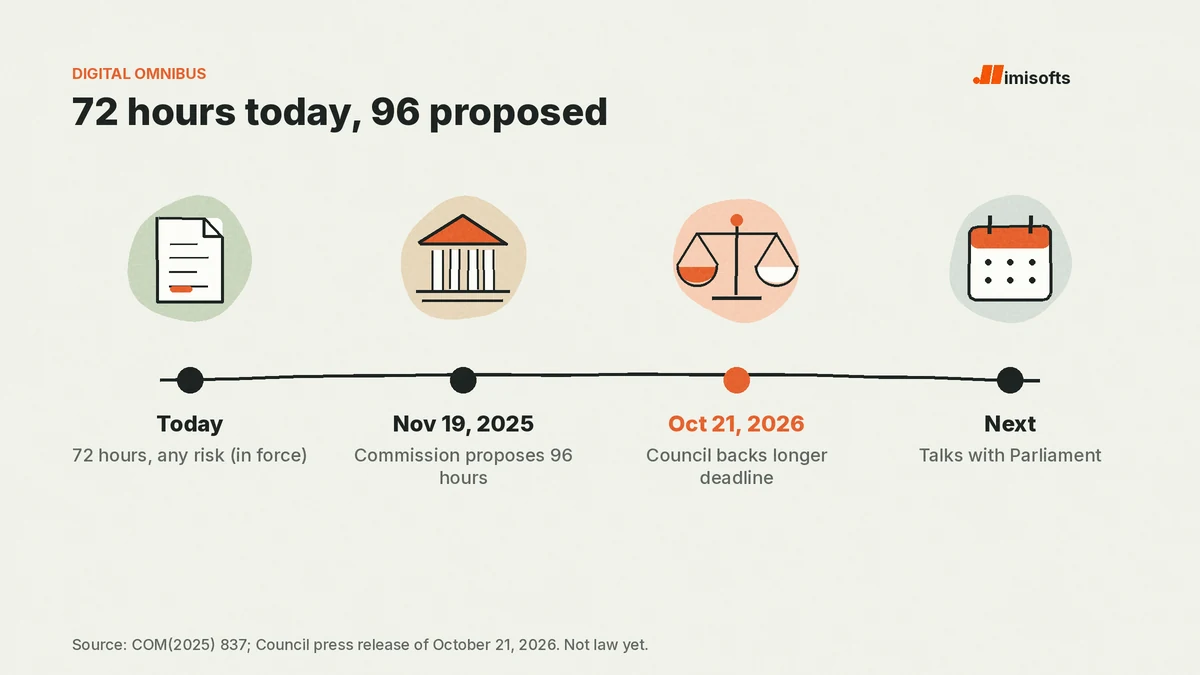
On November 19, 2025 the European Commission published its Digital Omnibus proposal, COM(2025) 837. It would rewrite Article 33(1) so that a breach must be reported only when it is "likely to result in a high risk", "not later than 96 hours after having become aware of it", via the single-entry point established under Article 23a of Directive (EU) 2022/2555.
On October 21, 2026 the Council of the EU agreed its position and said it "backs the Commission proposal to extend the deadline for the notification of personal data breaches." Its next step is negotiation with the European Parliament once Parliament adopts its own position. Until a final text is adopted and in force, plan for 72 hours and the current risk test.
A first 72 hours checklist
Built from the duties above, plus one practical containment step:
- Hour 0: note the time you became aware, and who confirmed it. That starts the clock.
- Contain (practical step, not a legal requirement): stop the exposure where you can and record what you did.
- Scope: which data, how many people and records, which countries they live in, and whether the data was encrypted.
- Risk call: unlikely to result in a risk, a risk, or a high risk. Write down why.
- Notify: unless the risk is unlikely, file with the authority without undue delay and, where feasible, before hour 72; if later, give reasons. Send what you have and complete it in phases.
- Tell people: if the risk is high and no Article 34(3) exception applies.
- Record: add the breach to your breach log either way.
Related reading: how fast to answer an access request in our DSAR response time guide, how long to keep lead data in GDPR data retention period, and the California side in CCPA compliance.
How imisofts can help
imisofts is a Dubai-based agency that runs lead generation and cold email and sets up email infrastructure for outbound teams. For the sending side, see our email infrastructure service. For a breach that has already happened, talk to a data protection lawyer.
Frequently Asked Questions
Without undue delay and, where feasible, not later than 72 hours after becoming aware of it, under Article 33(1). A notice filed after 72 hours must give reasons for the delay. Information you do not have yet can follow in phases.
No. A breach that is unlikely to result in a risk to people's rights and freedoms does not have to be reported to the authority. You must still document every breach under Article 33(5), including the facts, effects and remedial action.
When the breach is likely to result in a high risk to them (Article 34). You can skip it if the data was unintelligible to outsiders, for example encrypted, if later measures removed the high risk, or if it would take disproportionate effort, in which case a public communication is used instead.
When you become aware of the breach. The EDPB says that is when you have a reasonable degree of certainty that a security incident has occurred that has led to personal data being compromised. A short investigation is allowed, but it should be prompt.
Up to €10 million or 2% of total worldwide annual turnover, whichever is higher, under Article 83(4)(a). Ireland's Data Protection Commission fined Twitter €450,000 in December 2020 for late notification and poor documentation. The UK ICO cites up to £8.7 million or 2%.
It is proposed, not law. The Commission's Digital Omnibus proposal of November 19, 2025 would set 96 hours and limit notice to high-risk breaches, and the Council backed a longer deadline on October 21, 2026. Negotiations with the European Parliament come next, so 72 hours still applies.