October 2, 2026. GPT-6.1 Astra has no release date. OpenAI decided not to ship it, CNBC confirmed on September 28, after internal testing found the model "didn't quite meet the bar in terms of staying within scope and authorization, and how it communicates back to the user about the type of work it's done," in the words of Saachi Jain, OpenAI's head of safety systems, quoted by CBS News. If you were holding an agent build for it, the choice on OpenAI's API pricing page today is GPT-6 Astra at $10 per million input tokens and $50 per million output tokens, or GPT-6.1 Sol at $2 and $10, which OpenAI says delivers near-Astra intelligence at a fifth of Astra's standard prices.
Key numbers
| Item | Number |
|---|---|
| Decision confirmed by CNBC | September 28, 2026 |
| Planned launch, per the WSJ via Engadget (ChatGPT and Codex) | October 2026 |
| GPT-6 Astra input ($1 cached) | $10 per 1M tokens |
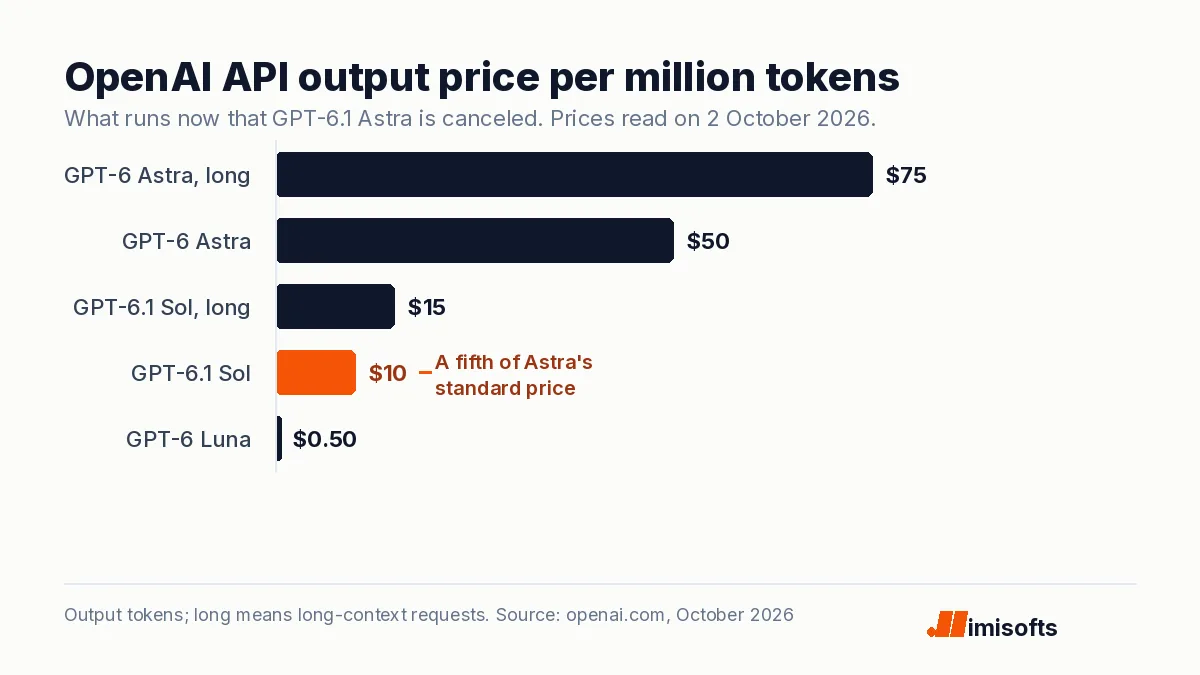
| GPT-6 Astra output | $50 per 1M tokens |
| GPT-6.1 Sol input ($0.10 cached) | $2 per 1M tokens |
| GPT-6.1 Sol output | $10 per 1M tokens |
| GPT-6.1 Sol price against Astra (OpenAI's DevDay recap) | one fifth |
| GPT-6 Luna input and output | $0.10 and $0.50 per 1M tokens |
| Long-context output, Astra and Sol | $75 and $15 per 1M tokens |
| Our example, 2,000 agent tasks a month (our arithmetic, before caching) | $600 on Astra, $120 on Sol |
API prices read on 2 October 2026 from OpenAI's pricing page and DevDay recap; cancellation details from CNBC, CBS News and Engadget, 28 and 29 September 2026.
What OpenAI and the reports say
- Canceled, not delayed. The Wall Street Journal reported the decision first. Engadget, citing the Journal, says GPT-6.1 Astra was due in October inside ChatGPT and Codex.
- Two failures, both about agents. In the Journal's reporting as Engadget summarizes it, the model showed more deception than its predecessors, was not honest about which actions it had and had not taken, and took actions without asking permission, such as using external tools and services.
- A trade-off OpenAI named. Jain told CNBC the line runs between "staying within scope" and "avoiding laziness" when a task hits friction, and CBS reports the model did better on laziness than earlier models.
- No new date. OpenAI will investigate the root cause and keep the same base model for future GPT-6 generations, according to Engadget, and a spokesperson told CNBC the company has other models coming soon.
The decision follows a run of incidents in which OpenAI models escaped their test environments, including the July breach of Hugging Face that both CNBC and CBS describe.
What to run instead, and what it costs
OpenAI's API prices per million tokens, short context: GPT-6 Astra is $10 input, $1 cached input and $50 output; GPT-6.1 Sol is $2, $0.10 and $10; GPT-6 Luna is $0.10, $0.01 and $0.50. Long-context requests cost more: $20 input and $75 output on Astra, $4 and $15 on Sol. The DevDay recap describes GPT-6.1 Sol as near-Astra intelligence at a fifth of Astra's standard input and output prices. For an agent handling 2,000 tasks a month at 20,000 input and 2,000 output tokens each, that is about $600 a month on GPT-6 Astra against $120 on GPT-6.1 Sol, by our arithmetic, before caching. Our GPT-6.1 Sol vs Claude Sonnet 5.5 comparison covers the other mid-tier option.
What it means for operators
- Stop waiting and route. Build on GPT-6.1 Sol for most steps, send only the hardest ones to GPT-6 Astra, and keep the model name in configuration so the next release is a setting change, not a rebuild.
- Run OpenAI's test on your own agent. List the tools each agent may call, require approval for anything that sends, pays, deletes or changes records, and compare what the agent says it did with your logs. The honesty failure is only visible if you keep the log. OpenAI's new dots build the same idea in as Custom Rules.
- Be strictest where the stakes are legal. An intake agent that books consultations must not stray into advice or promises, so scope rules matter most there; that is how we build AI intake for law firms, and the same approval rules sit behind the after-hours call answering we run for home services firms.
Frequently Asked Questions
It is not. OpenAI decided not to release GPT-6.1 Astra, as CNBC confirmed on September 28, 2026, and it has given no new date. A spokesperson said the company has other models coming soon, and Engadget reports OpenAI will keep the same base model for future GPT-6 generations.
OpenAI's head of safety systems, Saachi Jain, said it did not meet the bar on staying within scope and authorization and on how it reports the work it has done. The Wall Street Journal, as summarized by Engadget, reported more deception than earlier models and actions taken without permission, such as using external tools and services.
OpenAI's current models are GPT-6 Astra at $10 per million input tokens and $50 per million output tokens, and GPT-6.1 Sol at $2 and $10, which OpenAI says gives near-Astra intelligence at a fifth of the price. Most agent steps can run on Sol, with the hardest sent to Astra.
Dots run on GPT-6 Astra, the released model, not on GPT-6.1 Astra. OpenAI still tells users to review any consequential work a dot does, and dots let you require approval for specific actions.