September 30, 2026. Anthropic released Claude Sonnet 5.5 on September 28 and OpenAI released GPT-6.1 Sol a day later at DevDay, and the two mid-tier models now carry the same list price: $2 per million input tokens and $10 per million output tokens, with cache writes at $2.50 per million on both. The bills still differ. Cached input costs $0.10 per million on GPT-6.1 Sol and $0.20 on Sonnet 5.5, and once a prompt passes 272,000 input tokens GPT-6.1 Sol charges 2x input and 1.5x output for the whole request, while Anthropic bills Sonnet 5.5's full 1 million token window at standard rates.
Key numbers
| Item | Number |
|---|---|
| Claude Sonnet 5.5 release | September 28, 2026 |
| GPT-6.1 Sol release | September 29, 2026 |
| Input price, both models | $2 per million tokens |
| Output price, both models | $10 per million tokens |
| Cache write, both models (Sonnet 5.5 1 hour writes $4) | $2.50 per million |
| Cache read, GPT-6.1 Sol | $0.10 per million |
| Cache read, Claude Sonnet 5.5 | $0.20 per million |
| GPT-6.1 Sol long-context pricing (2x input, 1.5x output for the request) | above 272,000 input tokens |
| Context window, GPT-6.1 Sol and Sonnet 5.5 | 1,050,000 and 1 million |
| Agent turn: 40K cached, 2K new, 800 out (GPT-6.1 Sol, then Sonnet 5.5) | $0.016 and $0.020 |
| 300K-token document, 2K answer (GPT-6.1 Sol, then Sonnet 5.5) | $1.23 and $0.62 |
| Batch discount, both vendors | 50 percent |
Prices and limits read on 30 September 2026 from OpenAI's API pricing and model pages and Anthropic's pricing and model documentation; worked examples are our arithmetic at list prices.
What launched this week
- Claude Sonnet 5.5, September 28. Anthropic's announcement keeps Sonnet 5's price and says the new model typically needs far fewer tokens, costing up to 30 percent less per task in its testing, and generates output more than 30 percent faster. It has a 1 million token context window and up to 128,000 output tokens. Teams that ran Sonnet with thinking off must switch to a new between_tools setting before moving.
- GPT-6.1 Sol, September 29. OpenAI's announcement prices it at one fifth of GPT-6 Astra's $10 and $50 and says it nearly matches Astra on agentic coding, computer use and professional work. Its model page lists a 1,050,000 token window, 128,000 output tokens and reasoning effort from low to max, with no none or minimal setting. In ChatGPT it runs in Work and Codex for Plus, Pro, Business, Enterprise and Edu users, not yet in Chat.
- The same discounts and surcharges. Both vendors take 50 percent off for batch jobs, $1 in and $5 out, and both add 10 percent for regional or US-only processing.
Where the two bills differ
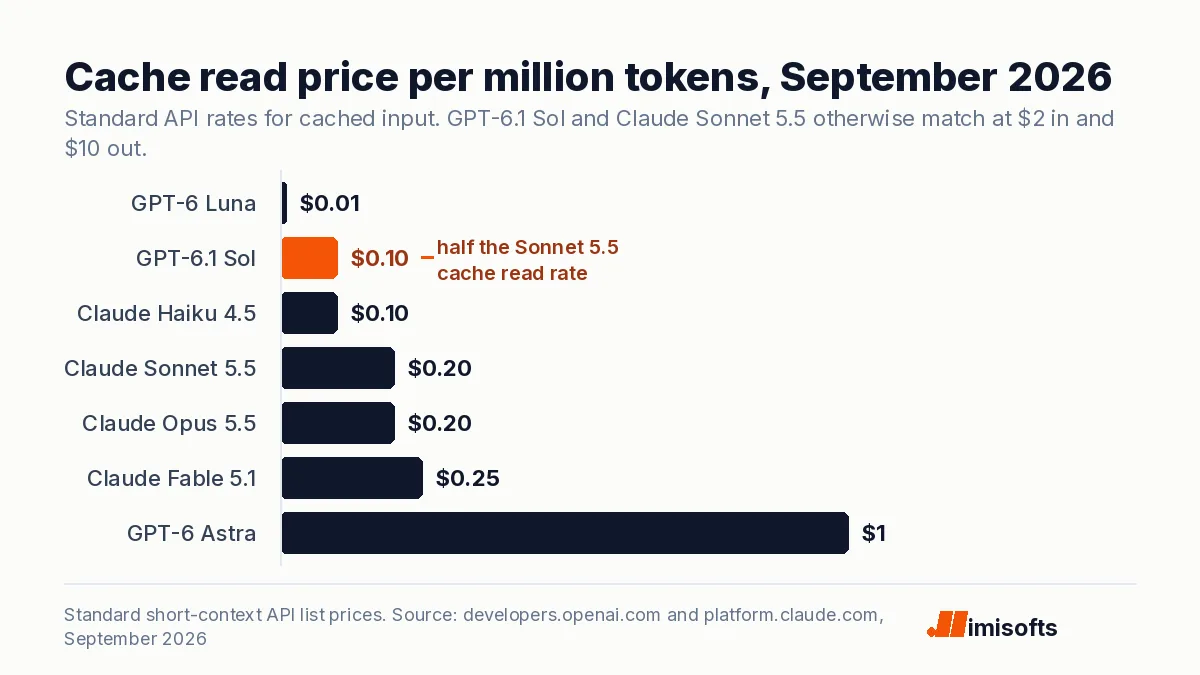
Take a support or sales agent that re-sends a cached 40,000 token context of instructions, tools and history on every turn, adds 2,000 new tokens and writes 800. At list prices that turn costs $0.016 on GPT-6.1 Sol and $0.020 on Sonnet 5.5, or $160 against $200 per 10,000 turns, because the cached read is half the price. Switch to one 300,000 token document with a 2,000 token answer and the order reverses: GPT-6.1 Sol bills the whole request at its long-context rate, $1.23, against $0.62 on Sonnet 5.5. For comparison, cache reads cost $0.01 per million on GPT-6 Luna, $0.10 on Claude Haiku 4.5, $0.20 on Claude Opus 5.5, $0.25 on Claude Fable 5.1 and $1.00 on GPT-6 Astra, per the OpenAI and Anthropic pricing pages.
Those sums assume both models use the same number of tokens, and they will not. A finance firm quoted on Anthropic's launch page reports about 121,000 tokens per answer on Sonnet 5.5 against 497,000 on Sonnet 5, and OpenAI makes its own efficiency claims, so the number that settles it is cost per completed task on your own workload. The New Stack reported both price lists on launch day, for Sonnet 5.5 and for GPT-6.1 Sol.
What it means for operators
Pick by the shape of the work. Agents that carry long, stable prompts, such as a bot that answers customer questions from a policy manual or qualifies inbound leads against a playbook, get the cheaper cache on GPT-6.1 Sol. Work that reads whole contracts, case files or long transcripts above 272,000 tokens is cheaper on Sonnet 5.5. For voice, latency matters more than price: GPT-6.1 Sol always reasons at least at low effort, while Sonnet 5.5 can keep up-front thinking off, which is worth timing before either model sits behind after-hours call answering. Run both on a week of real traffic, log tokens and outcomes per task, and keep your router able to switch, because prices moved twice in September alone. Our AI engineers can run that comparison on your workload, and our model pricing comparison and 272K long-context explainer go deeper on the rates.
Frequently Asked Questions
At list price they are identical for fresh input and output, $2 and $10 per million tokens. GPT-6.1 Sol is cheaper on cached input, $0.10 against $0.20 per million, and Sonnet 5.5 is cheaper on prompts above 272,000 input tokens, where OpenAI charges 2x input and 1.5x output for the full request.
$2 per million input tokens, $10 per million output tokens, $2.50 per million for 5 minute cache writes, $4 for 1 hour writes and $0.20 for cache reads, the same as Sonnet 5. Batch jobs cost half, $1 in and $5 out.
$2 per million input tokens, $0.10 per million cached input tokens, $2.50 per million cache writes and $10 per million output tokens. Prompts over 272,000 input tokens cost 2x the input and cache rates and 1.5x output, and batch and flex processing are 50 percent lower.
GPT-6.1 Sol lists 1,050,000 tokens and Claude Sonnet 5.5 lists 1 million, both with up to 128,000 output tokens. The practical difference is price: Anthropic charges one rate across the whole window, while OpenAI doubles the input rate above 272,000 tokens.