October 3, 2026. The Genesis Mission is the United States government's programme to use artificial intelligence to speed up scientific research. President Trump launched it by executive order on November 24, 2025, put the Department of Energy and its national laboratories in charge of building the platform, and on July 22, 2026 the White House announced "more than $5 billion in Federal commitments" to expand it, with 278 projects selected and more than 15 agencies taking part (White House, July 22, 2026). It is the largest public AI-for-science effort anywhere, it is frequently confused with the administration's "Super Intelligence" vocabulary order of September 29, and it is neither a regulator nor a superintelligence project. This article explains what the mission is, what the money buys, who runs it, what the platform is meant to do, what the programme is not, and what, if anything, it means for a business outside the laboratory.
Key numbers
| Item | Number |
|---|---|
| Executive order launching the Genesis Mission signed (Department of Energy and national laboratories in charge) | November 24, 2025 |
| Federal commitments announced (July 22, 2026; agency pledges, not a single appropriation) | More than $5 billion |
| Projects selected (Energy Secretary Chris Wright, July 22, 2026) | 278 |
| Federal agencies contributing (awards, datasets, facilities) | More than 15 |
| National Science and Technology Challenges (in five themes) | 18 |
| NASA data to be mined with AI (telescopes, orbiters, landers, satellites) | Over 150 petabytes |
| Stated goal for US research output (per the July 22, 2026 release) | Double it |
| Stated horizon for expanding federal R&D productivity (November 2025 fact sheet) | Within a decade |
whitehouse.gov: Launching the Genesis Mission (order and fact sheet, 24 November 2025) and the release of 22 July 2026, all read 3 October 2026.
What the Genesis Mission is
The founding order, titled Launching the Genesis Mission, "charges the Secretary of Energy with leveraging our National Laboratories to unite America's brightest minds, most powerful computers, and vast scientific data into one cooperative system for research", according to the White House fact sheet (fact sheet, November 24, 2025; order). It directs the Department of Energy "to create a closed-loop AI experimentation platform that integrates our Nation's world-class supercomputers and unique data assets to generate scientific foundation models and power robotic laboratories", and tells the President's science adviser to coordinate data and infrastructure from across the federal government. The named priority areas are biotechnology, critical materials, nuclear fission and fusion, space exploration, quantum information science, and semiconductors and microelectronics. The stated ambition is "to dramatically expand the productivity and impact of Federal research and development within a decade", on the diagnosis that "despite research budgets soaring since the 1990s, scientific progress has stalled". The fact sheet's one-line pitch: "Research that once took years could now take weeks or months."
What the $5 billion buys
The July 22, 2026 announcement, made by the White House science adviser Michael Kratsios at a Genesis Mission summit, turned a DOE programme into what the release calls "a whole-of-government initiative". Three things were announced together.
- Money. "More than $5 billion in Federal commitments expanding the Genesis Mission", drawn from more than 15 agencies that "will contribute research awards, funding opportunities, specialized scientific datasets, and research facilities". The release does not break the figure down by agency or year.
- Projects. Energy Secretary Chris Wright: "The 278 projects selected today represent the very best of our nation's scientific enterprise", chosen from what DOE Under Secretary Darío Gil called an "extraordinary response" to the application process.
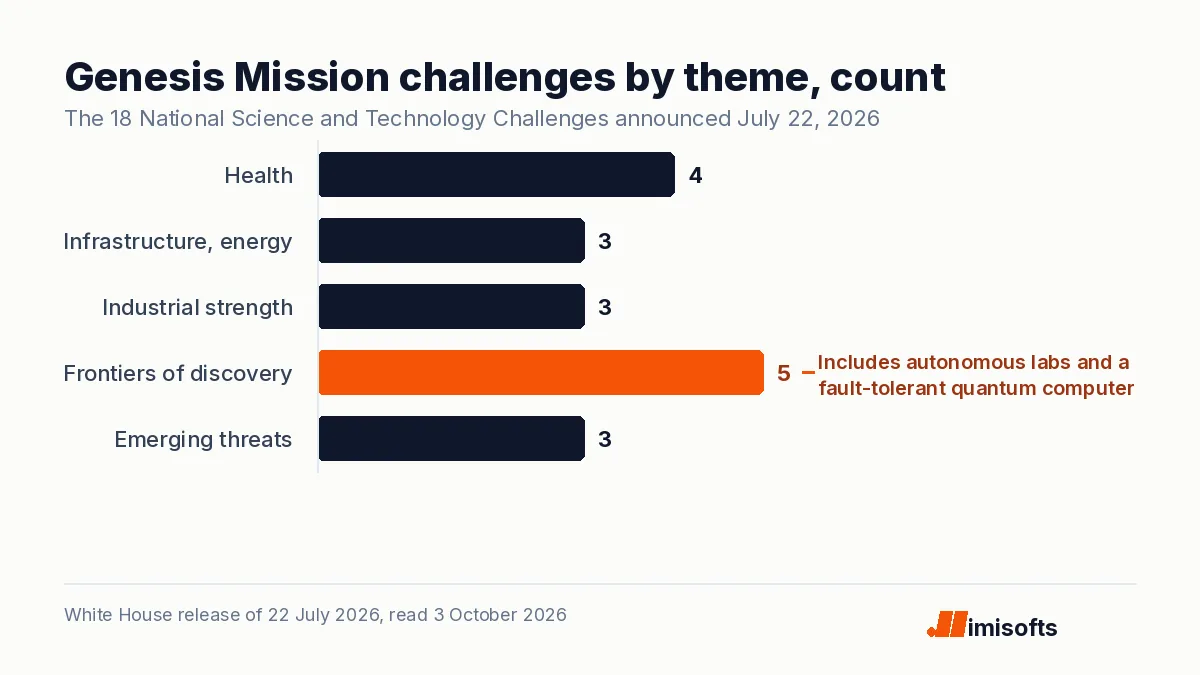
- Challenges. Eighteen National Science and Technology Challenges in five groups, each pairing agency datasets with DOE compute. Under health: finding the root causes of chronic disease, curing paediatric cancer, accelerating drug discovery, and better outcomes for veterans using the Million Veteran Program's genomic data. Under infrastructure and energy: digital twins for roads and buildings, grid planning, and natural-resource stewardship. Under industrial strength: microelectronics "beyond Moore's Law", scaling biology to industrial production, and, with the National Nuclear Security Administration, compressing the design and certification of conventional and nuclear weapon components. Under discovery: mining more than 150 petabytes of NASA data, autonomous laboratories, "the world's first scientifically relevant fault-tolerant quantum computer", predicting living systems, and materials design. Under threats: early detection of biological threats, materials for strategic deterrence, and nuclear forensics.
The same release says the mission aims "to double America's R&D output" and ties it to a report Kratsios published the day before, Science: A New Golden Age. The $5 billion figure is also the one the White House cited in its September 29 fact sheet alongside the Super Intelligence executive order, which is where many readers first saw it.
Who runs it
Coordination sits with the Office of Science and Technology Policy under Kratsios. Delivery sits with the Department of Energy, whose national laboratories hold the supercomputers and much of the data, under Secretary Wright and Under Secretary Gil, formerly IBM's head of research. The July release carries statements from the Secretary of Health and Human Services, the director of the National Institutes of Health, Jay Bhattacharya, who calls the health strand the "Bio Genesis Mission", the Transportation and Interior secretaries, the NASA administrator Jared Isaacman, the acting director of the National Science Foundation, the Under Secretary of War for Research and Engineering, and the chief scientists of the Agriculture Department and NIST. That breadth is the political point: by mid-2026 the programme had been written into the plans of nearly every science-funding agency, which makes it harder to unwind than a single department's initiative.
What the platform is meant to do
The technical core is what the July release calls "the DOE-built American Science and Security Platform, which provides shared infrastructure that connects researchers with data, compute, and AI tools". The founding order's phrase "closed-loop AI experimentation" describes the ambition: an AI system proposes an experiment, a robotic laboratory runs it, the result trains the next model, and the loop repeats without a graduate student in the middle. The "autonomous laboratories" challenge, shared by DOE, HHS, NSF and NIST, is the explicit version, described as "self-driving experimentation at unprecedented scale across scientific domains, which scientists can run and replicate from anywhere in the country". The "scientific foundation models" the order calls for are the same class of system as the language models in commercial use, trained on measurements rather than text. For the mechanism everyone expects this to feed, see recursive self-improvement explained: a loop in which AI designs the experiments that improve AI is the research version of the same idea.
What the Genesis Mission is not
- It is not a superintelligence programme. The order and the release never use the word. The programme funds narrow scientific AI; the September 29 order that renamed AI "Super Intelligence" in federal usage is a separate document that changes vocabulary, not funding; see the Super Intelligence executive order explained.
- It is not a regulator. It sets no rules for AI companies. The regulatory proposals are elsewhere: the voluntary White House accord of September 29 and the Ban Artificial Superintelligence Act of September 23, compared in who wants to ban superintelligence.
- It is not a consumer or business product. Access runs through research awards and the national laboratories. The commercial model labs, OpenAI, Anthropic, Google and the rest, are partners and suppliers at most; the release promises "additional announcements regarding industry, philanthropy, and international engagement".
- It is not an appropriation. "Federal commitments" are agency pledges from existing and planned budgets, not a new line Congress has voted. The number can grow or shrink with the budget cycle.
Why it matters in the AI argument
The Genesis Mission is the administration's answer to the question of what AI is for. While the statement signatories and the Sanders bill argue about whether frontier systems should be built, and the labs argue about who is ahead, the mission puts public money behind the claim that the near-term payoff of AI is faster science: drugs, materials, grid planning, weapons. It is also a bet on public infrastructure, supercomputers and national-lab data, at a time when most frontier compute is private. Whether it works will be visible in a few years in the only metric that matters, discoveries that would not otherwise have happened, and in the interim in whether the 278 projects publish. For the comparison to what private labs claim, see AGI companies ranked by what they have shipped.
What it means for a business outside the laboratory
Directly, very little, unless you sell to universities, national laboratories or the agencies named above, in which case the challenge list is a map of where the next few years of procurement will go: data engineering, laboratory robotics, simulation software, secure compute. Indirectly, two things. First, the datasets and scientific models the programme produces are meant to be shared, so expect better public data in health, materials and energy to show up in commercial tools over the decade. Second, the closed-loop idea scales down. A home services company that lets an AI calling agent answer and book calls, measures which bookings turned into jobs, and feeds that back into the agent's qualification script is running the same loop at small scale: act, measure, improve, without a person in the middle of every cycle. An AI automation agency that builds measurement into every workflow from the first day is applying the Genesis Mission's one transferable principle. The federal government needed $5 billion and 278 projects to set that loop up across science. A business can set it up on one process this month.
What to watch
- The project list. The 278 selected projects and their first published results, which will show whether the platform is being used or merely funded.
- Industry and international partners. The release promised further announcements; which model companies and which allies sign on will show whether the platform competes with or depends on private compute.
- The budget. Whether the commitments survive the next appropriations cycle and whether Congress converts them into a line item.
- The definition of Super Intelligence due around November 28, 2026 under the September 29 order, which could in principle sweep the mission's own models into a new federal category; our page on what super intelligence is covers the stakes.
Frequently Asked Questions
A US government programme, launched by executive order on November 24, 2025, to use artificial intelligence to accelerate scientific research. The Department of Energy and its national laboratories build a shared platform of supercomputers, data and AI tools, and more than 15 federal agencies contribute funding, datasets and facilities to a set of national science challenges.
On July 22, 2026 the White House announced more than $5 billion in federal commitments to expand the mission, alongside 278 selected projects. The figure is a set of agency commitments rather than a single congressional appropriation, and it is the number cited in the White House's September 29, 2026 fact sheet.
The White House Office of Science and Technology Policy under Michael Kratsios coordinates it; the Department of Energy, under Secretary Chris Wright and Under Secretary Dario Gil, builds and operates the American Science and Security Platform. HHS, NIH, NASA, NSF, the Departments of War, Interior, Transportation and Agriculture, NIST and others lead individual challenges.
Eighteen challenges in five groups announced on July 22, 2026: health (chronic disease, paediatric cancer, drug discovery, veterans), infrastructure and energy (digital twins, the grid, natural resources), industrial strength (microelectronics, industrial biology, weapons components), discovery (NASA data, autonomous labs, quantum, living systems, materials) and threats (biological threat detection, deterrence materials, nuclear forensics).
No. The order and the July 2026 release never use the word; the programme funds narrow scientific AI such as foundation models trained on experimental data and autonomous laboratories. The September 29, 2026 executive order that renames AI as Super Intelligence in federal usage is a separate document about vocabulary.
Directly only if you sell to universities, national laboratories or the participating agencies, where the challenge list maps future procurement in data engineering, lab robotics, simulation and secure compute. Indirectly, the shared datasets and models should improve commercial tools over the decade.