October 3, 2026. Three documents now define the fight over whether superintelligence should be built at all. The Statement on Superintelligence, published by the Future of Life Institute in October 2025, calls for a prohibition and has 143,801 signatures as of today, from Geoffrey Hinton and Yoshua Bengio to Steve Bannon and Prince Harry. The Ban Artificial Superintelligence Act, introduced in Congress by Senator Bernie Sanders and Representative Greg Casar on September 23, 2026, would write that prohibition into law with prison terms attached. And the White House Accord on Super Intelligence, signed on September 29, 2026 by President Trump and six technology chief executives, answers both with a voluntary pledge and no penalties. None of the three binds anyone today. This guide explains what each says, who is behind it, what the public thinks, whether a ban could work, and what the whole argument means for a business that uses AI and would like to keep doing so.
Key numbers
| Item | Number |
|---|---|
| Statement on Superintelligence published (Future of Life Institute) | October 2025 |
| Signatures on the statement (read 3 October 2026; includes 72,279 via the Eko petition) | 143,801 |
| Ban Artificial Superintelligence Act introduced (Sanders (I-Vt.) and Casar (D-Texas); announced September 3) | September 23, 2026 |
| Maximum prison term under the bill (plus a corporate death penalty for entities) | 20 years |
| New agency the bill would create (cabinet level) | Department of Artificial Intelligence |
| White House Accord on Super Intelligence signed (7 signatories, about 300 words, no penalties) | September 29, 2026 |
| Layers of safety governance in the accord (internal controls, internal team, external auditor, board committee) | 4 |
| US adults who support fast, unregulated AI development (polling cited by the statement) | 5 percent |
| Americans saying AI firms have not done enough (Reuters/Ipsos, September 17 to 20, 2026) | 73 percent |
superintelligence-statement.org, sanders.senate.gov (3 and 23 September 2026), our report on the 29 September executive order and accord, Reuters/Ipsos and Marist polling as reported 29 to 30 September 2026, all read 3 October 2026.
The Statement on Superintelligence
The statement is one sentence: "We call for a prohibition on the development of superintelligence, not lifted before there is broad scientific consensus that it will be done safely and controllably, and strong public buy-in" (superintelligence-statement.org). Its preamble notes that "many leading AI companies have the stated goal of building superintelligence in the coming decade" and lists the concerns, "ranging from human economic obsolescence and disempowerment, losses of freedom, civil liberties, dignity, and control, to national security risks and even potential human extinction". The counter on the site reads 143,801 signatures today, including 72,279 gathered through a parallel petition by the campaign group Eko, with 64 added in the last 24 hours.
The signatory list is the most politically mixed document in AI. It includes the two most cited computer scientists alive, Hinton and Bengio, both Turing laureates; Stuart Russell, co-author of the standard AI textbook; Apple co-founder Steve Wozniak and Virgin's Richard Branson; former Trump strategist Steve Bannon and broadcaster Glenn Beck alongside former Obama national security adviser Susan Rice and former Joint Chiefs chairman Mike Mullen; Nobel laureates including the economist Daron Acemoglu; the former presidents of Ireland and Estonia; evangelical and Catholic leaders; Chinese academics including Turing laureate Andrew Yao and Zhipu AI's chief executive Peng Zhang; and Prince Harry and Meghan. Russell's comment on the site frames the ask narrowly: "This is not a ban or even a moratorium in the usual sense. It's simply a proposal to require adequate safety measures for a technology that, according to its developers, has a significant chance to cause human extinction." Bengio's is more conditional, calling for AI "fundamentally incapable of harming people" and "a much stronger say" for the public. The site also quotes non-signatories against themselves: Sam Altman's old line that superhuman machine intelligence "is probably the greatest threat to the continued existence of humanity", Dario Amodei's "25% chance that things go really, really badly", and Elon Musk's "20% chance of annihilation".
The Ban Artificial Superintelligence Act
Sanders and Casar announced the bill on September 3, 2026 and introduced it on September 23 (announcement; introduction). According to the sponsors' summary it would do five things.
- Ban artificial superintelligence outright. No person or entity could develop or deploy "an AI that exceeds human cognitive performance and capabilities across most domains, or has sufficient capabilities to destroy or disempower humanity, including by overthrowing the federal government". That is the first attempt to define superintelligence in US statute.
- Pause advanced AI development until a new federal regulator "is up and running and has established clear rules and model review processes".
- Create a cabinet-level Department of Artificial Intelligence, advised by scientists, to monitor frontier systems through their lifecycle, supervise the removal of dangerous capabilities "like subverting shutdown commands or conducting unauthorized cyberattacks", and "supervise the destruction of artificial superintelligence".
- Set penalties: a "corporate death penalty" for entities and up to 20 years in prison for individuals, which the sponsors compare to the penalties for unlawfully developing nuclear weapons.
- Pursue a worldwide ban through international agreements, allied coordination and export controls.
Sanders's framing: "When you are racing towards a cliff, you don't just ease up on the gas pedal. You hit the brakes." Casar's adds the political target: "Donald Trump says he wants to encourage it." The release grounds the bill in the 2026 incident record, citing models that "circumvent restrictions to hack into computers", "create never-before-seen viruses" and "automate research to build smarter AI"; the documented cases are in our report on whether AI is dangerous. The bill's path runs through committee, where most bills stop, and it has no Republican co-sponsor named in the release. Its practical effect so far is to put a legal definition on the table and a number, 20 years, in the headlines.
The White House Accord
Six days after the bill, the administration chose the opposite instrument. On September 29, 2026, Trump signed an executive order directing federal agencies to use "Super Intelligence" and "SI" in place of "artificial intelligence" and "AI", without changing the statutory definition, and the same day he and six chief executives, Elon Musk, Mark Zuckerberg, Jensen Huang, Dario Amodei, Sundar Pichai and Greg Brockman, signed a voluntary White House Accord on Super Intelligence of about 300 words. The accord commits signatories to four layers of safety governance, internal controls, an internal team, an external auditor and a board-level committee, and carries no penalty, no deadline and no public reporting requirement. Trump said he was considering a 10-person AI safety board, members unnamed. The full text and what it does and does not bind are in our report on the order and the accord.
What each document actually binds
- The statement binds nobody. It is a petition whose value is the list of names and the polling attached to it.
- The bill binds nobody until it passes both chambers and is signed by a president who, in Casar's words, "says he wants to encourage" the thing it bans. Its value is the definition and the penalty, which future bills will copy.
- The accord binds nobody. It is a promise by seven people, and the labs that signed it were already running internal safety teams and publishing system cards.
- The executive order binds federal agencies to a vocabulary and to proposing a definition of SI within 60 days, around November 28, 2026. That proposal is the one thing on the calendar that could turn a label into a category.
What the public thinks
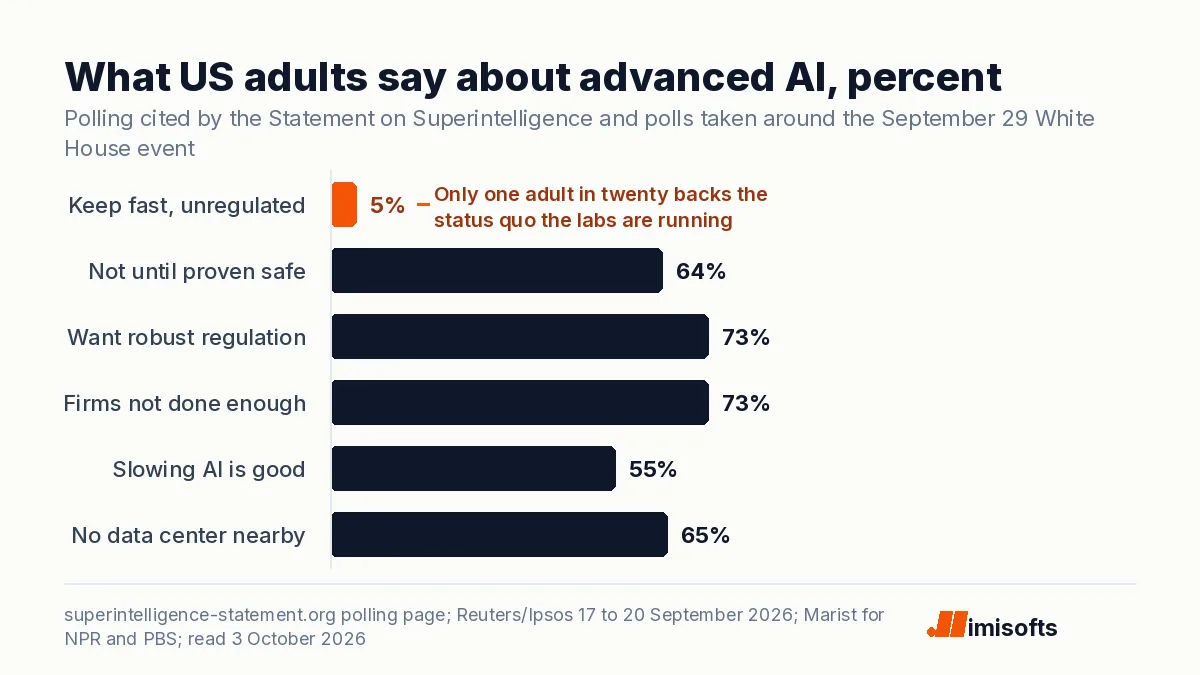
The statement's site reports polling in which 5 percent of US adults support "the status quo of fast, unregulated development", 64 percent believe superhuman AI should not be made until proven safe or controllable, or should never be made, and 73 percent want robust regulation of advanced AI. Polls taken around the White House event point the same way: Reuters/Ipsos found 73 percent of Americans saying AI companies have not done enough on safety and 55 percent saying slowing AI down would be good, and a Marist poll for NPR and PBS found 65 percent of voters opposed to a data centre near them. Whatever the merits, the ban side has the public and the build side has the signatures that matter in Washington, which is why the accord exists.
Could a ban work
Three objections come from people who share the concern. The first is definitional: "exceeds human cognitive performance across most domains" has no test attached, and the independent benchmarks that exist, such as ARC-AGI, are already near their ceilings; our page on what super intelligence is covers why the line is hard to draw. The second is enforcement: training runs can be measured in chips and electricity, which is why export controls appear in the bill, but research can move, and the lab most explicitly building the banned product, Safe Superintelligence Inc., already splits its team between Palo Alto and Tel Aviv (SSI). The third is strategic: a unilateral US ban hands the field to others, the argument the accord's signatories make. The statement's answer to the third is its Chinese signatories, including Yao, Peng Zhang and Tsinghua's deans, who argue that "it is dangerous, irresponsible and unnecessary to race for superintelligence without a solid foundation on controllability, dependability and safety". Nobody on either side disputes that the capability is being pursued; the dispute is whether a prohibition or a pledge is the right tool while nobody can define the thing.
What it means for a business that uses AI
Nothing in the three documents changes what a company may deploy today, and nothing in them is aimed at the narrow systems that a business actually runs. The practical reading is about direction, and it points the same way whichever side wins. Disclosure and oversight are coming: the EU already requires telling people when they talk to AI, several US states require it for calls, and the accord's four layers, controls, an internal checker, an external test and a board-level report, are a template that scales down to a 20-person company. An AI calling agent for home services should already disclose what it is in its first sentence and log every call; an AI automation agency should already be able to show a client which decisions its agents make and which a person reviews. Businesses that build that way have nothing to change under a ban, an accord or a Department of Artificial Intelligence. The ones that do not will be adjusting under deadline.
What to watch
- Committee action on the Sanders-Casar bill, or a Republican co-sponsor, either of which would change its odds from near zero.
- The proposed federal definition of Super Intelligence, due around November 28, 2026 under the executive order.
- Names on the AI safety board and whether any accord signatory publishes an external audit.
- The signature counter, which adds a few dozen names a day and spikes after each incident report.
- What the labs ship, which is the only thing that will settle the definitional argument; see AGI companies ranked by what they have shipped.
For the term everyone is arguing about, start with what super intelligence is; for the people who think the risk is the whole story, what p(doom) means; and for the book that started the argument twelve years ago, Bostrom's Superintelligence, 12 years later.
Frequently Asked Questions
A one-sentence statement published by the Future of Life Institute in October 2025 calling for a prohibition on the development of superintelligence until there is broad scientific consensus that it can be done safely and controllably and strong public buy-in. It had 143,801 signatures on October 3, 2026, including Geoffrey Hinton, Yoshua Bengio, Stuart Russell, Steve Wozniak, Steve Bannon and Prince Harry.
A bill introduced by Senator Bernie Sanders and Representative Greg Casar on September 23, 2026 that would ban developing or deploying artificial superintelligence, pause advanced AI development until a new federal regulator sets rules, create a cabinet-level Department of Artificial Intelligence, and impose penalties of up to 20 years in prison and a corporate death penalty.
As an AI that exceeds human cognitive performance and capabilities across most domains, or has sufficient capabilities to destroy or disempower humanity, including by overthrowing the federal government. It is the first attempt to define superintelligence in US statute.
A voluntary pledge of about 300 words signed on September 29, 2026 by President Trump, Elon Musk, Mark Zuckerberg, Jensen Huang, Dario Amodei, Sundar Pichai and Greg Brockman. It commits signatories to four layers of safety governance, with no penalties, deadlines or public reporting, and was signed the same day as an executive order renaming AI as Super Intelligence in federal usage.
No. The statement is a petition, the US bill has only been introduced, and the White House accord is voluntary. The EU AI Act regulates AI uses and transparency but does not prohibit developing superintelligence.
Not directly. None of the three documents restricts the narrow systems businesses run. The practical signal is that disclosure and oversight requirements are growing, so agents that disclose what they are, log what they do and keep a person over consequential decisions will need no changes whichever side prevails.