Short answer. Gemini 4 Neon costs $3.00 per 1M input tokens and $15.00 per 1M output tokens, thinking tokens included, on the paid tier of the Gemini API. Google's release notes list it as generally available in an entry dated November 18, 2026, and its pricing page, read on November 19, shows Batch and Flex at half that ($1.50 and $7.50) and Priority at $5.40 and $27.00. Neon is not on the free tier. Through November 30 it costs more than Gemini 4 Argon and Carbon, which list at $2.00 and $10.00; from December 1, when those two move to $4.00 and $20.00, Neon is 25% cheaper.
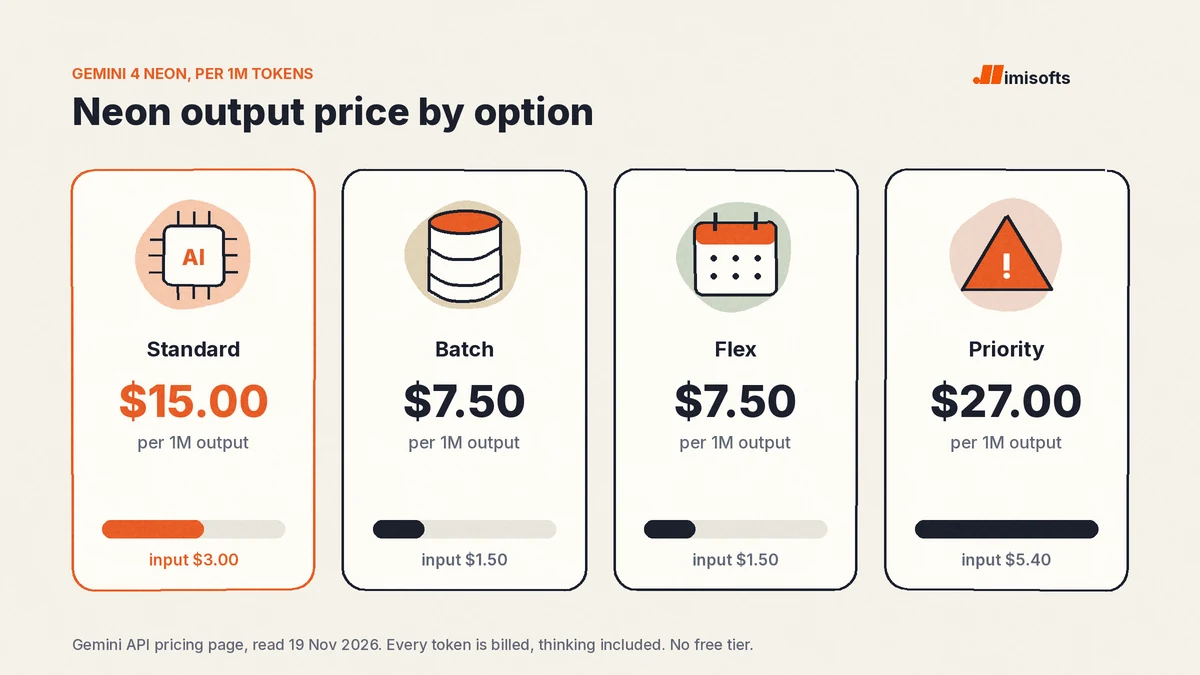
This guide covers Neon's published token rates, where it sits in the Gemini 4 family, what gets billed (thinking, caching, grounding), the limits that matter for agents, and a worked monthly bill. Prices are per 1M tokens in US dollars.
Key numbers
| Item | Number |
|---|---|
| Gemini 4 Neon input, per 1M tokens | $3.00 |
| Gemini 4 Neon output incl. thinking, per 1M tokens | $15.00 |
| Cached input at Standard, per 1M tokens (implicit caching only) | $0.15 |
| Batch and Flex, input and output | $1.50 and $7.50 |
| Priority, input and output | $5.40 and $27.00 |
| Free tier | Not available |
| Argon and Carbon from December 1, 2026 ($2.00 and $10.00 through November 30) | $4.00 and $20.00 |
| Context window (65,536 output by default) | 1,048,576 tokens |
| Search grounding (shared across Gemini 3 and newer models; 1,500 a day cap) | 5,000 free a month, then $14 per 1,000 |
| Release notes entry dated | November 18, 2026 |
| Worked example, 10,000 runs on Neon Standard (hypothetical) | $1,350.00 a month |
Prices and limits read on 19 November 2026 from Google's Gemini API pricing page, release notes, Neon model page and deprecations page; comparisons and the worked example are our arithmetic.
Gemini 4 Neon prices per 1M tokens
| Option | Input | Output | Cached input |
|---|---|---|---|
| Standard | $3.00 | $15.00 | $0.15 |
| Batch | $1.50 | $7.50 | $0.075 |
| Flex | $1.50 | $7.50 | $0.075 |
| Priority | $5.40 | $27.00 | $0.27 |
| Free tier | Not available | ||
By our arithmetic, Batch and Flex are 50% of Standard and Priority is 1.8 times Standard on every line. The pricing page notes that "Every token the model processes is counted and billed, including thinking tokens". Google's what's new page says Neon "is available on the paid tier of the Gemini API (across both generateContent and the Interactions API) and with Google AI Pro and Ultra plans in Google AI Studio."
Where Neon sits in the Gemini 4 family
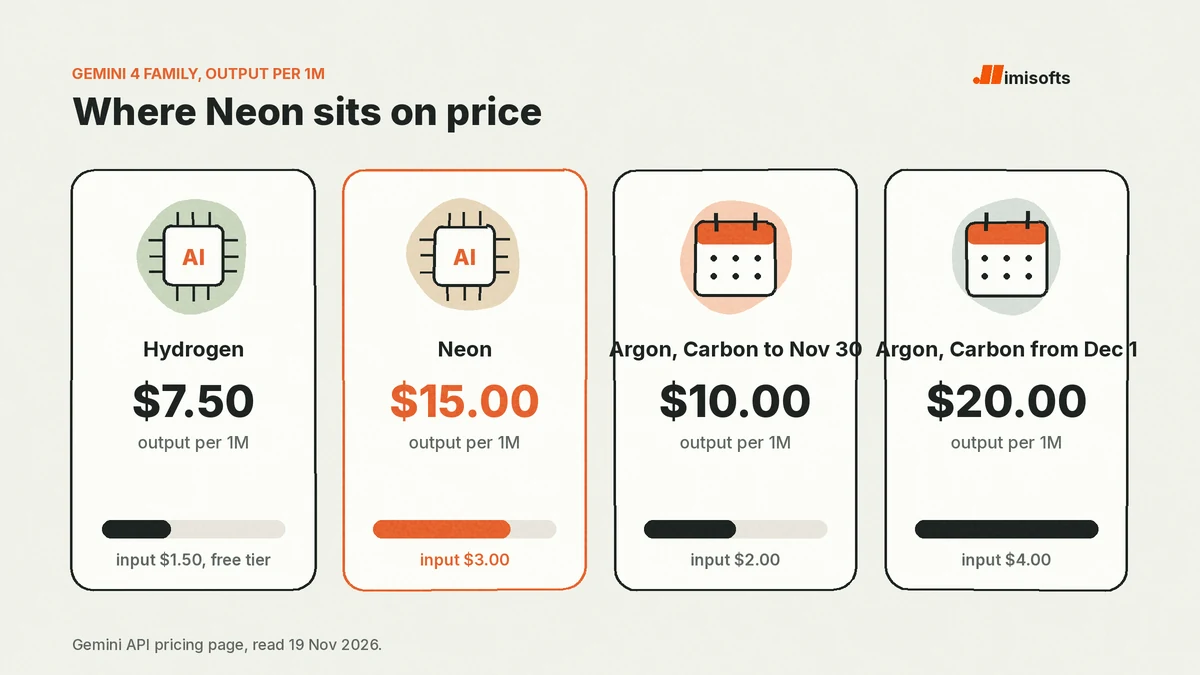
Google describes Neon as sitting "between Gemini 4 Hydrogen and Gemini 4 Carbon for high-frequency complex tasks." On price, where it sits depends on the date, because Argon and Carbon change on December 1.
| Model (release date) | Input / output through Nov 30 | Input / output from Dec 1 | Free tier |
|---|---|---|---|
| Gemini 4 Hydrogen (Nov 12) | $1.50 / $7.50 | $1.50 / $7.50 | Yes |
| Gemini 4 Neon (Nov 18) | $3.00 / $15.00 | $3.00 / $15.00 | No |
| Gemini 4 Argon (Oct 13) | $2.00 / $10.00 | $4.00 / $20.00 | No |
| Gemini 4 Carbon (Nov 10) | $2.00 / $10.00 | $4.00 / $20.00 | No |
The dates are those listed on Google's deprecations page, which lists no shutdown date for any of the four; for Hydrogen and Neon the pricing page shows no dated price change as of November 19. Neon costs twice Hydrogen on input and output. Through November 30 it costs 50% more than Argon and Carbon; from December 1 it costs 25% less. Google's own guidance: "Use Carbon for your hardest architecture, debugging, science, and security problems. Keep Hydrogen as the default for everyday coding and agentic workflows, and Gemini 3.5 Flash-Lite for high-volume, low-latency tasks." Our earlier guides cover Gemini 4 Hydrogen, Gemini 4 Carbon pricing and Gemini 4 Argon pricing.
Against OpenAI, read the same day on OpenAI's pricing page: GPT-6.2 Sol lists at $2.00 and $10.00 and GPT-6.2 Astra at $8.00 and $40.00, so Neon's Standard rate sits between the two (see our GPT-6.2 pricing guide). Our AI model API pricing comparison covers more vendors.
What gets billed: thinking, caching and grounding
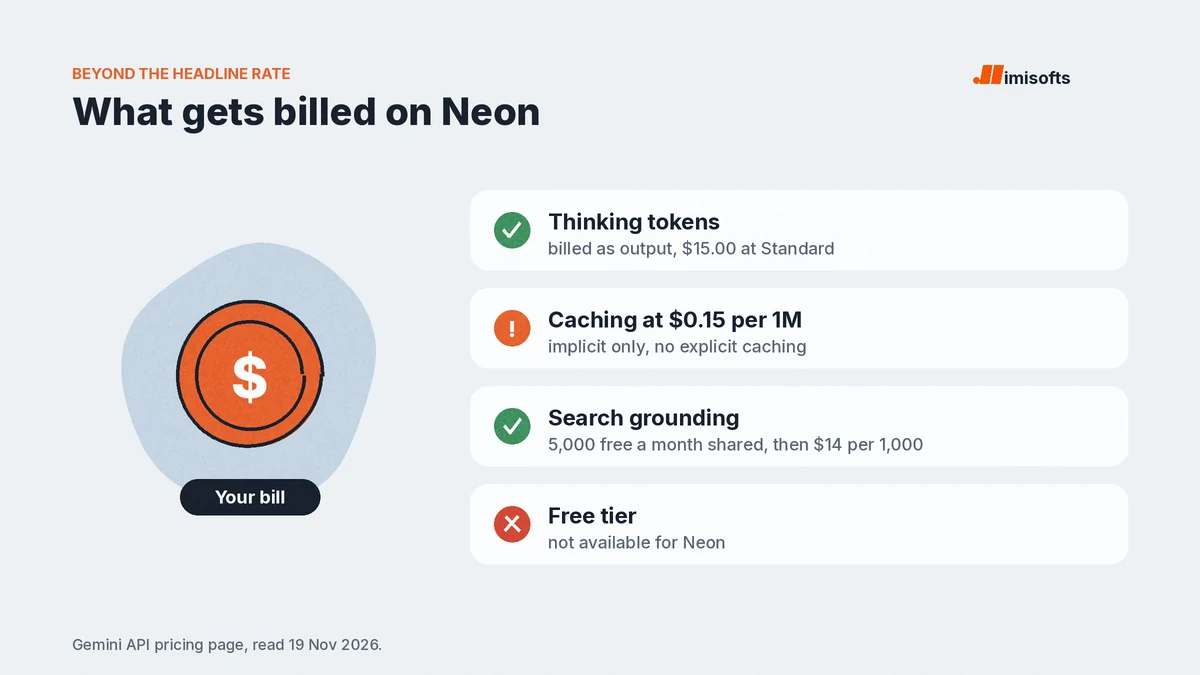
The pricing page puts it plainly: "Every token the model processes is counted and billed, including thinking tokens and internal tool system instructions and function declarations when using grounding." Three things move a Neon bill beyond the headline rate.
- Thinking level. Neon supports four levels: low, medium, high (the default) and xhigh. Thinking tokens are billed as output (the Standard output rate is $15.00), and Google says "Using xhigh increases latency and token use."
- Caching. Cached input costs $0.15 per 1M at Standard rates, 5% of the input rate. The page says "Implicit caching only (explicit caching is not supported)."
- Grounding with Google Search. 5,000 search requests a month are free, "shared across all Gemini 3 and newer models", then $14 per 1,000 requests, "subject to a daily cap of 1,500 requests per day". Grounding with Google Maps also lists 5,000 free requests a month, shared across Gemini 3 and newer models, then $14 per 1,000 queries.
On the paid tier, the pricing page lists "Used to improve our products" as No for Neon.
Google's what's new page describes the four thinking levels this way:
| Thinking level | Google's description | Google's suggested use |
|---|---|---|
| low | Fewest tokens, lowest latency | Cost- and latency-sensitive work such as fast chat and high-throughput processing |
| medium | Lower token use, faster responses | Interactive coding, responsive chat, latency-sensitive tool calls |
| high (default) | Balanced intelligence and speed | Most tasks, including agentic execution and tool calling |
| xhigh | Most tokens, deepest reasoning | Hard, multi-step problems where high falls short |
Google does not publish how many thinking tokens each level uses, so we would run our own prompts at each level and measure the tokens billed.
Context window, output limit and what Neon cannot do
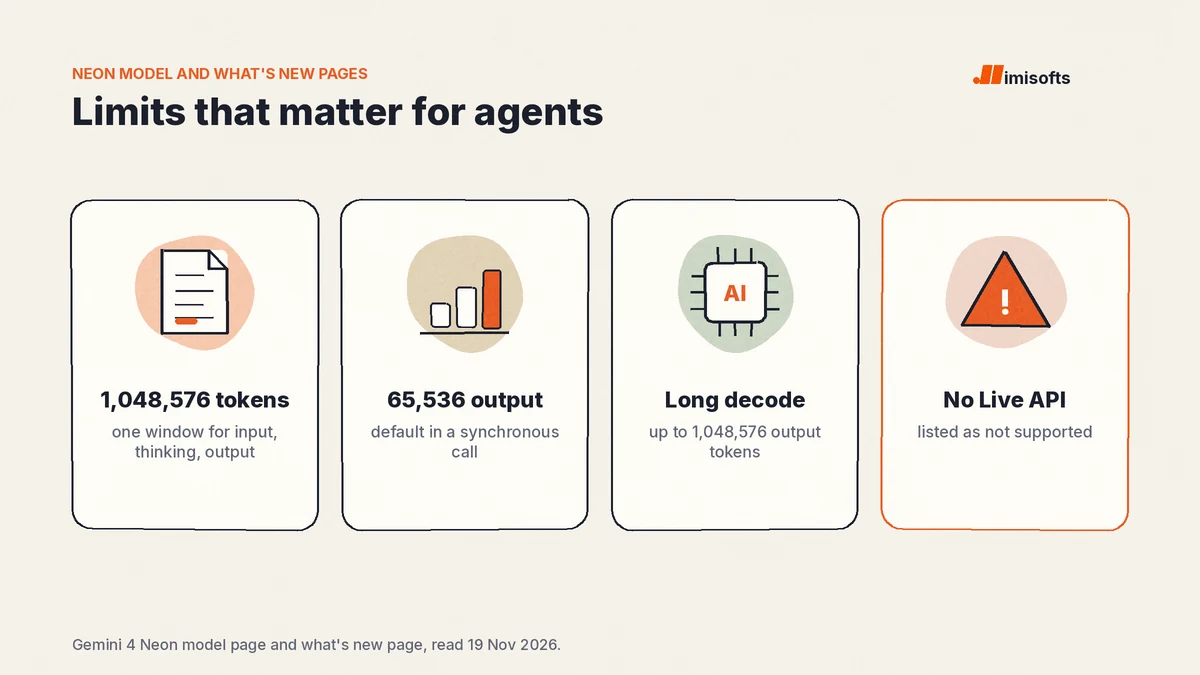
From the Neon model page and Google's what's new page:
- Context: 1,048,576 tokens. The what's new page says input, thinking and output tokens "share one 1,048,576-token window."
- Output: 65,536 tokens by default in a synchronous call, up to 1,048,576 with long decode (model page); the what's new page says responses can run past 64K "using background execution or client-side continuation."
- Inputs: text, image, video, audio and PDF; output is text only.
- Supported: function calling, structured outputs, code execution, computer use, file search, URL context, grounding, and Batch, Flex and Priority inference.
- Not supported: the Live API, audio generation and image generation.
Neon also runs inside Gemini Managed Agents: Google says the Antigravity agent "supports gemini-4-neon, either standalone or paired with Hydrogen in multi-model workflows." The model page lists the Live API as not supported. On our reading, that makes Neon a fit for work around a call rather than the live call itself, such as researching an account before a sequence starts or turning a long call transcript into a CRM update.
Paying for less input: file slicing
A separate release notes item, also dated November 18, added a cost lever to the Gemini API; the item does not say which models support it, and the Neon model page lists its inputs as text, image, video, audio and PDF. It says you can now pass Word, PowerPoint and Excel files directly, and "slice documents, spreadsheets, videos, and audio in user prompts and function responses." The entry lists the slices: page ranges, worksheet tabs, cell ranges, time intervals, or content layers "(such as page images, extracted text, formulas, or video transcripts) so you only process and pay for the content you need."
For an agent that reads long files, slicing can reduce input tokens. For example, a research agent that only needs one worksheet tab of a prospect's spreadsheet, or the extracted text of a long PDF rather than its page images, could send that slice instead of the whole file. We would measure the input tokens before and after on a few real files before counting on a saving, because the item publishes no token counts.
What an agent workload costs per month
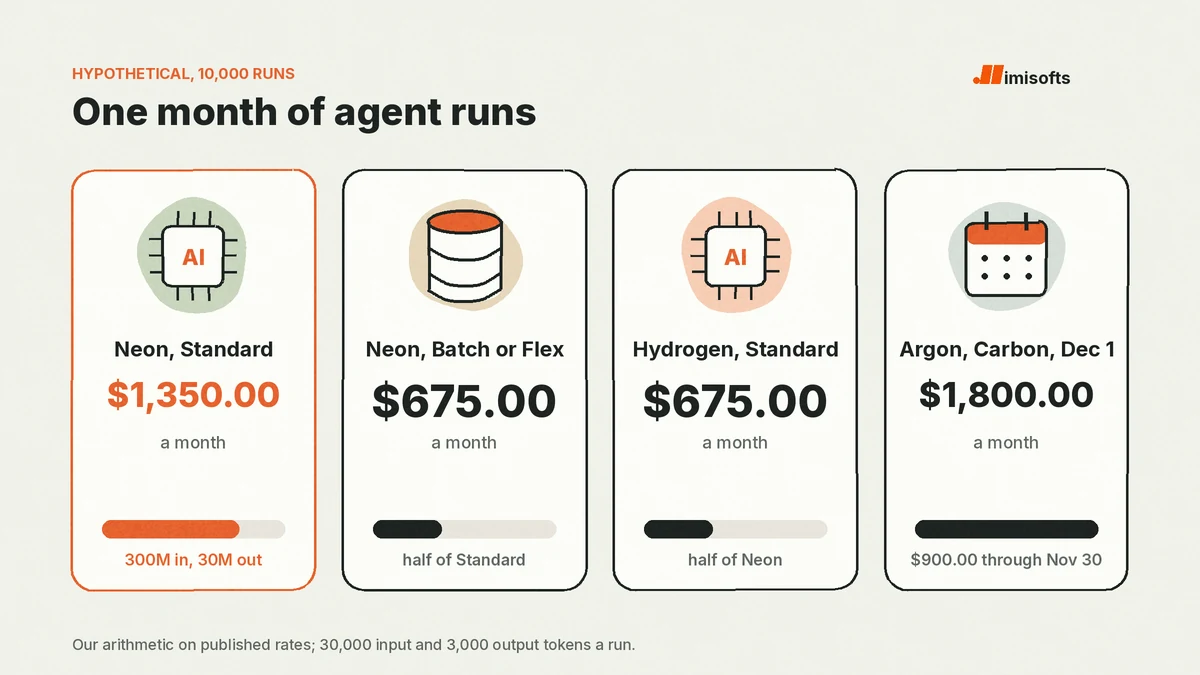
Take a hypothetical research agent that runs 10,000 times a month, reading 30,000 input tokens and writing 3,000 output tokens (thinking included) per run: 300M input and 30M output tokens. All figures are our arithmetic on the published rates.
| Model and option | Monthly cost | Per run |
|---|---|---|
| Gemini 4 Neon, Standard | $1,350.00 | $0.135 |
| Gemini 4 Neon, Batch or Flex | $675.00 | $0.0675 |
| Gemini 4 Neon, Priority | $2,430.00 | $0.243 |
| Gemini 4 Neon, half the input at the cache rate | $922.50 | $0.09225 |
| Gemini 4 Hydrogen, Standard | $675.00 | $0.0675 |
| Gemini 4 Argon or Carbon, through Nov 30 | $900.00 | $0.09 |
| Gemini 4 Argon or Carbon, from Dec 1 | $1,800.00 | $0.18 |
| GPT-6.2 Sol, Standard | $900.00 | $0.09 |
Two lines stand out. A job you can run on Batch costs the same on Neon as on Hydrogen Standard, $675.00. And a team that picked Argon or Carbon for this kind of work will see that line double on December 1, from $900.00 to $1,800.00, while Neon Standard stays at $1,350.00. If the agent grounds 6,000 requests in Google Search in a month and no other Gemini 3 or newer model used the free allowance, the search-request fee is $14.00, before the extra tokens that grounding adds to the bill.
When Neon is worth the price
These are our suggestions.
- Run your own test first. Google's quality claims are its own; test them. Run 50 of your real tasks on Hydrogen and on Neon, at the high and the low thinking levels, and compare the output and the token counts.
- Plan any switch for December 1. Until November 30, Argon and Carbon are cheaper ($900.00 against $1,350.00 in our example); from December 1 Neon is the cheaper of the three at Standard rates. Keep Carbon for the problems Google points it at.
- Send suitable work to Batch or Flex. Both list at half the Standard rate.
- Measure the thinking level. Google says xhigh "increases latency and token use"; measure it before changing model.
- Prototype on a free tier with care. Neon has no free tier. Hydrogen's free tier, covered in our Gemini API free tier limits guide, costs nothing, but the pricing page lists free-tier use as "Used to improve our products: Yes", so keep customer data off it.
If you want help choosing a model for each agent step, see our AI automation agency services and our AI calling for home services page. For where agents fit in a sales process, see our sales automation software guide.
Frequently Asked Questions
Gemini 4 Neon costs $3.00 per 1M input tokens and $15.00 per 1M output tokens, thinking tokens included, at Standard rates on the paid tier. Cached input is $0.15 per 1M. Prices are from Google's Gemini API pricing page, read on November 19, 2026.
No. The pricing page says Gemini 4 Neon is not available on the Free tier. Google says Neon is also available with Google AI Pro and Ultra plans in Google AI Studio; we could not confirm whether those plans include API usage. Of the four Gemini 4 models covered here, only Hydrogen has a free tier.
Yes. Batch and Flex both cost $1.50 per 1M input tokens and $7.50 per 1M output tokens, half the Standard rate. Priority costs $5.40 and $27.00, 1.8 times Standard.
At Standard rates, not until December 1, 2026. Through November 30, Carbon and Argon list at $2.00 and $10.00, below Neon's $3.00 and $15.00. From December 1 they list at $4.00 and $20.00, so Neon becomes 25% cheaper.
1,048,576 tokens; Google's what's new page says input, thinking and output share that window. A synchronous call returns up to 65,536 output tokens by default, and long decode allows up to 1,048,576.
Not through the Live API: the model page lists the Live API, audio generation and image generation as not supported, and its output is text only. It accepts audio as an input.