November 12, 2026. Google released Gemini 4 Hydrogen today, the fast model in its Gemini 4 family, at $1.50 per million input tokens and $7.50 per million output tokens on the paid Gemini API, flat across its 1 million-token context window. Unlike Gemini 4 Carbon, Hydrogen is also on the API free tier, and Google says it is now in Google Search for all users globally and in the Gemini app model menu. Google calls the Search change "the biggest model upgrade to Search yet."
Key numbers
| Item | Number |
|---|---|
| Standard input per 1M tokens (flat across the 1M-token context window) | $1.50 |
| Standard output per 1M tokens (includes thinking tokens) | $7.50 |
| Batch input and output per 1M (half the Standard rate) | $0.75 and $3.75 |
| Priority input and output per 1M (1.8 times Standard) | $2.70 and $13.50 |
| Context caching per 1M tokens (implicit caching only) | $0.075 |
| Gemini 3.8 Flash from January 1, 2027 (same as Hydrogen; $0.75 and $3.75 until then) | $1.50 and $7.50 |
| Hypothetical 1,000 tasks, 20K in and 4K out ($30 on Batch; $80 on Carbon now) | $60 |
| Artificial Analysis Intelligence Index, per Google (default high setting; 54 at xhigh; Argon 50) | 51 |
Prices read on 12 November 2026 from Google's Gemini API pricing page; other figures from Google's November 12 launch posts.
What Google announced on November 12
- A new everyday model. Google's launch post says Carbon and Argon handle "deep, long-horizon reasoning" while Hydrogen "is built for rapid execution across diverse agentic workflows." 9to5Google notes that Google unveiled Hydrogen instead of keeping the "Flash" branding.
- Price. $1.50 input and $7.50 output per million tokens, with the same rate at every context length, per the launch post and the Gemini API pricing page.
- Four thinking levels. Low, medium, high (the default) and a new xhigh tier. Thinking tokens are billed as output.
- Google's benchmark claims. Google says Hydrogen scores 51 on the Artificial Analysis Intelligence Index at its default high setting (54 at xhigh) against 50 for Argon, finishes tasks 2.5 times faster than Gemini 3.8 Flash and scores 57% on Terminal-Bench 4.1 against 18.2% for 3.8 Flash. These are Google's own figures.
- Orchestrator in Google Antigravity. A new feature that switches between Carbon and Hydrogen in one session. Google says it reached "near-Carbon task success rates" on Terminal-Bench 4.0 while using 24% less quota on average.
- A Search upgrade. Google's Search post says Hydrogen is "available globally in Google Search for all users," with an upgraded query fan-out that connects people "to a broader range of helpful links than before."
Gemini 4 Hydrogen API price by tier
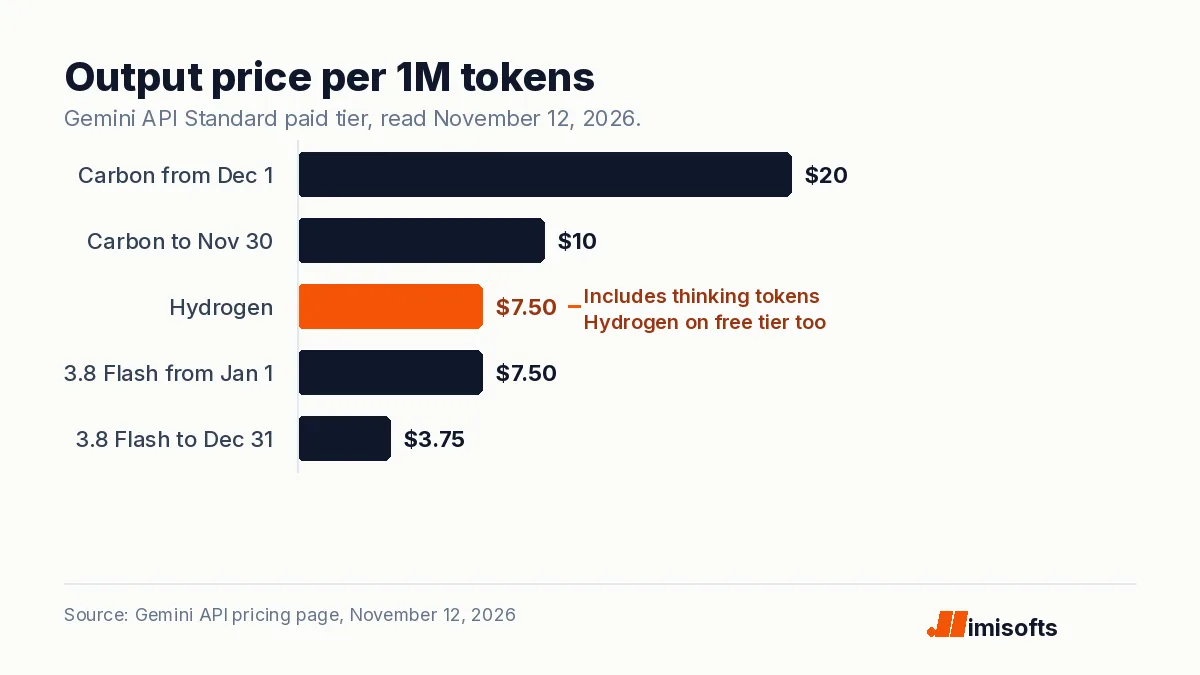
These are the rates on Google's Gemini API pricing page when we read it on November 12, 2026, per million tokens. Output prices include thinking tokens, and Google notes that "every token the model processes is counted and billed."
| Model and tier | Input | Output | Free tier |
|---|---|---|---|
| Gemini 4 Hydrogen, Standard | $1.50 | $7.50 | Yes |
| Gemini 4 Hydrogen, Batch | $0.75 | $3.75 | No |
| Gemini 4 Hydrogen, Priority | $2.70 | $13.50 | Yes |
| Gemini 3.8 Flash, to Dec 31, 2026 | $0.75 | $3.75 | Yes |
| Gemini 3.8 Flash, from Jan 1, 2027 | $1.50 | $7.50 | Yes |
| Gemini 4 Carbon, to Nov 30, 2026 | $2.00 | $10.00 | No |
| Gemini 4 Carbon, from Dec 1, 2026 | $4.00 | $20.00 | No |
Context caching is $0.075 per million tokens, implicit only. Grounding with Google Search is not on the free tier; paid users get 5,000 grounded requests a month shared across Gemini 3 and newer models, then $14 per 1,000, subject to a daily cap of 1,500 requests. Batch is half the Standard rate and Priority is 1.8 times it. On the free tier, the pricing page says your data is used to improve Google's products; on the paid tier it is not.
What a Hydrogen workload costs
Take a hypothetical agent job of 1,000 tasks, each reading 20,000 tokens and writing 4,000. On Hydrogen Standard that is $60, or $30 on Batch. The same token counts cost $80 on Carbon today and $160 after its December 1 rate change. On Gemini 3.8 Flash they cost $30 this year and $60 from January 1, 2027, when its rates double to exactly Hydrogen's price.
Token counts will not stay equal. Partners quoted by Google report Hydrogen using 12% to 23% fewer tokens than 3.8 Flash on their workloads, and higher thinking levels add thinking tokens. Run your own prompts on both models before switching, since Hydrogen costs twice 3.8 Flash's current per-token rate.
Where you can use Gemini 4 Hydrogen
- Developers: the Gemini API in Google AI Studio (free and paid tiers), the paid tier in Android Studio, and Google Antigravity for paid Google AI Pro or Ultra subscribers, per the launch post. The developer post adds that it can run alone or alongside Carbon and Argon. The model ID is gemini-4-hydrogen.
- Businesses: Gemini for business through the API or the model menu, Antigravity, and Gemini in Google Sheets for eligible business subscriptions.
- Everyone: the Gemini app model menu, where 9to5Google says it is labeled "Everyday help" and free users get it through Auto model selection when Auto judges it the right model for the prompt, and Google Search.
What it means for small teams
If you run a support bot, lead qualifier or internal agent on 3.8 Flash, the clock matters more than the launch. 3.8 Flash costs the same as Hydrogen from January 1, so test Hydrogen on your real prompts now and decide before the new year whether to switch, stay or move bulk jobs to Batch. Our guide to AI chatbot costs shows where model fees sit in a full bill, and our AI automation team builds and prices agents across model vendors.
For marketers, the Search change is the bigger story. Google says the upgraded fan-out runs "simultaneous queries across all the relevant subtopics" and helps people find sites they "previously might not have discovered." That is Google's stated intent, not a measured traffic change. In our view, pages with clear answers, comparison tables and coverage of each subtopic of a buyer's question are the ones best placed for it. Our AI search optimization work is built around that. For the model above Hydrogen, see our Gemini 4 Carbon pricing brief.
Frequently Asked Questions
On the paid Gemini API Standard tier it costs $1.50 per million input tokens and $7.50 per million output tokens, flat across the 1 million-token context window. Batch is half that, $0.75 and $3.75, and Priority is $2.70 and $13.50.
Yes, in two ways. The Gemini API free tier lists Hydrogen input and output as free of charge, though data sent on the free tier is used to improve Google's products. It is also in the Gemini app and Google Search for all users, and 9to5Google reports free app users get it through Auto model selection when Auto judges it the right model for the prompt.
No. Hydrogen's $1.50 and $7.50 per million tokens is twice 3.8 Flash's 2026 rate of $0.75 and $3.75. From January 1, 2027, 3.8 Flash rises to $1.50 and $7.50, the same as Hydrogen.
Google says Hydrogen is now in Search for all users globally, with more images, structured responses and comparison tables, and an upgraded query fan-out that links to a broader range of sites than before.