November 12, 2026. Google made Gemini 4 Carbon available to paying developers on November 10 at $2 per million input tokens and $10 per million output tokens, the same introductory price as Gemini 4 Argon, and its API pricing page shows both rates doubling to $4 and $20 on December 1, 2026. Carbon is not on the Gemini API free tier, and Google's launch post says consumers can try it in the Gemini app and AI Mode in Search with Google AI Ultra, which starts at $99.99 a month in the US. Same price per token as Argon does not mean the same bill: Google says Carbon uses more tokens than Argon.
Key numbers
| Item | Number |
|---|---|
| Standard input per 1M tokens, to November 30 ($4.00 from December 1, 2026) | $2.00 |
| Standard output per 1M tokens, to November 30 ($20.00 from December 1, includes thinking) | $10.00 |
| Batch or Flex, input and output per 1M ($2.00 and $10.00 from December 1) | $1.00 and $5.00 |
| Priority, input and output per 1M (1.8 times Standard) | $3.60 and $18.00 |
| Standard context caching per 1M tokens (implicit only; $0.20 from December 1) | $0.10 |
| Free Google Search grounding requests (then $14 per 1,000; 1,500 a day cap) | 5,000 a month |
| Google AI Ultra, US (starting price; includes Carbon in the Gemini app) | $99.99 a month |
| Hypothetical 1,000 tasks, 20K in and 4K out ($160 from December 1; $40 on Batch now) | $80 |
Prices read on 12 November 2026 from Google's Gemini API pricing page, its November 10 launch posts and the US Google AI plans page.
What Google released on November 10
- Wider availability. Google's launch post says it is "making Gemini 4 Carbon available to developers, enterprises, scientists, and consumers," two weeks after a release limited to cybersecurity defenders in its Fairwind Program.
- Where you can use it. Developers build on the Gemini API paid tier in AI Studio and Android Studio, per the developer post. Businesses get it in Gemini for business; Google AI Ultra subscribers get it in the Gemini app, AI Mode in Search and Google Antigravity.
- Carbon versus Argon. Google says "Argon remains the ideal choice for the majority of software engineering and knowledge work," while Carbon is for harder multi-step coding and research, "using more tokens than Argon."
- Google's benchmark claims. Google says Carbon ranks first on CursorBench 4.0, Perplexity's WANDR and Zapier's AutomationBench "at more than 2X lower cost per task compared to the next best external model." Those are Google's figures for its own model. BusinessToday reported the wider access and the December rate change on November 11.
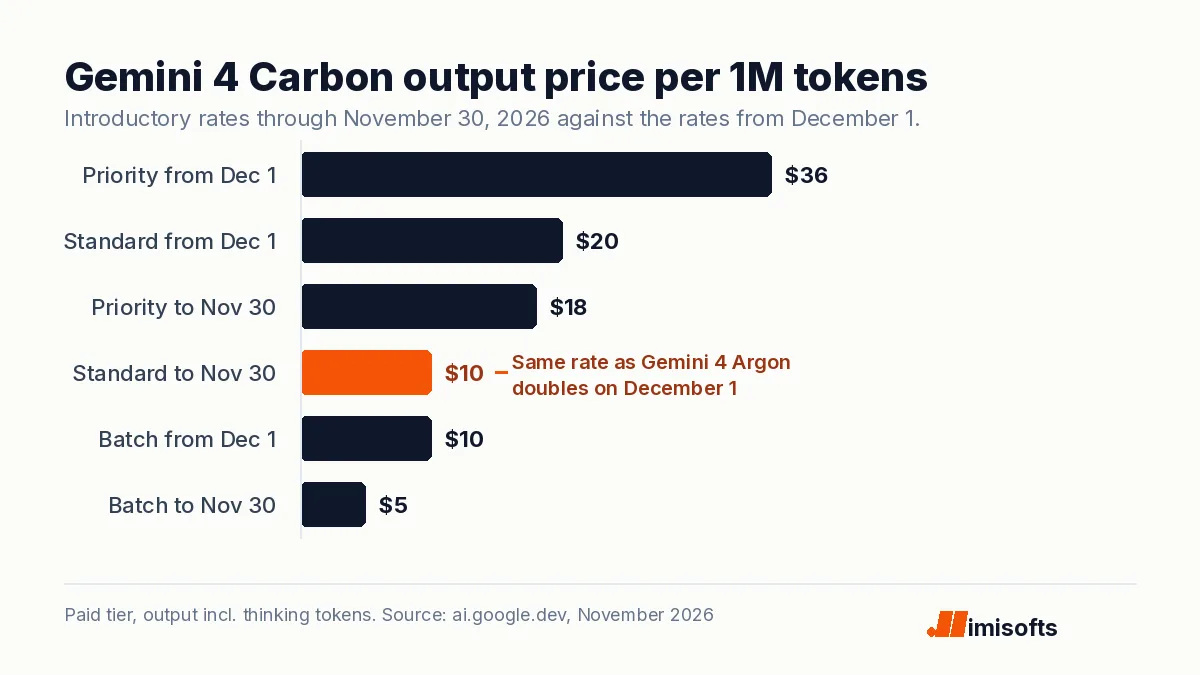
Gemini 4 Carbon API price by tier
| Tier (per 1M tokens) | Input to Nov 30 | Output to Nov 30 | Input from Dec 1 | Output from Dec 1 |
|---|---|---|---|---|
| Standard | $2.00 | $10.00 | $4.00 | $20.00 |
| Batch | $1.00 | $5.00 | $2.00 | $10.00 |
| Flex | $1.00 | $5.00 | $2.00 | $10.00 |
| Priority | $3.60 | $18.00 | $7.20 | $36.00 |
Output includes thinking tokens, and Google says "Every token the model processes is counted and billed." Context caching is $0.10 per million tokens on Standard until November 30 and $0.20 from December 1, with implicit caching only. Grounding with Google Search includes 5,000 free requests a month shared across Gemini 3 and newer models, then $14 per 1,000, with a cap of 1,500 requests a day. Argon's Standard rates on the same page are identical, so our Gemini 4 Argon pricing breakdown applies to Carbon's Standard rates as well.
What it means for agencies building agents
Take a hypothetical batch of 1,000 agent tasks, each with 20,000 input tokens and 4,000 output tokens. On Standard that costs $80 before December 1 and $160 after; through Batch it is $40 now and $80 after. Priority runs 1.8 times the Standard rate. Because Google says Carbon uses more tokens than Argon, in our view the same 1,000 tasks are likely to cost more on Carbon even at equal token prices, so measure tokens per task on your own workload before you switch.
We would test Carbon before November 30 while the introductory rate holds, keep Argon as the default for routine client work as Google itself suggests, and move anything that is not time-sensitive into Batch. If you are pricing an AI assistant for a client, set the December rates in the quote now; our guide to AI chatbot costs for a business shows where model fees sit in the total, and our Gemini Flash price increase breakdown covers the January 1, 2027 change to Gemini 3.8 Flash and 3.6 Flash. If you would rather hand the build off, see our AI automation agency. Carbon now also answers in AI Mode in Search for Ultra subscribers; in our view that is one more reason to do the AI search optimization work of making your pages easy for assistants to cite.
Frequently Asked Questions
On the Gemini API Standard tier it costs $2 per million input tokens and $10 per million output tokens through November 30, 2026, then $4 and $20 from December 1. Batch and Flex are half the Standard rate and Priority is 1.8 times it.
No. Google's pricing page says Gemini 4 Carbon is not available on the Gemini API free tier. Google's launch post says consumers can try it in the Gemini app and AI Mode in Search with Google AI Ultra, which starts at $99.99 a month in the US.
The Standard token prices are the same, $2 and $10 per million through November 30, 2026. Google says Carbon uses more tokens than Argon to reason and verify, so in our view the same task is likely to cost more on Carbon.
On December 1, 2026. Google's pricing page lists Standard input at $4.00 and output at $20.00 per million tokens from that date, and Batch, Flex and Priority input and output rates double too.