November 24, 2026. FCC Chairman Brendan Carr proposed on November 23 that many terminating voice providers be required to block calls that are highly likely to be illegal, based on reasonable analytics. Today the rule only lets them block those calls. The Commission votes on the proposal, a Notice of Proposed Rulemaking, at its December 17 open meeting. By our reading, for a business that makes lawful sales calls, a block that carriers must apply raises the cost of being misread by their analytics.
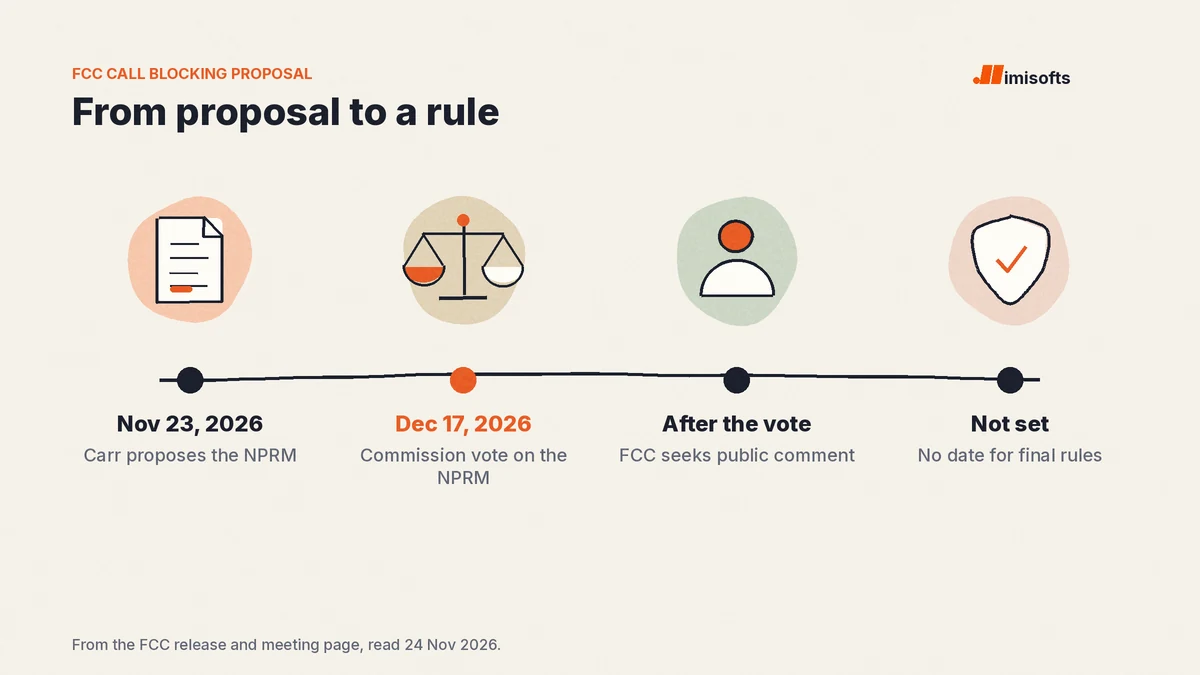
Key numbers
| Item | Number |
|---|---|
| Proposal announced (FCC news release) | November 23, 2026 |
| Commission vote (December open meeting) | December 17, 2026 |
| FCC notice to mitigate before a provider may block, today (47 CFR 64.1200(k)(4)) | 48 hours |
| Status update on a blocking error complaint (64.1200(k)(8)) | Within 24 hours |
| Response code for a blocked call on IP networks (64.1200(k)(9)) | SIP 603+ |
| Blocked-call list for the called party (within 3 business days of a request, (k)(10)) | Last 28 days |
Read on 24 November 2026 from the FCC news release of 23 November 2026 and 47 CFR 64.1200 on eCFR (up to date as of 20 November 2026).
What the FCC proposed on November 23
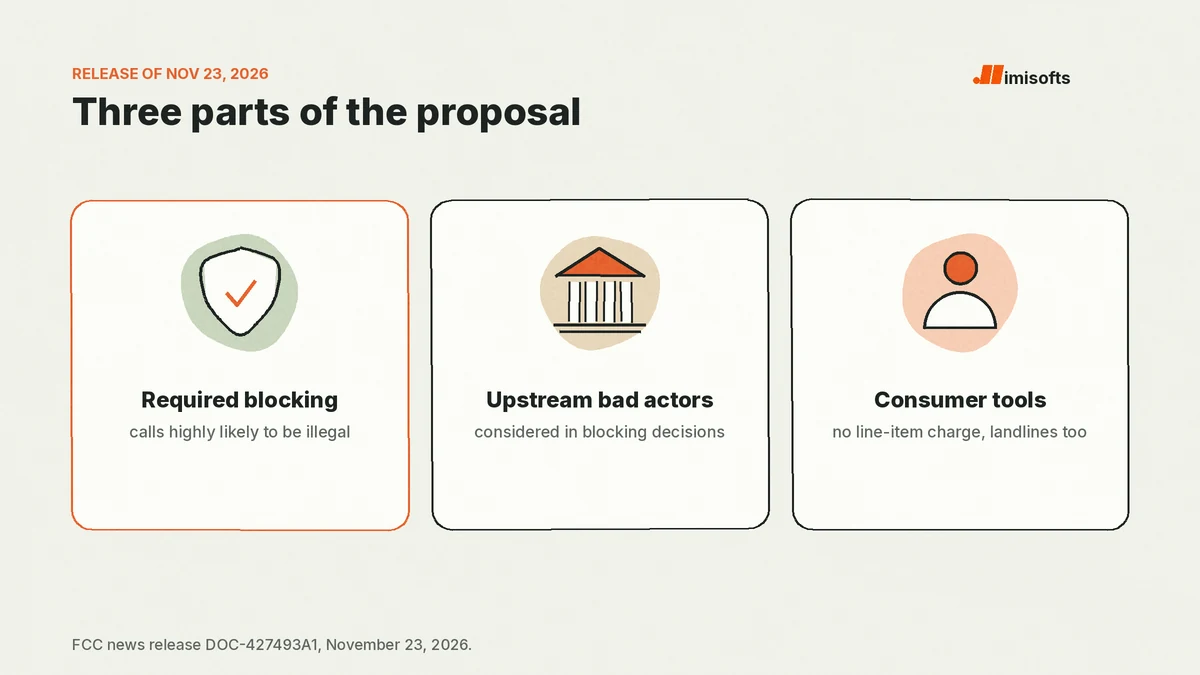
The FCC's news release says the Commission "would propose to require providers to block calls that are likely illegal before they reach consumers." Carr's blog post of the same day says the proposal "would require some terminating voice providers to block calls that are highly likely to be illegal."
- Required blocking. The NPRM "would propose to require many terminating providers to block calls that are highly likely to be illegal based on reasonable analytics."
- Upstream bad actors. Terminating providers "would also be required to consider in their blocking decisions whether an upstream provider is a bad actor."
- More tools for consumers. Rules so that people on landlines and basic mobile phones get "improved call screening and blocking options without additional line-item charges."
- A vote, not a rule. The Commission votes on the item on December 17, 2026. An NPRM proposes rules and seeks comment; it does not change the rules for callers on that day.
The draft text was not posted on the FCC's December meeting page when we checked on November 24, so neither the release nor the blog post says which providers count as "many" or "some", or what the comment dates are.
Today's rule and the proposal, side by side
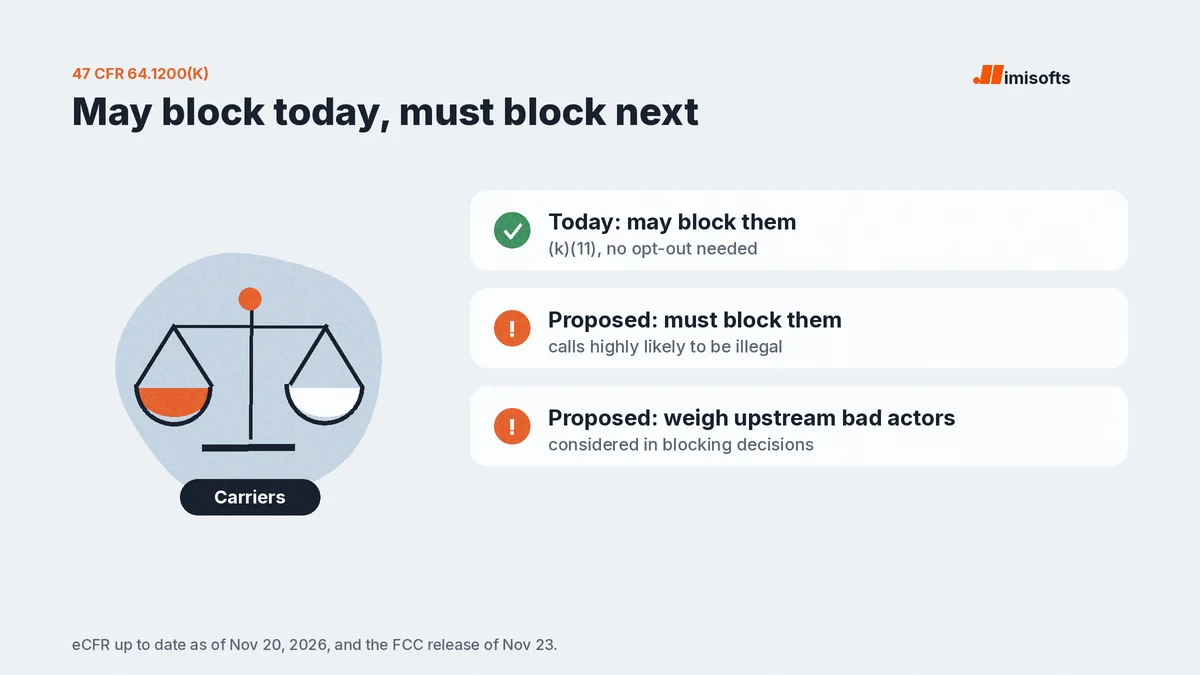
The current text is 47 CFR 64.1200(k), read on eCFR (up to date as of November 20, 2026). It opens: "Voice service providers may block calls". The table sets each point of the proposal next to it.
| Point | Today, 47 CFR 64.1200(k) | Proposed, release of Nov 23 |
|---|---|---|
| Calls highly likely to be illegal | A terminating provider may block them without an opt-out, under (k)(11) | Many terminating providers required to block them |
| Bad actor upstream providers | A provider may block or stop taking traffic when a provider the FCC notified fails to mitigate within 48 hours, under (k)(4) | Terminating providers required to consider whether an upstream provider is a bad actor |
| Charges to consumers | Analytics blocking already carries "no additional line-item charge", (k)(3)(v) and (k)(11)(vi) | Better screening and blocking for landline and basic mobile users, without line-item charges |
| Redress for callers | Single point of contact, status update within 24 hours, SIP 603+ code, (k)(8) and (k)(9) | Not mentioned in the release |
What it means for businesses that make sales calls
Our reading: the proposal targets calls that are "highly likely to be illegal", not lawful outbound calling. The risk for a sales team is the false positive. Today a carrier that blocks your calls chooses to. Under a duty to block, carriers have a reason to block more, and the tools a wrongly blocked caller has are the ones in (k)(8) and (k)(9), which the release does not mention. Under (k)(10) the called party, not the caller, can ask for a list of calls blocked in the last 28 days, due within 3 business days. Under (k)(8) the carrier must keep a public contact point for blocking error complaints, give "a status update within 24 hours", and, when a caller makes a credible claim of erroneous blocking and the carrier finds the calls should not have been blocked, "promptly cease the call treatment for that number". Under (k)(9) a carrier that blocks on analytics must return SIP code 603+ on an IP network.
If your numbers already show "spam likely", start with our guide to why a business number shows as spam. The basics are worth checking now: signed calls (see STIR/SHAKEN attestation) and consent records. If you use one local number per area code, check whether local presence dialing is legal.
What to do before December 17
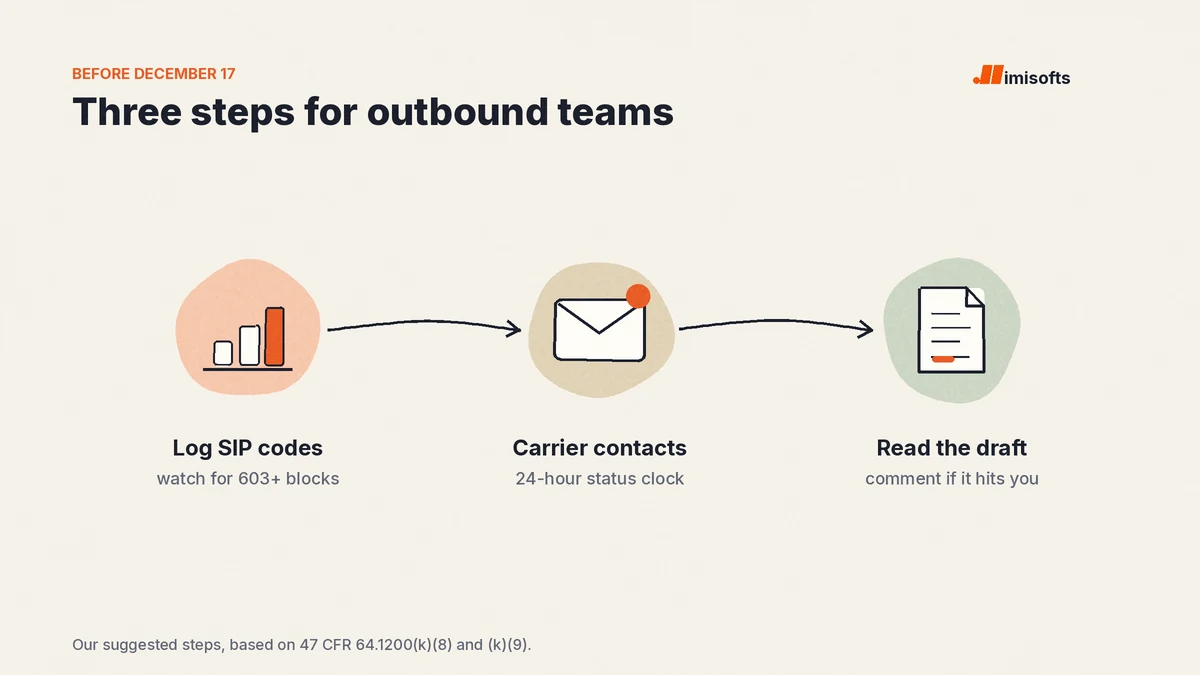
- Log the SIP response codes your dialer or voice AI platform receives, so a jump in 603+ shows up in a report, not in a lost week.
- Keep the blocking-error contact pages of the large carriers on file, and record the date of each complaint, since (k)(8) sets a 24-hour status clock.
- Read the draft NPRM once the FCC posts it, and comment if it would cover your carrier's analytics.
For how we approach consent and call records, see our TCPA-compliant AI calling service. For the wider law behind blocking, our TRACED Act guide covers the sections that set the safe harbor and redress rules.
Frequently Asked Questions
It has proposed to. On November 23, 2026 Chairman Carr proposed that many terminating providers be required to block calls highly likely to be illegal, based on reasonable analytics. The Commission votes on the proposal, a Notice of Proposed Rulemaking, on December 17, 2026, and an NPRM seeks public comment before any final rule.
Under 47 CFR 64.1200(k) carriers may block calls. A terminating provider may block calls that are highly likely to be illegal without an opt-out under (k)(11), and may block or stop taking traffic from a provider that fails to mitigate within 48 hours of an FCC notice under (k)(4).
Under 64.1200(k)(8) the terminating carrier must keep a public point of contact for blocking error complaints, give a status update within 24 hours and promptly stop blocking the number when a credible claim shows the calls should not have been blocked. Under (k)(9) a blocked call returns SIP code 603+ on IP networks.
No date is set. The December 17, 2026 vote is on a Notice of Proposed Rulemaking, which proposes rules and seeks comment. The FCC release gives no date for final rules.