Short answer. The EU AI Act reaches businesses outside the EU when the output of their AI system is used in the EU, under Article 2(1)(c). Its general rules have applied since August 2, 2026, its bans since February 2, 2025, and fines for breaking the transparency duties run up to EUR 15 million or 3% of worldwide turnover. For an SME the lower of the two applies, so a firm with EUR 2 million in turnover faces at most EUR 60,000 for a transparency breach. The Digital Omnibus of July 2026 moved the high-risk dates to December 2, 2027 and August 2, 2028, but left the chatbot and voice agent disclosure rules where they were.
This guide is for US, UK, Canadian, Australian and Gulf businesses that sell into Europe with AI in the loop: an AI SDR that writes to EU prospects, a voice agent that answers calls from Germany, a chatbot on a site with EU visitors. The rules below come from the AI Act, Regulation (EU) 2024/1689, and the Digital Omnibus on AI, Regulation (EU) 2026/1744, both read on EUR-Lex on November 24, 2026. It is a plain-language reading, not legal advice.
Key numbers
| Item | Number |
|---|---|
| Bans and AI literacy apply from | February 2, 2025 |
| Most of the Act, incl. Article 50, applies from | August 2, 2026 |
| Two new bans and older-tool marking deadline (Digital Omnibus) | December 2, 2026 |
| High-risk rules, Annex III systems (moved by the Omnibus) | December 2, 2027 |
| High-risk rules, Annex I products | August 2, 2028 |
| Fine cap, banned practice | EUR 35 million or 7% |
| Fine cap, transparency and operator duties | EUR 15 million or 3% |
| Fine cap, misleading information | EUR 7.5 million or 1% |
| SME with EUR 2 million turnover, Article 50 breach (maximum, our arithmetic) | EUR 60,000 |
Regulation (EU) 2024/1689 and Regulation (EU) 2026/1744 read on EUR-Lex on 24 November 2026; the SME example is our arithmetic.
Who the AI Act covers outside the EU
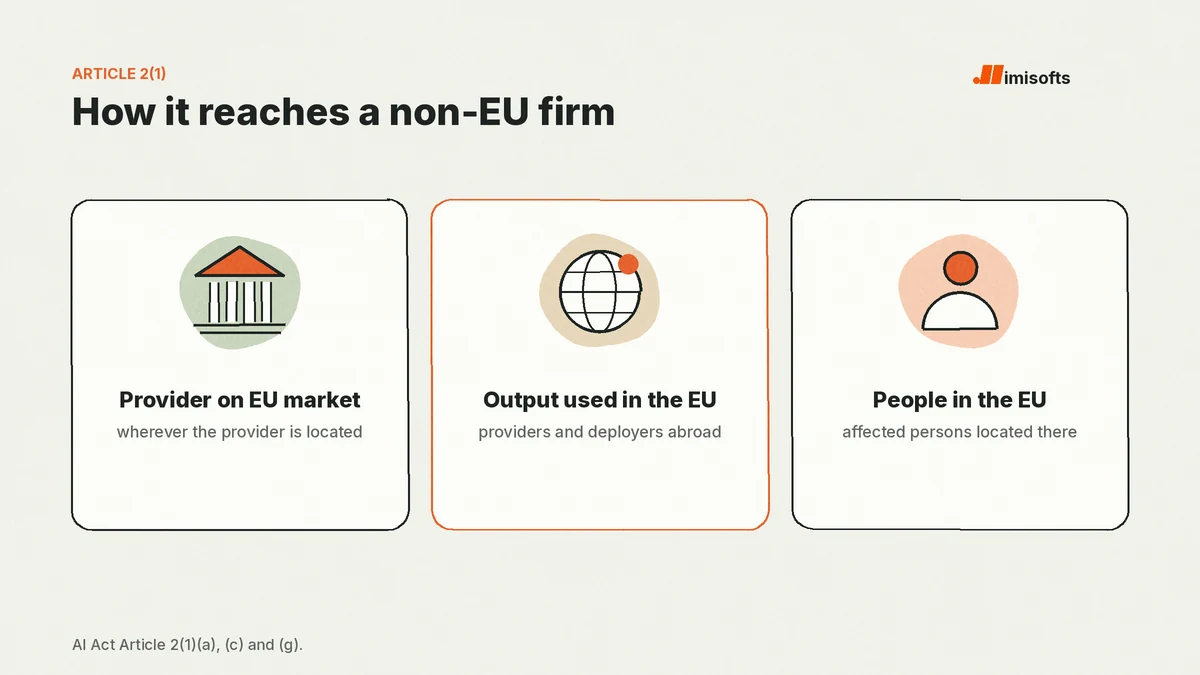
Article 2(1) lists who the Act applies to. Three lines matter for a firm based elsewhere:
- (a) Providers placing AI systems on the EU market or putting them into service in the EU, "irrespective of whether those providers are established or located within the Union or in a third country".
- (c) Providers and deployers located in a third country, "where the output produced by the AI system is used in the Union".
- (g) Affected persons located in the EU, the people the system is used on.
The two roles are defined in Article 3. A provider develops an AI system, or has one developed, and puts it on the market or into service "under its own name or trademark, whether for payment or free of charge". A deployer is anyone "using an AI system under its authority except where the AI system is used in the course of a personal non-professional activity".
Our reading: a US agency that runs a third-party voice agent for a client is a deployer of it, and becomes a provider if it sells that agent under its own brand. A business that only uses ChatGPT or Claude to draft emails is a deployer, and the model makers are the providers. When the drafted email lands in an inbox in Paris, the output is used in the Union.
Key dates after the Digital Omnibus
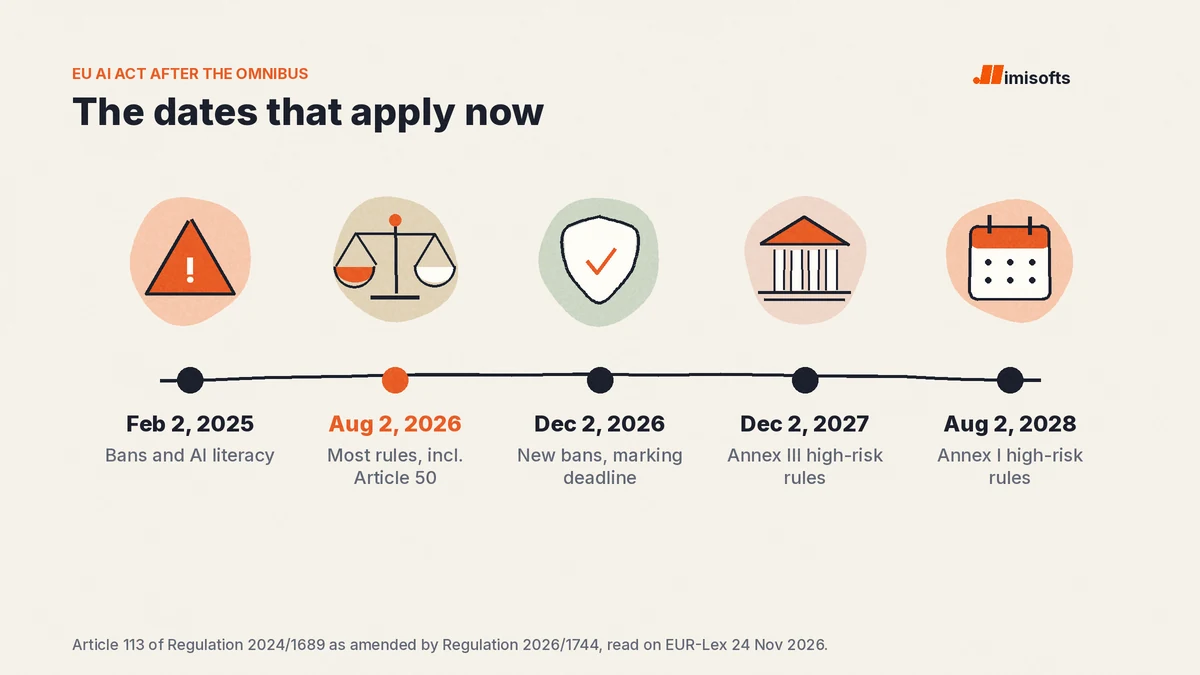
Article 113 of the AI Act set the start dates. The Digital Omnibus, dated July 8, 2026, published in the Official Journal on July 24, 2026 and in force three days later, rewrote parts of it.
| Date | What applies | Source |
|---|---|---|
| February 2, 2025 | Chapters I and II, which hold AI literacy (Article 4) and the banned practices (Article 5) | AI Act Art. 113(a) |
| August 2, 2025 | Chapter V on general-purpose AI models, and the other parts listed in Article 113(b) | Art. 113(b) |
| August 2, 2026 | The rest of the Act, including the Article 50 transparency duties | Art. 113 |
| December 2, 2026 | Two new bans (sexual deepfakes of identifiable people, child abuse material), and Article 50(2) marking for generative systems already on the market before August 2, 2026 | Omnibus, new Art. 113(a) and 111(4) |
| December 2, 2027 | High-risk rules for Annex III systems | Omnibus, new Art. 113(c)(i) |
| August 2, 2028 | High-risk rules for AI inside Annex I products | Omnibus, new Art. 113(c)(ii) |
The December 2, 2026 date is 8 days after this guide was written. It matters mainly to companies that build tools that generate text, audio, images or video: they must mark output "in a machine-readable format and detectable as artificially generated or manipulated" under Article 50(2). The Omnibus did not move Article 50(1), the duty to tell people they are dealing with an AI.
What applies to AI in sales and marketing
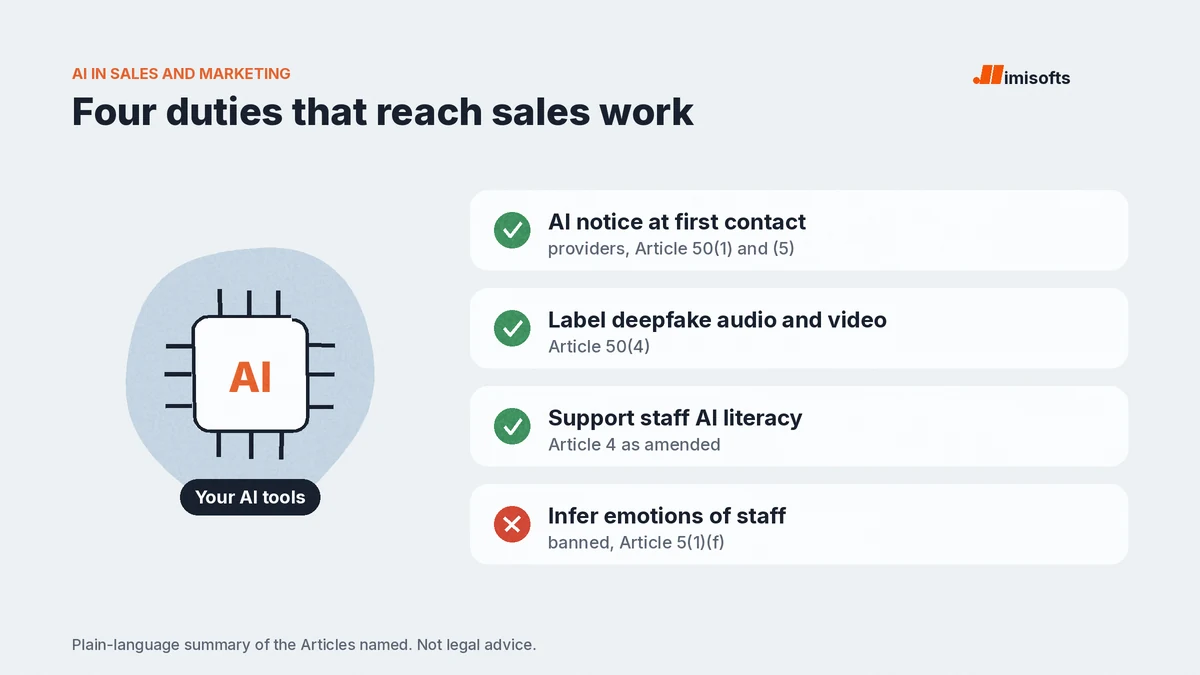
Most outbound uses of AI, drafting emails, scoring leads, booking meetings, are not on the banned list and not in the high-risk annexes by our reading. Check Annex III yourself if your system screens job applicants, scores credit or touches any listed area. Four duties do reach ordinary sales work.
Tell people they are talking to an AI
Article 50(1) requires providers to design AI systems "intended to interact directly with natural persons" so that people "are informed that they are interacting with an AI system, unless this is obvious" to "a natural person who is reasonably well-informed, observant and circumspect". Article 50(5) says the information must come "in a clear and distinguishable manner at the latest at the time of the first interaction or exposure". The duty sits with the provider, the business whose name is on the system. If you deploy a vendor's agent, the vendor carries the design duty; in our view you still want the notice in your own script, and for a phone agent the opening line of the call is the safe place. That applies to agents like the ones on our AI calling for home services page. For similar rules elsewhere, see the California AI caller disclosure law and the German rules in our Germany and Austria cold calling guide.
Label deepfakes and some published text
Under Article 50(4), deployers that generate or manipulate image, audio or video "constituting a deep fake" must disclose it. Text "published with the purpose of informing the public on matters of public interest" must also be disclosed, unless it "has undergone a process of human review or editorial control" and someone holds editorial responsibility. A one-to-one sales email is not published to inform the public, by our reading; our AI SDR disclosure guide covers what other laws ask of AI-written outreach.
Train the people who use it
The Omnibus rewrote Article 4. Providers and deployers "shall take measures to support the development of AI literacy of their staff and other persons dealing with the operation and use of AI systems on their behalf". The new text adds: "This obligation does not require providers or deployers to guarantee any specific level of AI literacy of any individual." In our view, a short written training for anyone who runs your AI tools is a reasonable record.
Stay clear of the banned practices
Two of the Article 5 bans sit close to sales and HR work. Article 5(1)(a) bans AI that uses "purposefully manipulative or deceptive techniques" to distort a person's behaviour in a way that causes or is reasonably likely to cause "significant harm". Article 5(1)(f) bans AI "to infer emotions of a natural person in the areas of workplace and education institutions", apart from medical or safety reasons. Emotion scoring of your own sales reps on calls is the use to check first.
EU AI Act fines, and the SME rule
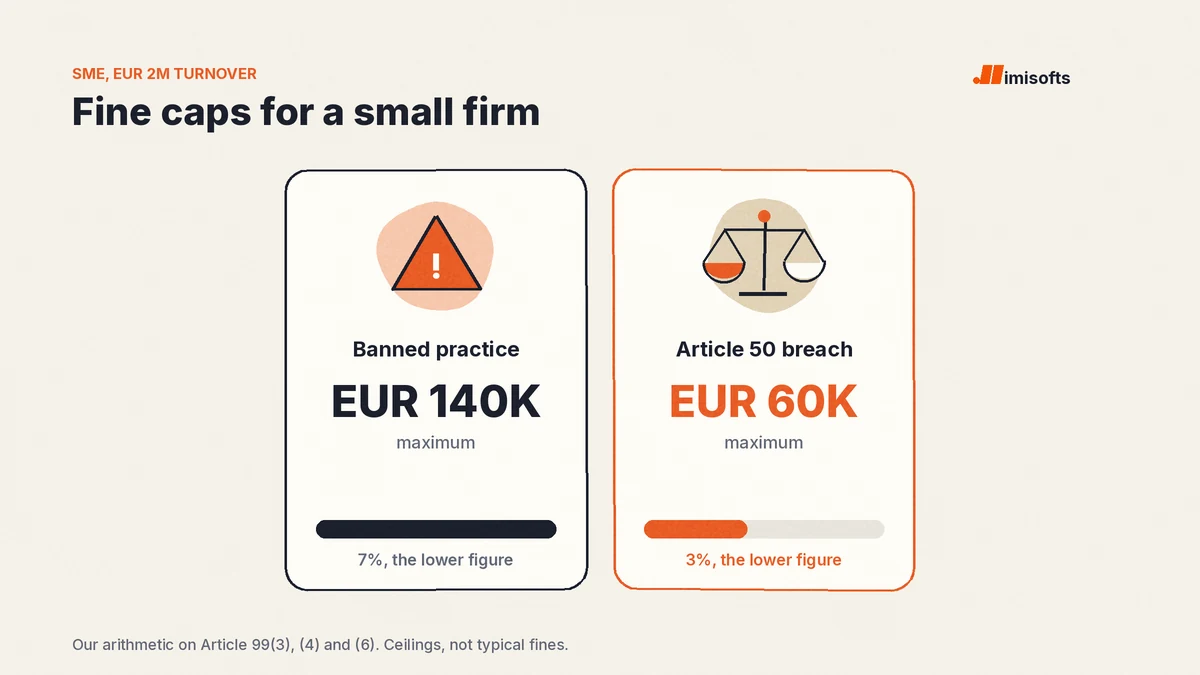
Article 99 sets three tiers. Large companies face the higher of the two figures. SMEs and start-ups face the lower in all three tiers, and small mid-caps in the second and third.
| Breach | Maximum fine | Article |
|---|---|---|
| A banned practice under Article 5 | EUR 35 million or 7% of worldwide annual turnover | 99(3) |
| Operator duties, including deployers under Article 26 and transparency under Article 50 | EUR 15 million or 3% | 99(4) |
| Incorrect or misleading information to authorities | EUR 7.5 million or 1% | 99(5) |
Article 99(6) flips the rule for small firms: "In the case of SMEs, including start-ups, each fine referred to in this Article shall be up to the percentages or amount referred to in paragraphs 3, 4 and 5, whichever thereof is lower." The Omnibus added paragraph 6a, which gives small mid-cap enterprises (SMCs) the same lower cap for the paragraph 4 and 5 fines. Our arithmetic on those caps:
- An SME with EUR 2 million turnover: up to EUR 60,000 for an Article 50 breach, up to EUR 140,000 for a banned practice.
- An SME with EUR 20 million turnover: up to EUR 600,000 and EUR 1.4 million.
- A large company with EUR 600 million turnover: up to EUR 18 million for an Article 50 breach, because 3% is higher than EUR 15 million.
These are ceilings. Member States set the actual penalty rules, and the amended Article 99 tells them to take into account "the interests of SMEs, including start-ups, and SMCs, and their economic viability". For the GDPR side of the same data, see our guide to GDPR fines.
A checklist for a non-EU business
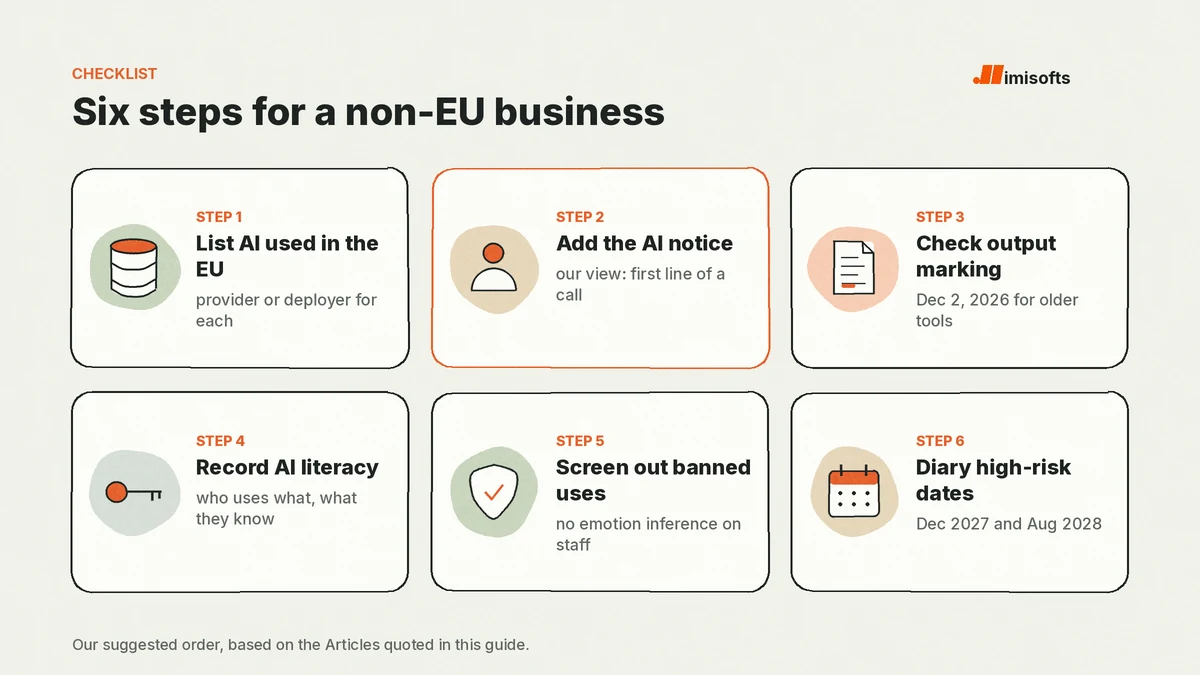
- List every AI system that touches the EU. Chatbots, voice agents, email writers, lead scorers. Note for each whether you are the provider (your name on it) or the deployer.
- Add the AI notice. Article 50(1) puts it on providers; in our view, put it in the first line of a call or chat either way. Keep a copy of the wording.
- Check marking if you build generators. Generative tools on the market before August 2, 2026 have until December 2, 2026 under the new Article 111(4).
- Write down your AI literacy steps. Who uses which tool, and what they were told about its limits.
- Screen out the banned uses. No emotion inference on staff, no manipulative design that could cause significant harm.
- Diary the high-risk dates. December 2, 2027 for Annex III systems, August 2, 2028 for Annex I products.
If you want help mapping your sales stack against these rules, see our AI automation agency service. For what such an agent costs to run, see AI chatbot costs for a business. Our earlier news piece on the Article 50 transparency deadline covers the August 2026 start in more detail.
Frequently Asked Questions
Yes. Article 2(1)(a) covers providers placing AI systems on the EU market wherever they are located, and Article 2(1)(c) covers providers and deployers in a third country where the output of the AI system is used in the Union. A US firm whose chatbot or voice agent talks to people in the EU is likely covered.
In stages. The bans and AI literacy rule have applied since February 2, 2025, the general-purpose AI model rules since August 2, 2025, and most of the Act, including the Article 50 transparency duties, since August 2, 2026. After the Digital Omnibus, high-risk rules start on December 2, 2027 for Annex III systems and August 2, 2028 for Annex I products.
Up to EUR 35 million or 7% of worldwide annual turnover for a banned practice, EUR 15 million or 3% for breaches of operator and transparency duties, and EUR 7.5 million or 1% for misleading information to authorities. Large firms face the higher figure; SMEs, start-ups and, for the last two tiers, small mid-caps face the lower one.
Yes, though the duty is written for providers. Article 50(1) requires providers to design such systems so that people are informed they are interacting with an AI system, unless that is obvious to a reasonably well-informed, observant and circumspect person. Article 50(5) says this must happen at the latest at the first interaction.
Regulation (EU) 2026/1744, in force since July 27, 2026, moved the high-risk dates to December 2, 2027 and August 2, 2028, added two bans that apply from December 2, 2026, rewrote the AI literacy duty, gave small mid-caps the lower fine cap for some breaches, and gave existing generative AI systems until December 2, 2026 to mark their output.
By our reading, the sender is a deployer of the AI tool, and the output is used in the EU when the email reaches an EU inbox. A one-to-one sales email is not text published to inform the public, so in our view the Article 50(4) text label does not apply to it.