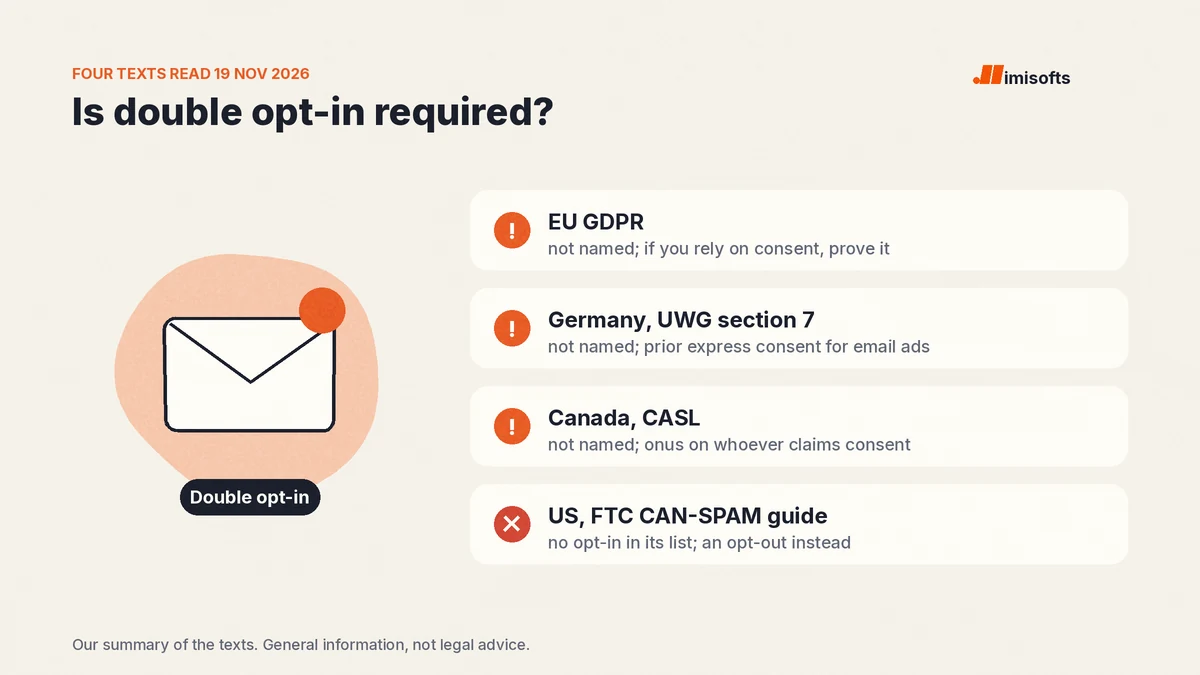
Short answer. None of the four texts we read on November 19, 2026 uses the word "double": the full text of the EU GDPR, the full text of Canada's CASL, the FTC's CAN-SPAM compliance guide, and section 7 of Germany's UWG. Two of them put the proof on whoever claims consent: the GDPR, where processing is based on consent, says the controller "shall be able to demonstrate" it (Article 7(1)), and CASL gives a person who alleges consent "the onus of proving it" (section 13). UWG section 7 treats email advertising without the addressee's "prior express consent" (our translation) as an unreasonable nuisance, with an exception for existing customers. The FTC's CAN-SPAM guide lists seven main requirements, including an opt-out honored within 10 business days, and prior consent is not among them. On our reading, double opt-in, where a subscriber confirms by clicking a link sent to the address, is one way to create a record of consent.
This guide covers what double opt-in is, what each of the four texts says, how to switch it on in Mailchimp, what the confirmation email should say, and what to keep as a record. It focuses on marketing lists people sign up for; for cold email, see our cold email laws by country table. This is general information, not legal advice.
Key numbers
| Item | Number |
|---|---|
| Texts read that use the word double (GDPR and CASL full texts, UWG section 7, FTC CAN-SPAM guide) | 0 of 4 |
| GDPR rule on demonstrating consent (where processing is based on consent) | Article 7(1) |
| CASL burden of proof | Section 13 |
| German rule on email advertising | UWG section 7(2) no. 2 |
| Conditions of Germany's customer exception (UWG section 7(3), all must hold) | 4 |
| CAN-SPAM main requirements, FTC guide (prior consent is not among them) | 7 |
| CAN-SPAM penalty per violating email | up to $53,088 |
| Time to honor a CAN-SPAM opt-out | 10 business days |
| CAN-SPAM opt-out must keep working (FTC guide) (after you send) | 30 days at least |
| Mailchimp double opt-in steps (signup form, then a confirmation click) | 2 |
Legal texts, FTC guidance and Mailchimp's help center, read on 19 November 2026 (EUR-Lex, gesetze-im-internet.de, Justice Laws Canada, ftc.gov, mailchimp.com). General information, not legal advice.
What double opt-in is
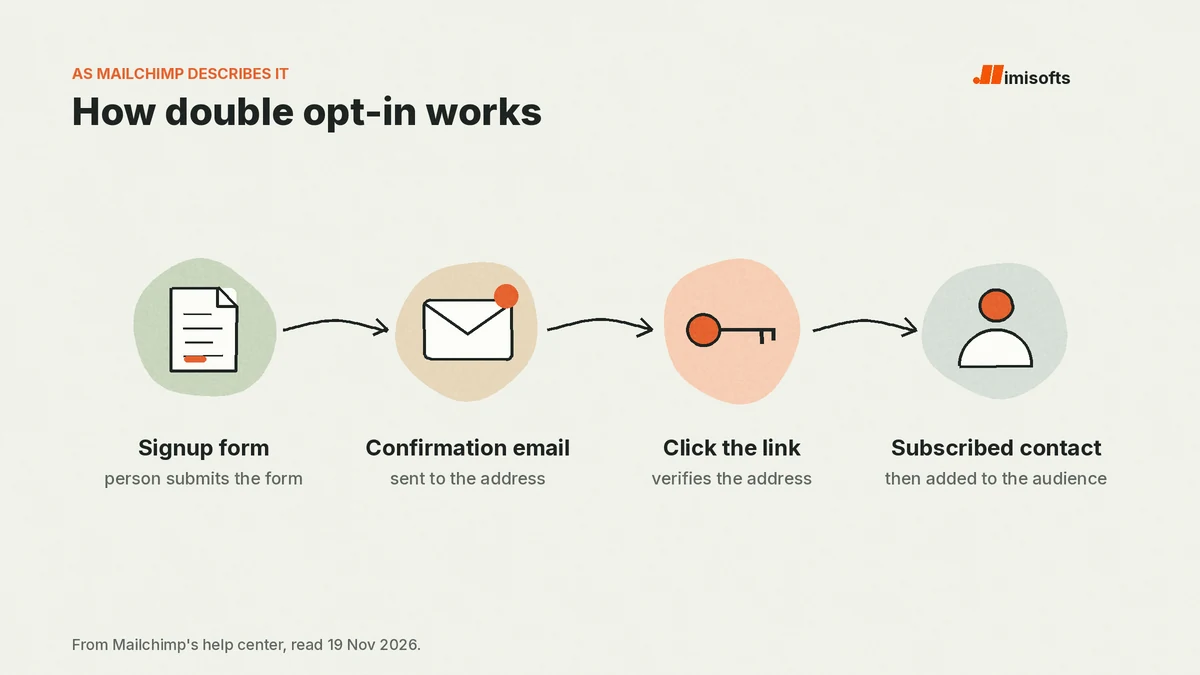
Mailchimp's help center says "Mailchimp offers 2 opt-in methods for email and SMS: single opt-in and double opt-in", and that double opt-in "includes an extra confirmation step that checks each email address or phone number." In its words, in step 1 a person "fills out and submits your online signup form"; in step 2 they "receive a confirmation email or text message and click a link to verify their email or phone number. Then, they're added to your Mailchimp audience as a subscribed contact."
| Text we read | What it says about consent | Uses the word "double"? |
|---|---|---|
| EU GDPR (full text) | Where processing is based on consent, the controller must be able to demonstrate it | No |
| Germany, UWG section 7 | Email advertising without prior express consent is an unreasonable nuisance, with an existing-customer exception | No |
| Canada, CASL (full text) | Express or implied consent; whoever alleges consent has the onus of proving it | No |
| FTC CAN-SPAM guide | Seven main requirements, including a working opt-out; prior consent is not among them | No |
The table is our summary of the texts quoted below. This is general information, not legal advice.
EU GDPR: if you rely on consent, be able to prove it
Article 7(1) of the GDPR reads: "Where processing is based on consent, the controller shall be able to demonstrate that the data subject has consented to processing of his or her personal data." Recital 42 repeats the point. Recital 32 says consent "should be given by a clear affirmative act establishing a freely given, specific, informed and unambiguous indication" of agreement, which "could include ticking a box when visiting an internet website", and that "Silence, pre-ticked boxes or inactivity should not therefore constitute consent." Article 7(3) adds that the person "shall have the right to withdraw his or her consent at any time."
On our reading, a box the person ticks themselves is one way to meet Recital 32, and the confirmation click adds a second record tied to the address, which can help show that someone with access to that inbox confirmed. Article 7(1) does not prescribe a method. Our GDPR and cold email guide covers the B2B side, and our GDPR data retention period guide covers how long to keep records. This is general information, not legal advice.
Germany: prior express consent for email ads
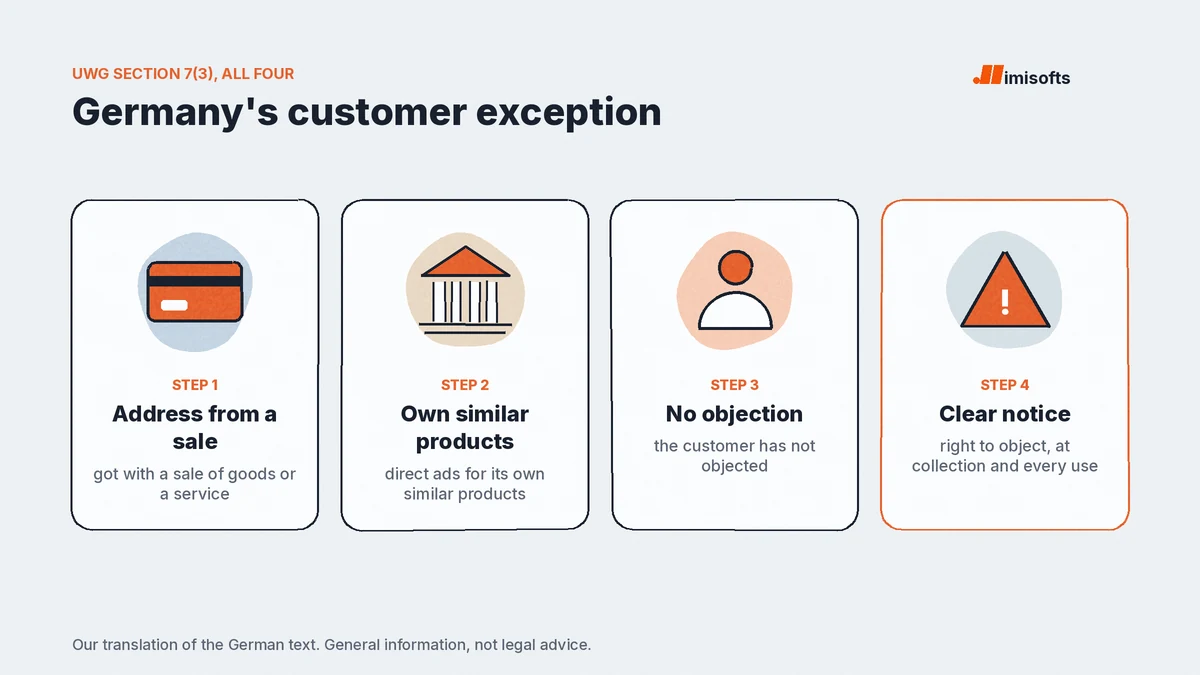
Germany's UWG section 7 (the Act against Unfair Competition) lists cases where an unreasonable nuisance is always assumed (our translation). Number 2 is advertising "using an automatic calling machine, a fax machine or electronic mail, without the prior express consent of the addressee" (our translation). Section 7(3) makes an exception for email only when all four conditions hold (our translation):
- a business got the customer's email address in connection with the sale of goods or a service;
- it uses the address for direct advertising of its own similar goods or services;
- the customer has not objected; and
- the customer is told clearly, when the address is collected and at every use, that they can object at any time at no cost beyond basic-rate transmission costs.
Section 7 asks for "prior express consent" without saying how to prove it. This covers the statute text only; we did not review German case law. For how German senders approach B2B outreach, see our cold email in Germany guide. This is general information, not legal advice.
Canada: CASL puts the burden on whoever claims consent
Canada's CASL (S.C. 2010, c. 23) prohibits sending, or causing or permitting to be sent, a commercial electronic message unless "(a) the person to whom the message is sent has consented to receiving it, whether the consent is express or implied; and (b) the message complies with subsection (2)" (section 6(1)). A request for express consent must set out "the purpose or purposes for which the consent is being sought" and "prescribed information that identifies the person seeking consent" (section 10(1)). Section 13, under the marginal note "Burden of proof", reads: "A person who alleges that they have consent to do an act that would otherwise be prohibited under any of sections 6 to 8 has the onus of proving it."
On our reading of sections 6(1), 10(1) and 13, none sets a confirmation method; section 13 puts the onus on whoever claims consent, and a confirmed signup stored with the wording of the request is one way to meet it. We did not review CRTC guidance for this guide. Our cold email laws in Canada guide covers implied consent and the B2B case. This is general information, not legal advice.
United States: the FTC's CAN-SPAM list has no opt-in
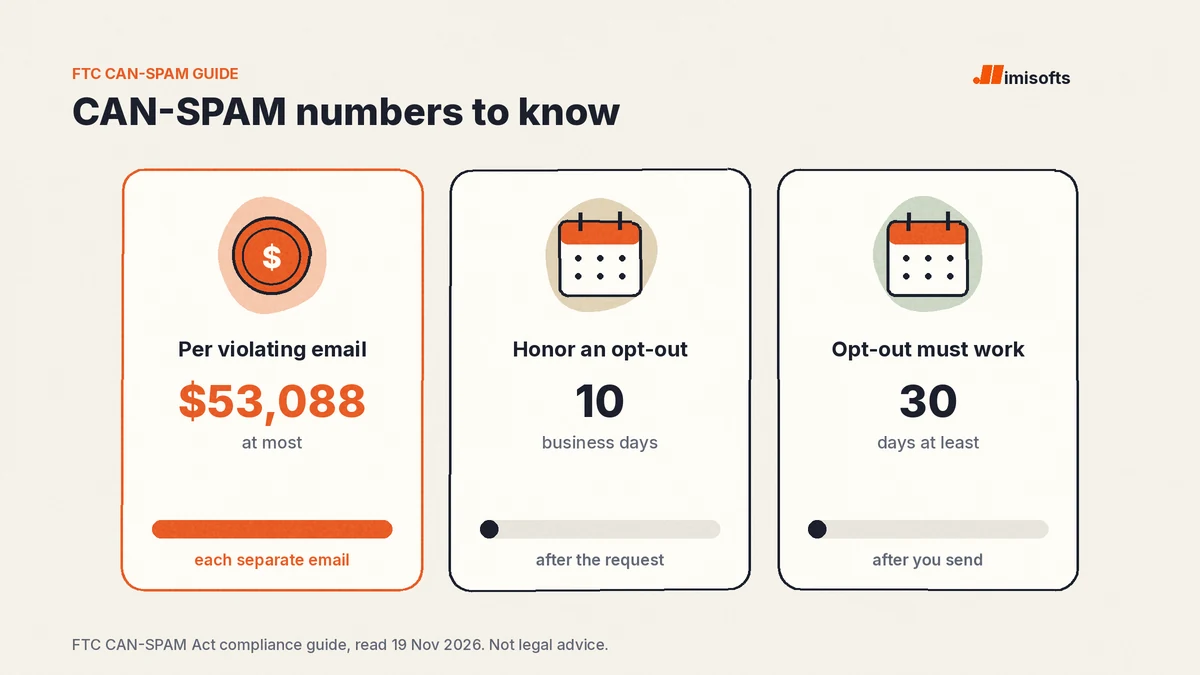
The FTC's CAN-SPAM compliance guide lists seven main requirements: no false or misleading header information, no deceptive subject lines, identify the message as an ad, tell recipients where you are located, tell them how to opt out, honor opt-out requests promptly, and monitor what others do on your behalf. Prior consent is not among them. The guide says "Each separate email in violation of the CAN-SPAM Act is subject to penalties of up to $53,088", that an opt-out mechanism "must be able to process opt-out requests for at least 30 days after you send your message", and "You must honor a recipient's opt-out request within 10 business days."
On our reading of the FTC's guide, CAN-SPAM does not make double opt-in a requirement for email; we did not review state or other federal rules. Text messages may follow other rules we did not review for this guide; see our SMS opt-in language guide. Our CAN-SPAM penalties guide covers the fines. This is general information, not legal advice.
How to switch on double opt-in in Mailchimp
From Mailchimp's help center, read on November 19, 2026:
- New audience: "Choose to enable double opt-in for your email contacts when you create a new audience in Mailchimp."
- Existing audience: "go to your audience settings to enable double opt-in."
- Several audiences: "you can make global changes for your email contacts on the Opt-In Settings page."
Two points matter. "Double opt-in for email contacts can only be enabled for Mailchimp signup forms", so a form built elsewhere or an API integration would need its own confirmation step if you want double opt-in. And "If your primary contact address is in the EU, some of your audiences may already use double opt-in as the default". For text messages, Mailchimp says "If you plan to send abandoned cart text messages to your contacts, double opt-in is required." Other tools may offer a similar setting; we did not read their help pages for this guide.
What the confirmation email should say
These are our suggestions. Keep the confirmation email short and plain, with one button or link, and repeat what the person agreed to. CASL section 10(1) asks a request for express consent to set out "the purpose or purposes for which the consent is being sought" and "prescribed information that identifies the person seeking consent". On our reading, a confirmation email that names your business and says what you will send repeats that information at the moment of the click; adding how often you will send and your contact details is our suggestion, not the Act's wording. Because GDPR Article 7(3) gives the person "the right to withdraw his or her consent at any time", we would also say how to unsubscribe. A person who never clicks has not confirmed; we would not mail that address, and we would measure how many signups confirm on your own form before and after any change. This is general information, not legal advice.
What to keep as proof
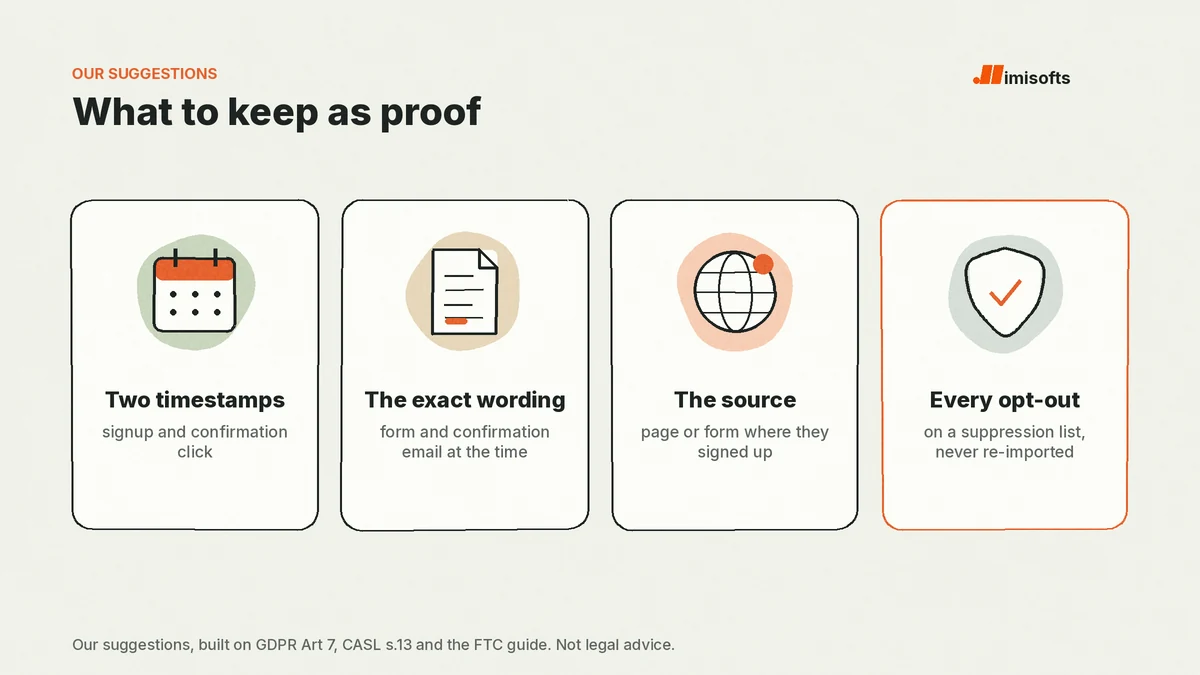
These are our suggestions, built on the texts above. For each subscriber, keep:
- the date and time of the signup and of the confirmation click;
- the exact wording of the signup form and the confirmation email at that time;
- the page or source where the person signed up;
- every later opt-out, kept on a suppression list so the address is never re-added by an import (see our email suppression list guide).
On our reading, a confirmation step also keeps mistyped addresses off the list, since Mailchimp describes it as a step that "checks each email address". If deliverability is already a problem, our email deliverability consultant cost guide covers what outside help costs, and our email hosting cost guide covers the mailbox side. For the sending setup itself, see our email infrastructure page. This is general information, not legal advice; for a specific list, ask a lawyer in the country you send to.
Frequently Asked Questions
The GDPR's text does not use the word double. Where processing is based on consent, Article 7(1) says the controller "shall be able to demonstrate" it, and Recital 32 says silence, pre-ticked boxes or inactivity should not constitute consent. On our reading, double opt-in is one way to create that record. General information, not legal advice.
On our reading of the FTC's CAN-SPAM guide, not for email: its seven main requirements include a working opt-out honored within 10 business days, and prior consent is not among them. Penalties are up to $53,088 per violating email. We did not review state or other federal rules. General information, not legal advice.
CASL's full text does not use the word double. It requires express or implied consent for commercial electronic messages, and section 13 puts the onus of proving consent on the person who alleges it. On our reading, a confirmed signup is one way to meet that burden. We did not review CRTC guidance. General information, not legal advice.
UWG section 7 does not use the word double. It treats email advertising without the addressee's prior express consent as an unreasonable nuisance (our translation), with an exception for existing customers that has four conditions. This covers the statute text only, not German case law. General information, not legal advice.
Mailchimp's help center says to enable it when you create a new audience, in the audience settings for an existing one, or for several audiences on the Opt-In Settings page. For email contacts, it can only be enabled for Mailchimp signup forms.
Mailchimp offers double opt-in for SMS too and says it is required on its platform if you send abandoned cart text messages. Texting rules outside Mailchimp were not reviewed for this guide; see our SMS opt-in language guide. General information, not legal advice.