October 11, 2026. Yes, an AI voice agent can call your past customers, but not about everything, and not on the strength of the customer relationship alone. The exemption most owners have in mind, the "established business relationship", stopped covering prerecorded sales calls to home phones in October 2013, and the FCC confirmed in February 2024 that an AI-generated voice counts as an artificial voice under the Telephone Consumer Protection Act. So a call that reminds a customer about a job already booked sits under one set of rules, and a call that sells a tune-up, a maintenance plan or an upgrade to that same customer sits under a much stricter one. For HVAC, plumbing, roofing and pest control companies sitting on years of customer records, that line decides whether a reactivation campaign is a growth channel or a lawsuit. This guide reads the rule text so you can see where the line is before you build AI calling for a home services business.
Everything below comes from the current text of 47 CFR 64.1200, the FCC orders that wrote it and the statute itself, all read 11 October 2026. It is a map, not legal advice; a telecom lawyer should review any outbound program before it dials.
Key numbers
| Item | Number |
|---|---|
| Business relationship window after a purchase (47 CFR 64.1200(f)(5)) | 18 months |
| Business relationship window after an inquiry (47 CFR 64.1200(f)(5)) | 3 months |
| Exemption for prerecorded sales calls to home lines ended (FCC 12-21, effective date per Federal Register) | October 16, 2013 |
| FCC ruling that AI voices are artificial voices (FCC-24-17) | February 8, 2024 |
| Informational AI calls to a home landline without consent (64.1200(a)(3)(iii), with ID and opt-out) | Up to 3 in 30 days |
| Deadline to honor a revocation or opt-out (64.1200(a)(10) and (d)(3)) | 10 business days |
| Statutory damages per call (47 U.S.C. 227(b)(3)) | $500, up to $1,500 if willful |
| Calling hours for telephone solicitations (64.1200(c)(1)) | 8 a.m. to 9 p.m. local time |
47 CFR 64.1200 (eCFR current text), FCC 12-21 Report and Order (February 15, 2012), Federal Register notice 2012-25316, FCC-24-17 (February 8, 2024) and 47 U.S.C. 227, all read 11 October 2026.
Why the old customer list feels safe
The rule defines an established business relationship as one formed by a purchase or transaction within the 18 months before the call, or an inquiry or application within the 3 months before it, that neither side has ended (64.1200(f)(5)). It is a real exemption and it still matters. A "telephone solicitation" is defined so that it excludes calls to anyone with whom the caller has that relationship (64.1200(f)(15)(ii)), which is why a person on your team can phone a customer from last spring even if that customer's number sits on the national Do Not Call Registry.
The trap is that the exemption lives inside the definition of telephone solicitation. The rules that govern artificial and prerecorded voices are written around different words: "advertisement" and "telemarketing". They never borrowed the exemption, and since 2013 they have not offered one of their own.
What changed in 2012, 2013 and 2024
Until 2012 the FCC let businesses send prerecorded telemarketing calls to home lines of existing customers, on the theory that the relationship implied consent. Its February 15, 2012 Report and Order ended that. In its own words, the Commission decided to "eliminate the established business relationship exemption for prerecorded telemarketing calls to residential lines" and to require prior express written consent instead (FCC 12-21, paragraph 35). The change took effect on October 16, 2013, the date set in the Federal Register notice announcing the approval of the written-consent rules.
The second change is newer. On February 8, 2024 the FCC released a declaratory ruling confirming that the TCPA's restrictions on "artificial or prerecorded voice" encompass current AI technologies that generate human voices, so calls using them need the called party's prior express consent (FCC-24-17). Your voice agent is, for this purpose, a prerecorded message that can listen.
Three kinds of call, three sets of rules
- Sales calls by an AI agent. Anything that encourages the customer to buy: a seasonal tune-up offer, a maintenance plan pitch, a water heater replacement quote, a "we have a technician nearby, want us to look at your roof?" call. To a cell phone this needs prior express written consent (64.1200(a)(2)). To a home landline it needs the same (64.1200(a)(3)). A purchase last year does not substitute for it.
- Informational calls by an AI agent about a job that exists. An appointment confirmation, a technician-on-the-way call, a parts-arrived notice. To a cell phone, any call using an artificial voice needs prior express consent, which does not have to be written (64.1200(a)(1)(iii)). To a home landline, a commercial call with no advertising needs no consent at all, provided you make no more than three such calls in any 30-day period and honor opt-outs (64.1200(a)(3)(iii)).
- Calls by a person. A human on your team calling a past customer about a new service is making a telephone solicitation, and the established business relationship keeps that call outside the national registry rule. It ends the moment the customer asks you to stop calling: a seller-specific do-not-call request terminates the relationship for telemarketing purposes even if they keep buying from you (64.1200(f)(5)(i)).
The renewal call is where most campaigns slip
Two words in the rule do most of the damage: a call that "includes or introduces an advertisement". A reminder that the customer's annual furnace service is due, booked under an agreement they already pay for, is informational. Add one sentence offering a duct cleaning discount and the same call introduces an advertisement, which moves it into the written-consent category. A renewal call that asks the customer to buy another year of a maintenance plan is encouraging a purchase, which is the definition of telemarketing in 64.1200(f)(13).
The practical fix is to script the two call types separately. Run reminders and dispatch updates as informational flows with no offers, and run anything with a price, a promotion or an upsell only to customers whose written consent you can produce. If your AI agent improvises, constrain it: an agent that is allowed to "mention our current specials" has just turned every reminder into a sales call.
What every AI call has to say anyway
Consent decides whether you may call. Paragraph (b) decides what the call must contain, for every artificial or prerecorded voice message:
- At the start, the identity of the business responsible, using the name under which it is registered with the state (64.1200(b)(1)).
- During or after the message, a telephone number the person can call; for telemarketing and for the exempt landline calls, that number must accept do-not-call requests during business hours (64.1200(b)(2)).
- For telemarketing, and for the exempt informational calls to residential lines, an automated voice or key-press opt-out offered within two seconds of the identification, which must log the number to your do-not-call list and end the call; a voicemail must give a toll-free number that reaches the same mechanism (64.1200(b)(3)).
Revocation is broader than the keypress. A customer may revoke consent by any reasonable method, including saying so to your agent, and you must honor it within ten business days (64.1200(a)(10)). Do-not-call requests are kept for five years (64.1200(d)(6)). We cover the spoken opt-out problem in can you opt out by talking to an AI voice agent and the disclosure question in is AI cold calling legal; several states add their own AI disclosure rules, listed in AI caller disclosure laws by state.
How to collect consent your next campaign can use
The definition of prior express written consent in 64.1200(f)(9) is short and specific. It must be a written agreement bearing the customer's signature, it must clearly authorize you to deliver advertisements or telemarketing calls using an artificial or prerecorded voice, it must name the phone number, and it must disclose that signing is not a condition of buying anything. Electronic signatures count. Home services companies have three natural places to collect it: the online booking form, the job estimate or invoice the customer signs, and the customer portal.
An example of the kind of wording teams start from, to be reviewed by your own counsel: "By checking this box, I agree that [Company] may call and text me at the number above with offers and reminders, including calls that use an AI-generated or prerecorded voice. I understand consent is not required to buy any service, and I can opt out at any time." Store the timestamp, the exact text shown, the number and the source with each record, because the caller carries the burden of proving consent.
What getting it wrong costs
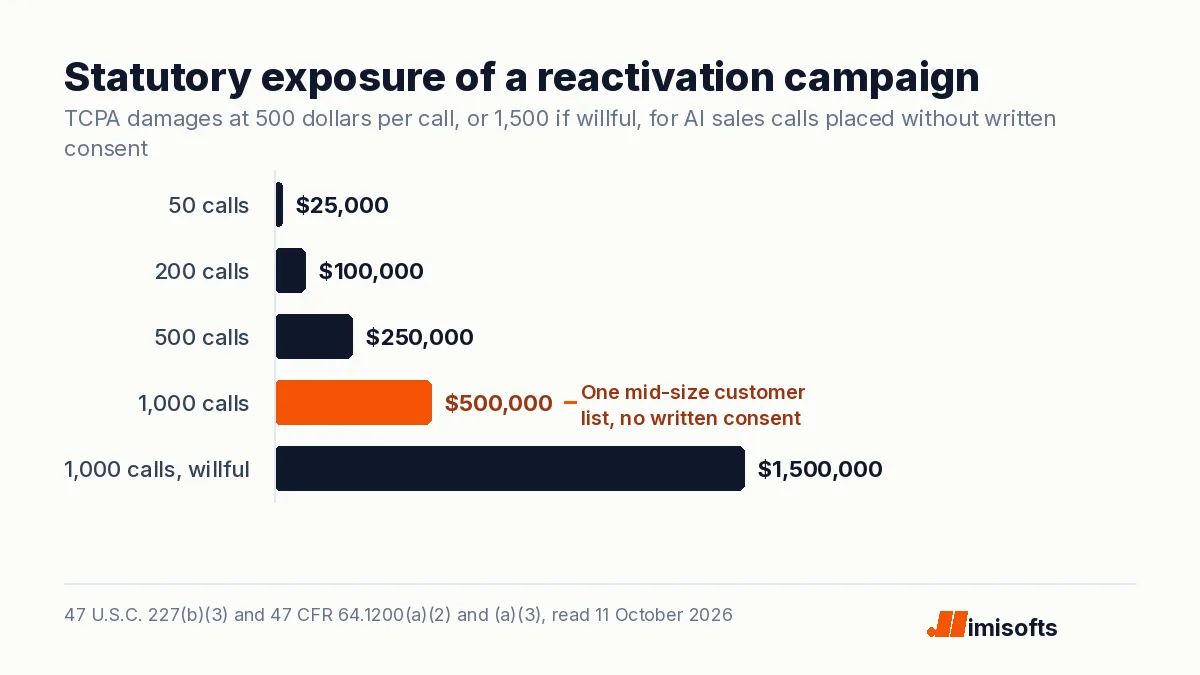
The statute gives every person called a private right to recover actual damages or 500 dollars per violation, whichever is greater, and lets a court triple that to 1,500 dollars when the violation was willful or knowing (47 U.S.C. 227(b)(3)). A 1,000-call reactivation campaign to customers without written consent is therefore 500,000 dollars of statutory exposure before anyone argues about willfulness.
One caveat on the 2024 ruling. Since the Supreme Court's June 20, 2025 decision in McLaughlin Chiropractic Associates v. McKesson Corp., district courts in private suits are not bound by the FCC's reading of the TCPA and interpret the statute themselves. That makes the AI-voice ruling persuasive rather than binding in court, but the statute's own phrase, "artificial or prerecorded voice", is the text a judge will read, and few businesses want to be the test case.
The bottom line
Your customer list is an asset, and an AI agent is a good way to work it, as long as the calls are sorted before they are dialed. Reminders and dispatch updates can go out under the informational rules. Offers, renewals and reactivation calls need written consent first, collected at booking and stored where your dialer can check it. If you want both flows built with the consent check, the opt-out logging and the scripts separated, that is what our TCPA-compliant calling setup does, and our home services AI calling team can wire it into your booking and dispatch tools. For the cost side of the same customers, see what a home services lead really costs.
Frequently Asked Questions
Not for sales calls. The FCC eliminated the established business relationship exemption for prerecorded telemarketing calls to residential lines in its February 15, 2012 order, effective October 16, 2013, and in February 2024 confirmed that AI-generated voices are artificial voices under the TCPA. An AI call that offers a service needs prior express written consent. The relationship still matters for live calls by a person, which it keeps outside the national Do Not Call Registry rule.
Yes, according to the FCC's declaratory ruling FCC-24-17 released on February 8, 2024, which says the TCPA's restrictions on artificial or prerecorded voice encompass current AI technologies that generate human voices. Since June 2025 courts are not bound by the FCC's reading, but the statute's wording is what they interpret.
Reminders that contain no advertising are informational calls. To a cell phone they need prior express consent, which does not have to be written. To a home landline they need no consent if you make no more than three such calls in any 30-day period and honor opt-outs. Every call must still identify the business, give a callback number and, for landline calls under the exemption, offer an automated opt-out.
If the call asks the customer to buy or renew, it encourages a purchase, which is how the rule defines telemarketing, so an AI voice needs prior express written consent. A notice about a visit already covered by an existing agreement can be informational, as long as it contains no offer or upsell.
Within a reasonable time not exceeding ten business days. Consent can be revoked by any reasonable method, including telling your AI agent, and do-not-call requests must be kept for five years under 47 CFR 64.1200(d)(6).
The TCPA lets each person called recover actual damages or 500 dollars per violation, whichever is greater, and up to 1,500 dollars per violation if the court finds it willful or knowing. A 1,000-call campaign without valid consent carries 500,000 dollars of statutory exposure.