October 15, 2026. In Poland, a sales call needs the recipient's consent before the phone rings. Article 398 of the Electronic Communications Law, in force since 10 November 2024, bans using telecommunications terminal equipment or automated calling systems for direct marketing to any subscriber or end user who has not agreed in advance, and the law's definition of an end user covers companies too. In a decision announced on 3 September 2026, the consumer authority, UOKiK, fined a telemarketing firm PLN 308,728 and its president at the time PLN 100,000 for calling consumers without consent, rejecting the firm's defense that its agents "only" booked meetings. For anyone planning AI voice agents or a call team for the Polish market, this guide covers what the law requires and how the regulators read it.
The statute is summarized in our Poland cold email guide, which sets out Article 398 clause by clause and the Article 446(5) fine, and the enforcement case comes from UOKiK's announcement of 3 September 2026, read 15 October 2026. The decision is not yet final. Treat this as a map, not legal advice.
Key numbers
| Item | Number |
|---|---|
| Consent rule for marketing calls (in force since 10 November 2024) | prior consent, Article 398 |
| B2B exception in Article 398 | none |
| Maximum UKE fine (whichever is higher) | 3% of revenue or PLN 1,000,000 |
| UOKiK fine on the company (announced 3 Sep 2026) | PLN 308,728 |
| UOKiK fine on the president at the time | PLN 100,000 |
| Calling consumers to ask for consent (UOKiK) | not allowed |
UOKiK announcement of 3 September 2026; Electronic Communications Law, Article 398 and Article 446, as summarized in our Poland cold email guide; all read 15 October 2026.
What Article 398 says about calls
The Electronic Communications Law (Prawo komunikacji elektronicznej) replaced the old Telecommunications Law on 10 November 2024. Its consent rule for marketing contact works like this:
- Consent first, for any end user. Article 398(1) prohibits using terminal equipment, such as a phone, or automated calling systems to send commercial information, including direct marketing, to a subscriber or end user who has not agreed beforehand.
- Companies are covered. The law defines an end user as anyone using a publicly available communications service for their own needs, which includes a business. The text contains no business-to-business exception.
- Competitors can sue. Article 398(4) makes a breach an act of unfair competition, so a rival can bring a claim while the regulator fines.
- The telecoms regulator can fine. The President of UKE, the Office of Electronic Communications, can fine a business that skips consent up to 3 percent of the previous year's revenue or up to PLN 1,000,000, whichever is higher.
The UOKiK case: "just booking a meeting" is marketing
Centrum Dotacji OZE, previously trading as Eko Centrum, ran telemarketing for an energy company, Energia Plus Gaz. Its consultants told people they might qualify for subsidies to replace their heating, asked how the home was heated and whether they were interested in solar panels or energy storage, and then offered a meeting with a sales representative. The company argued that the calls only arranged meetings and were not marketing.
UOKiK disagreed. In the words of its president, Tomasz Chróstny, if a call is meant to interest a consumer in an offer, identify their needs and lead to a meeting with a salesperson, it is direct marketing, and it does not matter that the price or the full offer comes later. His summary of the order of events: consumer consent first, then the call, never the other way round.
Bought lists and generated numbers
The case also shows where the company's numbers came from, and why neither source worked:
- Purchased databases. The company bought lists from other firms but could not show that the people on them had agreed to marketing contact from it. Part of the data dated from 2017 to 2019, before the company existed, so those people could not have consented to hear from it.
- Numbers generated by an algorithm. It also dialed numbers created by software that took a Polish prefix and added random digits. As UOKiK put it, if a business only generates the number, it cannot already hold that person's consent.
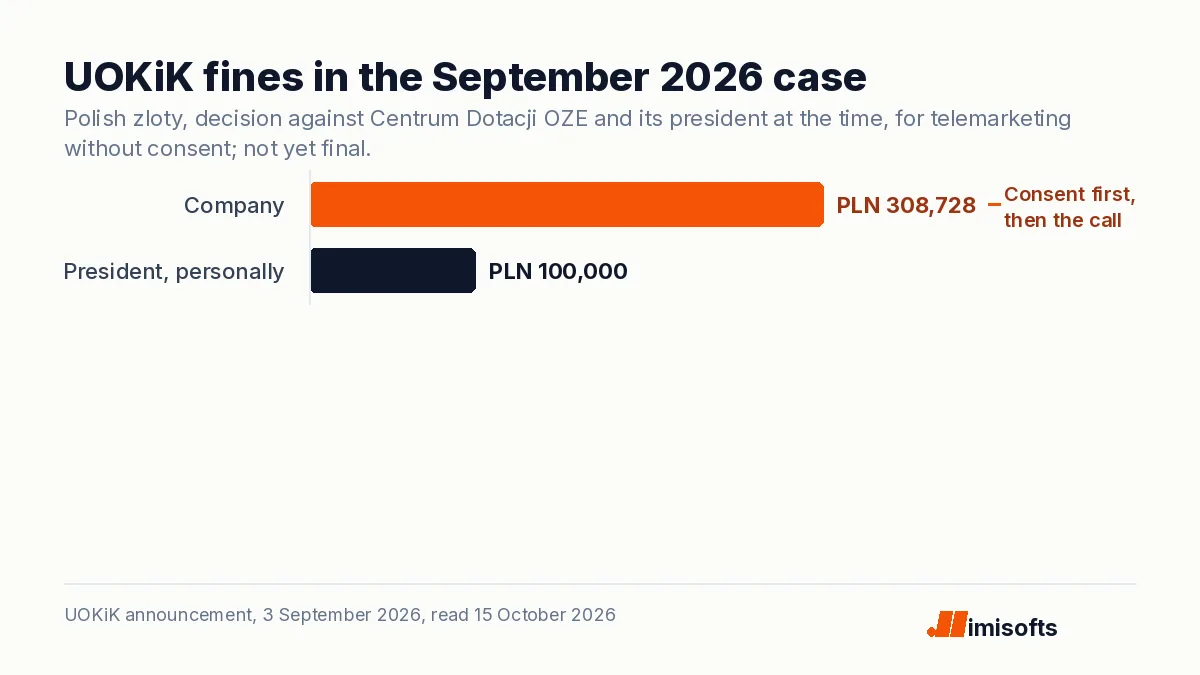
The fines were PLN 308,728 for the company and PLN 100,000 for its president at the time, personally, for intentionally allowing the infringement of collective consumer interests. UOKiK noted his personal involvement, including signing contracts with the suppliers of phone number databases. The company and the manager can appeal to the Court of Competition and Consumer Protection within a month of receiving the decision. The personal fine is the detail sales leaders should notice: in this case, the person who signed the data contracts was fined personally too.
What valid consent looks like
According to UOKiK, consent to marketing contact must be:
- Given in advance, before the first call.
- Voluntary, informed, specific and unambiguous.
- Clear about who will contact the person, for what purpose and through which channel, such as phone, text or email.
- Possible to withdraw at any time.
In practice, a consent statement on a form might read: "I agree that [company] may call me at this number about [product or service]. I can withdraw this consent at any time." It names who will call, the purpose and the channel, as UOKiK expects. That also rules out the common workaround of calling first and asking for consent during the call. Consent has to open the door to marketing, not appear after it has started. Owning a phone number, or buying it with a database, is not consent.
B2B cold calling in Poland
The UOKiK case concerned consumers, but Article 398 protects every subscriber and end user, and companies fall inside that definition. On the text of the law, a cold call to a company's buyer needs prior consent too, and the personal data on your list also falls under the GDPR, which the data protection authority, UODO, enforces. Practical routes that start with consent include inbound inquiries, demo and webinar sign-ups with a clear consent statement, events, and referrals where the person agrees to be contacted. If you also email Polish prospects, the same consent rule applies, as our cold email laws in Poland guide explains.
AI and automated calls
Article 398 names automated calling systems explicitly, so an AI voice agent that dials and pitches without prior consent breaches it, whether the person called is a consumer or a business. An AI voice agent is a good fit for consented lists, callbacks and inbound calls, where it can apply the rules on every call and log the consent it relied on. Our consent-first AI calling service builds consent records, suppression lists and opt-outs into the dialer, and our cold calling laws by country guide compares the rules in other markets, including the German and Austrian rules next door.
Checklist for calling into Poland
- Collect prior consent that names your company, the purpose and the phone channel, and store the proof.
- Do not call to ask for consent; get it through forms, events or inbound contact.
- Treat bought lists as unusable unless the consent covers contact from you.
- Never dial generated or sequential numbers.
- Give people an easy way to withdraw consent and honor it immediately.
- Hold call centers working for you to the same standard. Here UOKiK fined the firm that made the calls, and in 2019 UKE fined Koksztys for calls placed on its behalf, so outsourcing does not move the risk.
Frequently Asked Questions
Not without prior consent. Since 10 November 2024, Article 398 of the Electronic Communications Law prohibits using phones or automated calling systems for direct marketing to any subscriber or end user who has not agreed in advance. In a decision announced on 3 September 2026, UOKiK fined a telemarketer for calling consumers without consent.
On the text of the law, yes. Article 398 protects every subscriber and end user, the law's definition of an end user includes companies, and there is no business-to-business exception in the provision.
No. UOKiK says consent must come before the marketing contact, and a business may not call a consumer for marketing and only then ask for consent during the conversation. Article 398 protects business end users too, so we apply the same rule to B2B calls.
The President of UKE can fine a business up to 3 percent of the previous year's revenue or up to PLN 1,000,000, whichever is higher. UOKiK can also fine companies and their managers: in a decision announced on 3 September 2026 it fined a telemarketer PLN 308,728 and its president at the time PLN 100,000.
Only if the people on it consented to contact from your company. In the UOKiK case, the telemarketer could not show such consent for bought databases, some dating from before it existed, and that was part of the breach.
Only with prior consent. Article 398 explicitly covers automated calling systems, so an AI agent that dials and pitches without consent breaches it, whether the person called is a consumer or a business.