November 2, 2026. New Zealand has no national do-not-call register in law and no statute that fixes the hours of a live sales call. Three sources matter: one binding statute, one industry code, and a spam law that stops at voice calls. The Fair Trading Act 1986 treats any sale over $100 negotiated on a call the consumer did not invite as an "uninvited direct sale agreement": it must be in writing, a copy must reach the consumer within 5 working days, the consumer must be told orally of a 5 working day right to cancel before agreeing, and a supplier that skips those steps cannot enforce the contract and can be fined up to $10,000 as an individual or $30,000 as a company. The Marketing Association's Telemarketing Code of Practice, reviewed in December 2025, sets the industry standard: calls to private homes between 8.00 am and 9.00 pm, Sundays and public holidays avoided, a check of the Association's Do Not Call register before any new campaign, and no unsolicited calls to people at work "without prior permission." The Unsolicited Electronic Messages Act 2007, the spam law, excludes voice calls, including "a recorded or synthetic voice," so an AI voice agent is governed by the Fair Trading Act and the code, not by the spam regime that covers email and texts. Here is each source as it reads today and what it means for a team calling New Zealand numbers.
Key numbers
| Item | Number |
|---|---|
| Price threshold for an uninvited direct sale agreement (or price not ascertainable, s 36K) | $100 |
| Working days to deliver a copy of a telephone agreement (s 36L(1)) | 5 |
| Working days to cancel after receiving the copy (s 36M; any time if 36L breached) | 5 |
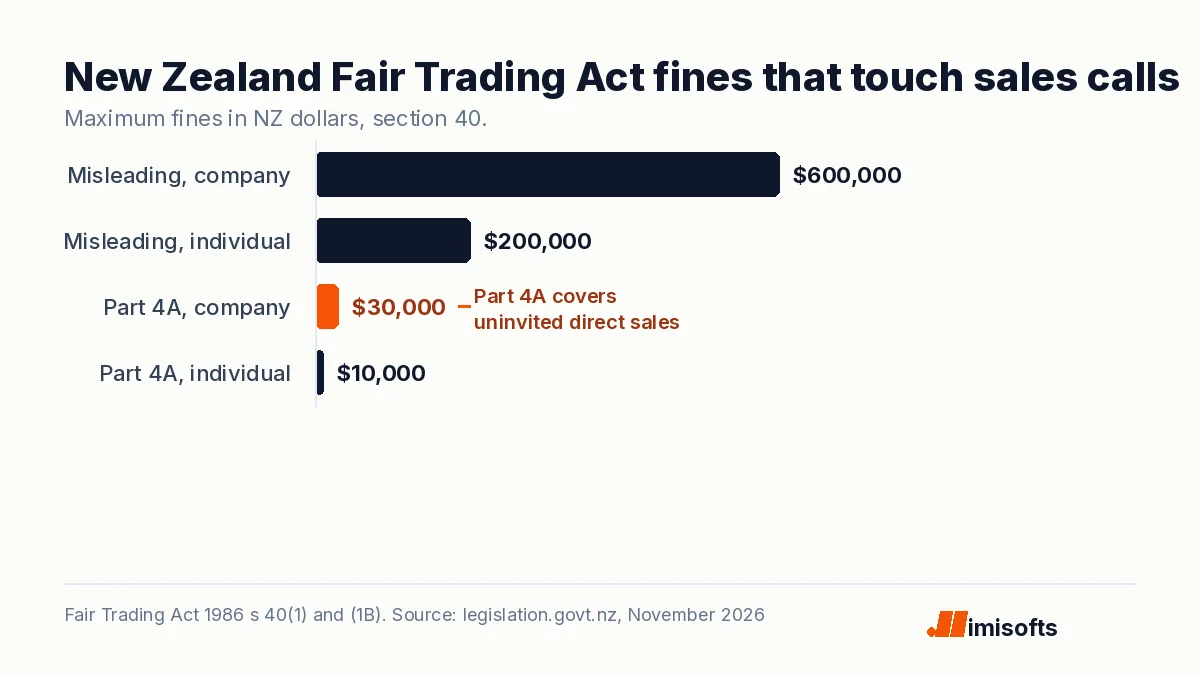
| Fine for a Part 4A breach, individual (s 40(1B)) | $10,000 |
| Fine for a Part 4A breach, body corporate (s 40(1B)) | $30,000 |
| Code of practice calling hours, private homes (Marketing Association, reviewed December 2025) | 8.00 am to 9.00 pm |
| Seconds an automated call may ring before hanging up (code clause 4(m)) | 90 |
| Telecommunications Act s 112 penalty (calls intended to offend) | 3 months or $2,000 |
| Spam law penalty for an individual (voice calls excluded from that Act) | $200,000 |
Fair Trading Act 1986, Telecommunications Act 2001 and Unsolicited Electronic Messages Act 2007 on legislation.govt.nz; Marketing Association Telemarketing Code of Practice (reviewed December 2025) and Do Not Call page, all read on 2 November 2026.
No register, no statutory hours: what the law leaves open
Start with what is absent. The Marketing Association, which runs the industry Do Not Call register, says on its register page that the service "is run by the Marketing Association to help decrease the number of unwanted, unsolicited phone calls to consumers," that "not every company subscribes to the service," and that "calls from overseas" cannot "be controlled or stopped." It also says, "This service does not extend to businesses." There is no statute behind it. The Telecommunications Act 2001 adds only a criminal backstop in section 112: an offence for anyone who "uses, or causes or permits to be used, any telephone device for the purpose of disturbing, annoying, or irritating any person ... with the intention of offending the recipient," punishable by up to 3 months' imprisonment or a fine of up to $2,000. An ordinary sales call is unlikely to meet that intent test.
The Fair Trading Act: uninvited direct sales
Part 4A of the Fair Trading Act 1986, inserted in 2014, is the statute that matters when a cold call turns into a sale. Section 36K(1) defines an "uninvited direct sale agreement" as an agreement to supply goods or services "to a consumer" made as a result of negotiations in one of two situations, where the price "is more than $100" or "cannot be ascertained at the time of supply." Section 36K(3) is the telephone situation: negotiations that "take place by telephone, where the consumer did not invite the supplier to make the telephone call for the purposes of entering into negotiations relating to the supply of those goods or services." Section 36K(5) closes the usual escape routes: a consumer has not invited the call merely because they gave contact details to the supplier for another purpose, or because they called back after a missed call from the supplier, and an unsolicited quote is not an invitation either. Renewal agreements are excluded.
| Obligation | Section | What the Act requires |
|---|---|---|
| Written agreement | 36L(1) | In writing, plain language, legible, clearly presented; a copy given at the time or, for telephone agreements, "within 5 working days after the date on which the agreement was entered into" |
| Front page contents | 36L(2) | Clear description of the goods or services; a summary of the right to cancel; the supplier's name, street address, telephone number and email address; the consumer's name and street address; the total price or how it will be calculated; the date |
| Oral notice before agreement | 36L(3) | Tell the consumer of "the consumer's right to cancel the agreement within 5 working days after the date on which the consumer receives a copy of the agreement" and "how the consumer may cancel" |
| Cancellation | 36M | Within 5 working days of receiving the copy, by any oral or written notice; "at any time" if the supplier failed to comply with 36L |
| Enforceability | 36N | "not enforceable by a supplier unless" 36L was complied with and the cancellation period has run, minor non-prejudicial failures excepted |
| Refund | 36P | "the supplier must immediately repay to the consumer all money paid" |
Section 40(1B) sets the criminal penalty for contravening Part 4A: "in the case of an individual, to a fine not exceeding $10,000; and in the case of a body corporate, to a fine not exceeding $30,000." Misleading or deceptive conduct on the call is a separate matter under Part 1, where section 40(1) allows fines up to $200,000 for an individual and $600,000 for a company. The Act's "consumer" is a person who acquires goods or services "of a kind ordinarily acquired for personal, domestic, or household use or consumption" and not for resale or production, so the uninvited direct sale rules cover only buyers within that definition.
The Marketing Association code: the operating rules
The Telemarketing Code of Practice is voluntary for non-members but is the source of the calling hours, and it has the endorsement of the Telecommunications Users Association and the Contact Centre Institute. Its first page says "The Code was reviewed and updated in December 2025." Its definition of consumers is broad: "customers or potential customers, whether they are members of the public, organisations or businesses." The clauses an outbound team needs:
- Identity and purpose, 2(a): "At the commencement of the call, telemarketers must clearly disclose their identity and state the general purpose of their call."
- Calling line identity, 2(d): callers "must not block the transmission of the calling line identity," and the number shown should be suitable for return contact.
- Hours, 3(a): "Telephone calls to private homes should only be made between 8.00 am and 9.00 pm, unless the caller is advised that a call at another time would be more convenient and acceptable."
- Sundays and public holidays, 3(b): "Calls should be avoided on Sundays and public holidays, unless the caller has reasonable grounds to believe that the call will be readily acceptable, or the consumer has advised a specific time to call them back."
- Unlisted numbers, 3(c): unlisted or unpublished numbers must not be called unless provided by the subscriber.
- Refusals, 3(d) and 4(a): a definite refusal must be accepted and the call ended promptly, and if the called party wants to end the conversation the call should end as soon as possible.
- Do Not Call check, 4(b): "All telemarketers must, before making new solicitations, check the list of people to be called against the Marketing Association's Do Not Call (DNC) Register and delete from the call list those people listed on the Register." The register "is available in real time by subscribers." The check "does not apply when calling existing members or customers."
- Workplace calls, 4(d): no unsolicited approaches by telephone "on private business" to people at their place of work "without prior permission."
- Recording, 4(l): consumers must be advised when a call is to be recorded.
- Automatic dialling with a recorded message, 4(m) and 4(n): such equipment "may only be connected to 'business' or 'non-residential' lines or mobile phones where consent has been given," must hang up if unanswered within 90 seconds, must identify the caller at the start, must never call emergency services or hospitals, and must make clear at the beginning that the call is automated, giving the called party the opportunity to end it.
The code's cooling-off clauses, 4(h) to 4(j), restate the Fair Trading Act: documents within five working days, a five working day cooling-off period with any deposit refunded in full, and no payment for services supplied during that period if the customer cancels. Our hub on cold calling laws by country places New Zealand alongside Australia.
Where the spam law stops
The Unsolicited Electronic Messages Act 2007 covers email and text messages, with a pecuniary penalty of up to $200,000 for an individual, and we cover that side in cold email laws in New Zealand. Its Schedule says the Act does not apply to "voice calls made using (i) a standard telephone service; or (ii) voice-over Internet protocol," and defines a voice call to include "a call that involves a recorded or synthetic voice." So a robocall or an AI voice agent is outside the spam law in New Zealand, and inside the Fair Trading Act, the code and Telecommunications Act section 112. A text sent by the same agent after the call is back inside the spam law.
What a team calling New Zealand should do
- Treat the code as the rulebook for consumer calls. 8.00 am to 9.00 pm, Sundays and public holidays avoided, Do Not Call scrub before each new campaign, identity and purpose up front, true calling line identity.
- Build the Part 4A paperwork into any phone close. Oral notice of the 5 working day cancellation right before the yes, written agreement with the front-page items sent within 5 working days, and a refund process that pays out "immediately."
- Keep automated voices for business or non-residential lines or mobile phones where consent has been given. That is the code's own limit, and the Fair Trading Act's enforceability rules still apply to any consumer sale over $100 an automated call makes.
- Ask permission before pitching at work. Clause 4(d) covers unsolicited calls on private business to people at work, and the Do Not Call register will not help you there because it excludes businesses.
An AI agent that answers and qualifies calls generated by advertising faces none of the uninvited-sale machinery, because the consumer made the call. For how we scope inbound and outbound AI calling, see TCPA-compliant AI calling; the best AI voice agents in 2026 compares platforms. This is general information, not legal advice.
Frequently Asked Questions
Yes. New Zealand has no statutory do-not-call register and no law fixing the hours of a live sales call. A cold call that leads to a sale over $100 to a consumer becomes an uninvited direct sale agreement under the Fair Trading Act 1986, which requires a written agreement, a copy within 5 working days, oral notice of a 5 working day cancellation right, and makes the contract unenforceable if those steps are skipped.
There is no statutory limit. The Marketing Association's Telemarketing Code of Practice, reviewed in December 2025, says calls to private homes should only be made between 8.00 am and 9.00 pm and should be avoided on Sundays and public holidays unless the call will be readily acceptable or the consumer has advised a specific time to call back.
Only an industry one. The Marketing Association runs a free Do Not Call register for consumers, and its code requires telemarketers to check call lists against it before any new campaign. The Association says not every company subscribes, overseas calls cannot be stopped, and the register does not extend to businesses.
A consumer may cancel an uninvited direct sale agreement within 5 working days after receiving a copy of the agreement, by any oral or written notice, and at any time if the supplier failed to meet the disclosure requirements in section 36L. On cancellation the supplier must immediately repay all money paid.
No. The Unsolicited Electronic Messages Act 2007 excludes voice calls made over a standard telephone service or VoIP, and defines a voice call to include a call that involves a recorded or synthetic voice. Such calls fall under the Fair Trading Act, the Telecommunications Act and the Marketing Association code, which says automated dialling with a recorded message may only be connected to business or non-residential lines or mobile phones where consent has been given, and must announce that it is automated.
Section 40(1B) of the Fair Trading Act sets a fine of up to $10,000 for an individual and $30,000 for a body corporate for contravening Part 4A. Misleading or deceptive conduct under Part 1 carries fines of up to $200,000 for an individual and $600,000 for a company.