October 26, 2026. Cold calling is legal in India only inside the registration system the Telecom Regulatory Authority of India (TRAI) requires, and from about 17 November 2026 that system also requires AI callers to be declared in advance. Under the Telecom Commercial Communications Customer Preference (Third Amendment) Regulations, 2026, which TRAI announced on 18 September 2026, any voice call that software places without a person dialing it, whether an autodialer, a robocall or an AI voice agent, is an Application-to-Person (A2P) call. Every business that makes A2P calls must declare them to its telecom operator in advance, with the numbers it will use, and an undeclared A2P call is treated as unsolicited commercial communication, the regulator's term for spam. Promotional calls already belong on 140-series numbers. The sanction falls on your phone lines rather than your bank account: graded action that can bar every outgoing line a sender holds for 15 days and, for repeat violations, disconnect every SIM, PRI line and SIP trunk for a year, with blacklisting.
Key numbers
| Item | Number |
|---|---|
| TCCCPR Third Amendment announced (Regulations 05 of 2026) | 18 September 2026 |
| Most provisions in force (30 days after Gazette publication) | about 18 October 2026 |
| A2P declaration for AI and robocalls (60 days; undeclared A2P calls count as spam) | about 17 November 2026 |
| Appeals and multi-operator AI matching (90 days) | about 17 December 2026 |
| A2P termination charge, per minute (operator to operator; regulated series exempt) | up to ₹0.05 |
| Flagged CLIs that trigger graded action (per sender, from operators' AI systems) | 5 in 10 days |
| Complaints that trigger action with an AI flag (5 in 10 days without one) | 3 in 10 days |
| Bar on all outgoing services (every line the sender holds) | 15 days |
| Disconnection for repeat violations (SIMs, PRI lines and SIP trunks, plus blacklisting) | 1 year |
| Calling window after a written or digital enquiry (enquiry kept in verifiable form) | 7 days |
| Consumer appeal window after a complaint ruling (via the TRAI DND app, operator app or 1909) | 15 days |
| Deadline to suspend a misused header or template (telemarketer at fault: 1 year disconnection) | 6 hours |
TRAI's 18 September 2026 release via the Press Information Bureau, with Gazette summaries by IndiaLaw LLP, Moneylife and TelecomLead, read on 26 October 2026.
What TRAI changed on 18 September 2026
TRAI's release through the Press Information Bureau lists the amendments to the 2018 regulations (TCCCPR). These are the ones that touch an outbound calling program:
- A2P calls are defined and must be declared. An A2P call is a voice call initiated by an application, software system or automated platform without direct human dialing, including autodialing, robocalls and pre-recorded or artificial voice technology. Every entity using them must pre-declare that use to its operator with the calling line identities (CLIs) it will call from, and the declaration is recorded on the operators' distributed ledger (DLT) platform, per TeamLease RegTech's summary.
- Automated calls carry a termination charge. The operator that receives an A2P call may charge the operator that sent it up to ₹0.05 a minute. Calls from the number series TRAI designates for regulated commercial communication, and calls TRAI authorizes, are exempt.
- AI spam detection becomes enforcement. A new Regulation 21A makes operators identify the CLIs most likely to be sending spam and share them with each other. When five or more CLIs linked to one sender are flagged within ten days, operators start graded action. Numbers in the 140xx, 1600xx and 1601xx series are not flagged as suspected spam.
- Fewer complaints trigger action. Three unique complaints within ten days now trigger action against a sender whose CLI the operator's AI system has also flagged. Without the flag, the threshold stays at five complaints in ten days.
- An enquiry opens a 7-day window. A business may send commercial communications on the basis of a customer's enquiry for seven days from that enquiry, provided it was made in writing or by digital means and the business keeps it in a verifiable form.
- Old consents must be registered. Consents a business already holds count only if they were obtained by verifiable means and are then registered on the operator's digital platform.
- Caller ID apps lose blanket blocking. Call management apps may no longer blanket block, filter or spam-tag the 140xx, 1600xx and 1601xx series, though each user can still block numbers on their own phone.
- Consumers can appeal. A customer unhappy with how a spam complaint was resolved can appeal within 15 days, through the TRAI DND app, the operator's app or portal, or a call or SMS to 1909.
When each part of the amendment starts
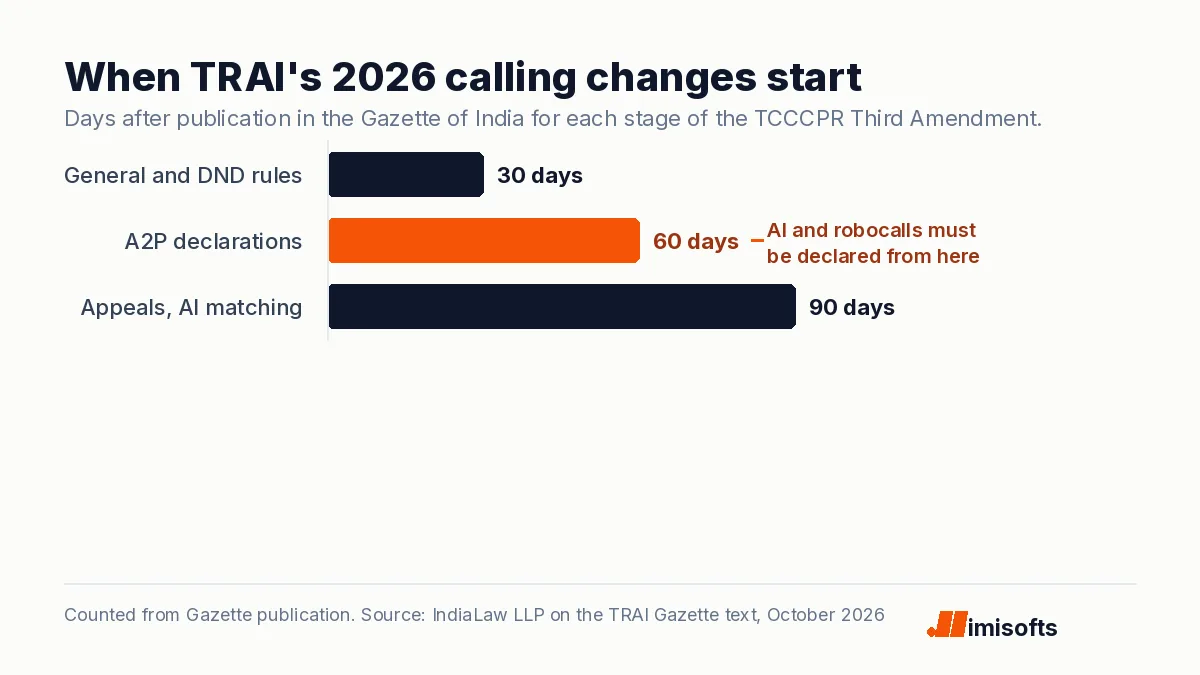
The amendment does not start on one day. According to IndiaLaw LLP's reading of the Gazette text, it comes into force in three stages counted from its publication in the Gazette of India: after 30 days for the general provisions and the revised Do Not Disturb rules, after 60 days for the mandatory A2P declarations, the operator interface for virtual network operators and the header suspension rules, and after 90 days for the appeals mechanism and the multi-operator AI matching. Counted from 18 September 2026, the date TRAI announced the amendment, that is about 18 October, 17 November and 17 December 2026. If the Gazette publication date turns out to be later, every stage moves with it, so plan for the earlier dates. On that count the first stage is already in force today.
Is AI cold calling legal in India?
Yes, if it runs inside the registered system, and the 2026 definition names artificial voice technology outright. An AI voice agent that dials on its own is an A2P caller, so it needs the advance declaration on top of the rules every telemarketer already follows:
- Sales calls go on 140 numbers. TRAI reserves the 140xx series for regulated promotional calls and the 1600xx and 1601xx series for service and transactional calls.
- A pitch makes a call promotional. Since the 2025 amendment, a service or transactional communication that also carries promotional content is treated as promotional, according to Khaitan & Co. An AI agent that confirms a delivery and then upsells needs promotional clearance.
- Consent is registered, not assumed. Explicit consent is recorded in the consent register, and inferred consent from a customer relationship lasts only as long as the contract (Khaitan & Co). IndiaLaw adds that consent under the TRAI framework covers calls and SMS only and is separate from consent to process personal data under the Digital Personal Data Protection Act.
- Customers choose what they block. A customer who sends BLOCK PROMO to 1909 stops promotional communications across every category, mode and time band, but not transactional, service or government communications, and preferences set under the old fully blocked option are migrated to it, Moneylife reports.
Penalties: your phone lines, not a fine
TRAI's rules act on the sender's telecom resources. When AI flags or complaints cross the thresholds, operators run graded action: KYC re-verification, physical verification, barring of outgoing services and, for repeated violations, disconnection. Moneylife's reading of the Gazette text puts the outgoing bar at 15 days, applied to every line the sender holds whether or not that line made the calls, and the repeat-offender sanction at a one-year disconnection of all SIMs, PRI lines and SIP trunks, with a blacklist that stops any operator from issuing new connections. One number may be kept, with outgoing calls barred except to notified emergency services. IndiaLaw places the 15-day suspension after a second, physical KYC check rather than at the first violation; both readings put it before disconnection.
The timelines are short. An operator whose AI flags a call must share it with the originating operator within two hours, and a misused message header or content template must be suspended within six hours; if a telemarketer is to blame, all its telecom resources across operators are disconnected for a year, with blacklisting (TelecomLead). The 2025 amendment also introduced substantial financial penalties on operators for non-compliance (Khaitan & Co).
What it means for operators
If you run or buy AI calling into India, this is the order of work before the A2P stage in mid-November:
- List every automated call flow. Outbound AI agents, predictive dialers, voice broadcasts and callback bots are all in scope. The test is whether a person dials each call.
- Declare before you dial. Give your operator the A2P declaration and the full list of CLIs; from the 60-day stage an undeclared AI call counts as spam.
- Put sales on 140 numbers. Run promotional calls through a registered telemarketer, keep service and transactional calls on 1600xx or 1601xx, and never add a pitch to a service call.
- Keep enquiry proof. A web form submission or a written message is your record; call within seven days and store it where you can produce it.
- Register the consents you already hold on your operator's platform, or stop relying on them.
- Script the opening. Name the business, say the caller is an AI and offer an opt-out. TRAI's release does not mention an AI disclosure; we script one anyway, as in our note on scripting the AI disclosure.
The lowest-risk use of AI voice in India is inbound: answering enquiries, booking and after-hours calls with an AI call answering agent, where the customer starts the conversation. For outbound, we build the same consent-first design into every compliant AI calling setup, and our guide to the best AI voice agents compares the platforms. Compare the calling rules in the UAE and South Africa, or the full cold calling laws by country table; for email, see the India row of our cold email laws by country guide. This is a summary of public documents, not legal advice.
Frequently Asked Questions
Yes, inside TRAI's registered system. Under the TCCCPR Third Amendment of 18 September 2026, a call placed by software without a person dialing, including an AI voice agent, is an A2P call that must be declared to the telecom operator in advance with its calling numbers; an undeclared A2P call is treated as spam. Promotional calls belong on 140xx numbers through a registered telemarketer, and customer preferences and consent records still apply.
An Application-to-Person call is a voice call initiated by an application, software system or automated platform without direct human dialing, including autodialing, robocalls and pre-recorded or artificial voice technology. The sender must pre-declare A2P use and its CLIs to its operator, and the receiving operator may charge the sending operator up to ₹0.05 a minute unless the call comes from a regulated commercial series.
The Third Amendment starts in three stages counted from publication in the Gazette of India: 30 days for most provisions, 60 days for the A2P declarations and 90 days for appeals and multi-operator AI matching, according to IndiaLaw LLP. Counted from 18 September 2026, that is about 18 October, 17 November and 17 December 2026.
TRAI reserves 140xx numbers for regulated promotional calls and 1600xx and 1601xx numbers for service and transactional calls. Since the 2026 amendment, operators do not flag these series as suspected spam and call management apps may not blanket block or spam-tag them.
TRAI acts on the sender's telecom resources. After AI flags or complaints cross the thresholds, operators run graded action: KYC re-verification, physical verification, a 15-day bar on outgoing services and, for repeated violations, a one-year disconnection of every SIM, PRI line and SIP trunk the sender holds, with blacklisting, according to Moneylife's and IndiaLaw's readings of the Gazette text.
Yes, for seven days. The 2026 amendment allows commercial communications based on a customer's enquiry for seven days from the date of the enquiry, provided it was made in writing or by digital means and the business keeps it in a verifiable form. After that you need registered consent or another basis under the regulations.