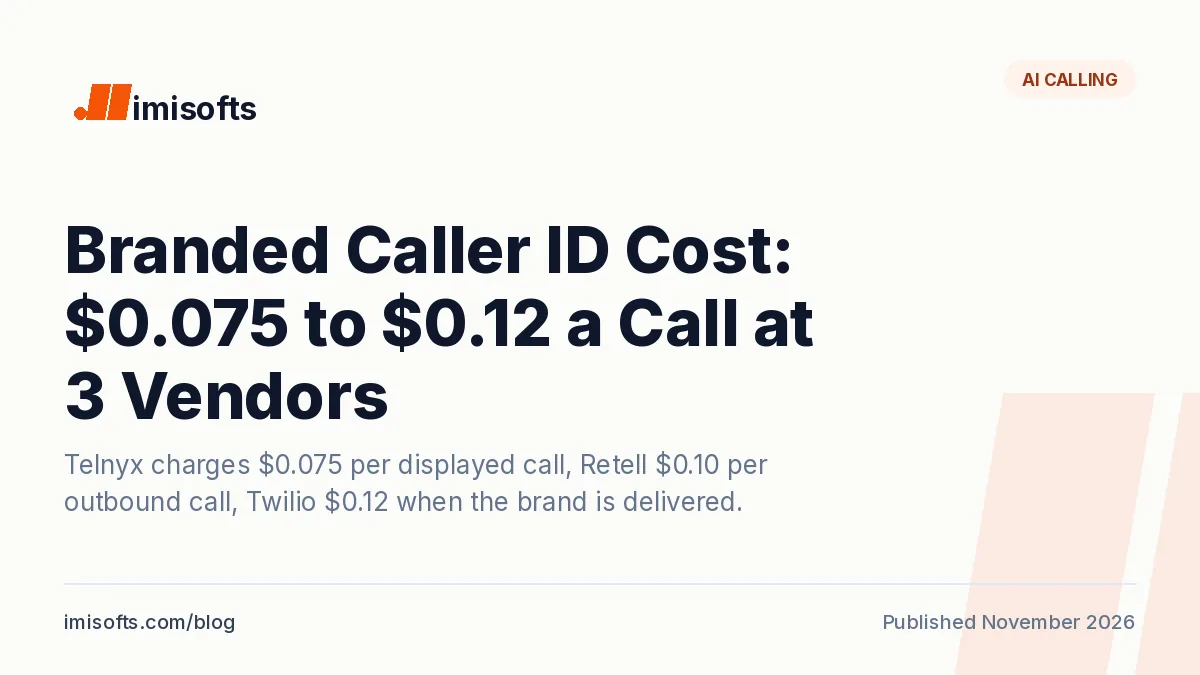
How much does branded caller ID cost? On the pricing pages and docs I read on 11 November 2026, Telnyx charges $0.075 per call that displays your brand plus $50 once and $50 a month per brand, Retell adds $0.10 per outbound call, and Twilio charges $0.12 a call, billed only when the brand information is delivered. Twilio and Telnyx list two US networks for it, T-Mobile and Verizon.
My view: branded caller ID is a per-call fee for a better first impression. Retell itself says a branded call may still be marked “Spam Likely” without its separate verified-number service.
In my view, pay to show your name only after the number is clean and the consent is on file.
Key numbers
| Item | Number |
|---|---|
| Telnyx, branded call display (per call that displays your brand to the recipient) | $0.075 |
| Telnyx, brand registration (per brand; Telnyx lists Enterprise registration as free) | $50 once plus $50 a month |
| Retell, branded call add-on (per outbound call, as its pricing page words it) | $0.10 |
| Retell, verified phone number (per number, a separate service from branded call) | $10 a month |
| Twilio, branded calling (per call, billed only when the brand information is delivered) | $0.12 |
| Twilio cost of 1,000 delivered branded calls (at the listed $0.12) | $120 |
| Networks Twilio and Telnyx list for US branding (T-Mobile and Verizon) | 2 |
| Name limit on Verizon in Retell’s docs (T-Mobile and AT&T: 32 characters) | 15 characters |
| Twilio US Branded Calling generally available (per Twilio’s launch post) | 5 August 2026 |
| FCC call branding proposal (FCC 25-76) voted (a proposed rule; I found no order adopting it) | 28 October 2025 |
| Reply comments on the proposal due by (per the Federal Register notice of 5 December 2025) | 3 February 2026 |
| Consumers who say they will not answer unidentified calls (12,000+ consumers in six countries, Hiya’s 2026 survey; Hiya advertises branded calling) | 86% |
Read on 11 November 2026 from the Twilio, Telnyx and Retell pricing pages and docs, Twilio’s launch post, Telnyx’s release note, Hiya’s blog, FCC 25-76, the Federal Register and the FCC’s 1 July 2026 fact sheet.
What branded caller ID costs per call
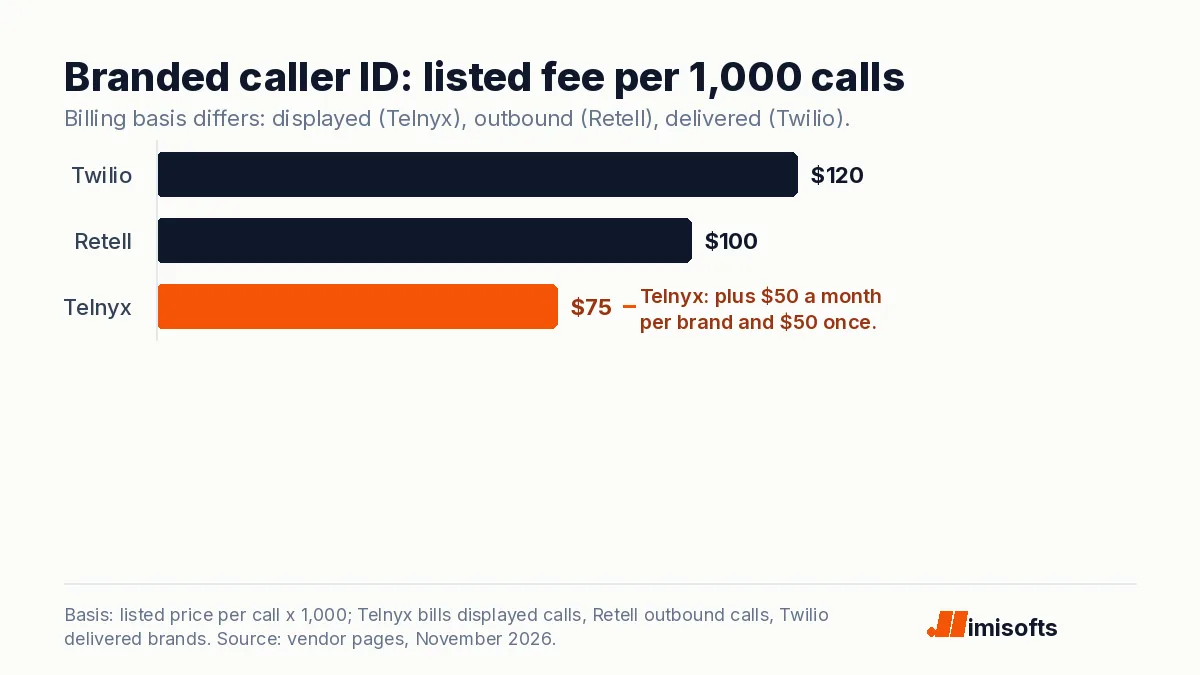
Telnyx’s rate card lists Branded Call Display at $0.075 per call, plus brand registration of $50 one-time and $50 a month per brand; its developer docs say the per-call fee is “Charged per call that displays your branded identity to the recipient” and list Enterprise registration as free. Retell’s pricing page lists “Branded Call +$0.10/outbound call” as an add-on to its AI agent rates. Twilio’s US voice price list shows “Branded calling $0.12 / call”, and its docs say “Twilio bills you only when the brand information is successfully delivered.”
| Vendor | Per call | When the per-call fee applies | Fixed fees | Listed fee per 1,000 billable calls |
|---|---|---|---|---|
| Telnyx | $0.075 | Per call that displays your brand | $50 once and $50 a month per brand | $75, plus the brand fees |
| Retell | $0.10 | Per outbound call, as its page words it | None listed for branded call; a verified number ($10 a month) is separate | $100 |
| Twilio | $0.12 | Only when the brand information is delivered | None in that row of the US price list | $120 |
The billing bases differ, so the last column is not like for like, and Telnyx says rates “may vary by destination and volume tier”. One oddity: the same Telnyx page’s worked example multiplies 100,000 outbound calls by $0.02 to show $2,000 a month; at the listed $0.075, 100,000 displayed calls come to $7,500. For the rest of each bill, see Retell AI pricing and Twilio Voice pricing.
Where the name actually shows
Hiya, which advertises branded calling, reports that 86% of consumers in its State of the Call 2026 survey of more than 12,000 people in six countries say they will not answer unidentified calls (blog post of 14 April 2026). But the name shows only where the network and the phone support it.
Twilio’s docs list two networks for US Enhanced Branded Calling: T-Mobile and Verizon. Telnyx says its branding “currently applies to US-to-US calls placed to US mobile numbers serviced by T-Mobile and Verizon”, and that whether it appears “depends on the receiving carrier, the recipient’s device, and the network path the call takes” (release note, 26 June 2026). Retell’s docs give name limits for T-Mobile and AT&T (32 characters) and Verizon (15), though Twilio and Telnyx do not list AT&T.
Phones matter too. Twilio’s device table lists iOS 18.5 or later for iPhone XS and later on T-Mobile, iOS 26.5 or later for iPhones on Verizon, and the display name only on MVNO lines. Its launch post of 5 August 2026 says call reason “is not currently supported on iOS devices due to an Apple limitation”.
What branding does not fix
Retell treats branding and its verified-number service as separate products. Retell’s own docs say branded call and a verified number are “separate services”, and that without a verified phone number “your calls may still be marked ‘Spam Likely’”; its verified number is $10 a month per number. For how labels get assigned, see our guide on why a business number shows as spam. Twilio also restricts eligibility: “If you get a high number of SIP 608 or 603 responses in your outbound calls, you might not be able to use Branded Calling,” its rules say.
Nor, on my reading, does a name change the consent rules. In FCC 24-17 (adopted 2 February 2024), the FCC confirmed that the TCPA’s limits on an “artificial or prerecorded voice” “encompass current AI technologies that generate human voices.” Under 47 CFR 64.1200(a)(2), a telemarketing call using one to a cell phone needs the called party’s prior express written consent; calls by or on behalf of a tax-exempt nonprofit need only prior express consent, and calls that deliver a “health care” message are treated separately. This is general information, not legal advice.
An assumption like this (illustrative): “Branding will clear our Spam Likely label.”
Retell’s docs call branded call and a verified number separate services, and say calls may still be marked “Spam Likely” without the second.
My suggestion: check the number, get consent on file, then add branding.
Twilio does not charge where the brand information is not delivered; Telnyx charges per call that displays.
The FCC proposal for a verified name on screen
On 28 October 2025 the FCC adopted FCC 25-76, a notice proposing “to require terminating voice service providers to transmit verified caller name” for display “whenever they transmit call authentication information indicating that the originating number is unlikely to be spoofed.” On my reading, paragraph 30 narrows it: the requirement “would apply only when a terminating provider chooses to transmit to the handset an indication that a call received an A-level attestation”, and the FCC says it does not propose to require providers to show the attestation or to transmit any new caller identification information. Our A-level attestation guide explains the grades. This is general information, not legal advice.
Comments were due by 5 January 2026 and reply comments by 3 February 2026, per the Federal Register notice of 5 December 2025 for the same dockets. A footnote in an FCC draft released with its 1 July 2026 fact sheet cites it as the “Call Branding FNPRM”, and in my searches on 11 November 2026 I found no order adopting it. A phrase search of the proposal turned up no section on what vendors may charge callers for branding. This is general information, not legal advice.
Four steps before you pay for branding
Check the label before the name
My suggestion: check how your outbound numbers are labeled, and whether your platform offers a verified-number service (Retell lists one at $10 a month), before paying per call for a name.
Get written consent on file
For telemarketing calls using an AI voice to cell phones, 47 CFR 64.1200(a)(2) requires prior express written consent, branded or not, subject to the exceptions above. Our TCPA compliance checklist lists the other checks. This is general information, not legal advice.
Ask how each vendor bills
My suggestion: Retell words its fee per outbound call, so ask whether it bills calls where the brand is not shown, and get every rate in writing, given the $0.02 example on Telnyx’s page.
Test on the networks listed
My suggestion: brand a test group of numbers, compare answer rates with unbranded ones over the same weeks, and decide on your own data rather than a vendor survey.
My team’s record: 500+ projects delivered across 30 countries. We build AI calling for home services and AI calling built around TCPA consent; which branding vendor you use is your decision. For the voice layer itself, see our best AI voice agents comparison and AI answering service for HVAC, and before you rotate local numbers, read is local presence dialing legal.
The bottom line
At list prices, Telnyx charges $0.075 per displayed call, Retell $0.10 per outbound call, Twilio $0.12 when the brand is delivered. In my view, test branding only once your numbers’ labels are checked and consent is on file: Retell says a branded call may still be marked “Spam Likely” without a verified number, and on my reading the consent rule is the same with or without a name. This is general information, not legal advice.