Short answer. Illinois's Biometric Information Privacy Act (BIPA, 740 ILCS 14) lists a "voiceprint" next to fingerprints and face scans, and it bars any private entity, including an individual or a business, from collecting one until it has told the person in writing what it collects, why and for how long, and has a written release. A business that holds biometric data must publish a retention schedule and destroy the data once its purpose is met or within 3 years of the person's last interaction, whichever comes first. Each person can sue for $1,000 per negligent violation or $5,000 per intentional or reckless one, or actual damages if higher, plus attorneys' fees; since 2 August 2024, repeated collection from the same person by the same method counts as one violation.
The Act took effect on 3 October 2008. This guide reads the Act's own text section by section, then the three Illinois Supreme Court decisions that shaped how it is enforced, and ends with what a business running AI voice tools should check. We read the statute and the opinions on November 22, 2026. This is general information, not legal advice.
Key numbers
| Item | Number |
|---|---|
| Liquidated damages, negligent violation (or actual damages, if greater) | $1,000 |
| Liquidated damages, intentional or reckless (or actual damages, if greater) | $5,000 |
| Latest destruction deadline (after the last interaction, or sooner when the purpose is met) | 3 years |
| Limitations period (Tims, 2 Feb 2023) (section 13-205 of the Code of Civil Procedure) | 5 years |
| Amendment limiting recovery (P.A. 103-769, one recovery per person and method) | 2 Aug 2024 |
| Cothron v. White Castle decided (a claim accrues with each scan or transmission) | 17 Feb 2023 |
| White Castle's own damages estimate (may exceed, for up to 9,500 workers, per Cothron) | Over $17 billion |
| BIPA took effect (P.A. 95-994) | 3 Oct 2008 |
Statute text (Justia, 2025 Illinois Compiled Statutes) and the Illinois Supreme Court opinions on CourtListener, read on 22 November 2026.
What BIPA covers
Section 10 defines a "biometric identifier" as "a retina or iris scan, fingerprint, voiceprint, or scan of hand or face geometry." It then lists what is not one: "writing samples, written signatures, photographs, human biological samples used for valid scientific testing or screening, demographic data, tattoo descriptions, or physical descriptions such as height, weight, hair color, or eye color." Information captured from a patient in a health care setting, or used for treatment, payment or operations under HIPAA, is also excluded.
"Biometric information" is any information "based on an individual's biometric identifier used to identify an individual," however it is captured, converted, stored or shared. On our reading, a template or hash made from a face scan and used to identify someone is covered too.
The Act binds every "private entity": "any individual, partnership, corporation, limited liability company, association, or other group, however organized." State and local government agencies are not private entities. Section 25 also excludes, among others, a financial institution or its affiliate subject to Title V of the Gramm-Leach-Bliley Act, and a contractor, subcontractor or agent of a State agency or local government when working for it. We read the text on Justia's copy of the 2025 Illinois Compiled Statutes, because the Illinois General Assembly's site timed out; Justia notes its copy may not be the most recent version. This is general information, not legal advice.
| Covered (section 10) | Not covered (section 10) |
|---|---|
| Retina or iris scan | Photographs |
| Fingerprint | Writing samples and written signatures |
| Voiceprint | Demographic data, physical descriptions |
| Scan of hand or face geometry | Patient data used under HIPAA |
The five duties in section 15
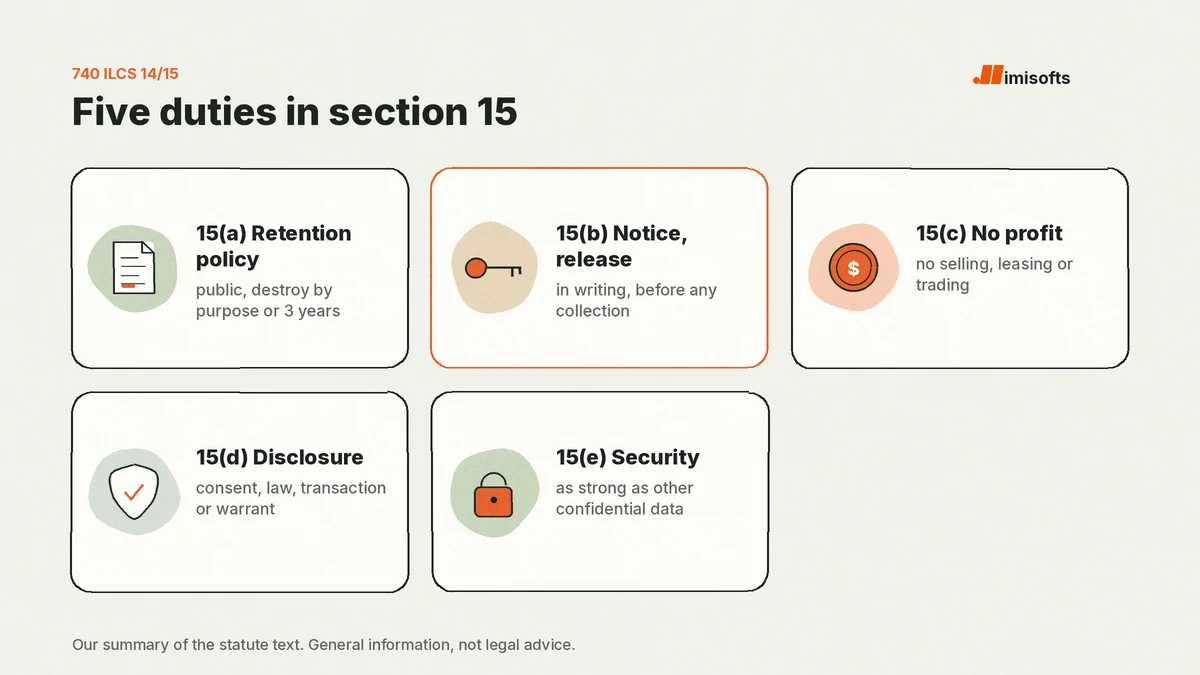
Section 15 is where the obligations sit. On our reading, each subsection is a separate duty; section 20(a) gives a right of action to "any person aggrieved by a violation of this Act."
- 15(a) Retention policy. A private entity "in possession of" biometric data "must develop a written policy, made available to the public," with a retention schedule and guidelines for destroying the data "when the initial purpose for collecting or obtaining such identifiers or information has been satisfied or within 3 years of the individual's last interaction with the private entity, whichever occurs first." Absent a warrant or subpoena, it "must comply with its established retention schedule and destruction guidelines."
- 15(b) Notice and written release before collection. No business may "collect, capture, purchase, receive through trade, or otherwise obtain" biometric data unless it first tells the person in writing that it is being collected or stored, tells them in writing "the specific purpose and length of term" for which it is collected, stored and used, and "receives a written release executed by the subject."
- 15(c) No profit. No business may "sell, lease, trade, or otherwise profit from" a person's biometric data.
- 15(d) No disclosure without a reason the Act lists. Disclosure is allowed only with consent, to complete a financial transaction the person asked for, when State or federal law or a municipal ordinance requires it, or under a valid warrant or subpoena.
- 15(e) Security. Biometric data must be protected "using the reasonable standard of care within the private entity's industry" and at least as well as the business protects its other confidential and sensitive information.
This is general information, not legal advice.
What the written release has to be
The Act defines a "written release" as "informed written consent, electronic signature, or, in the context of employment, a release executed by an employee as a condition of employment." An electronic signature is "an electronic sound, symbol, or process attached to or logically associated with a record and executed or adopted by a person with the intent to sign the record." Section 10's source note cites Public Act 103-769, effective 2 August 2024.
On our reading, that means a checkbox or click on a form can work as the release, provided it is attached to the record and the person intends to sign it, and provided the two written notices in section 15(b) come first. The notice has three parts the text names: that biometric data is being collected or stored, the specific purpose, and the length of term. A notice that leaves out the purpose or the term does not meet 15(b) as written. This is general information, not legal advice.
Damages: $1,000, $5,000 and the 2024 change
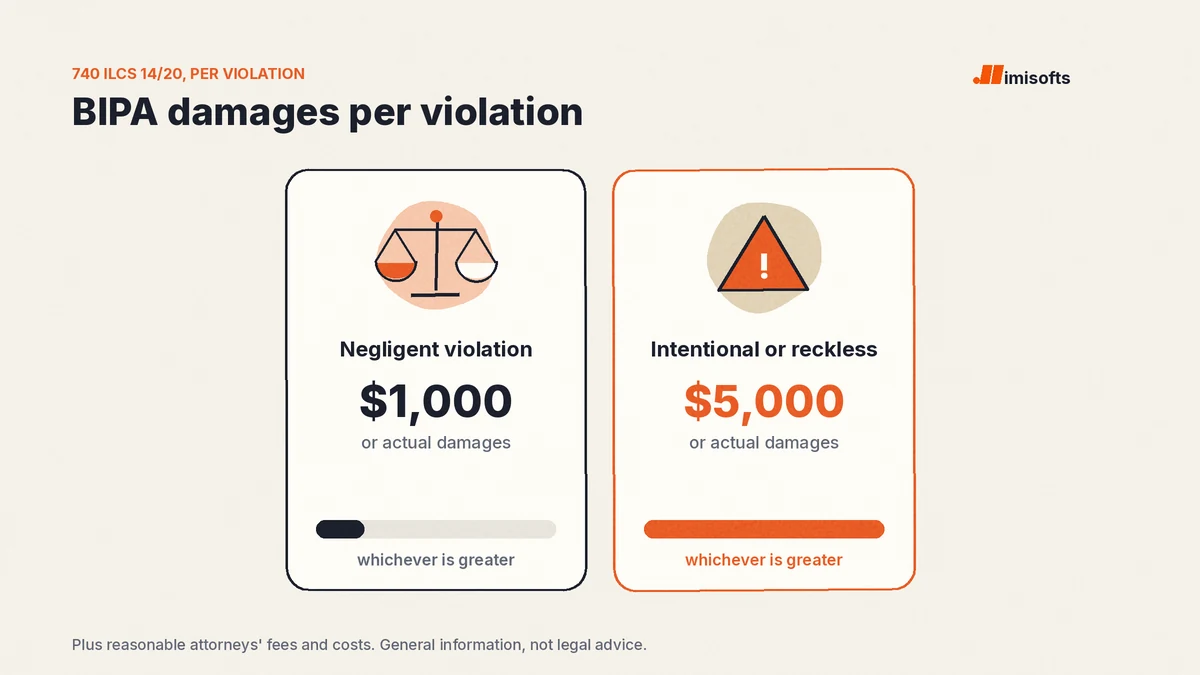
Section 20 gives "any person aggrieved by a violation" a right to sue in an Illinois circuit court or, as a supplemental claim, in federal district court. For each violation a prevailing party may recover:
- $1,000 in liquidated damages, or actual damages if greater, against a business that "negligently violates" the Act;
- $5,000, or actual damages if greater, against one that "intentionally or recklessly violates" it;
- reasonable attorneys' fees and costs, including expert witness fees; and
- other relief, including an injunction.
Three Illinois Supreme Court decisions shaped how far that reaches:
| Decision | Date | What the court held |
|---|---|---|
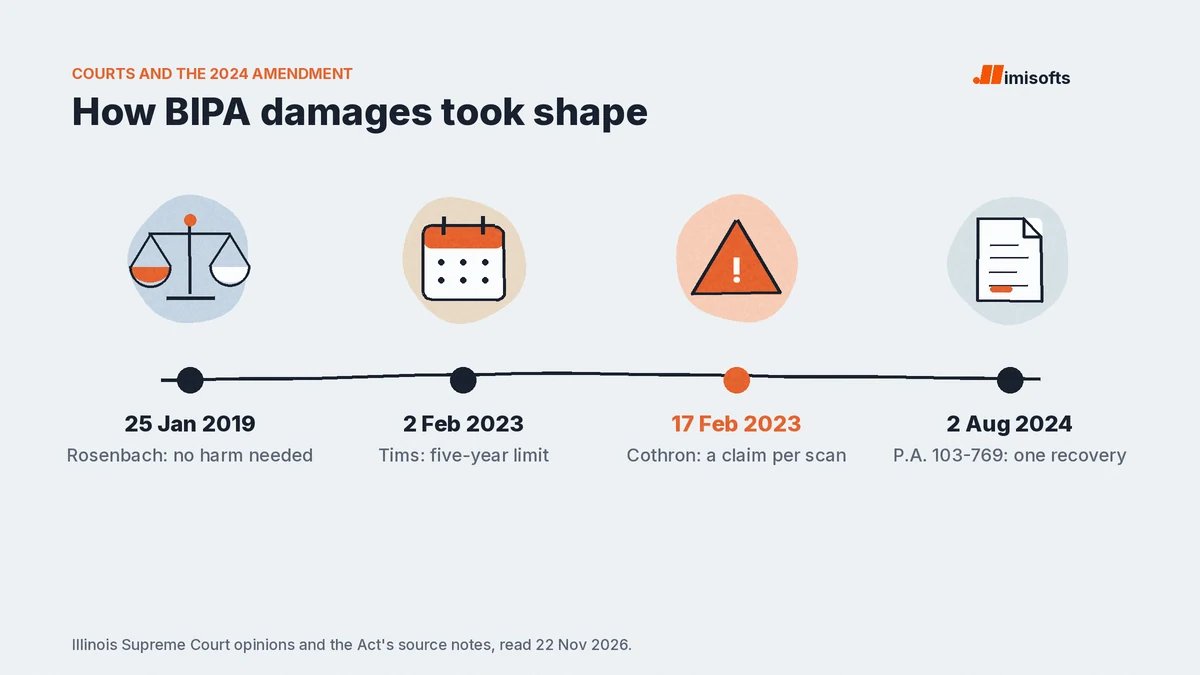
| Rosenbach v. Six Flags, 2019 IL 123186 | 25 Jan 2019 | A person need not allege "some actual injury or adverse effect" beyond the violation itself to be "aggrieved" |
| Tims v. Black Horse Carriers, 2023 IL 127801 | 2 Feb 2023 | The five-year limitations period in section 13-205 of the Code of Civil Procedure "controls claims under the Act" |
| Cothron v. White Castle, 2023 IL 128004 | 17 Feb 2023 | "a separate claim accrues under the Act each time a private entity scans or transmits" biometric data in violation of 15(b) or 15(d) |
In Cothron, White Castle's fingerprint system was used for pay stubs and computer access, and the company estimated that class-wide damages for up to 9,500 current and former employees "may exceed $17 billion." The court said "the statutory language clearly supports plaintiff's position," and added that "It also appears that the General Assembly chose to make damages discretionary rather than mandatory under the Act."
The legislature then changed section 20. Public Act 103-769, effective 2 August 2024, added that a business that collects "the same biometric identifier or biometric information from the same person using the same method of collection" more than once in violation of 15(b) has "committed a single violation" with "at most, one recovery." Subsection 20(c) does the same for repeated disclosure of the same person's data to the same recipient. The text we read does not say whether this applies to cases filed before 2 August 2024, so we do not state it.
A hypothetical to show the scale under the amended text: a business that collects voiceprints from 100 people without a release faces up to 100 recoveries, which is $100,000 at $1,000 each if negligent or $500,000 at $5,000 each if intentional or reckless, before fees. A court may award less, since Cothron says the damages appear to be discretionary. This is general information, not legal advice.
Voice AI and voiceprints: what to check
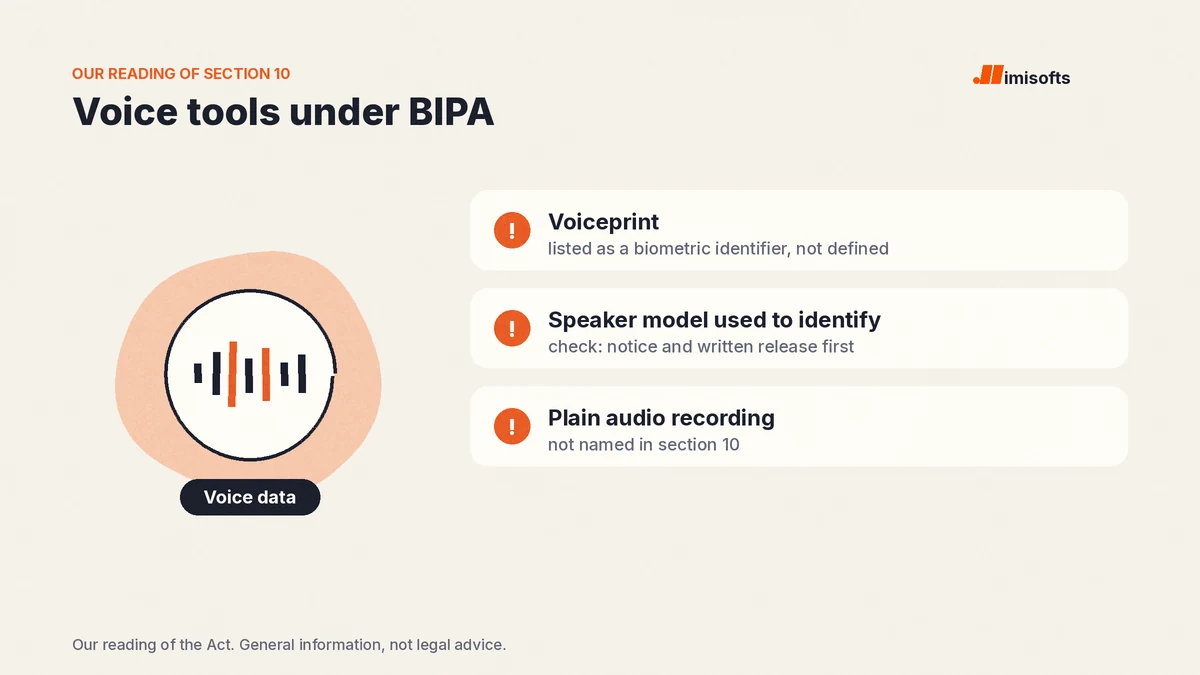
BIPA names "voiceprint" in its list but does not define it, and "biometric information" is limited to information "used to identify an individual." Section 10's definitions, as quoted above, do not name recordings, transcripts or AI. On our reading, the question for a business that uses AI phone agents, call recording or voice cloning is whether any tool in the chain builds a voice template that is used to recognize who is speaking. A recording kept only as audio is not named in section 10; a speaker-verification or voice-cloning feature trained on a specific person's voice is the case to check with the vendor and a lawyer.
If your outbound or inbound calls reach people in Illinois, we would ask each vendor in writing whether it creates voiceprints or speaker models, where they are stored and for how long, and whether it discloses them to anyone. Call recording consent is a separate question; our call recording laws by state guide covers it. This is general information, not legal advice. For calling that starts from consent records, see our AI calling built around TCPA consent page, and our AI voice agents compared guide for the platforms themselves.
A BIPA checklist for a small business
These are our suggestions, built on the sections quoted above. The text we read sets out no safe harbor, and this list is not one.
- List every tool that touches a fingerprint, face scan, iris scan, hand scan or voiceprint: time clocks, door access, ID checks, voice authentication, voice cloning.
- Publish a retention and destruction policy (15(a)) with the purpose-met or 3-year trigger, and comply with it.
- Before any collection, give both written notices and get a written release (15(b)); keep the signed record with its date.
- Never sell or otherwise profit from the data (15(c)); check vendor contracts for the same.
- Disclose only for a reason section 15(d) lists, and keep a record of each disclosure.
- Protect the data at least as well as your other confidential information (15(e)).
- Remember the window: Tims applies a five-year limitations period to claims under the Act.
Illinois is not the only privacy law that reaches outbound teams; our CCPA compliance guide covers California's. If you are pricing an AI assistant for your business, our AI chatbot for business cost guide lists what the tools charge. This is general information, not legal advice; for a specific system, ask an Illinois lawyer.
Frequently Asked Questions
BIPA is Illinois's Biometric Information Privacy Act, 740 ILCS 14, which took effect on 3 October 2008. It covers retina or iris scans, fingerprints, voiceprints and scans of hand or face geometry, and it lets any person aggrieved by a violation sue for $1,000 or $5,000 per violation, or actual damages if higher, plus attorneys' fees.
The Act lists a voiceprint as a biometric identifier but does not define it, and biometric information must be used to identify an individual. A plain audio recording is not named in section 10. On our reading, the risk is a tool that builds a speaker model or voice template used to recognize a person, such as voice authentication or voice cloning. Ask each vendor and an Illinois lawyer.
Section 20 allows $1,000 in liquidated damages per negligent violation and $5,000 per intentional or reckless violation, or actual damages if greater, plus reasonable attorneys' fees, costs and an injunction. Since 2 August 2024, repeated collection from the same person by the same method is a single violation with at most one recovery.
Section 15(a) requires a public written policy that destroys the data when the initial purpose is satisfied or within 3 years of the person's last interaction with the business, whichever occurs first. Absent a warrant or subpoena, the business must comply with that schedule.
Five years. In Tims v. Black Horse Carriers, decided on 2 February 2023, the Illinois Supreme Court held that the five-year limitations period in section 13-205 of the Code of Civil Procedure controls claims under the Act.
No. In Rosenbach v. Six Flags, filed on 25 January 2019, the Illinois Supreme Court held that a person need not allege some actual injury or adverse effect beyond the violation of their rights under the Act to be an aggrieved person.