November 11, 2026. Amazon told US sellers on November 5 that Fulfillment by Amazon fulfillment fees will rise by an average of $0.19 per unit sold from January 15, 2027, which it puts at about 0.8% of the average item's selling price. Amazon says "Fees for some products will increase, and others will decrease." Among standard-size items, small ones priced above $50 rise most, by $0.70 per unit on average, while large ones under $10 stay unchanged outside apparel. From February 1, 2027, Amazon drops the storage utilization surcharge and folds the aged inventory surcharge into a single age-based monthly storage rate.
Key numbers
| Item | Number |
|---|---|
| Average FBA fulfillment fee increase per unit (about 0.8% of average selling price) | $0.19 |
| Fulfillment fee changes take effect | January 15, 2027 |
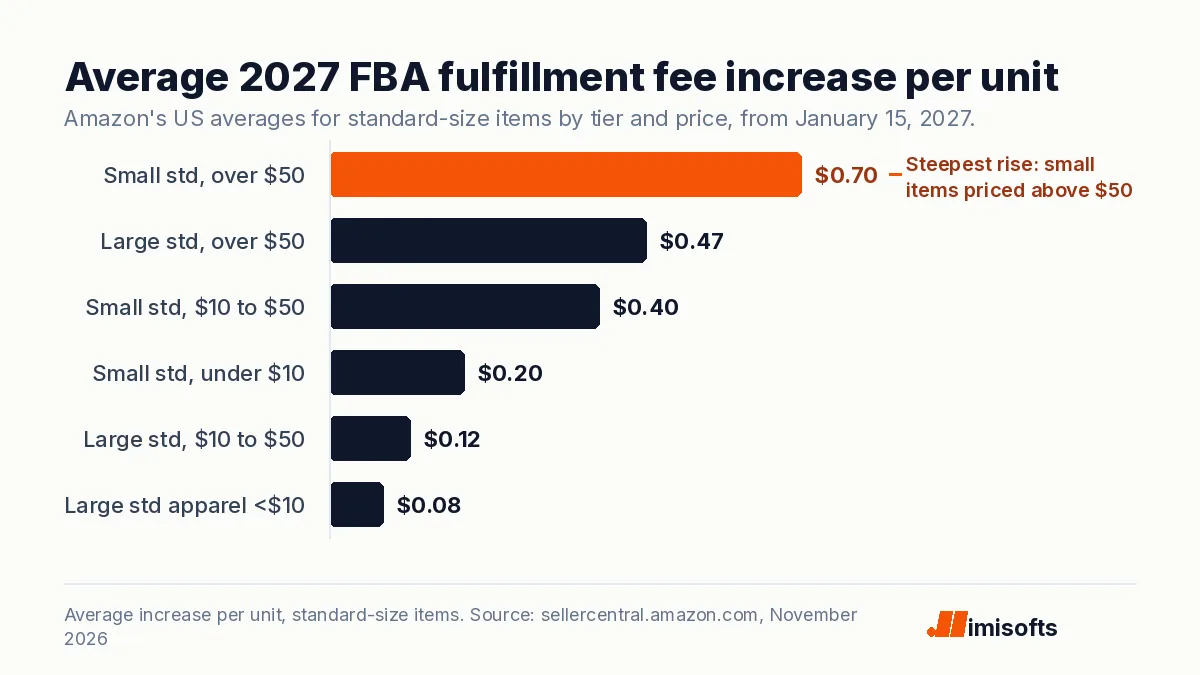
| Small standard-size, priced above $50 (average per unit) | +$0.70 |
| Small standard-size, priced $10 to $50 (average per unit) | +$0.40 |
| Large standard-size, priced above $50 (average per unit) | +$0.47 |
| Storage and low-inventory fee changes | February 1, 2027 |
| Low-inventory-level fee threshold | 28 days of supply |
| FBA fuel and logistics surcharge, unchanged (since April 17, 2026) | 3.5% |
Fee changes read on 11 November 2026 from Amazon's November 5 letter to sellers and its Seller Central fee pages.
What changes, and when
- January 15, 2027: fulfillment fees. Amazon's Seller Central summary lists average increases per unit. Small standard-size: $0.20 under $10, $0.40 from $10 to $50, $0.70 above $50. Large standard-size: unchanged under $10 outside apparel ($0.08 for apparel), $0.12 from $10 to $50, $0.47 above $50.
- January 15: fewer low-price rates. On Amazon's list of January 15 changes, Automotive and Powersports, Compact Appliances, Computers, Musical Instruments and AV Production, and Media (books, DVD, music, software, video) lose low-price FBA rates and pay the $10 to $50 rates instead.
- February 1: storage. In Amazon's letter to sellers from Sunny Jain, its vice president of Worldwide Fulfillment by Amazon, the change "will result in flat or lower fees for inventory that turns in under six months, higher fees for aged inventory, and a new age-based rate that will make your storage costs easier to predict."
- February 1: low-inventory-level fee. Instead of trailing 30- and 90-day sales, the fee will apply "only when your inventory falls below 28 days of supply," measured on shipments in the four weeks before and after the assessment date.
- Unchanged: the 3.5% surcharge. The fuel and logistics surcharge that has applied to FBA fulfillment fees since April 17, 2026 "remains unchanged." Amazon's 2027 rate cards are shown before it, and it still applies on top.
The update also raises Multichannel Fulfillment standard-speed and Buy with Prime fees by 3.5% on average, with expedited speed unchanged on average, and adds a $5 upfront fee plus a 2% variable fee capped at $2,000 for Buy X, Get Y promotions. PPC Land reported the $0.19 average and the January 15 date on November 6, including Amazon's example of a phone case priced under $10 moving "from $2.49 to $2.72 per unit."
One small item, three price bands
Amazon's 2027 rate card for a small standard-size item, excluding apparel, weighing more than 2 and up to 4 oz, at non-peak rates before the surcharge:
| Item price | 2026 fee | 2027 fee | Change |
|---|---|---|---|
| Under $10 | $2.49 | $2.72 | +$0.23 (9.2%) |
| $10 to $50 | $3.42 | $3.78 | +$0.36 (10.5%) |
| Over $50 | $3.68 | $4.34 | +$0.66 (17.9%) |
With the 3.5% surcharge added, the 2027 fees come to about $2.82, $3.91 and $4.49. A hypothetical store shipping 1,000 units a month of a 3 oz item priced at $25 would pay $360 more a month than at 2026 non-peak rates, before the surcharge, or about $373 with it. The chart shows Amazon's averages per tier and price band, so one weight band can differ.
What it means for operators
On this rate card, a small item priced just above $50 takes the steepest increase, so we would check SKUs priced near the $10 and $50 lines. Amazon points sellers to a new Fee Change Comparison dashboard in Profit Analytics and to the Revenue Calculator to model fee scenarios. January 15 is 65 days after November 11, and holiday peak fees, covered in our holiday shipping surcharges breakdown, run until January 14.
We would review slow-moving stock before February 1, since Amazon says aged inventory will pay more; we have not reviewed the new age-based rate card itself. If your own Shopify store ships through Multichannel Fulfillment or Buy with Prime at standard speed, budget the 3.5% average rise there as well; our Shopify experts can rework shipping rates and margins on the store side. To help shoppers find your own store in AI assistants, see how to claim your business in ChatGPT, and our AI search optimization team works on making store pages easier for assistants to cite, without promising placement.
Frequently Asked Questions
Amazon says US FBA fulfillment fees rise by an average of $0.19 per unit sold from January 15, 2027, about 0.8% of the average item's selling price, and that some fees will increase while others decrease. Small standard-size items rise $0.20 under $10, $0.40 from $10 to $50 and $0.70 above $50 on average; large standard-size items rise $0.12 and $0.47 in the two upper bands.
February 1, 2027. Amazon eliminates the storage utilization surcharge and combines the aged inventory surcharge with monthly storage fees into one age-based rate. Amazon says inventory that turns in under six months will see flat or lower fees and aged inventory higher fees.
Amazon's 2027 update leaves the FBA fuel and logistics surcharge unchanged. It has applied to FBA fulfillment fees in the US and Canada since April 17, 2026, and to Buy with Prime and Multichannel Fulfillment since May 2, 2026. Amazon's 2027 rate cards are shown before the surcharge, which still applies on top.
Amazon points sellers to a new Fee Change Comparison dashboard in Profit Analytics, which shows the changes at account and product level, and to the Revenue Calculator to model fee scenarios.