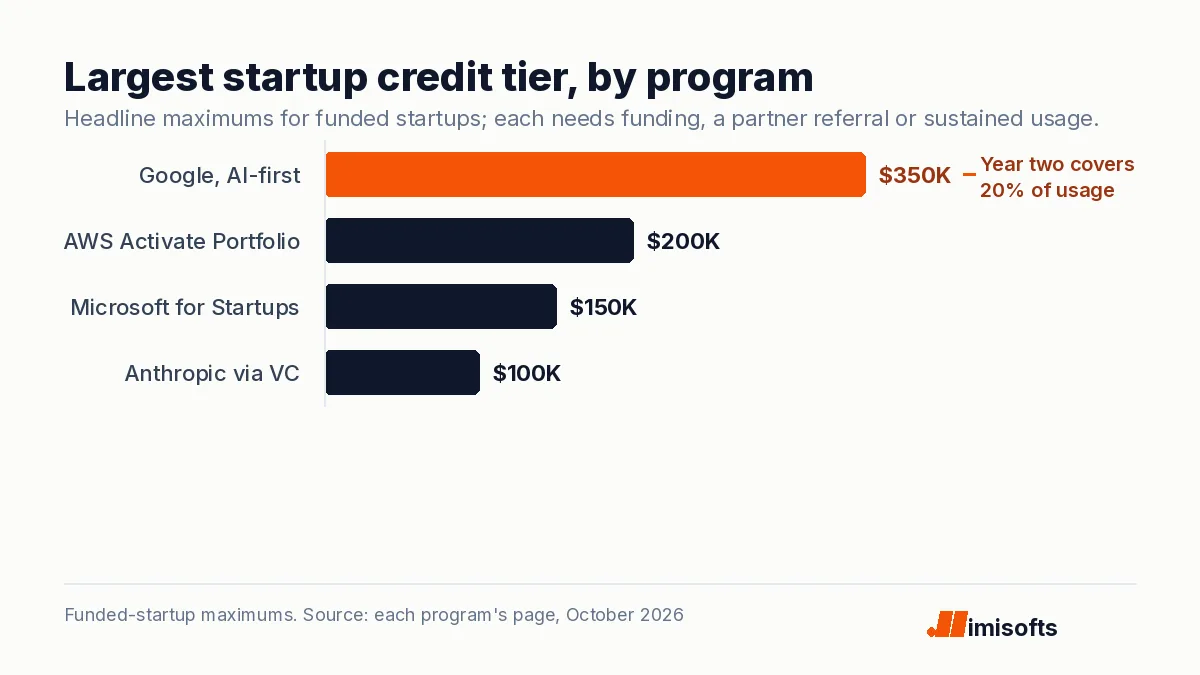
October 13, 2026. The largest AI credit offers for startups come from the clouds, not the model labs: Google gives AI-first startups up to $350,000 in Google Cloud credits over two years, AWS up to $200,000 in Activate Credits, and Microsoft up to $150,000 in Azure credits, the same ceilings Fin's AI credits guide lists. Anthropic's free Claude Team year and $1,000 API credit are on hold: its startups page says both are over capacity and applications will be re-reviewed. OpenAI's credits come only through partner VCs.
Key numbers
| Item | Number |
|---|---|
| Google Cloud credits, AI-first startups, year one (100 percent of usage) | up to $250,000 |
| Google Cloud credits, year two (20 percent of usage) | up to $100,000 |
| Google Start tier, pre-funded startups (valid one year) | up to $2,000 |
| AWS Activate Founders, self-funded (up to $5,000 for selected participants) | $1,000 |
| AWS Activate Portfolio, pre-Series B (needs an Activate Provider) | up to $200,000 |
| Microsoft for Startups, after business verification | $5,000 |
| Microsoft for Startups, top milestone (10+ workloads, about $3,000 a month) | $150,000 |
| Anthropic free Claude Team year and $1,000 credit (over capacity, re-review) | paused |
| Anthropic API credits through partner VCs | up to $100,000 |
| OpenAI API credits (amount not published) | partner VCs only |
| Agent call, 20,000 in and 1,000 out, Sonnet 5.5 (same on GPT-6.1 Sol) | $0.05 |
Program terms read on 13 October 2026 from cloud.google.com, aws.amazon.com, learn.microsoft.com, openai.com and claude.com; model list prices read on 12 and 13 October 2026.
Anthropic paused its offer within three days
Anthropic expanded Claude Startups on October 6. Two days later its head of startup marketing said the program had drawn 21 times as many applications in 48 hours as in its previous five months, and that the acceptance criteria had not been tuned, Forbes reported. Claimed offers stand, members keep the Startup Stack and office hours, and founders backed by a partner VC may still qualify for up to $100,000 in API credits through the firm. Our Claude for Startups guide has the original terms.
What each program gives
- Google for Startups Cloud Program. The Scale tier, for startups founded in the last five years that raised pre-seed or seed in that time or a Series A in the last 12 months, covers 100 percent of usage up to $100,000 in year one, or $250,000 for AI-first startups, then 20 percent of usage up to another $100,000 in year two. Pre-funded startups founded in the last 24 months can get the Start tier, up to $2,000 for one year. The credits cover Gemini and Gemma but not third-party models, and Google does not accept agencies, consultancies or dev shops, per its eligibility page.
- AWS Activate. Self-funded startups start with $1,000 in Activate Founders, up to $5,000 for selected participants. Startups backed by an Activate Provider can get up to $200,000 in Activate Portfolio, and an invite-only AI tier goes beyond $200,000. You must be pre-Series B, founded in the last 10 years and on a paid AWS account, per the Activate page. Unlike Google's, these credits can pay for third-party models on Amazon Bedrock under the Activate terms, and AWS says they usually expire within one to two years.
- Microsoft for Startups. Joining unlocks up to $200. Verifying a registered company unlocks $5,000, running 5 and then 7 Azure workloads for about 60 days unlocks $25,000 and $50,000, and $150,000 takes 10 or more workloads plus about $3,000 a month of Azure usage for about 60 days, per Microsoft's getting started guide.
- OpenAI for Startups. There is no public application or amount. OpenAI's startups page says API credits come through partner VCs such as Thrive Capital, Sequoia, a16z, Kleiner Perkins and Conviction Partners, using a referral code from the firm, and that billing switches to standard rates when the credits run out.
What the credits buy
An agent call that reads 20,000 tokens and writes 1,000 costs $0.05 on Claude Sonnet 5.5 or GPT-6.1 Sol, both $2 per million input and $10 per million output tokens, and $0.0375 on Gemini 3.8 Flash at the $1.50 and $7.50 Google charges from January 1, 2027, per its pricing page. So $1,000 covers about 20,000 such calls on Sonnet 5.5 or GPT-6.1 Sol, Google's $2,000 Start tier about 53,000 on Gemini 3.8 Flash, and Google's $100,000 first year about 2.7 million.
What it means for founders and agencies
Pick the cloud you will run on, then apply where your funding fits. Pre-funded founders can stack AWS's $1,000 to $5,000, Google's $2,000 Start tier and Microsoft's first $5,000, which needs a registered company. The six-figure tiers need a qualifying round, a partner referral or months of real usage. Apply when usage is about to ramp, because the credits expire: one year on Google's Start tier and one to two years at AWS. Google will not accept agencies, so when we build for a startup client, the client applies.
Credits pay for compute, not customers. Our SaaS launch and AI engineering teams build on whichever credits you win; getting the product named in ChatGPT and Google's AI answers is a separate job, covered by our AI search optimization work.
Frequently Asked Questions
Google, for funded startups: up to $350,000 over two years for AI-first startups, with year one covering 100 percent of usage up to $250,000 and year two 20 percent of usage up to $100,000. AWS Activate Portfolio offers up to $200,000 through an Activate Provider, and Microsoft up to $150,000 through usage milestones.
Not for new applicants right now. Anthropic's startups page says the free Claude Team year and the $1,000 API credit are over capacity and that applications will be re-reviewed. Startups that already claimed them keep them, and founders backed by a partner VC may still qualify for up to $100,000 in API credits through the firm.
Through a partner VC. OpenAI names Thrive Capital, Sequoia, a16z, Kleiner Perkins and Conviction Partners among its partners. The firm gives you a referral code, OpenAI does not publish an amount, and the account moves to standard billing when the credits run out.
AWS Activate Credits can pay for third-party models on Amazon Bedrock under the Activate terms. Google's program credits cover Gemini and Gemma but not third-party models. Microsoft's are Azure credits, and Anthropic's $1,000 credit worked only on the first-party Claude API, not on Bedrock or Vertex AI.