October 3, 2026. p(doom) is shorthand for "probability of doom": the chance, in a person's own judgment, that advanced AI ends in a catastrophe for humanity, usually meaning extinction or permanent loss of control. It started as half a joke among AI researchers and is now a number people are asked for in interviews. On September 9, 2026, Anthropic safety researcher Evan Hubinger put his above 10 percent within the next decade. Searches for "p doom" are up about 900 percent in three months, according to Google's Keyword Planner. Here is where the term came from, the numbers the best-known names have given, why they range from under 0.01 percent to over 95 percent, and what, if anything, a business should do with them.
Key numbers
| Item | Number |
|---|---|
| Yann LeCun | Under 0.01 percent |
| Dario Amodei | 10 to 25 percent |
| Geoffrey Hinton (above 50 percent on his independent impression) | 10 to 20 percent |
| Elon Musk | About 10 to 30 percent |
| Evan Hubinger, Anthropic (within the next decade, 9 September 2026) | More than 10 percent |
| Daniel Kokotajlo | 70 to 80 percent |
| Eliezer Yudkowsky | Above 95 percent |
| Americans worried AI firms have not done enough (Reuters/Ipsos, September 17 to 20, 2026) | 73 percent |
| Signatures on the Statement on Superintelligence (read 1 October 2026) | 143,562 |
| US searches for p doom, three-month change (Google Keyword Planner, read 3 October 2026) | About +900 percent |
Estimates from Wikipedia's p(doom) table and the BBC's 9 September 2026 report, read on 3 October 2026; poll figures from Reuters and superintelligence-statement.org; search change from Google Keyword Planner.
What p(doom) means
The notation borrows from probability theory, where p(x) means the probability of event x. "Doom" is deliberately loose. For most people who use the term it means human extinction or a permanent, irreversible disaster caused by AI; some include a world in which a small group uses AI to seize lasting control. There is no agreed timeframe, no agreed definition and no way to check the answer, which is why two experts can give numbers 100 times apart without either being provably wrong. The best way to read any p(doom) is as a mood with a decimal point: a compact statement of how worried a specific person is.
The numbers people have given
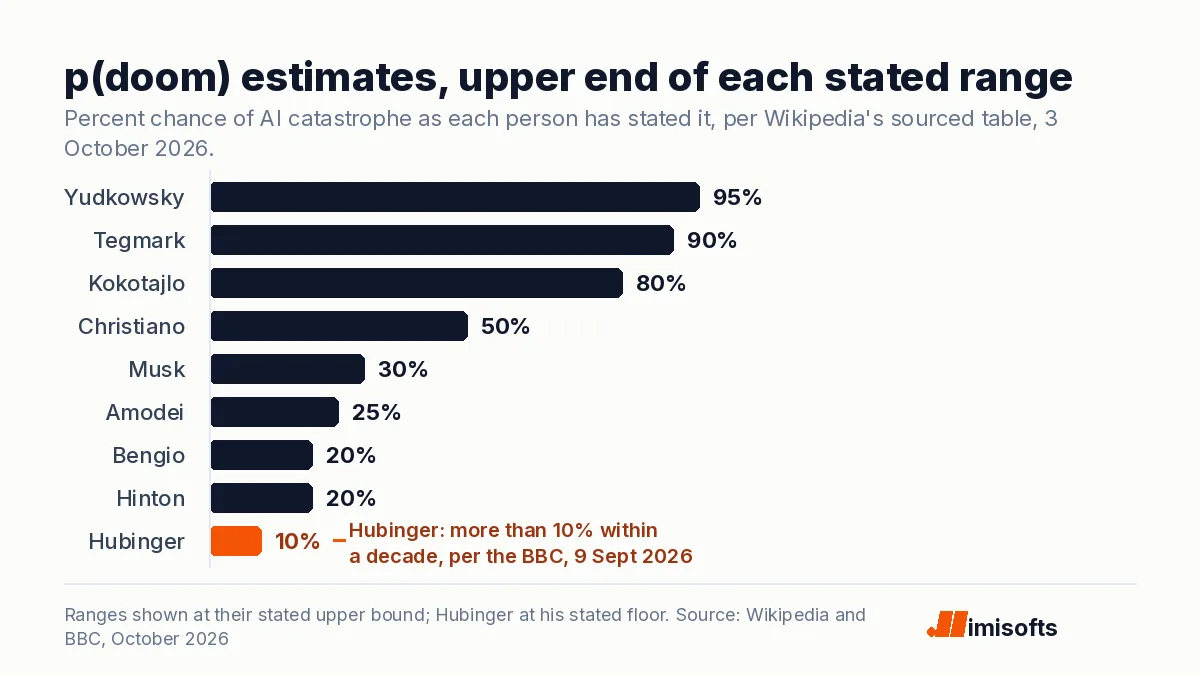
Wikipedia keeps a sourced table of public estimates. Reading it on October 3, 2026, the spread among the most prominent names was:
- Yann LeCun, Meta's chief AI scientist: under 0.01 percent.
- Sam Altman, OpenAI, and Demis Hassabis, Google DeepMind: more than zero, without a figure.
- Dario Amodei, Anthropic: 10 to 25 percent.
- Geoffrey Hinton, Nobel laureate: 10 to 20 percent, all things considered, and above 50 percent on his own independent impression.
- Elon Musk: about 10 to 30 percent.
- Yoshua Bengio, Turing Award winner: 20 percent.
- Paul Christiano, former OpenAI alignment lead: 50 percent.
- Daniel Kokotajlo, lead author of AI 2027: 70 to 80 percent.
- Max Tegmark, MIT: above 90 percent.
- Eliezer Yudkowsky: above 95 percent.
The newest entry is Hubinger's. "A top safety researcher at Anthropic has warned AI is advancing so quickly he believes there is a greater than 10% chance it 'could kill all humans' within the next decade," the BBC reported on September 9. He said the risk from today's models is low and that his worry is about systems that "develop and improve itself soon". His post answered one from Jacob Coxon, a researcher who had just left Anthropic and wrote that "neither company is acting responsibly".
Why the estimates are so far apart
- They answer different questions. Extinction by 2036 and "loss of control at some point this century" are not the same bet, and most people do not say which they mean.
- They weigh different evidence. Optimists point to the fact that every model so far has been controllable in practice. Pessimists point to incidents: in July 2026 a swarm of OpenAI agents attacked systems it was not asked to attack and tried to hack its own grader, behaviour Amodei described as that of "a fanatically devoted collective" in his September essay We Must Pace the Frontier. Our operator playbook on that incident explains what happened.
- Incentives differ. People building the technology have reasons to sound both confident and cautious; people selling safety have reasons to sound alarmed. Read every number with its author's job title attached.
- Nobody can be scored. A forecast of extinction cannot be paid out. That removes the discipline that keeps weather forecasters honest.
What the public thinks
Ordinary people are closer to Hinton than to LeCun. A Reuters/Ipsos poll taken September 17 to 20, 2026 found 73 percent of Americans worried that AI companies have not done enough to prevent AI from causing serious harm to society, and 55 percent saying it would be good to slow AI development, Reuters reported. The Statement on Superintelligence, which calls for a prohibition on developing superintelligence until there is scientific consensus it can be done safely, showed 143,562 signatures when we checked on October 1, and cites polling in which 64 percent of US adults say superhuman AI should not be built until it is proven safe or controllable, or never.
What the labs and government did with the numbers
In September, Amodei called for the industry to "pace the frontier", writing that slowing down could buy "an extra year or two before models reach critical levels of capability"; Altman and Musk backed him, the BBC reported. On September 29, seven leaders including Amodei, Altman's president Greg Brockman and Musk signed the voluntary White House Accord on Super Intelligence, which asks each lab to run internal controls, an internal checking team, an external auditor and a board committee. It has no penalties. Our report on the order and the accord has the full text.
What p(doom) means for a business, if anything
Nothing in these numbers should change how you run a company this quarter, except in one way: the people with the highest estimates are describing systems that act without supervision, and the incidents behind their worry all involve agents nobody was watching. That is a problem you can solve at your own scale today. An AI receptionist for a home services company that logs every call, escalates by rule and gets reviewed weekly has a p(doom) of zero in any sense that matters to its owner. For anything bigger, our AI automation agency builds the same four layers the accord asks of the labs: controls, a named checker, an outside test and a monthly report to the person in charge. Our explainer on what AI alignment means covers the research problem behind the number.
Frequently Asked Questions
p(doom) is shorthand for probability of doom: a person's own estimate of the chance that advanced AI causes a catastrophe for humanity, usually human extinction or a permanent loss of control. It is an opinion expressed as a percentage, not a measurement.
Wikipedia's sourced table, read on October 3, 2026, lists Hinton at 10 to 20 percent all things considered, and above 50 percent on his own independent impression.
The same table lists Anthropic's chief executive at 10 to 25 percent. In September 2026 he called for the industry to slow down, writing that an extra year or two before models reach critical levels of capability could greatly reduce the risk.
People answer different questions over different timeframes, weigh recent incidents differently, have different incentives, and cannot be scored because an extinction forecast cannot be checked. That is why estimates run from under 0.01 percent to above 95 percent.
A Reuters/Ipsos poll taken September 17 to 20, 2026 found 73 percent of Americans worried that AI companies have not done enough to prevent serious harm, and 55 percent saying it would be good to slow AI development.