October 15, 2026. Before a business sends a marketing call, text or fax to a Singapore phone number, it must check that number against the Do Not Call (DNC) Registry, and the check must be no more than 21 days old, unless the person has given clear and unambiguous consent. Messages to a company's business line about business offers, and messages whose sole purpose relates to an ongoing relationship with the recipient, fall outside the rule. Each main account gets 1,000 free checks a year, after which a check costs between S$0.0109 and S$0.0273 per number. The maximum financial penalty for breaching the DNC provisions is S$1 million for an organisation. We build AI voice agents for outbound and inbound calling, so this guide sets out the rules a Singapore campaign has to build in.
The rules come from the Personal Data Protection Commission's guide to the DNC provisions and its instructions for checking numbers, both updated in April 2026 and read 15 October 2026, with penalty limits from law firm Allen & Gledhill's summary of the 2022 increases. The DNC provisions are part of Singapore's Personal Data Protection Act (PDPA). Treat this as a map, not legal advice.
Key numbers
| Item | Number |
|---|---|
| DNC check validity | 21 days |
| Registers | voice calls, text messages, fax |
| Free checks per main account | 1,000 a year |
| Prepaid check price (incl. 9% GST) | S$0.0218 to S$0.0109 per number |
| Pay-per-use check price (S$10 minimum) | S$0.0273 or S$0.0251 per number |
| Account setup fee (S$65.40 for overseas organisations) | S$32.70 |
| Maximum DNC penalty, organisation | S$1 million |
| Maximum DNC penalty, individual | S$200,000 |
PDPC Organisation's Guide to the DNC Provisions and How to Check Numbers Against the DNC Registry (updated 22 April 2026); Allen & Gledhill, 2 November 2022; all read 15 October 2026.
What the DNC Registry covers
The Registry is free for individuals and run by the PDPC. It has three registers: voice calls, text messages and fax messages. A person can list a Singapore number on any of them, so check the register for each channel you plan to use.
The duty applies to a "specified message": one that advertises, promotes or offers goods, services, land, property interests or business and investment opportunities, or promotes a supplier of them. If any part of a message has a marketing purpose, it counts. The PDPC gives two examples that catch businesses out: a delivery update that includes a discount code, and an order confirmation that offers a referral bonus. Both are specified messages.
When you do not need to check
- Ongoing relationships. If the recipient has an ongoing relationship with you, such as a membership, subscription, account or loan, and the message relates solely to that relationship, it is not a specified message. A one-off purchase does not create an ongoing relationship, and once the relationship ends the DNC check applies again.
- Business-to-business messages. Marketing sent to an organisation's contact details, such as an office line, about business offers is outside the DNC provisions. They apply again if the message markets goods or services for the recipient's personal use.
- Clear and unambiguous consent. If the person has consented to the specific messages, you do not need to check. Consent must come from a positive action, must say the messages will go to their Singapore number, cannot be hidden in general terms and conditions, and must be recorded in written, electronic or another form you can refer to later. The PDPC's example is a checkbox that reads "I agree to receive information by SMS about special offers from [your company]".
When someone withdraws consent, the PDPC's best practice is to stop the messages within 21 days and to include clear withdrawal instructions, such as "Reply UNSUB", in every message.
How to check numbers and what it costs
Checks run through the DNC Registry portal. Singapore organisations open a main account with their UEN and a Corppass representative, sole practitioners without a UEN use Singpass, and overseas organisations submit their registration information and a bill. Setup costs a one-time S$32.70 including GST for Singapore organisations and S$65.40 for overseas ones. Numbers can be checked by small lookup for fewer than 10, by bulk CSV upload with results within 24 hours, or by API for instant checks of 10 to 100 numbers.
Every main account receives 1,000 free credits a year. After that, each number checked costs one credit, even if it was checked before:
| Option | Price incl. 9% GST | Per number |
|---|---|---|
| Prepaid 5,000 credits | S$109.00 | S$0.0218 |
| Prepaid 10,000 credits | S$163.50 | S$0.0164 |
| Prepaid 25,000 credits | S$381.50 | S$0.0153 |
| Prepaid 100,000 credits | S$1,308.00 | S$0.0131 |
| Prepaid 250,000 credits | S$2,943.00 | S$0.0118 |
| Prepaid 1,000,000 credits | S$10,900.00 | S$0.0109 |
| Pay-per-use, 1 to 4,999 numbers | Minimum S$10 | S$0.0273 |
| Pay-per-use, over 5,000 numbers | Minimum S$10 | S$0.0251 |
The 21-day rule in practice
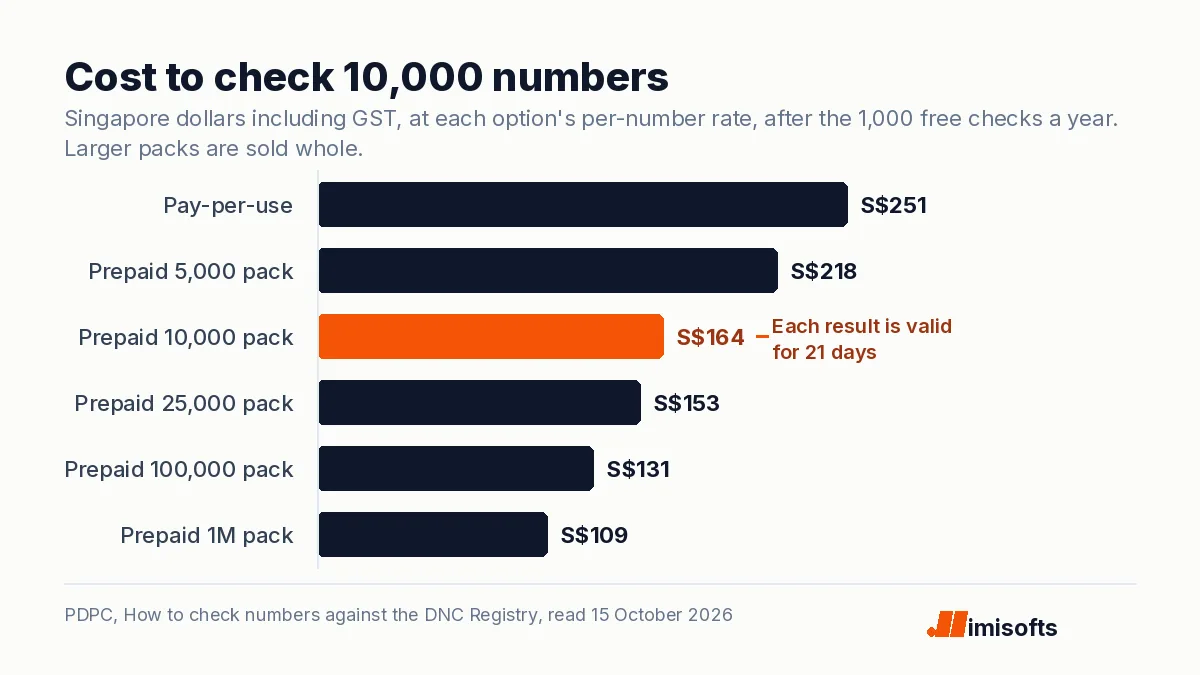
A result is valid for 21 days from the date of the check. If a campaign sends after that, the numbers must be checked again, and paid for again. The PDPC's advice is to build the check into the pre-campaign workflow and run it no more than 21 days before the send date. The cost adds up for campaigns that run continuously. At the per-number rates above, each re-check of 10,000 numbers costs from about S$109 on a 1,000,000-credit pack to S$251 on pay-per-use, where a single submission of more than 5,000 numbers is charged S$0.0251 each. Re-checking 10,000 numbers every three weeks uses about 170,000 credits a year, which a 250,000-credit pack at S$2,943 would cover.
Buying a list described as "DNC-cleaned" does not end the question. The PDPC says a third-party checker must give you accurate results and tell you the date it received them and their validity period, and that if you have reason to suspect the 21 days have expired or the information is wrong, you must not rely on it.
Penalties
Since 1 October 2022, according to Allen & Gledhill, the PDPC can impose financial penalties of up to S$1 million on an organisation, or S$200,000 on an individual, for breaching the DNC provisions. Using dictionary attacks or address-harvesting software to generate numbers is a separate breach, with penalties for larger businesses of up to 5 percent of Singapore turnover where that turnover exceeds S$20 million.
AI calls and texts to Singapore numbers
We treat the marketing calls an AI voice agent makes to Singapore numbers as voice calls, so we build in the same DNC check, consent and B2B rules. The rules apply across calls, texts and faxes alike. Our consent-first AI calling service builds consent records, registry checks and opt-out lists into the dialer, and our cold calling laws by country guide compares the rules in other markets.
Checklist for Singapore campaigns
- Decide whether each message is a specified message, remembering that any marketing element counts.
- Separate business lines contacted about business offers from personal and mobile numbers.
- Record clear, specific consent wherever you rely on it, outside general terms and conditions.
- Check the Registry no more than 21 days before each send, and re-check for later sends.
- Budget for credits beyond the 1,000 free checks, and keep the result files.
- Include withdrawal instructions in every message and act on them promptly.
- Never generate numbers or harvest them with software.
Frequently Asked Questions
It is a registry, free for individuals, run by the Personal Data Protection Commission under the PDPA, where individuals can opt their Singapore numbers out of marketing voice calls, text messages and faxes. Organisations must check numbers against it before sending specified messages, unless an exception or consent applies.
Results are valid for 21 days from the date of the check. If you send specified messages after that, you must check the numbers again, and each check is charged even if the number was checked before.
Not for marketing sent to an organisation's business contact details, such as an office line, about business offers; the PDPC says those are outside the DNC provisions. The rules apply again if the message markets goods or services for the recipient's personal use.
Each main account gets 1,000 free credits a year. After that, prepaid credits cost from S$0.0218 per number for a 5,000 pack down to S$0.0109 for a million, and pay-per-use costs S$0.0273 per number below 5,000 and S$0.0251 above, with a S$10 minimum. Account setup is S$32.70, or S$65.40 for overseas organisations.
The PDPC can impose financial penalties of up to S$1 million on an organisation or S$200,000 on an individual for breaching the DNC provisions, according to Allen & Gledhill's summary of the limits in force since 1 October 2022.
Only with care. The PDPC says the vendor must give accurate results and tell you when it received them and how long they are valid; if you suspect the 21-day validity has expired or the information is wrong, you must not rely on it.