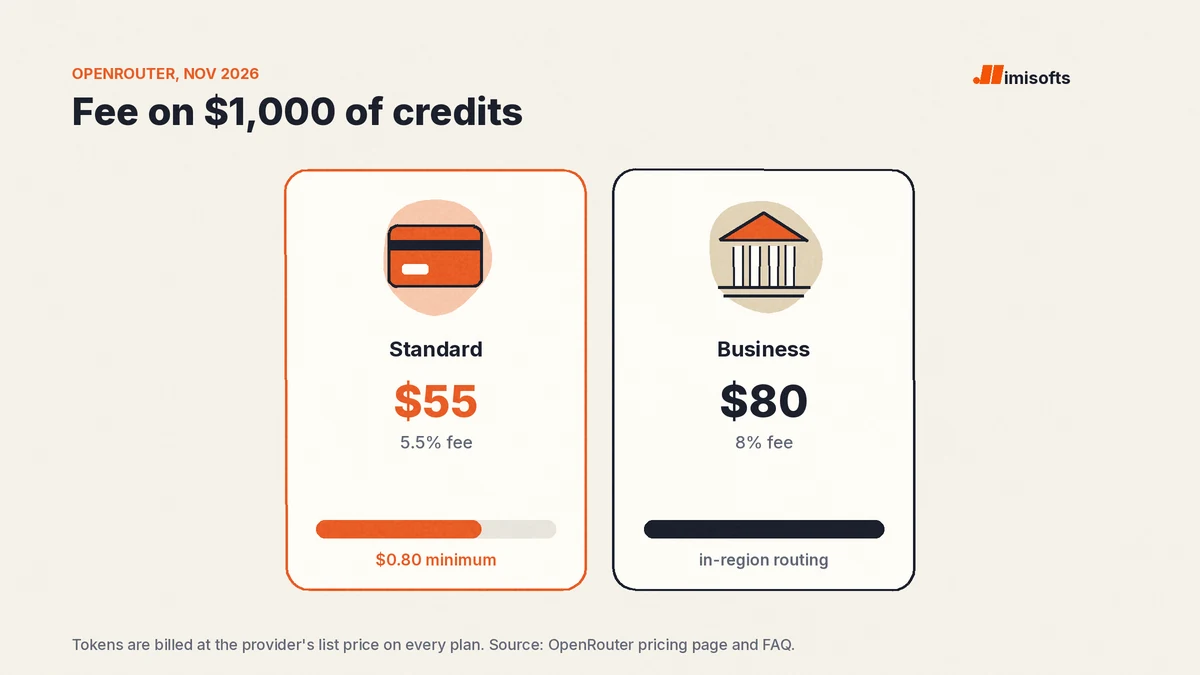
Short answer. OpenRouter does not mark up model prices. Tokens are billed at the provider's list price, and OpenRouter takes its cut when you buy credits: 5.5% of the purchase on the Standard plan (with a $0.80 minimum), 8% on the Business plan, and 5% when you pay in crypto, according to its pricing page and FAQ. On $1,000 of credits that is $55 on Standard or $80 on Business.
One change is recent. On November 6, 2026, OpenRouter relaunched its Auto Router and said it would "return to pricing closer to where Auto was a few months ago" so the router picks from a wider range of models. If you route with openrouter/auto, your cost per task can rise, and OpenRouter's fix is to set the cost tier to low. It gave no figure for the change.
Below are the fees by plan, worked examples for a real top-up, the BYOK allowance, the free model limits and the billing rules that catch people out. If you are choosing models for an AI agent, our AI automation team can help compare the options on your own prompts. Figures were read on November 18, 2026.
Key numbers
| Item | Number |
|---|---|
| Markup on model tokens (billed at the provider's list price on every plan) | None |
| Standard fee (of each credit purchase, $0.80 minimum) | 5.5% |
| Business fee (of each credit purchase) | 8% |
| Crypto fee (USDC; plan interaction not stated; never refundable) | 5% |
| BYOK allowance (list-price inference with no fee, then 5%) | $25,000 a month |
| Free models (1,000 a day after $10 of credits; 20 a minute) | 50 a day |
| Refund window (unused credits; fees not refunded) | 24 hours |
| Workspaces (Standard / Business) | 5 / 1,000 |
| Auto Router relaunch (pricing "closer to where Auto was a few months ago") | Nov 6, 2026 |
OpenRouter pricing page, docs FAQ, limits documentation and Auto Router announcement of November 6, 2026. Read November 18, 2026.
OpenRouter fees by plan
OpenRouter resells access to models from 80+ providers against one credit balance. You buy credits in US dollars, and each request deducts its cost from that balance. The plan decides the fee you pay on each credit purchase and a few account features.
| Plan | Platform fee | Models listed | Rate limits | Workspaces |
|---|---|---|---|---|
| Free | N/A | 25+ free models | 50 requests a day | 5 |
| Standard | 5.5% of credit purchases | 600+ | Passed through from the provider | 5 |
| Business | 8% of credit purchases | 600+ | Passed through from the provider | 1,000 |
| Enterprise | Fee discounts available | 600+ | Higher allowances available | Custom |
The fee is charged when you buy credits, "never on individual requests", in the words of the pricing page FAQ. The docs FAQ gives the 5.5% fee a $0.80 minimum and that crypto payments carry a fee of 5%. It does not say whether that crypto rate also applies on the Business plan, and we did not find a page that does. On discounts the two pages differ: the pricing page offers discounted fees on Enterprise and says inference is never discounted, while the docs FAQ says OpenRouter does not currently offer volume discounts.
Neither plan has a minimum spend or a contract. The pricing page says Standard and Business have "no minimums and no lock-in", and that you can move to Business from your account settings without talking to sales.
What the fee costs on a real top-up
Because the fee is a percentage of each purchase, the math is simple. The table applies the published rates to a few top-up sizes.
| Credits bought | Standard (5.5%, $0.80 minimum) | Business (8%) | Crypto payment fee (5%) |
|---|---|---|---|
| $10 | $0.80 | $0.80 | $0.50 |
| $100 | $5.50 | $8.00 | $5.00 |
| $1,000 | $55 | $80 | $50 |
| $10,000 | $550 | $800 | $500 |
Two things stand out. First, the $0.80 minimum binds on any Standard purchase under about $14.55, so a $10 top-up pays 8% in effect. Buying fewer, larger top-ups keeps you at 5.5%. Second, the Business fee is about 1.45 times the Standard fee, so a team buying $10,000 of credits a month pays $250 more on Business. On Business, 8% of $10 is also $0.80. The docs FAQ states the $0.80 minimum only for the 5.5% fee. The crypto column applies the 5% crypto fee from the docs FAQ; OpenRouter does not say whether it replaces the plan fee or is added to it, or whether a minimum applies.
OpenRouter says prices exclude taxes, and VAT or GST may be added to invoices where required. Budget for that on top of the fee if your country charges it.
BYOK: $25,000 a month without a fee
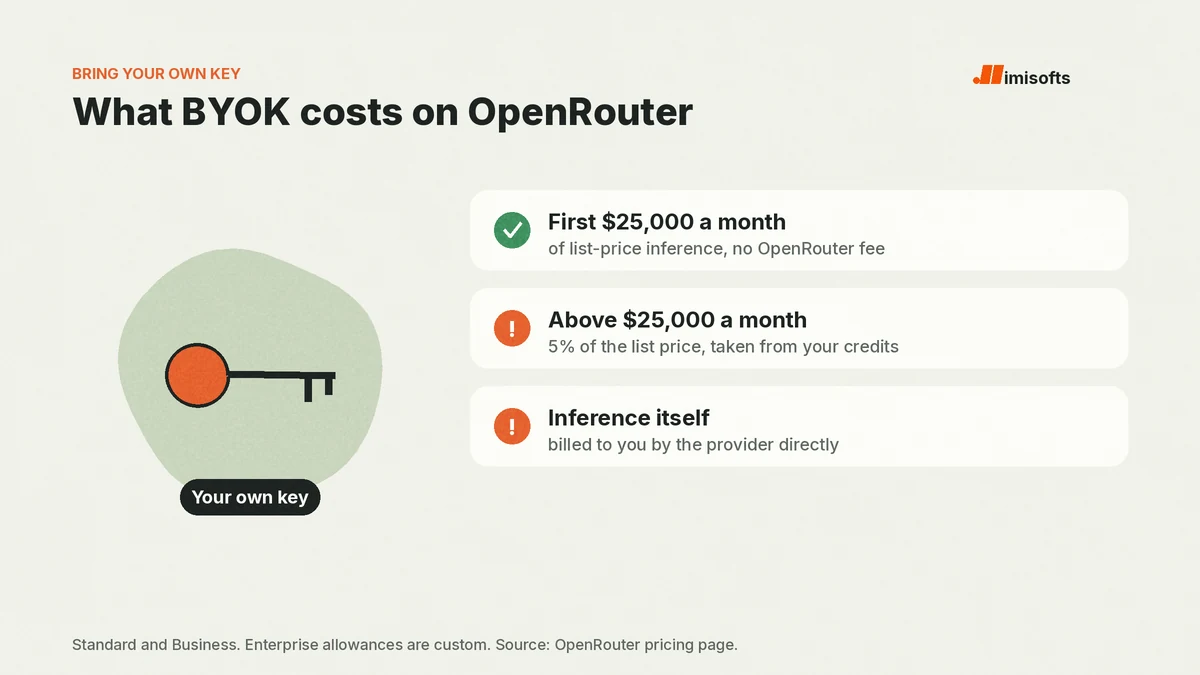
BYOK (bring your own key) means you connect your own provider API key to OpenRouter. The provider bills you for inference directly.
On Standard and Business, the first $25,000 of list-price inference a month through BYOK carries no OpenRouter fee. Above that, OpenRouter charges 5% of what the same request would cost at list price on OpenRouter, deducted from your OpenRouter credits. The allowance is measured in dollars of list-price usage, not in requests. Enterprise allowances are custom.
A worked example. A team that runs $40,000 of list-price inference a month through its own keys pays the providers directly, plus 5% of the $15,000 above the allowance: $750 in OpenRouter credits. If it bought the same $40,000 as Standard credits instead, the fee would be $2,200.
Is OpenRouter free? The free model limits
You can use free models without paying. The docs FAQ also says new users get "a small free allowance to test out OpenRouter" and that free models "are usually not suitable for production use". It does not put a dollar figure on the allowance.
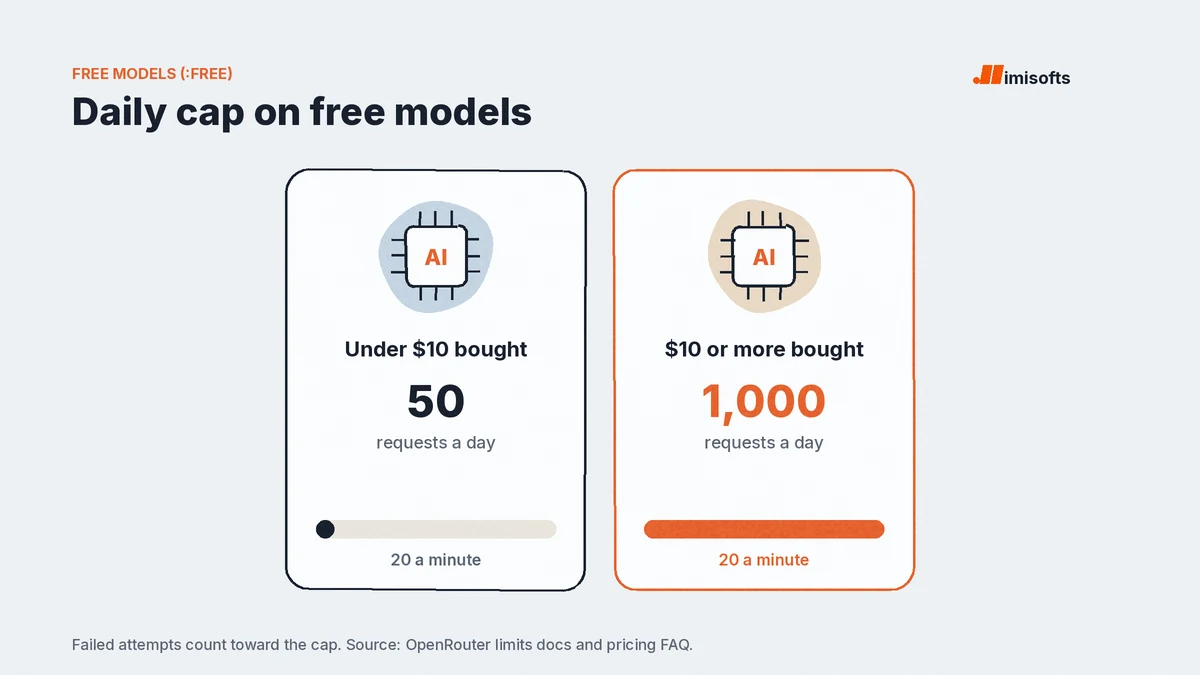
The free limits are set by how much you have ever bought, according to the limits documentation:
| Credits purchased (all time) | Requests per minute | Requests per day |
|---|---|---|
| Less than $10 | 20 | 50 |
| At least $10 | 20 | 1,000 |
So a one-time $10 purchase raises the daily cap on free models 20 times. Failed attempts count toward the daily cap, and a negative balance blocks free models until you add credits. Free model IDs end in :free, and the openrouter/free router picks a free model for you.
Paid models have no plan-based rate limit on OpenRouter. The pricing page says a limit you hit there "normally comes from the provider", and that only very high burst traffic is rejected by OpenRouter's own DDoS protection with a 429 error. Opening more accounts or keys does not raise your limits, because OpenRouter says it governs capacity globally.
Standard or Business: what the extra 2.5 points buy
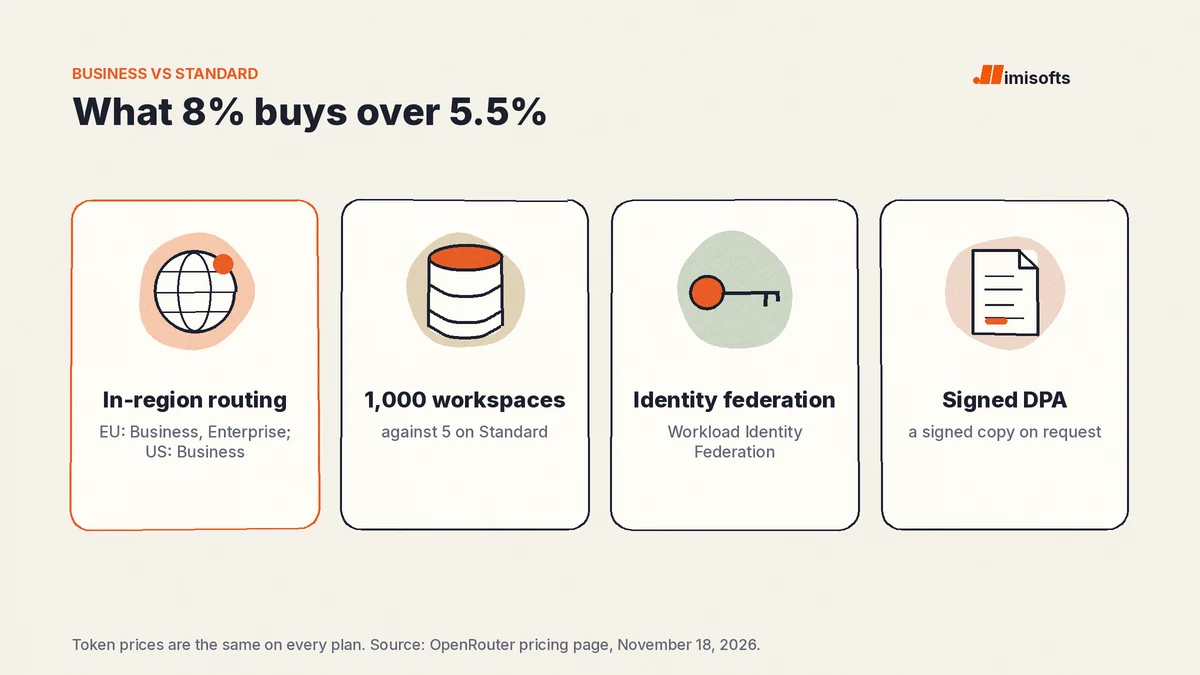
Token prices are the same on both plans. The pricing page lists these differences for Business:
- EU and US in-region routing.
- Up to 1,000 workspaces, against 5 on Standard. Within a workspace, each API key can carry its own credit cap.
- Advanced notifications and Workload Identity Federation.
- A signed copy of the data processing agreement on request (Standard covers it through the terms of service).
SSO with SAML, contractual SLAs and managed policy enforcement are Enterprise only. You can downgrade from Business 30 days after the upgrade.
Our view: for a small team with one product, Standard is usually enough. Business makes sense when a client needs requests routed within the EU or the US, or when you run many client projects and want each one walled off in its own workspace.
Refunds, expiry and failed requests
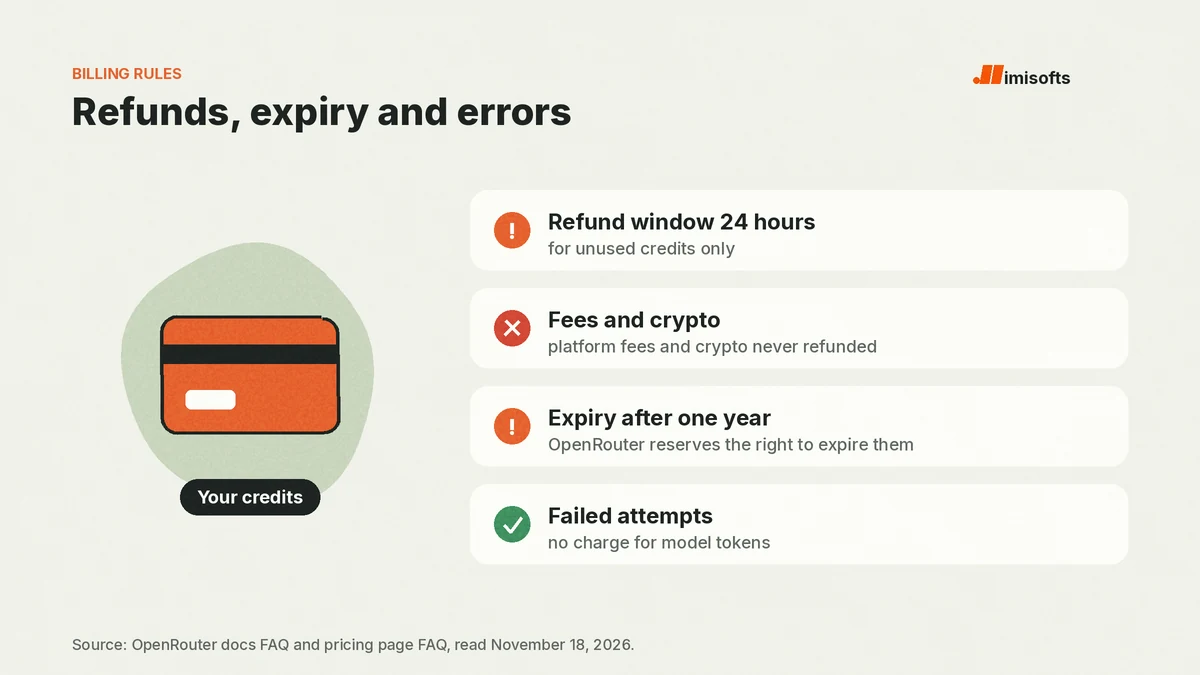
A few rules in OpenRouter's docs FAQ and pricing page FAQ are worth knowing:
- Refunds: unused credits can be refunded only within 24 hours of the purchase. The platform fee is never refunded, and crypto payments are never refundable.
- Expiry: OpenRouter reserves the right to expire unused credits one year after purchase.
- Failed requests: an attempt that errors is not charged for its model tokens, so with fallback you pay only for the attempt that answers. Web search or file parsing that already ran may still be billed.
- Price changes: if a model's price changes, OpenRouter keeps routing to that model and bills the new rate. A deprecated model returns a 404 error.
- Streaming: billed per token, the same as non-streaming requests.
Because of the 24-hour refund window and the one-year expiry clause, we suggest auto top-up with a modest threshold rather than one large prepayment.
OpenRouter or the provider direct
For one model, the per-token price should match. We checked one: OpenRouter's public model list showed Grok 4.7 at $2 per 1M input tokens and $6 per 1M output tokens, and its batch variant at $1.60 and $4.80, which matches the list price and 20% batch discount on xAI's own pricing page in our Grok API pricing guide.
So the real cost of OpenRouter is the 5.5% or 8% fee on what you load, against what you get for it: one credit balance for 80+ providers, automatic fallback when a provider fails, and routing tools. If you only ever call one provider and already have an account with it, going direct saves the fee. If you switch models often or need fallback across providers, the fee buys that.
In our experience the model you pick moves the bill more than the fee does: on OpenRouter's list, GPT-6.2 Sol costs $10 per 1M output tokens against $6 for Grok 4.7, a gap far larger than 5.5%. See our DeepSeek API pricing rate card and the AI model API pricing comparison for the token rates themselves. For what OpenAI and Anthropic give new accounts, read our guides to the OpenAI API free tier and the Claude API free tier.
The Auto Router change of November 6, 2026
Auto Router (openrouter/auto) picks a model for each request. Routing through it adds no fee; you pay the rate of the model that serves the request. That makes its choice of model your cost.
In its November 6 announcement, OpenRouter said the new router weighs "eleven factors about each request" together with live pricing, provider health and cache status. It also said the old router had drifted "lower on cost per task", and that the new one returns "to pricing closer to where Auto was a few months ago in order to introduce a greater variety of models". Users who preferred the old behavior can set the cost tier to low. The same release added a router called Auto Code (openrouter/auto-code), which OpenRouter says scores in line with Claude Opus 5.5 "while costing 74% less per task" on its own benchmarks.
If you use Auto Router in production, check your cost per request in your OpenRouter usage records for the days since November 6, and pin a model ID where you need a predictable model choice; its price can still change.
How imisofts can help
imisofts is a Dubai-based agency that builds AI automation and AI voice agents. We help clients estimate token use, compare OpenRouter, BYOK and direct access, and set per-key credit caps to limit what any one agent can spend. The same model choice drives the running cost of an AI phone agent for home services, which we also build. If you are also pricing a customer-facing assistant, our guide to AI chatbot costs for a business shows the other line items. To talk it through, contact our AI automation agency team.
Frequently Asked Questions
No. OpenRouter says inference is billed at the provider's list price on every plan. It charges a platform fee when you buy credits instead: 5.5% on Standard, 8% on Business and 5% for crypto payments.
Free models are, within limits: 50 requests a day and 20 a minute until you have bought $10 of credits, then 1,000 a day. Paid models cost the provider's list price plus the fee on your credit purchase.
On Standard, 5.5% of $100 is $5.50. On Business it is $8, and paid in crypto it is $5. Purchases under about $14.55 on Standard pay the $0.80 minimum fee.
Not for the first $25,000 of list-price inference a month on Standard or Business. Above that it charges 5% of what the same requests would cost on OpenRouter, taken from your credits. The provider bills you for inference directly.
Unused credits can be refunded within 24 hours of purchase. The platform fee is not refunded, crypto payments are never refundable, and OpenRouter reserves the right to expire unused credits after one year.
Not plan-based ones on paid models. Limits there normally come from the provider, and only very high burst traffic is blocked by OpenRouter's DDoS protection. Free models are capped at 20 requests a minute and 50 or 1,000 a day.