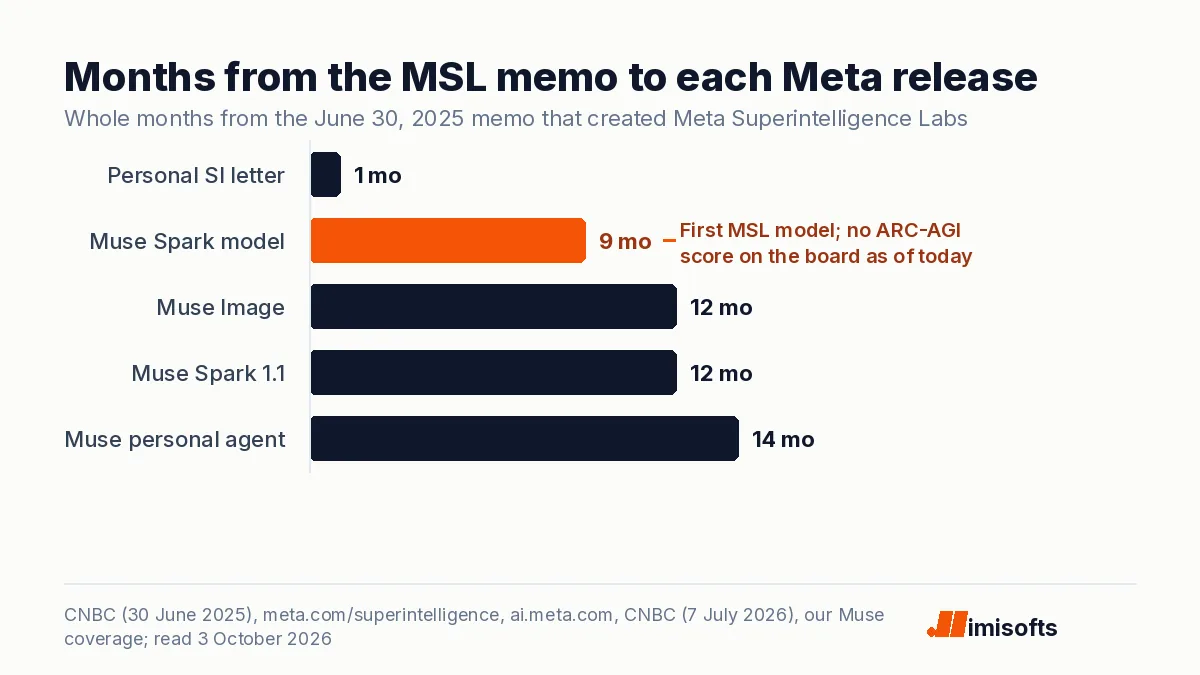
October 3, 2026. Fifteen months ago Mark Zuckerberg reorganised Meta's AI effort into Meta Superintelligence Labs, paid $14.3 billion for a stake in Scale AI to get its founder Alexandr Wang as chief AI officer, hired away the chief executive of Safe Superintelligence Inc., and published a letter promising "personal superintelligence" for everyone. What exists today is a model family called Muse: Muse Spark, released April 8, 2026 as "the first step on our scaling ladder"; Muse Image on July 7; Muse Spark 1.1 and a model API on July 9; and a Muse personal agent on September 8 that shops, books and fills forms for consumers, which Amazon promptly blocked. No Muse model has an independent score on the ARC-AGI leaderboard, and nothing Meta has shipped is superintelligent by anyone's definition, including Meta's. This article compares what was promised with what was delivered, explains where Meta's vision differs from OpenAI's, SSI's and Anthropic's, and sets out what a business should do about a company whose stated plan is to put a shopping agent in everyone's glasses.
Key numbers
| Item | Number |
|---|---|
| Meta Superintelligence Labs created (Zuckerberg memo; Alexandr Wang chief AI officer) | June 30, 2025 |
| Meta investment in Scale AI (June 2025, per Reuters and CNBC) | $14.3 billion |
| Personal Superintelligence letter published (superintelligence is now in sight, it said) | July 30, 2025 |
| Muse Spark released (first MSL model; succeeded Llama; closed weights) | April 8, 2026 |
| Compute saving claimed against Llama 4 Maverick (same capabilities, per Meta) | Over an order of magnitude |
| Muse Image released (free tier plus Meta One subscriptions from May) | July 7, 2026 |
| Muse Spark 1.1 and model API (agentic tasks, tool and computer use) | July 9, 2026 |
| Muse personal agent launched (Amazon blocked it September 20; Shop Pay inside from September 21) | September 8, 2026 |
| Muse models on the ARC-AGI leaderboard (Llama 4 Maverick and Scout score 0 percent on ARC-AGI-2) | 0 |
CNBC (30 June 2025 and 7 July 2026), Reuters (30 June and 3 July 2025), meta.com/superintelligence, ai.meta.com (8 April and 9 July 2026), ARC Prize leaderboard, and our September 2026 Muse coverage, all read 3 October 2026.
How Meta Superintelligence Labs started
On June 30, 2025 Zuckerberg sent staff a memo, published by CNBC, creating Meta Superintelligence Labs to house the company's foundation model teams, product teams and research under Wang, who had joined days earlier when Meta invested $14.3 billion in his data-labelling company Scale AI (CNBC; Reuters). Three days later Reuters reported that Daniel Gross, chief executive and co-founder of Safe Superintelligence Inc., had joined Meta to lead its AI products division after Meta had tried and failed to buy his company (Reuters). The memo and the hiring spree, with reported nine-figure offers to individual researchers, were the moment "superintelligence" became a line in corporate org charts rather than a philosophy seminar; our profile of SSI covers the other side of that poaching.
What Zuckerberg promised
The July 30, 2025 letter, signed "Mark" and still the company's only statement of intent, makes five claims (Personal Superintelligence). First, on progress: "Over the last few months we have begun to see glimpses of our AI systems improving themselves. The improvement is slow for now, but undeniable. Developing superintelligence is now in sight." Second, on the goal: "Meta's vision is to bring personal superintelligence to everyone." Third, a jab at competitors: this "is distinct from others in the industry who believe superintelligence should be directed centrally towards automating all valuable work, and then humanity will live on a dole of its output". Fourth, on form factor: "Personal devices like glasses that understand our context because they can see what we see, hear what we hear, and interact with us throughout the day will become our primary computing devices." Fifth, a hedge on openness: "We'll need to be rigorous about mitigating these risks and careful about what we choose to open source." The letter closes by calling "the rest of this decade" the "decisive period" for whether superintelligence becomes "a tool for personal empowerment or a force focused on replacing large swaths of society".
What exists: the Muse family
- Muse Spark, April 8, 2026. Meta's first MSL model, described as "a natively multimodal reasoning model with support for tool-use, visual chain of thought, and multi-agent orchestration" and "the first product of a ground-up overhaul of our AI efforts". Meta says it reaches "the same capabilities with over an order of magnitude less compute than our previous model, Llama 4 Maverick", names the Hyperion data centre as the next rung, and shipped it in the Meta AI app and at meta.ai with a private API preview (Meta). It succeeded the Llama family, and unlike Llama its weights were not released.
- Muse Image, July 7, 2026. An image model, codenamed Mango, free in the Meta AI app, WhatsApp and Instagram Stories, with heavy use gated behind the Meta One subscriptions that launched in May, and wired into Advantage+ so advertisers get generated ad variants (CNBC).
- Muse Spark 1.1 and the model API, July 9, 2026. An update "built for agentic tasks, with major gains in tool and computer use, coding, and multimodal" work, and a general API (Meta).
- The Muse agent, September 8, 2026. A personal agent that opens a browser, fills forms, negotiates, books travel, lowers bills and checks out, with Shopify's Shop Pay inside it from September 21. Amazon cut it off from Amazon.com on September 20 for violating its conditions of use; Meta's Muse explained for businesses and why Amazon blocked Muse have the detail.
What is missing
Three things. There is no independent capability score: the ARC Prize leaderboard, read today, lists no Muse model, and Meta's only entries remain Llama 4 Maverick and Scout from April 2025, both at 0 percent on ARC-AGI-2, against 95.0 for OpenAI's best and 93.3 for Anthropic's (ARC Prize). Until Meta submits or ARC Prize tests Muse, its place among the labs is unknowable; our ranking in AGI companies ranked by what they shipped leaves it unranked for that reason. There is no open release: the company that made open weights its brand with Llama has shipped Muse closed, which the letter's "careful about what we choose to open source" line prepared the ground for. And there is no superintelligence, nor any claim of one; the "glimpses" of self-improvement in the letter have not been followed by published evidence, and the Muse Spark post describes a scaling plan, not an arrival.
Personal superintelligence against the other visions
The letter's "dole" line is aimed at a specific set of rivals. OpenAI's charter defines AGI by economic output, "highly autonomous systems that outperform humans at most economically valuable work", and its leadership has long paired that with proposals for distributing the proceeds; Elon Musk's "universal high income" is the same idea from another direction, covered in what universal high income means. Meta's position is that superintelligence should be a personal tool rather than a replacement workforce with a transfer payment attached. Safe Superintelligence Inc. rejects the product framing altogether and will ship nothing until it has the end state. Anthropic sells models while publishing the safety and welfare evaluations that the others do not. The differences are real, and they are also marketing: Meta's revenue is advertising inside apps that people use personally, so "personal" is where its superintelligence has to live. For the term itself, see what super intelligence is.
The business Meta is actually building
Follow the releases rather than the letter and the strategy is plain. Muse Image feeds Advantage+ ad creative. The Muse agent moves shopping and bookings inside Meta's apps, where Shop Pay now handles checkout. Meta's business agents on WhatsApp and Instagram, billed by token, let a company answer and sell inside the same apps; the pricing and the billing surprises are in Meta business agent token pricing. Glasses are the long-term interface, and the letter says so. Personal superintelligence, in the version that exists, is a very capable assistant that lives where Meta sells ads and increasingly completes the purchase itself.
What it means for your business
Two consequences follow for a company that sells to consumers. First, an agent will increasingly be the customer: Muse, and its equivalents from OpenAI and Google, will search for a plumber, compare quotes and try to book. Amazon chose to block that; Shopify chose to plug into it. A local business cannot block it and should not want to, which means your phone, your booking page and your pricing need to be reachable by an agent as well as a person. An AI calling agent for home services that answers every call, quotes from a live price list and books into the calendar is how a small company becomes bookable by whatever is calling, human or Muse. Second, the same capability is available to you now. The model behind Muse is sold through an API, as are its rivals', and an AI automation agency can build the inbox triage, lead follow-up and booking workflows that a personal agent will expect to find on the other end. Waiting for superintelligence is not a strategy; being the business that an agent can transact with in under a minute is.
Scorecard: promised against delivered
- "Superintelligence is now in sight." Not delivered, not claimed since; no published evidence of the self-improvement glimpses.
- "Personal superintelligence to everyone." Partly: a personal agent inside Meta's apps, free at the basic tier, subscription above it.
- Glasses as the primary device. In progress; the agent runs on phones today.
- Frontier capability. Unverified; no independent benchmark score.
- Openness. Reversed: Muse is closed where Llama was open.
- Commercial product. Delivered: four Muse releases in five months, an API, subscriptions and ad tooling.
What to watch
- An ARC-AGI or equivalent score for Muse Spark 1.1, which would settle where Meta stands.
- Hyperion coming online, named in the Muse Spark post as the infrastructure for the next rung of the ladder.
- Any open-weight Muse, or a statement that there will be none.
- Retailer responses to the agent: more Amazons or more Shopifys.
- The next letter. Zuckerberg's July 2025 text is dated; a company that says the decade is decisive will have to say how year one went.
Frequently Asked Questions
The organisation Mark Zuckerberg created on June 30, 2025 to house Meta's foundation model, product and research teams under chief AI officer Alexandr Wang, who joined when Meta invested $14.3 billion in Scale AI. Its stated goal, set out in Zuckerberg's July 30, 2025 letter, is personal superintelligence for everyone.
Zuckerberg's term for a superintelligent AI that serves each individual's own goals, delivered through Meta's apps and eventually through glasses, as opposed to superintelligence directed centrally at automating work. The letter frames it against rivals who, in his words, expect humanity to live on a dole of AI output.
Muse Spark, a multimodal reasoning model, on April 8, 2026; Muse Image on July 7; Muse Spark 1.1 and a model API on July 9; and the Muse personal agent, which browses, books and checks out for consumers, on September 8, 2026. Meta One subscriptions launched in May 2026.
Meta says it matches its previous model, Llama 4 Maverick, with over an order of magnitude less compute and offers competitive multimodal, reasoning and agentic performance. There is no independent ARC-AGI score for any Muse model as of October 3, 2026, so its standing against OpenAI, Anthropic and Google is unverified.
No. Unlike the Llama family, Muse models have been released as closed services through Meta's apps and an API. Zuckerberg's July 2025 letter said Meta would be careful about what it chooses to open source.
Agents such as Muse will increasingly search, compare and book on consumers' behalf, so a business needs a phone line, booking page and price list that an agent can transact with. The same model capabilities are available through APIs today for a company's own automation.