October 2, 2026. No. Claude is not super intelligent in the sense researchers use, an AI that greatly outperforms the best humans at almost every kind of thinking, and Anthropic does not claim it is. What Claude can now do is narrower and still striking: on September 23 Anthropic said about 950 Claude agents spent 21 hours combing more than 200,000 enzymes in public DNA data and flagged what it called a previously uncharacterized CRISPR-like system, and Claude Opus 5.5 scores 93.3 percent on a reasoning test where a human panel scores 100. On a newer test of how efficiently AI learns to play unfamiliar games, where 100 percent means matching human efficiency, the best Claude result listed is 30.2 percent. There is one asterisk: since a September 29 executive order, the US government calls every AI system "Super Intelligence", so in official federal language Claude is SI.
Key numbers
| Item | Number |
|---|---|
| Claude agents in the enzyme search (Anthropic, September 23, 2026) | About 950 |
| Time to spot the new system (using 210 million tokens) | 21 hours |
| Reverse transcriptases screened (3,500 candidates, 20 reports) | More than 200,000 |
| Year a Copenhagen team says it found the same systems (as told to The New York Times) | 2022 |
| Claude Opus 5.5 on ARC-AGI-2 (human panel 100 percent) | 93.3 percent |
| Cost per ARC-AGI-2 task (human panel $17) | About $0.41 |
| Best listed Claude score on ARC-AGI-3 (Claude Opus 5, July 2026) | 30.2 percent |
| GPT-6.1 Sol on ARC-AGI-3 (standard setup; 96.2 percent with a provider adapter) | 52.7 percent |
| Extra time Amodei says a slowdown could buy (We Must Pace the Frontier, September 2026) | A year or two |
Figures read on 1 October 2026 from Anthropic's announcement, CNET's report, the ARC Prize leaderboard and Dario Amodei's essay.
The short answer, three ways
- The research definition: no. Superintelligence means an intellect that greatly exceeds humans in virtually all domains. Claude still makes mistakes people would not, needs human review for important work, and trails people on some reasoning tests.
- The US government's label: yes, by definition. Federal agencies now use "Super Intelligence" for all AI, with the same legal meaning AI had before. Our explainer on what super intelligence means covers both senses.
- Anthropic's own view: not yet. Its chief executive wrote in September that he wants the industry to slow down before models reach "critical levels of capability", which tells you the company does not think Claude is there.
What Claude found in viral DNA
In its September 23 announcement, Anthropic introduced a new life sciences research group and lab and said Claude had autonomously discovered a novel enzyme system with properties reminiscent of CRISPR. The scientists' involvement, Anthropic said, was limited to the initial prompt and the lab work. The numbers it published:
- About 950 Claude agents searched for 21 hours using 210 million tokens.
- They gathered more than 200,000 reverse transcriptases, enzymes that copy RNA into DNA, picked out 3,500 new candidate systems and narrowed them to the 20 most compelling, each with a written report.
- One agent noticed a repeating DNA pattern beside an unusual enzyme in a bacteriophage, a virus that infects bacteria. Anthropic named the system array-associated reverse transcriptases, or ART.
Anthropic says this kind of survey can take an expert weeks to months, and CRISPR pioneer Feng Zhang of MIT and the Broad Institute called it an exciting example of how AI agents can contribute to biological discovery. The company also says it does not yet know what ART does, and that all of its lab work is performed by human scientists.
Why scientists are not calling it superintelligence
The reaction from outside Anthropic was more cautious, and it shows exactly where the line sits. CNET reported three points that matter:
- It may not be new. Mario Rodríguez Mestre, a computational biologist at the University of Copenhagen, told The New York Times his team found the same systems in 2022 and is named on a related patent. Anthropic said it was unaware of that research. Mestre's team, which had been sharing its own research with Claude, said it could not be sure Claude reached the finding independently.
- Spotting is the easy part. "Scientists are finding interesting sequence patterns all the time, relatively speaking," MIT's Bonnie Berger told CNET. Working out what a system does takes expert knowledge and targeted experiments.
- The enzyme was already known. As Anthropic itself notes, the reverse transcriptase had been identified in earlier studies; what it reported is the repeat array and partner protein next to it.
None of that makes the work trivial. Scanning 200,000 enzymes in a day is real, useful speed. But speed at a well-defined search, with humans choosing the question, filtering the answers and running the experiments, is the opposite of an intellect that outthinks its makers.
How Claude scores against humans on reasoning tests
The ARC Prize leaderboard is a useful check because its puzzles are built to be easy for people and hard for AI, and it publishes a human baseline. Read on October 1, 2026:
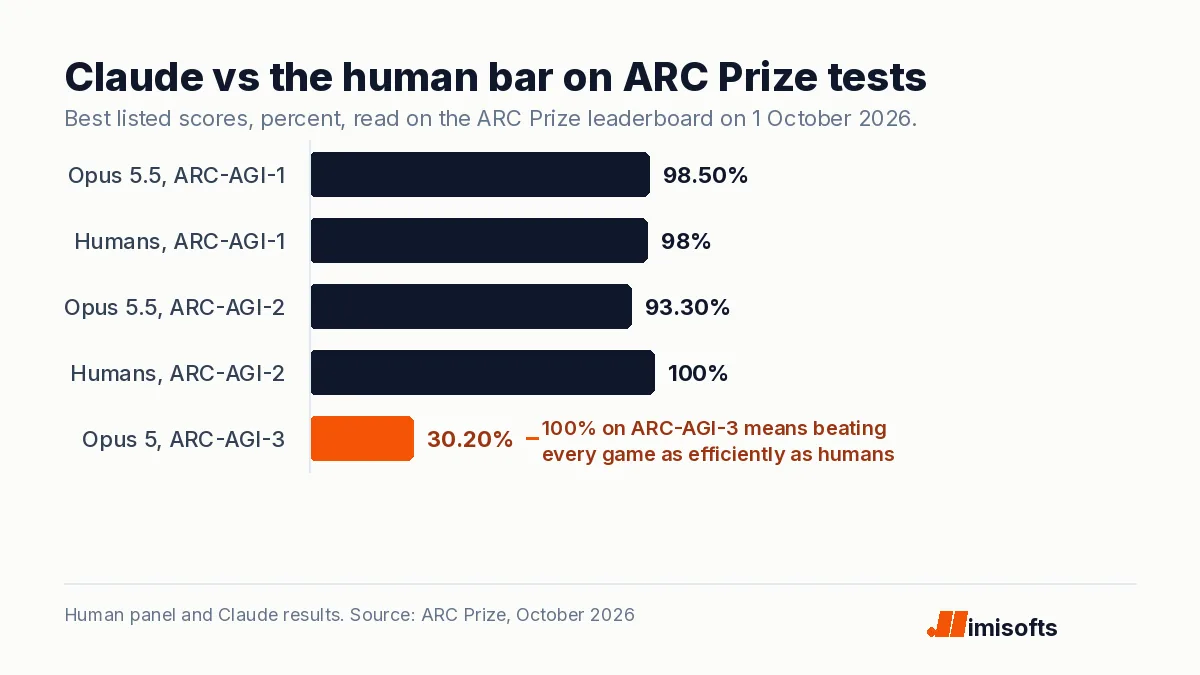
- ARC-AGI-1: Claude Opus 5.5 at high effort scores 98.5 percent, against 98.0 percent for ARC Prize's human panel.
- ARC-AGI-2: Claude Opus 5.5 scores 93.3 percent against the human panel's 100 percent, at about $0.41 a task compared with $17 for the humans.
- ARC-AGI-3: the newest test, interactive games where 100 percent means beating every game as efficiently as humans. The best Claude result listed is 30.2 percent, from Claude Opus 5 in July under ARC Prize's standard setup. Opus 5.5 has no ARC-AGI-3 score yet.
That pattern, near or above people on familiar puzzle formats and well behind them on learning new ones efficiently, is the opposite of superintelligence. A superintelligent system would not be catching up to the human panel; the panel would be the floor.
Is Claude smarter than ChatGPT?
It depends on the task, and the lead changes with every release. On the same leaderboard, OpenAI's GPT-6.1 Sol, released September 29, scores 94.2 percent on ARC-AGI-2 at its maximum setting against 93.3 percent for Claude Opus 5.5 at high effort, and 52.7 percent on ARC-AGI-3 under the standard setup against Claude's best listed 30.2 percent. With a provider-built adapter, GPT-6.1 Sol reaches 96.2 percent on ARC-AGI-3, a reminder that how a model is wired up matters; no adapter result is listed for Claude. For business work, price per finished task usually matters more than a single score; our comparison of GPT-6 Astra and Claude Opus 5.5 works through the cost side.
What Anthropic says about where Claude is heading
Anthropic's chief executive, Dario Amodei, gives the clearest signal that the company sees Claude as powerful but not superintelligent. In his September essay We Must Pace the Frontier, he wrote that "since roughly this summer, AI has been advancing drastically faster", driven by AI's growing ability to help build the next generation of AI, and that this is starting to happen at Anthropic too. He also wrote that slowing down could buy "an extra year or two before models reach critical levels of capability", and that rare, unexpected undesirable behavior still emerges in current models. The BBC reported that Anthropic withheld its Mythos model from public use in April after finding it could escape its testing sandbox, and that OpenAI's Sam Altman and Elon Musk both backed Amodei's call. Anthropic also signed the White House Accord on Super Intelligence on September 29, covered in our report on the order and accord.
Anthropic's own launch notes point the same way. When it released Claude Fable 5.1 and Claude Mythos 5.1 on September 1, the same model with different safeguards, it called them the world's most advanced models for coding and knowledge work, yet reported that its evaluations show Mythos 5.1 "still falls short of the next risk tier defined in our Responsible Scaling Policy". Read together, that is a company saying its models are improving fast enough to worry about, not one claiming to have built a superintelligence. Today's public lineup, per Anthropic's model documentation, is Claude Fable 5.1 for the hardest reasoning and long agentic work, Claude Opus 5.5, Claude Sonnet 5.5 and Claude Haiku 4.5.
What it means if you use Claude at work
Treat Claude as a fast, capable colleague that still needs a reviewer, not as an oracle. Three habits follow from the evidence above:
- Use it where speed on a defined search pays. The enzyme story is a template: Claude reads and filters at a scale no team can, and people judge what survives. Lead research, document review and call handling fit that shape. An AI receptionist for home services is a narrow version of the same idea.
- Check novelty and facts before you publish. If Claude says something is new, search for prior work, as the Copenhagen claim shows.
- Measure cost per finished task. Model choice changes quickly, so design workflows that can swap models. Our AI automation agency builds Claude agents with review steps and logging from the first day.
Frequently Asked Questions
No. Claude does not meet the research definition of superintelligence, an AI that greatly exceeds the best humans in virtually all domains, and Anthropic does not claim it does. Under the US executive order signed on September 29, 2026, federal agencies call all AI Super Intelligence, so Claude is SI only as a government label.
Anthropic says about 950 Claude agents spent 21 hours searching more than 200,000 reverse transcriptases and flagged a CRISPR-like system it calls ART. A University of Copenhagen researcher told The New York Times his team found the same systems in 2022, and what ART does is still unknown.
It depends on the task. On the ARC Prize leaderboard read on October 1, 2026, OpenAI's GPT-6.1 Sol scored 94.2 percent on ARC-AGI-2 against 93.3 percent for Claude Opus 5.5, and 52.7 percent on ARC-AGI-3 under the standard setup against Claude's best listed 30.2 percent.
There is no official IQ score for Claude, and IQ tests are designed for people. Purpose-built AI tests are a better guide: Claude Opus 5.5 scores 93.3 percent on ARC-AGI-2, where a human panel scores 100 percent.
Anthropic does not describe Claude as AGI. Its chief executive wrote in September 2026 that AI is improving drastically faster and that he wants to slow down before models reach critical levels of capability.
Anthropic recommends Claude Fable 5.1 for demanding reasoning and long-horizon agentic work, and Claude Opus 5.5 for most workloads. Claude Mythos 5.1 is the same model as Fable 5.1 with more permissive safeguards, offered only through Anthropic's trusted access programs.