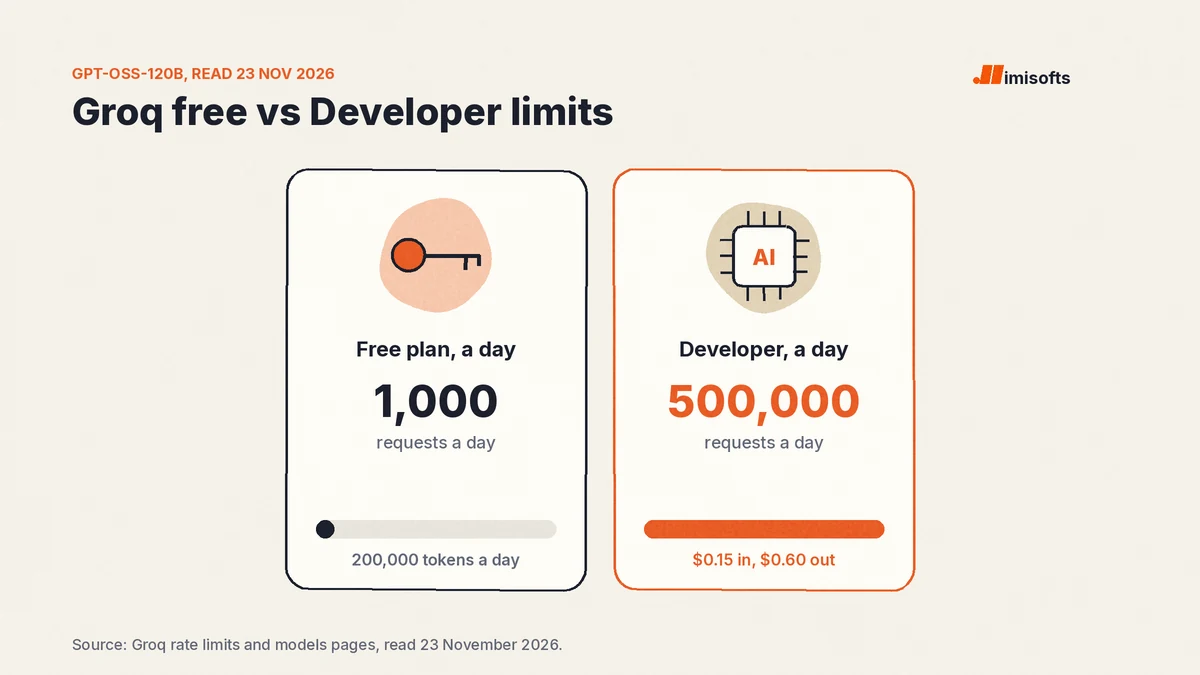
Short answer. Groq's API has a free plan: on 23 November 2026 its rate limits page gave openai/gpt-oss-120b 30 requests a minute, 1,000 requests a day, 8,000 tokens a minute and 200,000 tokens a day, and Whisper speech to text 2,000 requests a day and 28,800 audio seconds a day (8 hours). The Developer plan lifts the same model to 1,000 requests a minute, 500,000 a day and 250,000 tokens a minute, billed per token at $0.15 per million input and $0.60 per million output. Llama 3.1 8B and Llama 3.3 70B are marked Enterprise, "Contact Sales", and do not appear in the free table at all.
We build AI agents and voice agents for small teams and compare model APIs for them; Groq pays us nothing. Every limit and price below was read on Groq's own rate limits page, models page and billing FAQ on 23 November 2026. Groq calls its table "a high level summary" and says "there may be exceptions", so check the Limits page in your own console before you plan around a number.
Key numbers
| Item | Number |
|---|---|
| Free plan, gpt-oss-120b requests a day (30 a minute) | 1,000 |
| Free plan, gpt-oss-120b tokens a day (8,000 a minute) | 200,000 |
| Free plan, Whisper audio a day (8 hours) | 28,800 seconds |
| Developer plan, gpt-oss-120b requests a day (1,000 a minute, 250,000 tokens a minute) | 500,000 |
| gpt-oss-120b price per 1M tokens (Developer plan) | $0.15 in, $0.60 out |
| gpt-oss-20b price per 1M tokens (Developer plan) | $0.075 in, $0.30 out |
| Whisper large v3 turbo (large v3: $0.111 an hour) | $0.04 an hour |
| Progressive billing thresholds (then monthly) | $1, $10, $100, $500, $1,000 |
Limits and prices read on 23 November 2026 from Groq's rate limits, models and billing FAQ pages.
What the Groq free tier gives you, model by model
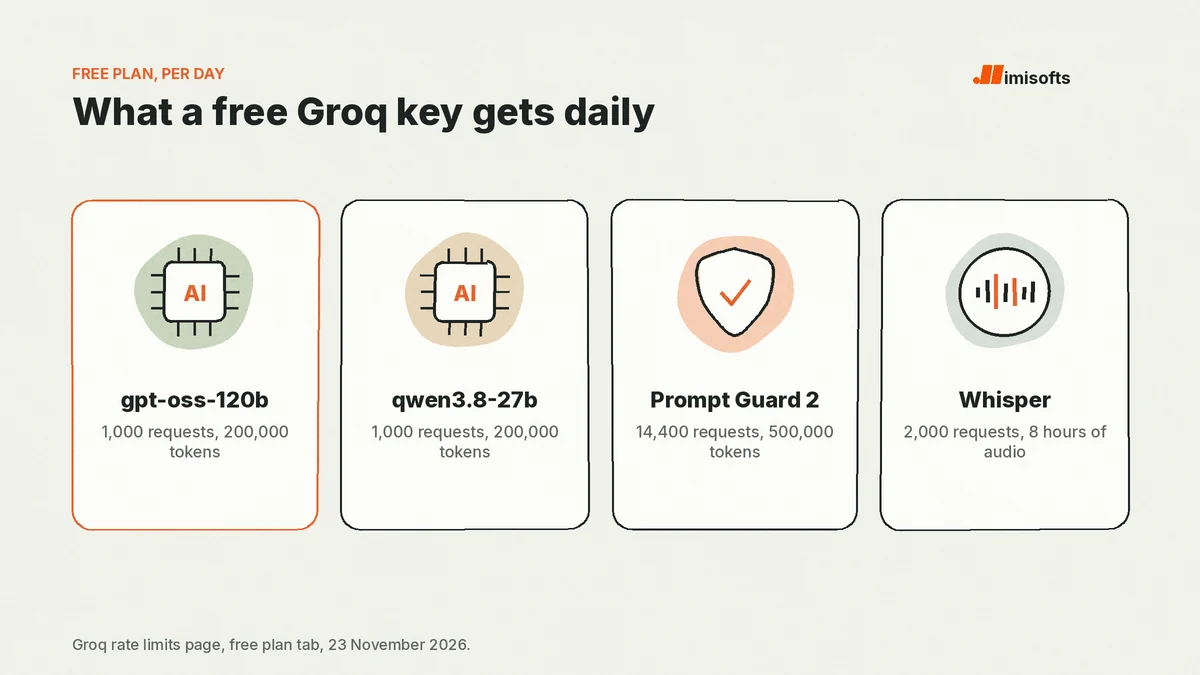
Groq measures limits per minute and per day, for requests, tokens and audio seconds. The free plan table on its rate limits page, read on 23 November 2026, lists ten models:
| Model | Requests a minute | Requests a day | Tokens a minute | Tokens a day |
|---|---|---|---|---|
| openai/gpt-oss-120b | 30 | 1,000 | 8,000 | 200,000 |
| openai/gpt-oss-20b | 30 | 1,000 | 8,000 | 200,000 |
| qwen/qwen3.8-27b | 30 | 1,000 | 8,000 | 200,000 |
| openai/gpt-oss-safeguard-20b | 3 | 1,000 | 2,000 | 200,000 |
| Llama Prompt Guard 2 (22M and 86M) | 30 | 14,400 | 15,000 | 500,000 |
| Orpheus text to speech (English, Arabic Saudi) | 10 | 100 | 1,200 | 3,600 |
| whisper-large-v3 and whisper-large-v3-turbo | 20 | 2,000 | none | none |
The two Whisper models are limited by audio instead of tokens: 7,200 audio seconds an hour and 28,800 a day on the free plan. That is 2 hours of audio per hour and 8 hours per day.
Three rules from the same page decide how the numbers behave in practice:
- Limits are per organization. "Rate limits apply at the organization level, not individual users", so three developers sharing one free org share one set of limits.
- Whichever limit you hit first wins. Groq's own example: with 50 requests a minute and 200,000 tokens a minute, 50 tiny requests still hit the request cap.
- Cached tokens are free of the count. "Cached tokens do not count towards your rate limits."
Which models are not on the free plan
On 23 November 2026 Groq's models page marked four models as Enterprise, with price and rate limits both "Contact Sales": llama-3.1-8b-instant, llama-3.3-70b-versatile, meta-models/muse-spark-open and minimaxai/minimax-m2.7. None of the four appears in the free plan table or the Developer plan table.
That matters if your code was written for the Llama models. On the pages we read, the models a free or self-serve account can call by default are the GPT OSS family, Qwen3.8 27B, the guard models, Whisper and the Orpheus voices. If your code still calls llama-3.3-70b-versatile, check what your console allows before you assume a free key will run it.
How much work fits inside the free limits
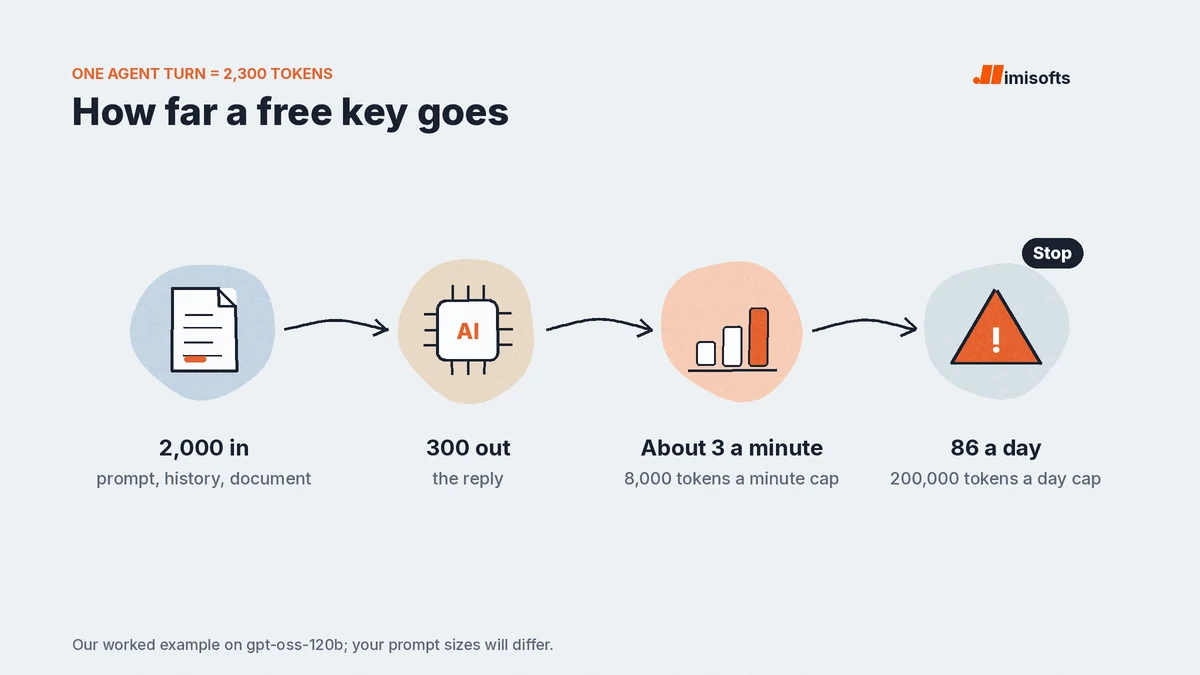
Daily tokens, not daily requests, are the cap a busy agent hits first. A typical agent turn that sends a 2,000 token prompt (instructions, history and a retrieved document) and gets 300 tokens back uses 2,300 tokens. At 200,000 tokens a day, the free plan runs 86 of those turns on gpt-oss-120b before it stops, far below the 1,000 request ceiling.
The per-minute cap bites next. At 8,000 tokens a minute, the same turn fits about three times a minute, which in our view leaves room for one or two live conversations at once. On our arithmetic, that is enough for a prototype, an internal tool or a nightly batch of a few dozen jobs, and not enough for a phone agent that answers calls as they come in.
Whisper is the most generous part of the free plan. Eight hours of audio a day covers a test of a call-transcription flow, or a small team's daily meeting recordings, without paying.
Which free Groq model to start with
For a general agent, start with gpt-oss-20b: it has the same free limits as the larger model, is listed at twice the speed (1,000 tokens a second against 500), and costs half as much once you upgrade. Move to gpt-oss-120b when the answers are not good enough for your task. Groq's models page lists both with 131,072 tokens of context and up to 65,536 completion tokens.
qwen/qwen3.8-27b shares the free limits but costs much more on the Developer plan ($0.80 in, $4.00 out per million), and its maximum completion is 16,384 tokens. Use the guard models (Prompt Guard 2 and gpt-oss-safeguard-20b) to screen inputs before they reach your main model; Prompt Guard's free daily allowance of 14,400 requests is the largest on the plan.
What the Developer plan changes, and what it costs
The Developer plan is pay as you go. Its limits for the main text models, from the same page:
| Model | Free: requests a minute / a day / tokens a minute | Developer: requests a minute / a day / tokens a minute | Price per 1M tokens (input / output) |
|---|---|---|---|
| openai/gpt-oss-120b | 30 / 1,000 / 8,000 | 1,000 / 500,000 / 250,000 | $0.15 / $0.60 |
| openai/gpt-oss-20b | 30 / 1,000 / 8,000 | 1,000 / 500,000 / 250,000 | $0.075 / $0.30 |
| qwen/qwen3.8-27b | 30 / 1,000 / 8,000 | 1,000 / 500,000 / 250,000 | $0.80 / $4.00 |
| whisper-large-v3 | 20 / 2,000 / audio | 300 / 200,000 / audio | $0.111 per hour of audio |
| whisper-large-v3-turbo | 20 / 2,000 / audio | 400 / 200,000 / audio | $0.04 per hour of audio |
For gpt-oss-120b that is 33 times the requests a minute, 500 times the requests a day and 31 times the tokens a minute. The Developer plan also adds Batch and Flex processing, chat support and spend limits, according to the billing FAQ.
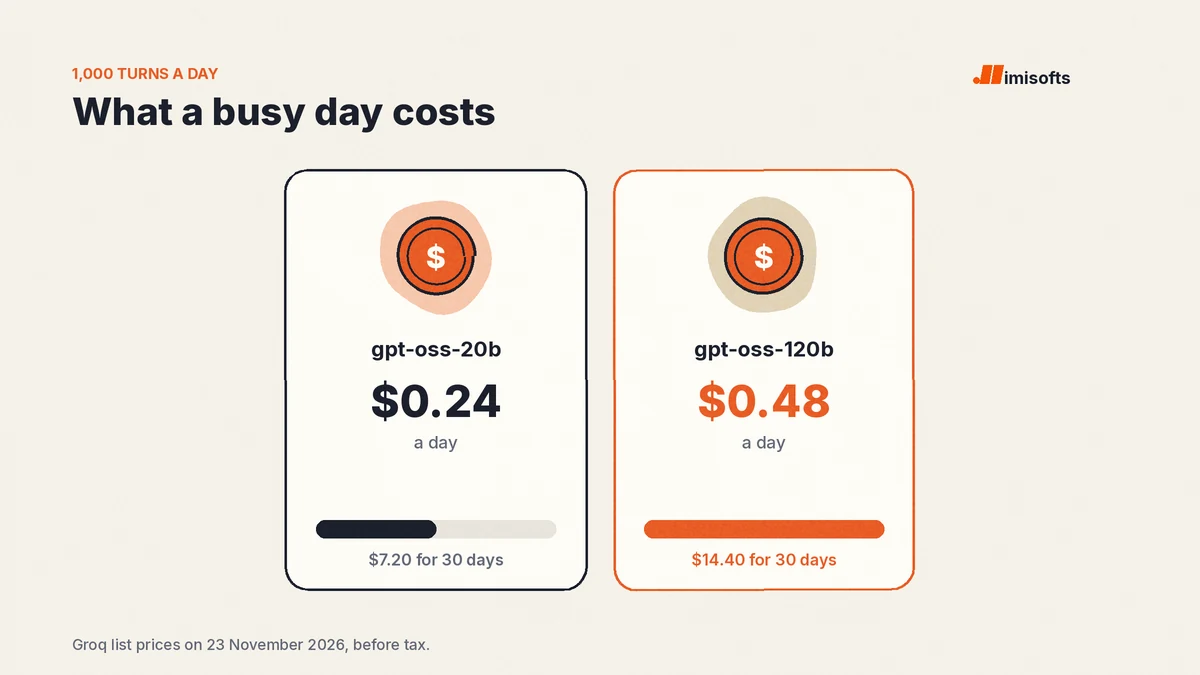
A worked cost. Take the agent turn above (2,000 tokens in, 300 out) and run it 1,000 times a day. On gpt-oss-120b that is 2 million input tokens at $0.15 and 300,000 output tokens at $0.60: $0.48 a day, or $14.40 for 30 days. On gpt-oss-20b it is $0.24 a day, $7.20 for 30 days. Transcribing 100 hours of calls costs $11.10 on whisper-large-v3 and $4.00 on the turbo model. Prices are Groq's list prices on 23 November 2026, before any tax.
If you are comparing providers, our pages on the OpenAI API free tier, the Claude API free tier and OpenRouter pricing use the same worked turn, and our Whisper API pricing page compares OpenAI's own transcription prices.
How upgrading and billing work
Upgrading needs a payment method: "credit card, US bank account, or SEPA debit account", per the billing FAQ. There is no charge at the moment you upgrade. Instead, new accounts are billed progressively: an invoice is triggered when lifetime usage first crosses $1, $10, $100, $500 and $1,000, and after that Groq bills monthly in arrears. Customers with a billing address in India have thresholds of $1, $10 and then every $100. You can downgrade to the free plan at any time; Groq issues a final invoice for any usage not yet billed.
When you pass a limit, the API answers 429 Too Many Requests and sets a retry-after header in seconds. Every response also carries rate limit headers; note that x-ratelimit-limit-requests "always refers to Requests Per Day" while x-ratelimit-limit-tokens "always refers to Tokens Per Minute", so a dashboard that reads both as per-minute values will be wrong.
Is the Groq free tier enough for an AI agent or voice agent?
Our view, as people who build these systems: the free plan is a good place to prove a flow works and to measure how many tokens a real conversation uses. It is not built for live traffic. The daily token cap stops a busy agent within the first hundred turns, and the per-minute cap allows only a couple of conversations at once.
Groq's models page lists speeds: gpt-oss-20b at 1,000 tokens a second and gpt-oss-120b at 500. Speed matters most in voice, where every pause is heard by the caller. For a home services business that wants an agent answering calls around the clock, see how we build those on our AI calling for home services page, and what a simpler text assistant costs in our guide to AI chatbot costs for a business.
Before you build on any free tier, write the 429 handling first: back off for the number of seconds in retry-after, queue the turn, and log which limit you hit. That one habit tells you exactly when the free plan stops being enough.
Frequently Asked Questions
Yes, Groq has a free plan. On 23 November 2026 it allowed gpt-oss-120b 30 requests a minute, 1,000 a day, 8,000 tokens a minute and 200,000 tokens a day. Higher limits need the pay-as-you-go Developer plan.
For the main text models (gpt-oss-120b, gpt-oss-20b, qwen3.8-27b): 30 requests a minute, 1,000 requests a day, 8,000 tokens a minute and 200,000 tokens a day. Whisper gets 20 requests a minute, 2,000 a day and 28,800 audio seconds a day. Limits apply to the whole organization.
Not on the pages we read on 23 November 2026. Groq's models page marked llama-3.3-70b-versatile and llama-3.1-8b-instant as Enterprise with Contact Sales pricing, and neither appeared in the free or Developer rate limit tables.
On the Developer plan, gpt-oss-120b costs $0.15 per million input tokens and $0.60 per million output tokens, gpt-oss-20b $0.075 and $0.30, and Whisper large v3 $0.111 per hour of audio. A 1,000-turn day of 2,000 tokens in and 300 out costs about $0.48 on gpt-oss-120b.
The API returns HTTP 429 Too Many Requests with a retry-after header in seconds. Note that the x-ratelimit-limit-requests header refers to requests per day and x-ratelimit-limit-tokens to tokens per minute.
No. Groq's rate limits page says cached tokens do not count towards your rate limits, so a long system prompt that is served from cache does not eat into your tokens per minute or per day.