November 2, 2026. On 29 October 2026 the Federal Trade Commission said its staff are sending warning letters to 25 companies "that market or generate sales leads for healthcare plans," timed to the open enrollment season, with more letters to follow "on a rolling basis." The letters name four claims the agency says may break the law: misrepresenting a plan's benefits or limits, calling a limited plan "major or comprehensive medical health insurance," misrepresenting cost, and falsely promising free offers, cash rewards or rebates for enrolling. They also remind recipients that the Telemarketing Sales Rule bars sales robocalls and charges "without express, informed consent" and bars calls to numbers on the National Do Not Call Registry "absent consent or other narrow exceptions", that the Impersonation Rule makes it illegal to pose as a government agency or an insurance carrier, and that the civil penalty runs to "up to $53,088 per violation," with "each unlawful call, advertisement, or misrepresentation" able to count separately. The letters "do not allege any wrongdoing by any of the recipients." If you sell leads, buy leads or dial them for an insurance client, this is the agency telling you where it is looking this winter.
Key numbers
| Item | Number |
|---|---|
| Companies receiving the first round of letters (more to follow on a rolling basis) | 25 |
| Date the FTC announced the letters (during open enrollment) | 29 October 2026 |
| Claim types the letters flag (a list introduced with include: benefits, cover, cost, incentives) | 4 |
| Maximum civil penalty cited per violation (TSR or Impersonation Rule) | $53,088 |
| Largest prior judgment listed (Simple Health Plans, 2024) | $195 million |
| Lead generator redress order listed (MediaAlpha, 2025) | $45 million |
| Prior cases cited in the template (two still in litigation) | 8 |
| Recipients the letters accuse of wrongdoing (letters allege no violation) | 0 |
FTC press release of 29 October 2026 and the warning letter template it links, and 16 CFR 310.4 on eCFR (current to 29 October 2026), read on 2 November 2026.
Who got a letter and what it says
The FTC's release says the letters go to companies "that market or advertise Affordable Care Act Marketplace health insurance or other healthcare products, such as limited indemnity plans and medical discount programs." The agency published the letter template, signed by Lois C. Greisman, Associate Director of the Division of Marketing Practices. It tells recipients that the staff "have identified a pattern of deceptive claims made by marketers or advertisers, including lead generators, of health insurance and healthcare-related products," and asks them to review "paid or other online ads, representations made on your websites, on social media, in promotional materials and communications, and through third-party distributors, marketing affiliates, and sales agents."
Christopher Mufarrige, Director of the Bureau of Consumer Protection, put the message in one sentence: "Today's letters remind companies that open enrollment is not an invitation to misrepresent what their plans actually cover."
The four claims the FTC says cross the line
The release and the template list the same four in substance, drawn from "information collected by FTC staff and the agency's enforcement experience", and the template says the list is not exhaustive:
- "Misrepresenting the benefits or limitations of a healthcare plan, including any insurance benefits."
- "Misrepresenting that a healthcare plan is major or comprehensive medical health insurance or the equivalent of such health insurance, when in fact it is not."
- "Misrepresenting the costs of a healthcare plan."
- "Falsely claiming that consumers who enroll in a healthcare plan will receive free offers, cash rewards, rebates or other incentives."
The list says nothing about intent, and the letters went to lead generators as well as sellers. A landing page that implies a discount program is insurance falls under the first or second claim; a quiz funnel promising a gift card that enrollees never receive is the fourth.
The calling rules in the letter
The template devotes a paragraph to telemarketing because, in its words, "consumers have also reported receiving unsolicited calls promoting healthcare-related product offers." It cites 16 CFR 310.4(b)(1) of the Telemarketing Sales Rule, which "prohibits sellers and marketers from initiating or causing the initiation of outbound telephone calls that deliver pre-recorded messages ('robocalls') to induce the purchase of products", including health insurance, "or to charge consumers for products without express, informed consent," and adds that the rule "also prohibits calling consumers who have placed their phone number on the National Do Not Call Registry, absent consent or other narrow exceptions."
An AI voice agent delivers an artificial voice, so on our reading, under the TCPA's artificial-voice rule and the TSR's prerecorded-message rule, a lead generator or agency that lets an AI agent dial a health insurance lead needs the same consent a recorded message does, and the do-not-call scrub besides. We covered the consent mechanics in is AI cold calling legal, the registry cost in Do Not Call Registry cost, and who answers for a vendor's calls in TCPA vicarious liability.
The letter's third rule is the Rule on Impersonation of Government and Business, 16 CFR Part 461, which "makes it illegal to falsely pose as a government agency (such as the Department of Health and Human Services) or business entities (such as insurance carriers), or to misrepresent affiliation with, endorsement, or sponsorship by, a government agency or business entities." Ads that borrow a marketplace look, a government seal or a carrier's name are the target.
The prior orders the letters cite
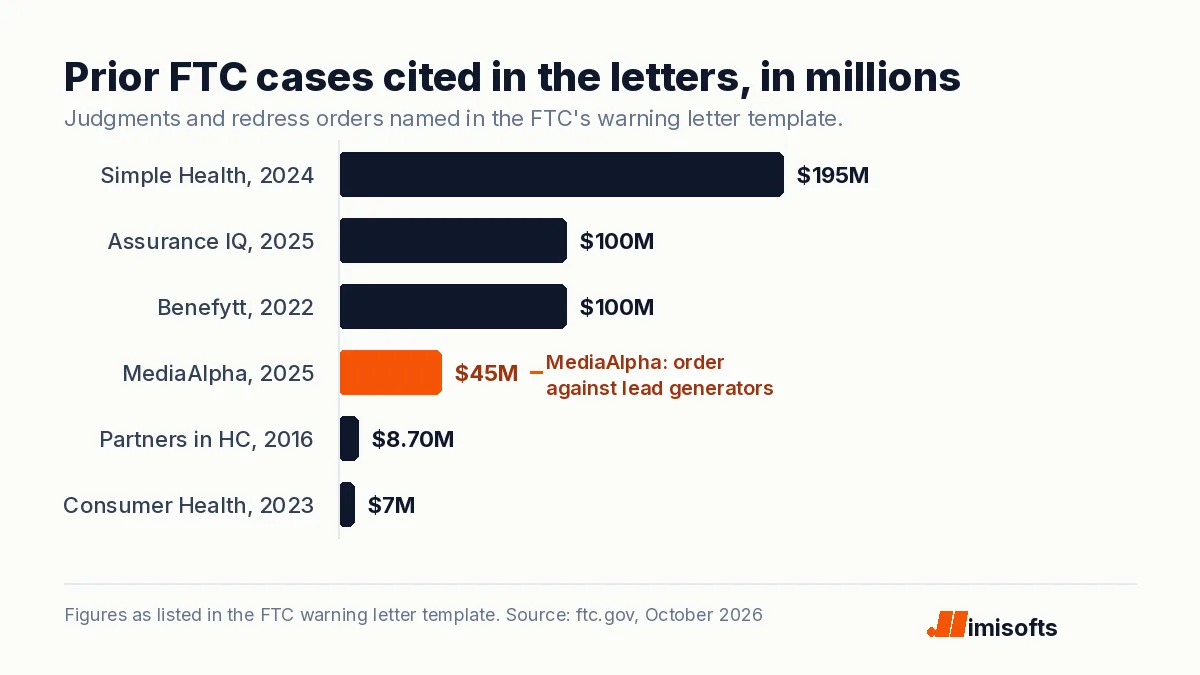
The template lists eight prior cases, saying they "demonstrate the Commission's focus on protecting consumers from such unlawful conduct." Six carry a dollar figure.
| Case, as the FTC lists it | Outcome in the letter |
|---|---|
| FTC v. Simple Health Plans, LLC et al. (S.D. Fla.) | 2024 order imposing a $195 million judgment against lead generators and telemarketers |
| FTC v. Assurance IQ, LLC (W.D. Wash.) | 2025 order requiring $100 million in consumer redress, in a case alleging telemarketing of plans that did not provide the coverage advertised |
| FTC v. Benefytt Technologies, Inc. et al. (M.D. Fla.) | 2022 orders requiring $100 million in redress and banning two executives from selling healthcare products |
| FTC v. MediaAlpha, Inc. et al. (C.D. Cal.) | 2025 order requiring lead generators to pay $45 million in redress, in a case alleging deceptive ads and websites that collected consumer information sold to telemarketers |
| FTC v. Partners in Healthcare Association, Inc. et al. (S.D. Fla.) | 2016 order imposing an $8.7 million judgment and barring the defendants from selling healthcare-related products and from telemarketing |
| FTC v. Consumer Health Benefits Association et al. (E.D.N.Y.) | 2023 order requiring telemarketers to pay $7 million in redress |
| FTC v. Top Healthcare Options Insurance Agency Inc. et al. (S.D. Fla.) | Litigation ongoing; preliminary injunction entered |
| FTC v. Innovative Partners, LP et al. (S.D. Fla.) | Litigation ongoing; preliminary injunction entered |
Two points in that table matter for lead sellers specifically. MediaAlpha, whose defendants the FTC describes as lead generators, was ordered to pay $45 million in a case alleging "use of deceptive ads and websites to collect consumer information that was sold to telemarketers of healthcare plans." Simple Health's $195 million judgment ran "against lead generators and telemarketers" together. The agency does not treat the form that captured the lead as a bystander to the call that closed it.
What a lead or calling business should do this month
- Read every ad and landing page against the four claims. The template asks for exactly that review, including affiliates' pages that run under your offer. Keep the dated screenshots.
- Separate "insurance" from everything that is not. If the product is a limited indemnity plan or a discount program, the page should say so where the price is, not in a footer.
- Check consent before any recorded or AI call. The letter cites express, informed consent for robocalls and the registry for everyone else. On our reading, consent written for a different brand or product is unlikely to carry over.
- Only promise incentives you deliver. Falsely claiming that enrollees will get free offers, cash rewards or rebates is the fourth claim on the list.
- Audit the look of the funnel. Seals, marketplace colors and carrier logos you do not have the right to use are Impersonation Rule exposure, at up to $53,088 per violation.
Agencies that sell insurance leads, and carriers' agents who buy them, can run the follow-up call on a platform that stores the consent with the lead; see AI calling for insurance agencies and AI calling built around TCPA consent. For what a health, life or final expense lead costs before any call is placed, read our insurance lead generation cost guide, and compare dialing platforms in best AI voice agents. This is general information, not legal advice.
Frequently Asked Questions
On 29 October 2026 FTC staff said they were sending letters to 25 companies that market or generate sales leads for healthcare plans, including Affordable Care Act Marketplace insurance, limited indemnity plans and medical discount programs, with more letters to follow on a rolling basis. The release does not name the recipients and says the letters do not allege wrongdoing.
Four: misrepresenting a plan's benefits or limitations, misrepresenting that a plan is major or comprehensive medical insurance or its equivalent, misrepresenting a plan's costs, and falsely promising free offers, cash rewards, rebates or other incentives for enrolling.
Yes. The release describes recipients as companies that market or generate sales leads, and the template cites MediaAlpha's $45 million order and Simple Health's $195 million judgment against lead generators and telemarketers as prior examples.
The template says violations of the Telemarketing Sales Rule or the Impersonation Rule may bring a civil penalty of up to $53,088 per violation, that each unlawful call, advertisement or misrepresentation may be a separate violation, and that a court may order refunds and an injunction halting the business.
On our reading, only with the express written consent the Telemarketing Sales Rule requires for prerecorded sales calls, since an AI agent delivers an artificial voice, and only after scrubbing against the National Do Not Call Registry. On our reading the consent should name the product and the company that will call.
No. The template lists eight prior cases, including Simple Health Plans ($195 million judgment, 2024), Assurance IQ ($100 million, 2025), Benefytt Technologies ($100 million, 2022), MediaAlpha ($45 million, 2025), Partners in Healthcare ($8.7 million, 2016) and Consumer Health Benefits Association ($7 million, 2023), plus two cases still in litigation.