November 2, 2026. Belgium is still an opt-out country for live sales calls, and a bill to change that was filed in the federal parliament with a critical opinion from the data protection authority attached. Under Book VI of the Code de droit économique, a live call for direct marketing is allowed "en l'absence d'opposition manifeste du destinataire, personne physique ou morale," unless the number is on the "Ne m'appelez plus" list, the Do Not Call Me register that the FPS Economy says makes "Tout appel publicitaire vers un numéro de téléphone qui figure dans ce fichier" illegal. Automated calls without a human and faxes need prior consent. Businesses that call Belgian numbers for marketing or fundraising must hold a licence from the Do Not Call Me ASBL, from 600 euro a year or 60 euro a month, excluding VAT, for an advertiser with up to 250 employees, and scrub their files against a list the ASBL updates daily, with a recommendation to refresh "au moins tous les 3 jours." The list held about 1.5 million numbers in March 2026. On 12 January 2026 the Autorité de protection des données issued opinion 02/2026 on a bill (Chamber document 56 1081) that would ban calling any consumer "qui n'a pas exprimé préalablement son consentement" and raise the sanction from level 2 to level 4; as of August 2026 Belgian press still described the regime as opt-out. Here is the current law, the price of compliance, and what the bill would change, from the FPS Economy, the licence manager and the APD opinion.
Key numbers
| Item | Number |
|---|---|
| Advertiser licence, up to 250 employees (or 60 euro a month, VAT excluded) | 600 euro a year |
| Advertiser licence, more than 250 employees (DNCM tariff page) | 1,950 euro a year |
| Service provider licence (call centres and data processors) | 550 or 1,350 euro |
| Recommended maximum interval between file refreshes (daily updates available) | 3 days |
| Working days for operators to record an objection (FPS Economy) | 5 |
| Numbers on the list (DNCM manager, March 2026) | about 1.5 million |
| Fine ceiling cited by DNCM (DNCM manager, March 2026; statute amount not verified) | 80,000 euro |
| Date of the APD opinion on the opt-in bill (avis 02/2026, Chamber doc 56 1081) | 12 January 2026 |
| Sanction level the bill proposes (up from level 2) | 4 |
| Licence manager since (Do Not Call Me ASBL) | 28 June 2015 |
FPS Economy pages (updated 6 October 2025 and 17 March 2025), Do Not Call Me ASBL site, APD opinion 02/2026 of 12 January 2026, Customer Contact interview of 19 March 2026 and L'Avenir of 12 August 2026, read on 2 November 2026.
Three regimes in one code
The APD's opinion sets out the current rules before assessing the bill. It identifies three regimes:
- Automated calls and fax, article VI.110 §1. The FPS Economy states it as "L'utilisation d'un système automatisé d'appel sans intervention humaine ou d'un télécopieur (fax) à des fins de prospection directe, est interdite sans le consentement préalable, libre, spécifique et informé du destinataire des messages." It adds that the consent can be withdrawn at any time, without reasons or cost, and that "L'émetteur a la charge de la preuve du respect de ses obligations légales."
- Live calls, articles VI.110 §2 and §3, VI.111, VI.112 and VI.114. These "mettent en place un régime d'opt-out en ce qui concerne les appels téléphoniques avec intervention humaine effectués à des fins de prospection commerciale." Such calls "sont autorisés, sauf si leurs destinataires s'y sont opposé soit directement auprès des émetteurs de ces appels, soit de manière générale, en inscrivant leur(s) numéro(s) de téléphone sur la liste « Ne m'appelez plus ! »."
- Email and SMS, article XII.13. Prior consent, softened by the "soft opt-in" of the royal decree of 4 April 2003. The APD notes the code's definition of electronic mail covers emails and SMS and that the FPS Economy reads it as covering voicemail messages too. We cover that side in cold email laws in Belgium.
Two points in the FPS Economy's statement of the live-call rule matter for business callers. The opposition can come from a "personne physique ou morale," so a company can object and register, and the identity of the business "au nom de laquelle la communication est faite, ne peut être dissimulée": the firm behind the call must be named.
How the Ne m'appelez plus list works
Telecom operators must record a subscriber's objection "dans les 5 jours ouvrables de la demande," confirm the date in writing, allow objection free of charge by phone, email or post, keep the file current and "mettre le fichier à disposition des personnes qui font du marketing direct." Consumers register by calling 02 882 1975. The list itself is administered by the Central Number Database ASBL, and since 28 June 2015 the Do Not Call Me ASBL, DNCM, "gère officiellement les licences de la liste Ne m'Appelez Plus." DNCM states the scope plainly: companies that call customers or prospects "pour des actions commerciales ou pour collecter des dons" must consult and respect the list, and "elles ne peuvent pas contacter des consommateurs ou des entreprises inscrits sur la liste." Confirming an appointment or warning a customer about a product fault is not direct marketing; recruiting members or asking for donations is.
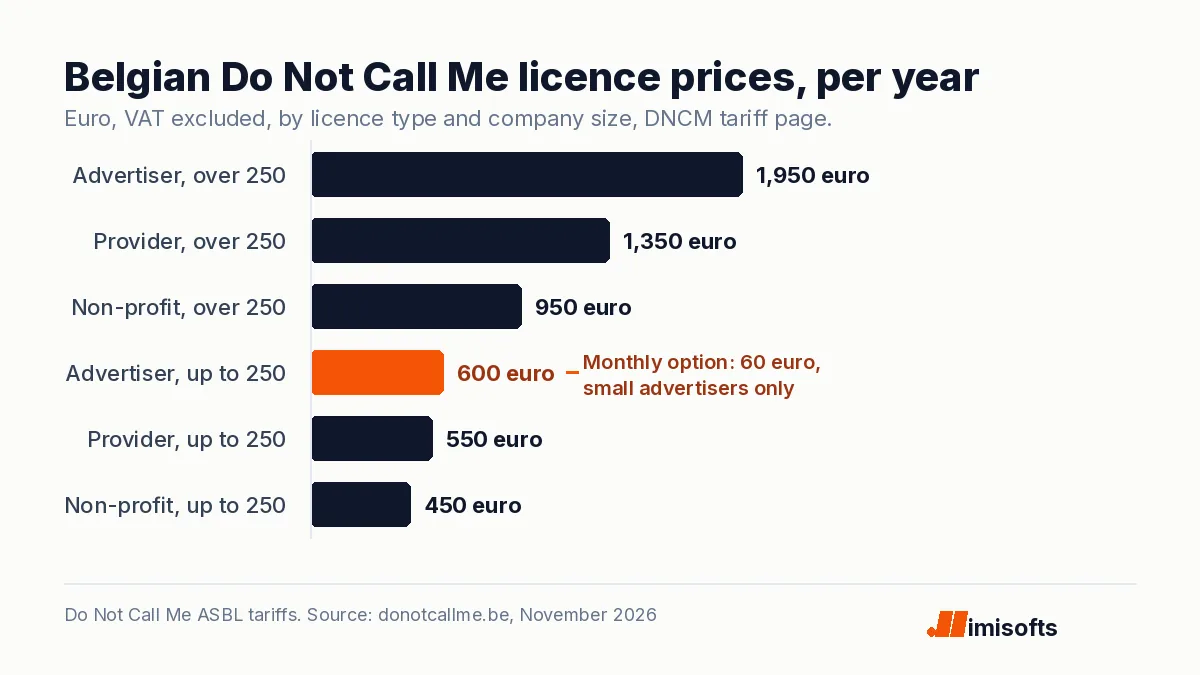
| DNCM licence | Up to 250 employees | More than 250 employees |
|---|---|---|
| Advertiser (annonceur) | 600 euro a year, or 60 euro a month | 1,950 euro a year |
| Service provider (call centre, data processor) | 550 euro a year | 1,350 euro a year |
| Non-profit organisation | 450 euro a year | 950 euro a year |
All prices exclude 21 percent VAT. The monthly licence exists only for advertisers with 250 or fewer staff; annual licences renew tacitly unless cancelled a month before expiry, with a reminder two months out. Once paid, a licensee can look up single numbers or download the full list manually, by SFTP or by API, with "Une mise à jour quotidienne," and DNCM recommends updating call files "au moins tous les 3 jours." Burt Riské, DNCM's manager, told the Customer Contact forum in March 2026 that "Dès qu'un numéro est inscrit, elles ont cinq jours pour s'y conformer," that the list holds "environ 1,5 million de numéros privés," and that enforcement sits with the FPS Economy, where "L'amende peut atteindre 80 000 euros."
Penalties
The APD opinion records that article XV.83, paragraph 1, 16° of the code "établit actuellement une sanction de niveau 2 pour les violations des articles VI.110 à VI.115." The euro ceiling for a level 2 sanction is not stated in the sources we read today, so the 80,000 euro figure above is DNCM's description, not the statute's words. Consumers report violations through the FPS Economy's Consumer Connect service.
The bill: opt-in for every consumer call
The proposal the APD examined was sent to it on 5 November 2025 by the president of the Chamber, Peter De Roover; the bill's author is deputy De Smet. It would replace article VI.110 §1 with a new rule: "Il est interdit de démarcher téléphoniquement, ou par toute autre technique de communication, directement ou par l'intermédiaire d'un tiers agissant pour son compte, un consommateur qui n'a pas exprimé préalablement son consentement à faire l'objet de prospections commerciales par ce moyen." The sender would bear the burden of proving consent, with one exception for solicitations made in the course of an ongoing contract and directly related to it. The deputy's office told the APD the bill is meant to cover any use of a consumer's fixed or mobile number, "en ce compris les SMS, WhatsApp." It would also abolish the level 2 sanction and create a level 4 sanction for violations of articles VI.110 to VI.115.
The APD has given earlier opinions, including 23/2025 on another opt-in proposal. Its objections here were to drafting. The bill amends only §1 of VI.110, the automated-calls paragraph, and leaves §2, the live-call opt-out, untouched, which the APD says would create inconsistency. It would conflict with EU law by removing the soft opt-in for SMS; the APD notes Belgian law cannot remove the EU soft opt-in. According to DNCM's manager, the federal coalition agreement mentions a possible transition from opt-out to opt-in; DNCM's manager said in March 2026 that "Le dispositif concret n'est donc pas encore décidé," and on 12 August 2026 L'Avenir reported, after France's new law took effect on 11 August, that "En Belgique, ce n'est pas encore le cas."
What a team calling Belgium should do now
- Buy the DNCM licence that matches your role. An agency calling for clients with up to 250 employees is a service provider at 550 euro a year; a client of that size selling its own product is an advertiser at 600 euro a year or 60 euro a month.
- Refresh the list every three days at most, and treat a new registration as binding within five days. Daily downloads by API are available.
- Scrub business numbers too. The list accepts "consommateurs ou des entreprises," and the legal right to object belongs to a "personne physique ou morale."
- Keep automated and AI voices on consented numbers only. Article VI.110 §1 already requires prior, free, specific and informed consent for any calling system "sans intervention humaine," and the caller carries the burden of proof. A live-agent cold call is lawful on an opt-out basis; an AI agent with no human on the line most likely needs consent. Belgium's neighbours have gone further: see the Netherlands' opt-in regime and France's cold calling ban from August 2026.
- Build the consent database the bill would require. If the opt-in passes in any form, the asset that survives is a record of who agreed to be called, by which seller, for what, with a timestamp.
For how Belgium sits among the other European markets, see cold calling laws by country. For consent capture on AI calls (US rules), see TCPA-compliant AI calling; the best AI voice agents in 2026 compares platforms. This is general information, not legal advice.
Frequently Asked Questions
Yes, for live calls. Book VI of the Code de droit économique allows direct marketing calls with human intervention unless the recipient has objected, either to the caller or by registering on the Ne m'appelez plus list. Automated calls without human intervention and faxes require prior, free, specific and informed consent under article VI.110 §1.
It is Belgium's Do Not Call Me register. Consumers and businesses register free, by phone at 02 882 1975. Companies that call for marketing or fundraising must hold a licence from the Do Not Call Me ASBL: 600 euro a year or 60 euro a month for an advertiser with up to 250 employees, 1,950 euro a year above that, 550 or 1,350 euro for call centres and data processors, and 450 or 950 euro for non-profits, all excluding 21 percent VAT.
The ASBL publishes a daily update and recommends refreshing call files at least every three days. Telecom operators must record a subscriber's objection within five working days, and the licence manager says companies have five days to comply once a number is registered.
A bill filed in the Chamber of Representatives, document 56 1081, would ban calling a consumer who has not given prior consent and raise the sanction from level 2 to level 4. The data protection authority's opinion 02/2026 of 12 January 2026 criticised its drafting, and DNCM's manager says the coalition agreement mentions a possible move to opt-in, but as of August 2026 Belgian press reported the opt-out regime still in force.
Most likely not without consent. Article VI.110 §1 bans automated calling systems without human intervention for direct marketing unless the recipient gave prior, free, specific and informed consent, and the caller must prove it. Live agents may cold call on an opt-out basis after scrubbing against the Ne m'appelez plus list.
Yes. The FPS Economy says the right to object belongs to a natural or legal person, and the licence manager says licensees may not contact consumers or businesses registered on the list.