October 15, 2026. Clay charges in two currencies: Actions, which pay for the work the platform does, and Data Credits, which pay for the emails, phone numbers and company data it buys from its 150-plus data partners. The Free plan includes 500 Actions and 100 Data Credits a month. Launch starts at $185 a month, or $167 a month billed annually, with 15,000 Actions and 2,500 Data Credits a month. Growth starts at $495 a month, or $446 billed annually, with 40,000 Actions and 6,000 Data Credits, and Enterprise is priced by quote on an annual commitment. Our lead generation service builds prospect lists for outbound campaigns, so this guide breaks down what each plan includes and how the two meters add up.
Prices and rules come from Clay's pricing page and its pricing FAQ, read 15 October 2026. The plan cards show the annual-billed monthly price, while the FAQ quotes monthly billing, which is why you will see both $167 and $185 for the same plan.
Key numbers
| Item | Number |
|---|---|
| Clay Free plan | 500 Actions and 100 Data Credits a month |
| Clay Launch ($167 billed annually; 15,000 Actions, 2,500 Data Credits) | from $185 a month |
| Clay Growth ($446 billed annually; 40,000 Actions, 6,000 Data Credits) | from $495 a month |
| Clay Enterprise (200,000+ Actions, 100,000+ Data Credits a month) | custom, annual commitment |
| Annual billing discount | 10% |
| Data Credit top-ups on Launch and Growth | 30% premium |
| Action cost (Clay FAQ) | under 1 cent each |
| Charge for an enrichment with no result (Clay FAQ) | none |
Clay pricing page and pricing FAQ, read 15 October 2026.
Clay plans and prices
| Plan | Monthly billing | Billed annually | Actions a month | Data Credits a month | What it adds |
|---|---|---|---|---|---|
| Free | $0 | $0 | 500 | 100 | Unlimited seats and tables, waterfalls, Claygent, your own API keys, 200 rows per table |
| Launch | from $185 | from $167 | 15,000 | 2,500 | Phone enrichment, job change and other signals, email campaign integrations, 50,000 rows per table |
| Growth | from $495 | from $446 | 40,000 | 6,000 | CRM auto-sync, HTTP API, webhooks, web intent signals, ad audiences, priority support |
| Enterprise | Custom, annual | Custom | 200,000+ | 100,000+ | SSO, role-based access, Clay API, data warehouse syncs, a dedicated growth strategist |
Annual billing saves 10 percent, and on annual plans Clay grants all the credits up front. The Free plan has no phone number enrichment, which is the feature most outbound teams notice first.
Actions and Data Credits, explained
Clay's FAQ describes the split as two things happening at once: Clay doing work, and Clay buying data on your behalf.
- Actions measure orchestration: enriching data, running a table, calling an AI model, sending data to another system or exporting it. Clay says Actions cost less than a cent each and get cheaper with scale, and that each plan includes enough to cover 90 percent of customers.
- Data Credits pay for the data itself, such as an email address, a phone number or a company detail from one of Clay's partners. Clay says Data Credits get cheaper with volume.
- Your own API keys skip Data Credits entirely. If you already pay a data provider directly, connecting its key means you only spend Actions in Clay.
- Empty results are free: according to the FAQ, an enrichment that returns no result is not charged Data Credits or Actions. AI research columns work differently, which our breakdown of what Clay's account agents cost covers.
What extra volume costs
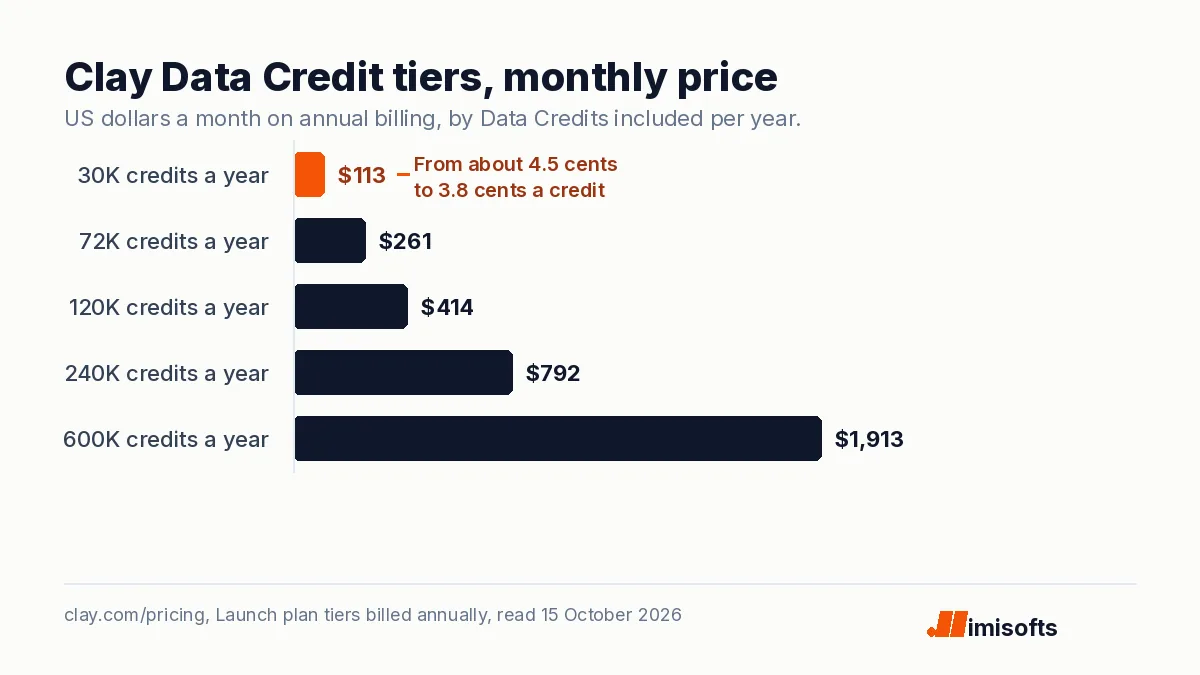
Both meters come in tiers, and the plan price is simply the two added together. On the Launch plan billed annually, the smallest tiers are 180,000 Actions a year for $54 a month and 30,000 Data Credits a year for $113 a month, which is the $167 headline price. Moving up the Launch plan's Data Credit tiers shows the volume discount Clay describes:
| Data Credits a year | Price a month, billed annually | Approximate cost per credit |
|---|---|---|
| 30,000 | $113 | 4.5 cents |
| 72,000 | $261 | 4.4 cents |
| 120,000 | $414 | 4.1 cents |
| 240,000 | $792 | 4.0 cents |
| 600,000 | $1,913 | 3.8 cents |
Actions fall faster: on Launch, 180,000 a year works out to about 0.36 cents each, and 2.4 million a year at $486 a month to about 0.24 cents. Growth's Data Credit tiers start higher, at 72,000 credits a year for $261 a month, and its Actions cost more: $185 a month for 480,000 a year, against $135 for the same amount on Launch.
Rollover, top-ups and the fine print
- Actions do not roll over. They reset each billing cycle, so unused platform capacity is lost.
- Data Credits do roll over, with a cap. The FAQ says unused credits on Launch and Growth can build up to twice your monthly credit amount, so a 10,000-credit plan can bank up to 20,000. The comparison table on the same page lists rollover as 15 percent of annual credits, so confirm the rule for your contract. Enterprise customers can carry over up to 15 percent of the prior year's purchased credits when they renew at an equal or higher commitment.
- Top-ups cost more. Buying extra credits on Launch or Growth carries a 30 percent premium over plan rates, so it is cheaper to size the tier correctly than to top up every month.
How to estimate your own Clay bill
Clay's 90 percent figure describes its customers in general, so your own data is the better guide. The practical way to budget is to build one table of 200 real prospects, run your actual waterfall, and read the credits and Actions it used. Multiply by your monthly volume, add a margin for rows that match on the second or third provider, and pick the tier that covers it without top-ups.
Remember that Clay is a data and workflow layer, not the whole outbound system. It can send email itself or through integrations, and Growth adds buying domains and email accounts for the Clay Sequencer, but deliverability still depends on how those domains and inboxes are set up and warmed up, which is what our email infrastructure setup handles. If your people search starts on LinkedIn, our guide to Sales Navigator pricing covers that side.
Clay or buying data directly
Whether Data Credits cost less than buying from a provider directly is easy to test: run a sample in Clay, note the Data Credits it used, and compare their cost at your tier with your provider's rate card. The bigger difference is the workflow. A waterfall that tries several providers in turn, signals such as job changes, and pushing results straight into your CRM or sequencer are what the Actions pay for. If you only ever use one data source and export a CSV, connecting your own API key or buying from that provider directly may cost less.
Which Clay plan to choose
- Testing the idea: Free, with your own API keys if you have them, and tables under 200 rows.
- One team running outbound: Launch, for phone numbers, job change signals and email sequencing integrations.
- Revenue teams that live in a CRM: Growth, for CRM auto-sync, webhooks and web intent signals.
- Security reviews, SSO or very high volume: Enterprise, quoted on an annual commitment.
Comparing tools? Our guides to Clay vs Apollo and Clay data enrichment cover the trade-offs. And if you would rather have the lists built, enriched and worked for you, that is what our done-for-you lead generation does.
Frequently Asked Questions
Clay's Launch plan starts at $185 a month on monthly billing or $167 a month billed annually, and Growth starts at $495 a month or $446 billed annually. Enterprise is priced by quote on an annual commitment. There is also a Free plan with 500 Actions and 100 Data Credits a month.
Actions measure the work Clay's platform does, such as enriching rows, running tables, calling AI models and exporting data; Clay says they cost less than a cent each. Data Credits pay for data bought from Clay's 150-plus partners, such as emails, phone numbers and company details.
Yes. The Free plan includes 500 Actions and 100 Data Credits a month, unlimited seats and tables, multi-provider waterfalls, Claygent and your own API keys, with tables of up to 200 rows. It does not include phone number enrichment.
Actions reset every billing cycle and do not roll over. Data Credits do: Clay's FAQ says unused credits on Launch and Growth can accumulate up to twice the monthly credit amount, while its comparison table lists 15 percent of annual credits, so confirm the rule for your plan. Enterprise can roll over up to 15 percent of the prior year's credits.
According to Clay's FAQ, an enrichment that returns no result is not charged Data Credits or Actions. If you bring your own API keys for a provider, you skip Data Credits and only use Actions.
Yes, by 10 percent. Launch drops from $185 to $167 a month and Growth from $495 to $446 a month when billed annually, and annual plans receive all their credits up front.