Short answer. Schema markup is code that labels what a page is about so search engines can read it as data. On 11 November 2026, Google's own search gallery lists 25 structured data features it supports. FAQ rich results are not one of them: Google says they stopped appearing on May 7, 2026. Google's AI optimization guide also says structured data "isn't required" for its generative AI features in Search.
This guide is for a business owner or marketer deciding whether schema is still worth the work. It covers what Google supports now, what it has retired since 2023, what Google and Bing say about schema and AI answers, and the rules that can cost a page its rich result. Every source below was read on 11 November 2026. For the wider picture of what search work costs, see our guide to SEO pricing.
Key numbers
| Item | Number |
|---|---|
| Structured data features in Google's gallery (read 11 November 2026) | 25 |
| FAQ rich results stopped appearing (Google changelog, May 8 entry) | May 7, 2026 |
| FAQ documentation removed (39 days later) | June 15, 2026 |
| FAQ limited to government and health sites (Google blog) | August 8, 2023 |
| Types phased out in one 2025 announcement (June 12, 2025) | 7 |
| Rich result types retired since 2023 (our count from Google's posts) | 10 |
| Formats Google supports (JSON-LD recommended) | 3 |
| Schema needed for Google AI features (Google AI optimization guide) | None special |
| Rotten Tomatoes CTR vs pages without markup (pages with structured data) | 25% |
Google Search Central documentation, blog and changelog, and Bing Webmaster Guidelines, read 11 November 2026.
What schema markup is
Google defines structured data as "a standardized format for providing information about a page and classifying the page content." Google's own example is a recipe page, where markup can label the ingredients, the cooking time and temperature, and the calories. Most of these labels come from the schema.org vocabulary, which is why people say "schema markup" and "structured data" for the same thing.
One point in Google's introduction to structured data surprises people. Google says you "should rely on the Google Search Central documentation as definitive for Google Search behavior, rather than the schema.org documentation." In other words, for Google Search the reference is Google's documentation, not schema.org's.
The payoff Google describes is the rich result: a search listing with extra detail, such as a product's price or review rating. Google's introduction lists case studies, without dates. Rotten Tomatoes "measured a 25% higher click-through rate" on pages with structured data, and Nestlé measured "an 82% higher click through rate" on pages that showed as rich results. These are results Google chose to publish about its own feature, so we would treat them as best cases, not averages.
JSON-LD, Microdata or RDFa
Google supports three formats and says "all 3 formats are equally fine for Google, as long as the markup is valid." It recommends JSON-LD, whose markup "is not interleaved with the user-visible text," calling it "the easiest solution for website owners to implement and maintain at scale." Google also says it can read JSON-LD that is injected by JavaScript. If your CMS, such as Wix, WordPress or Shopify, does not let you edit HTML, Google says it "may have a search engine settings page, or you may be able to install a plugin."
What Google still supports
Google's structured data search gallery listed 25 features when we read it: Article, Breadcrumb, Carousel, Course list, Dataset, Discussion forum, Education Q&A, Employer aggregate rating, Event, Image metadata, Job posting, Local business, Math solver, Movie, Organization, Product, Profile page, Q&A, Recipe, Review snippet, Software app, Speakable, Subscription and paywalled content, Vacation rental and Video. FAQ and HowTo are absent.
For a typical small business site, we think these are the ones with a clear use. The descriptions paraphrase Google's gallery:
| Type | What Google says it can show |
|---|---|
| Organization | Logo, legal name, address, contact details and company identifiers, in knowledge panels and attribution |
| Local business | Open hours, ratings, directions and booking or ordering actions in the knowledge panel |
| Product | Price, availability and review ratings |
| Article | The title of the article and larger than thumbnail images, for news, sports or blog articles |
| Breadcrumb | The page's position in the site hierarchy |
| Video | Video information, with the option to play the video, video segments and live streams |
Google adds a caveat in its general structured data guidelines: it "does not guarantee that your structured data will show up in search results, even if your page is marked up correctly according to the Rich Results Test." Markup makes a page eligible. It does not make the rich result appear.
What Google has retired since 2023
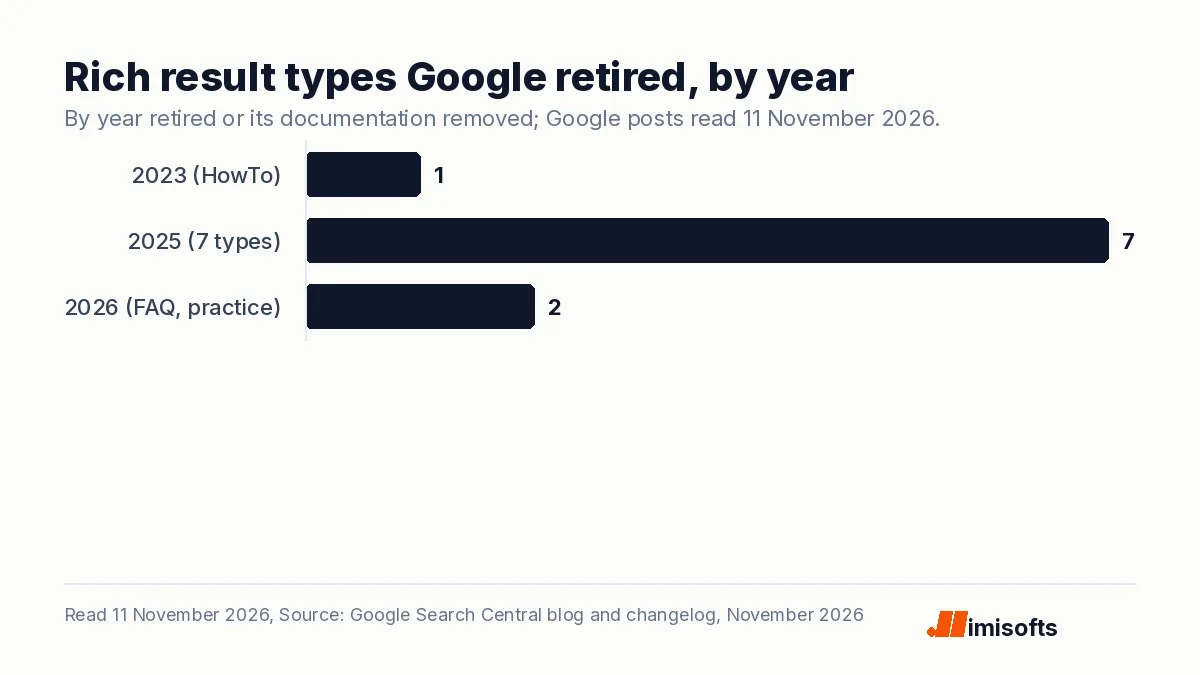
Google has been cutting rich result types for three years. Counting only what its own blog and changelog name, we count 10 types retired since August 2023:
| Date | What changed | Source |
|---|---|---|
| August 8, 2023 | FAQ rich results limited to "well-known, authoritative government and health websites" | Google blog |
| September 13, 2023 | How-to rich results no longer shown on desktop; Google calls the type deprecated | Google blog update |
| June 12, 2025 | 7 types to be phased out: Book Actions, Course Info, Claim Review, Estimated Salary, Learning Video, Special Announcement, Vehicle Listing | Google blog |
| November 5, 2025 | Google says it is "beginning to phase these lesser-used features out" and will remove support in Search Console and its API from January 2026 | Google blog |
| January 6, 2026 | Practice problem documentation removed; the type is "no longer shown" | Google changelog |
| May 7, 2026 | FAQ rich results stop appearing in Google Search | Google changelog |
| June 15, 2026 | FAQ rich result documentation removed | Google changelog |
Two lines in the June 2025 post soften this for the seven types it named. It says "This update won't affect how pages are ranked." And it says the use of these types "outside of Google Search (and dependent features) is not affected."
FAQ schema after May 7, 2026
The FAQ rich result ended in two steps. From August 2023, Google showed it only for "well-known, authoritative government and health websites." Then the changelog entry of May 8, 2026 said the feature "will no longer appear in Google Search starting May 7, 2026," and the documentation went on June 15, 39 days later.
Do you need to delete it? Google's 2023 guidance, which we have not seen withdrawn, said: "there's no need to proactively remove it. Structured data that's not being used does not cause problems for Search, but also has no visible effects in Google Search." Our suggestion is simple. Keep the visible FAQ section if readers use it, leave existing FAQPage markup alone, and stop adding FAQ schema in the hope of a rich result in Google.
Does AI search use schema markup?
This is a People Also Ask question for "schema markup," and Google answered it for its own AI features in its guide to optimizing for generative AI features. Under "Overfocusing on structured data," it says: "Structured data isn't required for generative AI search, and there's no special schema.org markup you need to add." It then says it is "a good idea to continue using it as part of your overall SEO strategy, as it helps with being eligible for rich results on Google Search."
The same guide sets the real entry bar: a page "must be indexed and eligible to be shown in Google Search with a snippet." It also names two products that can help local businesses and stores appear in AI responses: Google Business Profiles and Merchant Center feeds. In our view, that is a better use of a first hour than new markup. Our local SEO guide covers the Business Profile side.
Bing is a little warmer on schema. Its Webmaster Guidelines say "Structured data may support clearer grounding but does not guarantee visibility or grounding traffic. Markup must accurately reflect visible content." The same guidelines talk about pages selected "for grounding results or citations" and content used "in Copilot responses and grounding results." Bing also says to "Define Entities Clearly and Consistently"; we think Organization markup is one way to do that. We did not check what OpenAI, Anthropic or Perplexity say about schema, so this guide makes no claim about them. For how AI answer work differs from classic SEO, see AEO vs SEO.
The rules that cost a rich result
In our view, three rules in Google's documentation matter most for a small business site:
- Mark up only what people can see. Google says not to "add structured data about information that is not visible to the user, even if the information is accurate." Bing says the same: markup "must accurately reflect visible content."
- No star ratings for your own business. Google's review snippet rules say that when a business controls the reviews about itself, its pages using LocalBusiness or Organization markup "are ineligible for star review feature." That includes reviews shown "through an embedded third-party widget," such as a Google reviews widget on your own site.
- Complete beats long. Google says you "must include all the required properties" to be eligible, and that it is better to supply "fewer but complete and accurate" recommended properties "rather than trying to provide every possible recommended property."
Google says any structured data issue "can result in a manual action," and that a structured data manual action "means that a page loses eligibility for appearance as a rich result; it doesn't affect how the page ranks in Google web search." You can check for one in the Manual Actions report in Search Console.
How to add and test schema
Following Google's introduction page, the process looks like this:
- Pick a feature from the gallery that matches what the page really is, and read that feature's required properties.
- Add it, ideally as JSON-LD, through your code, your CMS settings or a plugin.
- Test it with the Rich Results Test before launch, then confirm Google found it with the URL Inspection tool.
- Measure it. Google suggests a before and after test on a few pages that "won't change much" and already have "several months of data in Search Console," then recording "the performance for a few months in the Performance report."
After launch, the rich result status reports in Search Console flag pages whose markup breaks "due to templating or serving issues." For AI features, Google points to the Generative AI performance report in Search Console. If you also run a chatbot or assistant on your site, we suggest holding it to the same rule: its answers should match what the page says. Our guide to AI chatbot costs covers that side.
How imisofts can help
imisofts is a Dubai-based agency. Our AI search optimization and SEO services include structured data work: choosing the types Google still supports, writing the JSON-LD, testing it and checking Search Console afterwards, alongside the content and technical work that also affects whether a page is shown. Tell us which pages matter most to you.
Sources: Google, Introduction to structured data markup; Google, Structured data search gallery; Google Search Central, Latest documentation updates; Google, Changes to HowTo and FAQ rich results (2023); Google, Simplifying the search results page (2025); Google, Update on simplifying the search results page (2025); Google, Optimizing for generative AI features; Google, Review snippet structured data; Google, General structured data guidelines; Bing Webmaster Guidelines.
Frequently Asked Questions
Schema markup is structured data, which Google recommends writing as JSON-LD, that labels what a page contains, such as a product's price or a business's address. Google uses it to understand pages and to show rich results. On 11 November 2026, Google's gallery listed 25 features that can use it.
The Google documentation we read does not call it a ranking factor. Its June 2025 post on retired types said the change "won't affect how pages are ranked," and a structured data manual action removes rich result eligibility without affecting ranking. The benefit is eligibility for rich results, which Google's case studies tie to higher click-through rates.
Not for Google rich results. Google says FAQ rich results stopped appearing on May 7, 2026 and removed the documentation on June 15, 2026. Its 2023 guidance said unused markup causes no problems, so we see no need to remove existing FAQPage code.
For Google, its AI optimization guide says structured data "isn't required for generative AI search" and no special schema is needed. Bing says structured data "may support clearer grounding" but "does not guarantee visibility or grounding traffic." We have not checked a published statement from OpenAI, so we make no claim about ChatGPT.
From Google's gallery, we would start most service sites with Organization, Local business, Breadcrumb and Article, plus Product for stores and Video where you host video. Google does not allow star ratings on your own LocalBusiness or Organization pages when you control the reviews.
Use Google's Rich Results Test before launch, then the URL Inspection tool to confirm Google found the markup. After launch, watch the rich result status reports in Search Console, and compare a few pages for a few months in the Performance report.