No. You do not have to port your business number to use an AI receptionist. Forward the number to the line the agent answers on, every call or only the calls you miss, and the agent is live in one star code. Port later, if ever, and then to a carrier you control, not into the vendor's number pool.
I read the porting and forwarding pages of Twilio, Telnyx, Vapi, Retell, Bland, HighLevel, Smith.ai, Verizon and the FCC on 28 September 2026, because it is one of the first questions a trades owner asks when we scope AI calling for home services.
The number on the trucks will outlive the vendor. Do not hand it to the newest company in your stack.
Key numbers
| Item | Number |
|---|---|
| FCC simple port, one line (the rule for ports with no complex switching changes) | 1 business day |
| Twilio US port-in, typical (up to 4 weeks or longer after a carrier rejection) | 5 to 15 days |
| Telnyx US port-in | 1 to 7 business days |
| HighLevel port-in, under 50 numbers | 2 to 4 weeks |
| Twilio port-in fee, US number | $0 |
| Telnyx port-in fee, US and Canada | $0 |
| Twilio SMS routing after a port | 2 to 3 business days |
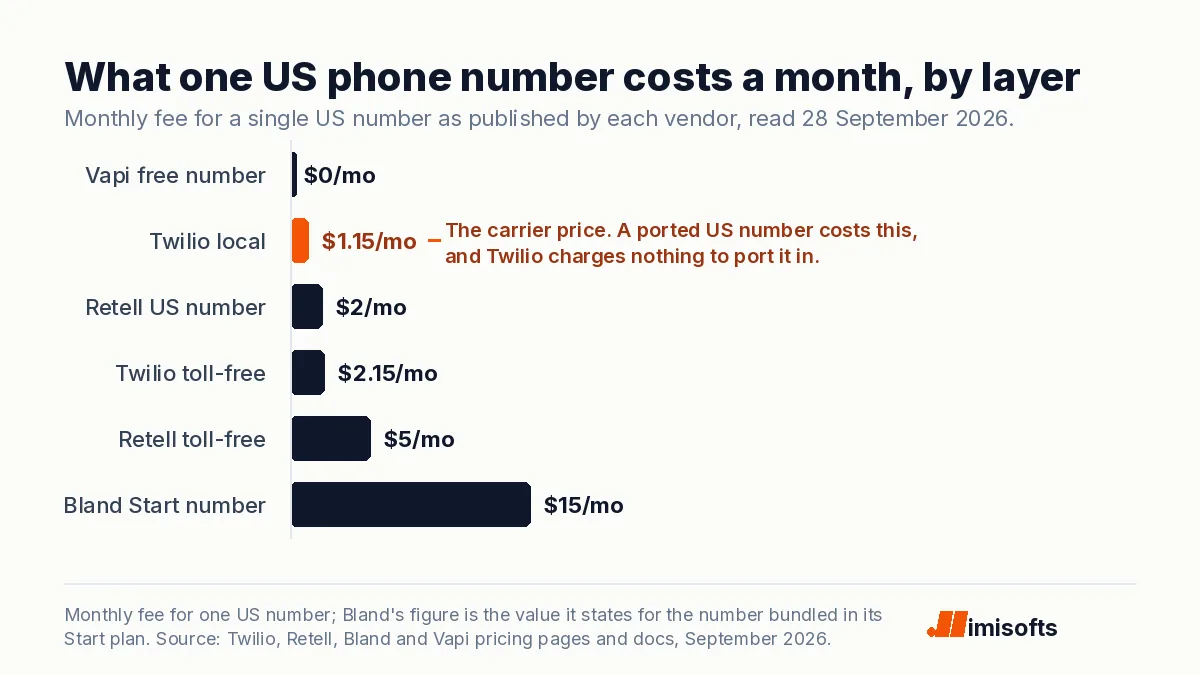
| Twilio local number, monthly | $1.15 |
| Retell US number, monthly | $2.00 |
| Bland Start plan number, stated value | $15.00/mo |
| Vapi free numbers per account (US area codes, inbound only) | 1 |
| Twilio inbound, local number (Retell-provisioned number $0.015/min) | $0.0085/min |
Figures read on 28 September 2026 from the FCC porting guide, the Twilio and Telnyx help centres, HighLevel's porting article and the Vapi, Retell, Bland and Twilio pricing pages.
The mistake: treating the number as part of the software
Two versions of one mistake. The first is taking the vendor's number and printing it. Vapi gives you one free US number, inbound only, with no card on file; Retell sells a US number for $2 a month; Bland's Start plan bundles an inbound number it values at $15 a month. Now the business has two numbers, the one on the trucks and the one the agent answers, and whoever dials the old one still gets voicemail.
The second is porting the main line into the AI platform on day one. Now the number every customer has memorised lives with a company you signed with last week, and every platform change is another port with its own clock and rejection risk. Smith.ai's support pages describe the sane order among its own clients: a cell phone used as the business number goes on conditional forwarding, and some clients port to Smith.ai later and buy a new cell number.
What a port actually takes, from the pages that run them
The FCC rule is one business day, but only for a simple port, a single line with no complex switching changes. A business account with several lines is not simple. Twilio's help centre says a US port typically lasts 5 to 15 days and can run to four weeks or longer when the losing carrier rejects it; a rejection adds two to four weeks, and text messaging routes two to three business days after the voice port. Telnyx quotes 1 to 7 business days. HighLevel quotes two to four weeks for fewer than 50 numbers.
The paperwork is the same everywhere: a Letter of Authorization that matches the name and service address on the losing carrier's record, a recent bill, within 30 days on Twilio, and on Twilio a physical service address, because a PO Box is refused. A wrong PIN, a mismatched address or an unauthorised requester are Twilio's listed rejection reasons. The money is the good news: neither Twilio nor Telnyx charges to port a US number in, and the number then costs what any number costs: $1.15 a month for a Twilio local number, $2.15 toll-free, against $2 and $5 for the ones Retell provisions.
Two sentences outrank the timelines. The FCC: do not terminate service with your existing company before starting service with the new one. Twilio: keep your numbers active with the losing carrier while the port runs. Cancel early and the port has nothing left to move.
Forwarding works because the human receptionists proved it
Smith.ai has answered business lines with people for years, and it does not require a port. Cloud numbers and landlines: forward all calls. A cell phone used as the business number: conditional forwarding only, so your phone rings first and the receptionist gets what you miss. Verizon's code for that is *71 plus the ten digits; *72 forwards everything and *73 switches it off. One code to set, one to reverse, so an AI agent can take real calls this afternoon without touching the number.
Forwarding has one rule that none of the pricing pages I read prints and Smith.ai's support page does: the number that forwards cannot be the number the agent transfers to. Send a call back to the line that forwarded it and it forwards again, an infinite loop in Smith.ai's words. So the transfer target has to be a different number, a cell, a second line, the on-call tech, sitting in the agent's escalation path from day one. It is the same design problem as the after-hours handoff.
It also costs twice. Verizon bills a forwarded call as if you had answered it unless the plan has unlimited minutes, with no monthly fee for the feature on most plans. Then the platform bills its inbound minute: Twilio charges $0.0085 a minute on a local number, Retell $0.015. At 300 three-minute calls a month the Twilio side is $7.65. Plan around the loop, not the minutes.
Port the main line into the AI vendor on day one
5 to 15 days on Twilio, up to four weeks after a rejection, and the number now lives with your newest supplier.
Forward today, port to a carrier you control later
Live in one star code. When you do port, Twilio and Telnyx charge nothing for a US port-in and the number outlives the vendor.
Where the number should live when you do port
When forwarding has done its job and you want the agent to own the line, port to a carrier, not to a vendor. Twilio and Telnyx port US numbers in for free, and they are the carriers the AI platforms already use: Vapi imports Twilio or Telnyx numbers and takes a SIP trunk; Retell's recommended route for a number you already own is elastic SIP trunking with your own provider, at no charge; Bland connects your Twilio account or any SIP trunk, and its pricing page files number porting under its 28-day Enterprise framework. A number on your own carrier account connects to all three by import or SIP trunk, so the next platform change is a re-point, not a port.
A port also changes texting. On Twilio a ported local number cannot text until an A2P 10DLC brand and campaign are approved and the number is added after the port completes. If missed-call texts are in the plan, start that registration the day you submit the port, and read the daily message caps before promising anyone a text-back.
Four moves before you touch the number
Forward the missed calls today
Dial your carrier's conditional code (*71 on Verizon) to the number the agent answers on. Your phone still rings first; the agent gets what you miss. Nothing about the number changes, and *73 undoes it.
Point transfers at a different number
The forwarding line cannot be the transfer destination, or the call loops. Put a cell, a second line or the on-call tech in the agent's escalation path and place a test call that asks for a human before you announce anything.
Test the caller ID on a forwarded call
Call your own number from a mobile and read the agent's call log. If it shows the caller's number, the follow-up text and the CRM match will work. If it shows your own line, fix that with the carrier before you build anything on it.
When you port, port to your own carrier account
Open a Twilio or Telnyx account in the business's name, submit the LOA and a bill under 30 days old, keep the old service active until the completion email, and connect the number to the agent by import or SIP trunk. Budget 5 to 15 days and start A2P registration the same day.
The bottom line
Forwarding is a reversible, one-minute test of whether an AI receptionist earns the line. Porting is a commitment measured in weeks that moves one of the oldest assets the business owns. Run the test first, keep the transfer target separate, and once the agent has earned the line, move the number to a carrier you control. What after-hours call answering costs is on the page we scope these builds from.
I have built inbound and outbound calling for more than 200 businesses, and the number is the part I set up last, after the agent has proved itself on forwarded calls. If you are choosing between forwarding and porting, send me the carrier and the phone system and I will tell you which route and what it costs.