October 19, 2026. OpenAI will switch off GPT-4o, GPT-4o mini, GPT-4.1 and GPT-4.1 mini in its API on January 14, 2027, and it names GPT-6 Luna as the replacement for all four, according to its deprecations page, which says developers using them were told on October 14. That is 92 days of notice. On list prices the move saves money: Luna costs $0.10 per million input tokens and $0.50 per million output tokens, against $2.50 and $10 for GPT-4o. The catch is that Luna reasons at medium effort by default, and reasoning tokens are billed as output, so a straight swap of the model name can cost more than the model it replaces.
Key numbers
| Item | Number |
|---|---|
| GPT-4o, GPT-4o mini, GPT-4.1, GPT-4.1 mini API shutdown (notice sent October 14, 2026) | January 14, 2027 |
| Notice given (policy promises at least 6 months for GA models) | 92 days |
| GPT-6 Luna, input and output (cached input $0.01, cache writes $0.125) | $0.10 / $0.50 per 1M tokens |
| GPT-4o, input and output | $2.50 / $10 per 1M tokens |
| GPT-4o mini, input and output | $0.15 / $0.60 per 1M tokens |
| GPT-4.1, input and output | $2 / $8 per 1M tokens |
| GPT-4.1 mini, input and output | $0.40 / $1.60 per 1M tokens |
| Luna surcharge over 272,000 input tokens (for the whole request) | 2x input, 1.5x output |
| 10,000 chats a month, 3,000 in and 300 out each (Luna at effort none, before caching) | $105 on GPT-4o, $4.50 on Luna |
| gpt-3.5-turbo, gpt-4, o4-mini and others shut down | October 23, 2026 |
| New fine-tuning jobs blocked for active customers (no GPT-6 model on the fine-tuning price list) | January 6, 2027 |
| gpt-realtime and gpt-4o audio models shut down | January 20, 2027 |
Dates and prices read on 19 October 2026 from OpenAI's deprecations page, model pages, pricing page and GPT-6 migration guide.
What OpenAI shuts down on January 14, 2027
The October 14 notice covers four model families and their dated snapshots. Standard list prices below are per million tokens, read from OpenAI's model pages on October 19.
- GPT-4o (gpt-4o-2024-08-06 and gpt-4o-2024-11-20): $2.50 input, $1.25 cached input, $10 output, with a 128,000-token context window.
- GPT-4o mini (gpt-4o-mini-2024-07-18): $0.15 input, $0.075 cached, $0.60 output.
- GPT-4.1 (gpt-4.1-2025-04-14): $2 input, $0.50 cached, $8 output, the model OpenAI still labels its smartest non-reasoning model, with a 1M-token context window.
- GPT-4.1 mini (gpt-4.1-mini-2025-04-14): $0.40 input, $0.10 cached, $1.60 output.
- Every fine-tuned version of them. OpenAI says fine-tuned models follow the same shutdown schedule as their base models.
Three months of notice, not six
OpenAI's own policy, on the same page, promises at least six months of notice before it retires a generally available model, three months for specialized variants such as chat or Codex models, and as little as two weeks for previews. It allows a faster timeline only when safety or compliance concerns require one. The October 14 notice gives no reason, and The New Stack reported on October 15 that none was offered. The contrast is on the page itself: GPT-5.1 and GPT-5.3-Codex, deprecated on October 1, got six months, to April 1, 2027.
Two escape hatches exist. The List models endpoint now returns a shutdown_date field for each model, so a script can flag retirements before they bite. And OpenAI says some customers can provision dedicated capacity to keep a model running after its shutdown date, through its sales team. The first only warns you, and the second is a sales conversation most small businesses will never have.
What GPT-6 Luna costs, and the catch
The GPT-6 Luna model page lists $0.10 per million input tokens, $0.01 cached input, $0.125 for cache writes and $0.50 output, with a 1,050,000-token context window, 128,000 maximum output tokens and a May 18, 2026 knowledge cutoff. It reads text and images and does not take audio. Batch and Flex cost half; Fast mode costs double. A prompt over 272,000 input tokens is billed at twice the input and cache rates and 1.5 times the output rate for the whole request, a rule we unpack in our 272K long-context pricing explainer.
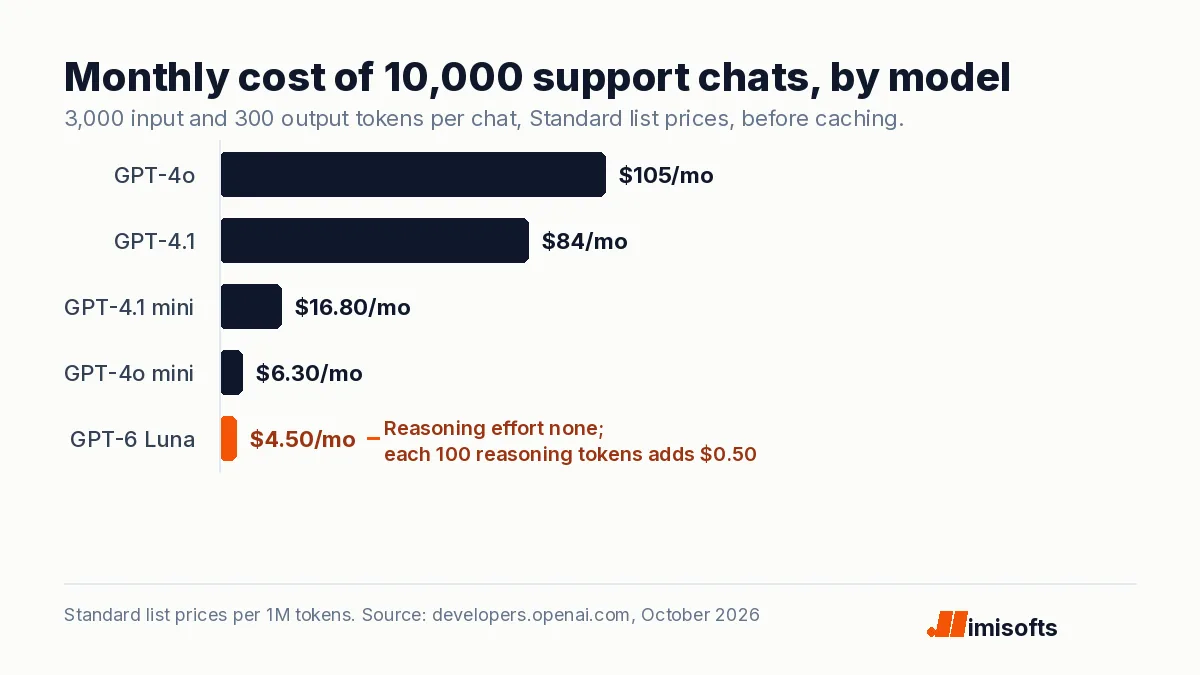
Take a support chatbot that handles 10,000 conversations a month, each reading 3,000 tokens and writing 300. Before caching, that month costs $105 on GPT-4o, $84 on GPT-4.1, $16.80 on GPT-4.1 mini, $6.30 on GPT-4o mini and $4.50 on Luna with reasoning switched off.
Now leave Luna at its default. OpenAI's reasoning guide says hidden reasoning tokens are billed as output tokens. On this workload, every 100 reasoning tokens per conversation adds $0.50 a month, so a GPT-4o mini user's $1.80 saving is gone at about 360 reasoning tokens per conversation. Teams coming from GPT-4o or GPT-4.1 still save heavily; teams coming from the mini models only save if they control effort.
What breaks when you only change the model name
OpenAI's GPT-6 migration guide lists the settings that matter, and several only show up when a request fails.
- Tool calls in Chat Completions. Luna supports function calling in Chat Completions only with
reasoning_effortset to none. To reason and call tools in the same request, move to the Responses API. - Sampling settings. When reasoning effort is anything but none, remove temperature, top_p and top_logprobs, and logprobs in Chat Completions. GPT-4.1 accepted all of them.
- Cache writes. GPT-4o's price card has input, cached input and output. Luna adds cache writes at 1.25 times the input rate, so a request that writes a long prompt to the cache pays 25 percent more on those tokens. See our cached input pricing guide.
- No audio. Luna is text and image only. Voice apps built on GPT-4o's audio and realtime variants run on a separate schedule, covered below.
- No fine-tuning path. OpenAI's pricing page says it is winding down the fine-tuning platform, and active customers can no longer create new fine-tuning jobs from January 6, 2027. Every model on its fine-tuning price list is on the shutdown calendar, and no GPT-6 model is on it. A fine-tuned GPT-4o mini already bills $0.30 per million input tokens and $1.20 output, double the base model.
Every OpenAI API shutdown date to April 2027
The GPT-4o notice is one line on a crowded calendar. From the deprecations page, read on October 19:
- October 23, 2026: gpt-3.5-turbo, gpt-4, gpt-4-turbo, gpt-4.1-nano, the first GPT-4o snapshot (gpt-4o-2024-05-13), o1, o1-pro, o3-mini, o4-mini and gpt-image-1, plus fine-tunes of gpt-3.5-turbo, gpt-4, gpt-4.1-nano, o4-mini, babbage-002 and davinci-002. Replacements are GPT-5.6 Sol, Terra and Luna, and gpt-image-2.5 for images.
- November 30, 2026: Agent Builder and the Evals dashboard and API, as covered in our Agent Builder shutdown brief.
- December 1, 2026: gpt-image-1-mini, gpt-image-1.5 and chatgpt-image-latest.
- December 11, 2026: the August 2025 GPT-5 snapshots, gpt-5-pro, o3 and o3-pro.
- January 6, 2027: tts-1, tts-1-hd and gpt-4o-mini-tts, replaced by gpt-realtime-2.1-mini. From this date active customers can no longer create new fine-tuning jobs.
- January 14, 2027: GPT-4o, GPT-4o mini, GPT-4.1 and GPT-4.1 mini, replaced by gpt-6-luna.
- January 20, 2027: gpt-realtime, gpt-4o-realtime, gpt-audio, gpt-4o-audio and their mini versions, replaced by gpt-realtime-2.1, gpt-realtime-2.1-mini and gpt-audio-1.5.
- February 26, 2027: whisper-1 and the gpt-4o transcribe models, replaced by gpt-live-transcribe or gpt-transcribe. Our transcription cost per hour page prices the switch.
- April 1, 2027: gpt-5.1 and gpt-5.3-codex, replaced by gpt-6-sol, and gpt-5.4-nano, replaced by gpt-6-luna.
What it means for operators
Most small businesses do not call these models directly. They run them inside a chatbot, a CRM workflow, an automation platform or an app an agency built, which is why a retirement email sent to whoever owns the API key can go unread. The practical order of work:
- Inventory this week. Call GET /v1/models and read each
shutdown_date, then search your code, prompts and automation steps for gpt-4o, gpt-4.1, gpt-3.5-turbo, o3-mini and o4-mini. Anything on the October 23 list fails in four days. - Test Luna at effort none first. That is the closest match to a non-reasoning model, it keeps tool calls working in Chat Completions, and it is the cheapest setting. Raise effort only where quality drops, and cap spend with
max_output_tokens. - Measure reasoning tokens before you quote. Log output tokens on a sample of real traffic at each effort level, then reprice the month. The list-price comparison flatters Luna.
- Export fine-tuning data now. If a client depends on a fine-tuned GPT-4o or GPT-4.1, rebuild the behavior as a cached prompt with examples. At $0.01 per million cached tokens, a long example block is cheap to resend.
- Check voice agents separately. An AI receptionist built on gpt-realtime or gpt-4o-realtime has until January 20. The listed replacement, gpt-realtime-2.1, prices audio at $32 per million input tokens and $64 output, and OpenAI also documents a move to per-minute GPT-Live sessions, priced in our GPT-Live pricing brief. If you run an AI receptionist for a home services business, test the replacement on recorded calls before the January deadline, not on live customers after it.
OpenAI's recommended path is cheaper on paper, but only a measured month proves it. If you would rather hand the migration to someone who has done it, our AI automation agency audits model calls across a stack, or you can hire an AI engineer to run the Luna tests against your own traffic.
Frequently Asked Questions
OpenAI removes GPT-4o, GPT-4o mini, GPT-4.1 and GPT-4.1 mini from its API on January 14, 2027, including the gpt-4o-2024-08-06, gpt-4o-2024-11-20, gpt-4o-mini-2024-07-18, gpt-4.1-2025-04-14 and gpt-4.1-mini-2025-04-14 snapshots. Developers using them were notified on October 14, 2026. The earliest GPT-4o snapshot, gpt-4o-2024-05-13, shuts down sooner, on October 23, 2026.
OpenAI recommends gpt-6-luna for all four models. It costs $0.10 per million input tokens and $0.50 per million output tokens, with a 1,050,000-token context window. Set reasoning effort to none to get the closest match to GPT-4o behavior and to keep function calling working in Chat Completions.
On list prices, yes: $0.10 and $0.50 per million input and output tokens against $0.15 and $0.60. But Luna reasons at medium effort by default and reasoning tokens are billed as output. On a month of 10,000 conversations with 3,000 input and 300 output tokens each, Luna at effort none costs $4.50 against $6.30, and that saving is gone at about 360 reasoning tokens per conversation.
They stop on January 14, 2027 with their base models, because OpenAI says fine-tuned versions follow the base model's shutdown schedule. From January 6, 2027 active customers can no longer create new fine-tuning jobs, and OpenAI's pricing page says it is winding down the fine-tuning platform, with no GPT-6 model on its fine-tuning price list, so plan to rebuild the behavior with prompts and examples.
OpenAI did not say. Its deprecations policy promises at least six months for generally available models and allows a shorter timeline only for safety or compliance concerns. The October 14 notice gives 92 days. OpenAI says some customers can provision dedicated capacity through its sales team to keep using a model after its shutdown date.
gpt-3.5-turbo, gpt-4, gpt-4-turbo, gpt-4.1-nano, gpt-4o-2024-05-13, o1, o1-pro, o3-mini, o4-mini and gpt-image-1, plus fine-tuned gpt-3.5-turbo, gpt-4, gpt-4.1-nano, o4-mini, babbage-002 and davinci-002 models. OpenAI points them to GPT-5.6 Sol, Terra or Luna, or to gpt-image-2.5 for images.